From Capital Deployment to Community Impact
Balancing production and preservation


Balancing production and preservation

 1059
1059
 0
0

The metaphysics, the machine, and the future of the Impact Economy
 1121
0
1121
0

What FLY paper reveals about the limits of bespoke financial tools
 1441
0
1441
0

Abrupt UK cuts threaten coastal resilience, food security, and community-led adaptation
 990
0
990
0

At MIE 2026, investors reframed risk as a tool for scale, resilience, and courage
885
0

Local economies as a bulwark against cross-border extraction and violence
 950
0
950
0


 2285
0
2285
0

Immersive entertainment can create jobs, revive places, and deepen cultural engagement. But can it actually change behavior, shift public imagination, and contribute to systems transformation — or does it remain a compelling form of values-aligned consumption?
Impact investors are always looking for the same intersection: where can capital generate solid returns, measurable value creation, and positive change? One emerging sector is making a compelling case that it can deliver all three: immersive entertainment.
Immersive experiences are reshaping how people engage with art, culture, place, and one another. What began as a scattered set of experimental, multisensory storytelling formats has evolved into a recognizable segment of the creative economy, one capable of driving job creation, urban revitalization, cultural access, and community cohesion. For investors, that opens the possibility of genuine triple-bottom-line returns.
But for Impact Entrepreneur readers, the deeper question is not simply whether immersive entertainment businesses can be responsible employers and engines of local economic growth. It is whether immersive storytelling itself can reshape how people understand social and environmental challenges, and whether values-aligned consumption of these experiences can produce durable change.
Unlike traditional entertainment, where audiences passively observe, immersive experiences invite visitors into active participation. They engage multiple senses through tools such as projection mapping, AR and VR, multisensory installations, and interactive environments designed to provoke exploration, creativity, and reflection. As Immersive Denver notes, the audience is placed at the center of the experience.
This is still not a formally defined industry. Examples of place-based experiences — often grouped under the term Location-Based Entertainment (LBE) — include TeamLab in Japan, Meow Wolf in the American Southwest and Midwest, and Sleep No More in New York. The sector remains fragmented, made up largely of smaller players. Habo estimated the growing LBE market at $5 billion in 2019.
 Behind immersive experiences lies a creative workforce whose labor, compensation, and working conditions are part of the sector’s impact case.
Sitting at the intersection of art, science, and technology, these businesses often offer self-guided, nonlinear experiences. Visitors are not simply told a story; they move through it. They begin anywhere, encounter anything, and construct meaning through participation rather than observation.
Other attractions — including Color Factory, the Museum of Ice Cream, and the older Madame Tussauds Wax Museum — are often lumped into the same category. While certainly multisensory, they are more linear, “Instagrammable” group attractions than open-ended immersive worlds. They may be profitable and entertaining, but they are not necessarily socially responsible companies or carriers of deeper societal messages.
Some newer ventures are explicitly trying to add mission-driven layers to the experience. Starlings, for example, is a multiplatform immersive entertainment company with an environmental focus that blends technology, art, and theater for impact.
Sitting at the intersection of art, science, and technology, these businesses often offer self-guided, nonlinear experiences.
The sector’s growth trajectory is significant. Grand View Research projects the global immersive entertainment market to reach $442 billion by 2030, with a compound annual growth rate of 26% between 2026 and 2030. That estimate uses a broad definition that includes large entertainment incumbents such as Disney, regional theme parks, and Dave & Buster’s — but even so, it signals an important trend.
Taken together, the category is still coalescing, but it is clearly commanding attention. On a recent trip to London, nearly every other billboard on the Tube seemed to advertise an immersive experience aimed at capturing tourist attention and family spending. What was once experimental is moving into the mainstream.
If the broader category remains fluid, a narrower subset may be especially interesting to impact investors: community-based immersive entertainment. By this we mean participatory, multisensory experiences intentionally designed to engage local communities, support artists, and create social and cultural value. Here, the aspiration is not only entertainment, but change.
For investors, the relevant question is how to understand that value. A useful framework is a quadruple bottom line:
Financial return. These ventures can generate enterprise value through ticket sales, food and beverage, merchandise, partnerships, and real estate activation.
Economic benefit. They create quality jobs for artists, fabricators, performers, and technical staff while also driving tourism, foot traffic, and spillover effects for local businesses. In places struggling with shuttered malls, vacant main streets, or underused urban spaces, immersive projects can help reactivate neglected assets.
Social impact. This can include living wages and benefits for workers, increased accessibility, educational outcomes, and stronger community cohesion.
Cultural value. These experiences can support artists, preserve locally rooted narratives, amplify diversity, and strengthen civic pride.
Upstart Co-Lab has argued that the creative economy is one of the most significant new areas of opportunity for impact investors. UNESCO projects it could account for 10% of global GDP in the years ahead. In that context, immersive entertainment may offer one way of aligning profit with cultural enrichment, community revitalization, and job creation.
That still leaves the central question: do immersive experiences meaningfully contribute to systems change?
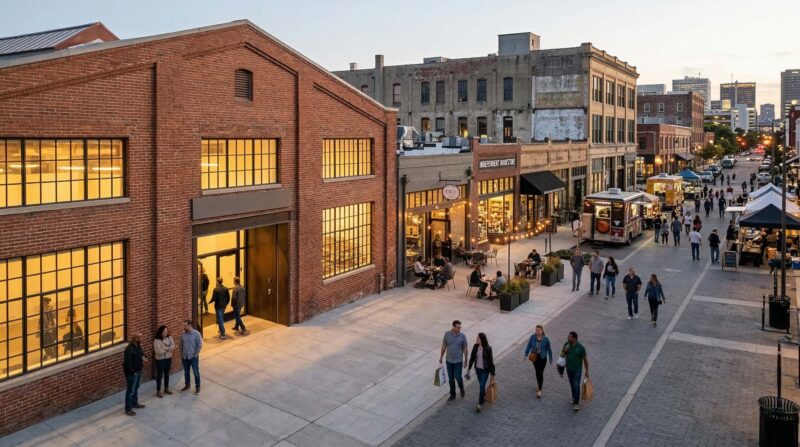 At their best, immersive venues can function as local economic anchors, helping reactivate underused spaces and strengthen neighborhood vitality.
It is too early to answer with confidence. Existing research suggests that immersive experiences can influence perception, heighten empathy, and increase short-term motivation, especially in narrative-driven, embodied environments. One extended-reality advertising study, for example, found that immersion strengthened emotional connection and behavioral intention, including willingness to act.
But there is still limited evidence that these experiences translate into durable behavior change, lasting shifts in values, or broader systems transformation.
For now, immersive entertainment is best understood as a potential lever for social and environmental impact — one that may complement education, civic engagement, and policy efforts, but whose full effectiveness remains to be rigorously tested. Moving from memorable experience to sustained change likely requires thoughtful design, follow-on engagement, and integration into broader social ecosystems.
Community-based immersive entertainment expands the conversation about value creation beyond profit alone.
Some ventures are beginning to explore this more deliberately. Starlings, for instance, has partnered with Stanford University to help assess its environmental and economic impacts.
That is encouraging. But it also underscores the point: the impact case for immersive entertainment remains promising, not settled.
One of the most prominent examples is Meow Wolf, the punk-Disneyland art adventure founded in Santa Fe, New Mexico, which has since expanded into four additional major markets and announced new locations in Los Angeles and New York.
Drew Tulchin served as Meow Wolf’s first CFO beginning in 2016, when immersive entertainment still sat outside traditional investment categories. Meow Wolf would go on to raise more than $100 million. This was also a moment of broader growth in experiential entertainment: Cirque du Soleil was opening new shows in Las Vegas, Blue Man Group had sold for $66 million, and LEGOLAND properties were changing hands as strategic assets.
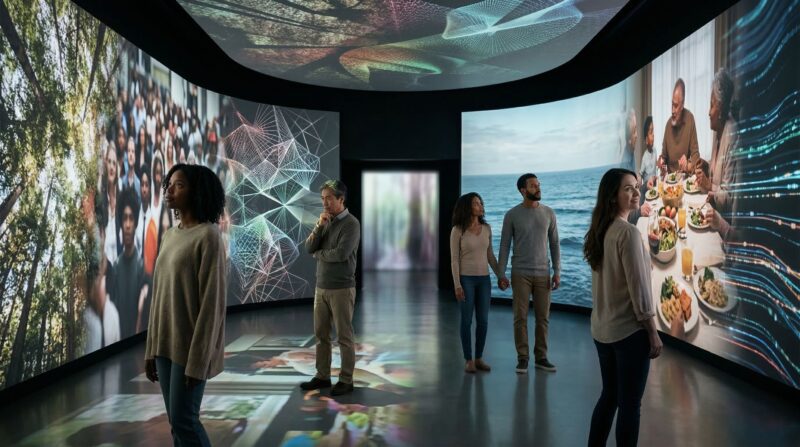 The central question is not whether immersive experiences are memorable, but whether they can shift awareness, values, and behavior in durable ways.
Meow Wolf is a B Corp-certified company that attempted to scale responsibly. It paid sustainable wages to artists, provided employee benefits as it grew from 50 to 550 people, and is now unionized. It also anchored economic redevelopment, including the reopening of a bowling alley that had been closed for a decade. It attracted national media attention, became a notable live music venue, and built a business around tickets, food and beverage, and merchandise.
These are meaningful outcomes. But Meow Wolf’s story alone does not prove that immersive entertainment produces lasting shifts in public values or behavior. What it does show is that immersive experiences can scale responsibly, serve as cultural and economic infrastructure, and align financial performance with measurable social and community benefits. That makes them worthy of serious impact-investment consideration.
Community-based immersive entertainment expands the conversation about value creation beyond profit alone. In an attention-scarce world, experiences that engage the senses and emotions can do more than entertain. They can foster connection, spark curiosity, and create openings for reflection.
Whether those openings lead to durable change is a harder question.
That will depend on what happens after the experience ends: whether there is repeat engagement, whether civic or educational partnerships deepen the encounter, whether workers and artists benefit meaningfully, whether communities have some ownership stake, and whether these experiences are embedded in ecosystems that turn reflection into action.
For investors, this is where the opportunity becomes more interesting, and more demanding. Immersive entertainment may be a sector where capital can generate returns while strengthening communities, supporting artists, and expanding cultural access. But investors should be careful not to mistake emotional intensity for systems change.
The real test is not whether these ventures are memorable. It is whether they help build the cultural infrastructure, civic relationships, and institutional follow-through that make lasting transformation possible.
--
Disclosure: Co-author Drew Tulchin served as CFO of Meow Wolf during its early capital-raising years, continues to hold shares in the company, and is a board member of Investors Circle.




Related Content

Why research infrastructure is the missing middle in climate-smart agriculture
 747
0
747
0

How verified outcomes can finance regenerative land use
 667
0
667
0

How Haverford’s student investing program pivoted toward more purpose-suited capital
 723
0
723
0
Abrupt UK cuts threaten coastal resilience, food security, and community-led adaptation
990
0
Comments
Deep Dives
RECENT
 990
0
990
0
 885
0
885
0
 950
0
950
0
Editor's Picks
 3757
0
3757
0
 4086
0
4086
0
 7024
0
7024
0
 1059
0
1059
0
 1121
0
1121
0
 1441
0
1441
0
Webinars
News & Events

Across the cohort, founders are creating solutions at the intersection of sustainability and social impact

Everspring Fund focuses across emerging markets

Subscribe to our newsletter to receive updates about new Magazine content and upcoming webinars, deep dives, and events.
Become a Premium Member to access the full library of webinars and deep dives, exclusive membership portal, member directory, message board, and curated live chats.

Join our global community of systems-minded changemakers.
Subscribe to the Impact Entrepreneur newsletter for the latest insights, magazine features, and invitations to exclusive webinars, Deep Dives, and events.


0 Comments