The Long Game of Systems Change
How three Skoll Awardees build public systems for lasting impact



How three Skoll Awardees build public systems for lasting impact

 112
112
 0
0

How place-based capital is expanding housing stability and ownership
 280
0
280
0

How Ziggma is trying to make values-aligned investing more transparent
 345
0
345
0
Lessons from Atlanta’s BeltLine and Pittsburgh Yards
 789
0
789
0

Jeremy Nicholls on building an accounting system fit for the impact economy
821
0

How portfolio theory could make cultural infrastructure more investable
 827
0
827
0
Upcoming Events

 4866
0
4866
0

Artificial intelligence is not just changing what impact organizations do — it is transforming how they decide, adapt, and govern. Drawing on the surprising metaphor of the octopus, this article explores how distributed intelligence can unlock resilience, trust, and scale across the impact economy.
Artificial intelligence is reshaping how mission-driven organizations — from impact enterprises to social ventures, investors, and development agencies — design solutions, allocate capital, and collaborate at scale. But unlocking AI’s potential requires more than mastering new tools. It demands a fundamental rethinking of how organizations operate, make decisions, and distribute authority.
For decades, the social sector — broadly defined — has wrestled with the challenge of balancing central oversight with frontline autonomy. Impact investors want transparency; entrepreneurs need flexibility. Regulators require accountability; local innovators demand room to experiment.
A surprising biological metaphor can help illuminate a new way forward: the octopus.
With nine brains — a central one and eight in its arms — the octopus is a master of distributed intelligence. Each arm can explore, decide, and act independently, while still coordinating with the whole. For organizations navigating today’s complexity, the octopus offers a vivid blueprint for an AI-enabled future in which authority flows outward rather than upward.
AI makes a more decentralized model possible — not just for NGOs, but for impact enterprises, social innovators, and catalytic investors seeking agility and responsiveness.
AI brings three transformational capabilities:
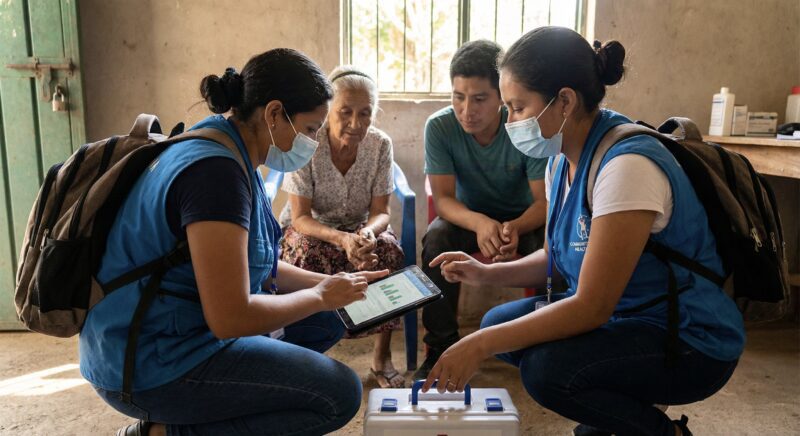
AI tools can embed organizational knowledge — best practices, historical learnings, and expert judgment — directly into frontline operations. This empowers local teams, franchise-style micro-entrepreneurs, and community-based partners to make informed decisions in real time.
Automated monitoring and anomaly detection reduce the need for rigid compliance structures. Investors can track portfolio performance without burdening entrepreneurs, and enterprises can maintain accountability without drowning in paperwork.
AI can interpret text, voice notes, photos, and field observations — which dominate social-sector and emerging-market realities — enabling cleaner dashboards, transparent communication, and cross-team learning.
The result is an organizational landscape that looks far less like a pyramid and far more like a network.

Many impact enterprises already operate across dispersed geographies, informal markets, and rapidly shifting conditions. AI-driven distributed decision-making can help these organizations:
Imagine a clean-energy microgrid company, like Gridscape, where field technicians use AI to troubleshoot, manage demand fluctuations, and deploy preventive maintenance — all without requiring centralized approval. The enterprise becomes faster, smarter, and more resilient.
With nine brains — a central one and eight in its arms — the octopus is a master of distributed intelligence.
Or look at Penda Health, an NGO in Kenya. Through a clinical copilot called "AI Consult", the NGO equips junior physicians with expert guidance. This reduces the need to confer with scarce senior doctors and speeds treatment decisions, helping patients receive diagnosis and treatment often in a single visit. The tool has also resulted in a 16% reduction in diagnostic errors and a 13% reduction in treatment errors. AI has enabled Penda Health to operate faster, better, and more economically – all at once.

Impact investors increasingly recognize that transformative change depends on:
AI can help investors shift from rigid reporting to continuous learning models that reward what works, not just what was planned. Portfolio companies can share updates through voice notes or mobile photos; AI can synthesize patterns and flag outliers for human review.
Empowerment without oversight is dangerous, and AI without transparency can easily undermine trust.
This reduces the friction that has long plagued the relationship between funders and implementers — enabling trust-based collaboration rather than compliance-driven oversight.
The benefits extend to traditional development actors as well. AI can decentralize decision-making to field teams, community partners, or local government collaborators — allowing adaptive responses that rigid logframes rarely accommodate.
But the lessons do not apply only to aid organizations. They apply equally to impact-driven firms that must harmonize global strategies with place-based knowledge and emergent market realities.
Empowerment without oversight is dangerous, and AI without transparency can easily undermine trust. Any distributed model must include:
Impact enterprises and investors must approach AI not merely as an efficiency tool but as a governance challenge — one that requires openness, inclusivity, and accountability.
Real-world systems are nonlinear. Interventions that succeed in one market may falter elsewhere. AI strengthens adaptive management — but leadership must consciously cultivate:
Impact enterprises and NGOs alike will need to build organizational cultures capable of shifting course quickly while staying anchored to shared mission outcomes.
The octopus metaphor is powerful not because of its novelty, but because it captures what mission-driven systems need most today:
AI is not replacing human wisdom — it is enabling organizations to place wisdom where it matters most: closer to communities, markets, and environmental realities.
Mission-driven organizations that embrace this shift — enterprises, investors, NGOs, cooperatives, government partners — will be better equipped to navigate mounting complexity, climate disruptions, and fast-changing social needs.
The impact economy rewards those who learn, adapt, and distribute authority effectively.
The octopus reminds us that resilience and intelligence come not from a single powerful head, but from a system in which many arms can sense, decide, and act — together.



Related Content
How three Skoll Awardees build public systems for lasting impact
112
0
How place-based capital is expanding housing stability and ownership
280
0
How Ziggma is trying to make values-aligned investing more transparent
345
0

Why education pilots need government adoption, not just proof
 465
0
465
0
Comments

Deep Dives

Featuring
Laurie Lane-Zucker
Founder & CEO, Impact Entrepreneur
July 30 - 12:00 PM EST
RECENT
 789
0
789
0
 821
0
821
0
 827
0
827
0
Editor's Picks
 112
0
112
0
 280
0
280
0
 345
0
112
0
280
0
345
0
345
0
112
0
280
0
345
0
Webinars

Featuring
Sateesh Nori
Legal Futurist
July 23 - 12:00 PM EST
News & Events

To amplify entrepreneur voices in impact investing


Subscribe to our newsletter to receive updates about new Magazine content and upcoming webinars, deep dives, and events.
Become a Premium Member to access the full library of webinars and deep dives, exclusive membership portal, member directory, message board, and curated live chats.

Join our global community of systems-minded changemakers.
Subscribe to the Impact Entrepreneur newsletter for the latest insights, magazine features, and invitations to exclusive webinars, Deep Dives, and events.


0 Comments