What a Broken Plate Reveals About Value
Artist Rob Strati on inherited objects, the limits of market price, and the creative possibilities…



Artist Rob Strati on inherited objects, the limits of market price, and the creative possibilities…

 77
77
 0
0

Counting what we fail to prevent, sixty seconds at a time
84
0

How collateral rules and payment terms keep impact capital out of reach
 191
0
191
0

How states can crowd in local early-stage capital
362
0

Why last-mile healthcare needs an operating model, not just more mobile clinics
 343
0
343
0

How Australia’s succession wave could turn ownership into a funding model
 461
0
461
0

 1065
0
1065
0

Dr. Oby Ezekwesili speaks at a Global Schools Forum event during Skoll World Forum week
Education innovation is often judged by the strength of its pilots and the rigor of its evidence. But as Dr. Oby Ezekwesili argued at a Global Schools Forum event during Skoll World Forum week, the harder question is whether promising models can be adopted, financed, and sustained by public systems. Ebuka Emebinah examines the structural gap between proof of concept and lasting change — and why designing for adoption may be the real frontier of impact.
The global education community has long debated a hard question: why does innovation so often fail to become lasting change? Practitioners discuss it at conferences. Funders circle it in strategy sessions. Researchers often approach it through evidence and evaluation. But the question is still too rarely confronted in public with the bluntness it deserves: what good is a promising education innovation if it cannot be adopted by the public systems responsible for educating children at scale?
That question sat at the center of Pioneering Change: Aligning Education Innovation with the Realities of Government Adoption, a Global Schools Forum event held on the sidelines of the Skoll World Forum in Oxford. The gathering brought together education innovators, funders, and system actors working in low- and middle-income countries, where the distance between a successful pilot and sustained public adoption can be vast.
Dr. Obiageli “Oby” Ezekwesili, former Nigerian Minister of Education, former Vice President for Africa at the World Bank, and founder of Human Capital Africa, put the sector’s hardest truth directly on the table. Innovation matters only when it can move with government, not merely alongside it.
Her central question was as simple as it was unsettling: how does innovation move with government and not around it?
Anyone who has spent time in impact circles will recognize one of Dr. Ezekwesili’s best-known maxims: “In God I trust, everyone else must bring data.” It has become shorthand for the evidence-first approach she has carried through decades of public service, multilateral leadership, and civil society advocacy.
So when she used the Skoll platform to complicate that very commitment, the room paid attention. Data, she suggested, does not speak for itself. Years of work and significant funding have gone into building an industrial complex around proof: commissioning studies, constructing frameworks, funding pilots, and publishing peer-reviewed research. The machinery for generating evidence is both well-oiled and well-resourced.
What happens after the evidence lands is far less settled.
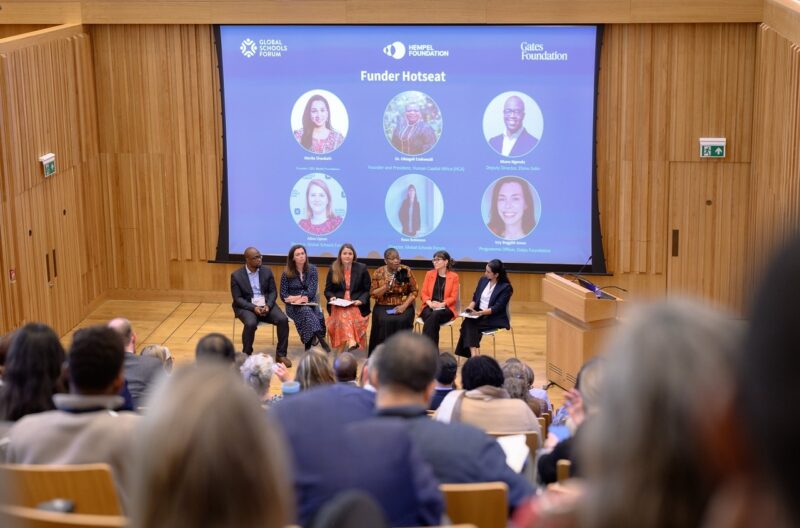
At a Global Schools Forum event during Skoll World Forum week in Oxford, Dr. Obiageli “Oby” Ezekwesili and fellow panelists explored what it takes for education innovation to move from promising pilot to government adoption and public-system scale. From left: Muna Ngenda, Deputy Director, Elimu-Soko; Izzy Boggild-Jones, Program Officer, Gates Foundation; Alina Lipcan Director, Global Schools Forum; Dr Obiageli Ezekwesili (Obiageli “Oby” Ezekwesili) President, Human Capital Africa; Rosa Robinson, Senior Manager, Hempel Foundation; Merlia Shaukath, Founder and CEO, Madhi Foundation
Persistence and collective action, she argued, are required to turn data into working solutions. That is especially true where the need is greatest: in low-income countries, fragile states, and communities where infrastructure, personnel, procurement, and fiscal capacity are already stretched thin. In those settings, evidence alone keeps running into walls it was never designed to breach.
Dr. Ezekwesili was not retreating from rigor. She was offering a more honest account of what rigor requires. If evidence cannot be translated into institutional, budgetary, and political decisions, then the sector has not finished the work. It has only finished the pilot.
The poor learning outcomes seen across many low- and middle-income countries are often misdiagnosed. The standard explanations include insufficient evidence, weak implementation, or lack of political will. Dr. Ezekwesili challenged that diagnosis. There is often evidence. And many governments, she said, genuinely want better outcomes for their citizens.
The deeper problem is failure by design.
The gap between developed and developing contexts is not simply a gap in resources. It is structural. In wealthier markets, a rigorous pilot can function as a genuine proof point, a foundation from which an intervention moves into wider program delivery. The theory of change holds because the institutional infrastructure needed to carry it already exists.
If evidence cannot be translated into institutional, budgetary, and political decisions, then the sector has not finished the work. It has only finished the pilot.
In resource-constrained environments, that infrastructure is frequently absent or overburdened. Commissioned pilots produce findings that rarely travel beyond the organizations that funded them. A theory of change developed in one setting can dissolve when transplanted into a place with different inputs, incentives, budget constraints, procurement rules, and administrative capacity. What looks like adoption failure may actually be a structural design flaw — one misidentified and therefore mistreated.
This distinction matters. The response to a structural design flaw is fundamentally different from the response to a political will problem. You cannot lobby your way out of a broken blueprint. No amount of advocacy can compensate for an innovation that was never designed to be financed, owned, adapted, and operated by government.
This was the day’s most incisive insight. Global education and global development more broadly structurally rewards novelty. New technologies, models, and approaches attract funding, attention, and conference-stage enthusiasm. But the sector consistently undervalues the less glamorous work of mass adoption: repetition, institutional embedding, adaptation, coalition-building, and budget alignment.
Innovation, Dr. Ezekwesili suggested, is too often treated as an event. Events end. A pilot launches, generates results, and is celebrated as proof of concept. Then, when the funding cycle closes and external teams depart, governments are left responsible for something they were not fully equipped to operationalize.
A peer-reviewed paper is not a budget case.
The out-of-school children challenge offers one example. The socioeconomic pressures that push children out of school do not disappear once they enroll. Relapse rates can be high, and meaningful impact — measured not only by enrollment but by sustained learning and completion - materializes on a timeline that extends beyond many political terms. For an elected official making hard choices with scarce fiscal and political capital, the incentive calculus can be unforgiving: why invest in a program whose measurable payoff may arrive after you have left office?
This is not simply hypocrisy. It is rational behavior inside a misaligned system. Treating politicians as the primary problem misses the point. The incentive structures are the problem.
If the novelty trap is where good ideas stall, the finance ministry is where many of them die.
Dr. Ezekwesili, herself a chartered accountant and someone deeply familiar with how budget processes work, was characteristically direct: a peer-reviewed paper is not a budget case. An RCT, however rigorous, does not by itself create a line item in a national budget. If the finance minister cannot prioritize funding, the reform does not get funded. The success of a donor-supported pilot does not automatically make the intervention fiscally legible.
Her point should sit uncomfortably with everyone working in education innovation. Evidence that is not legible to government for adoption purposes is not yet useful evidence for scale.
The gap between the language of evidence — academic, technical, methodologically precise — and the language of public finance — fiscal space, primary deficit, budget cycle, administrative feasibility, and political tradeoff — is not a communication gap that can be solved with a better slide deck. It is a structural misalignment. Closing it requires a different kind of engagement, and many education and development organizations have not yet made the necessary investment in learning how government finance actually works.
Dr. Ezekwesili’s prescription, distilled from decades across public service, multilateral development, and civil society, can be understood in three interlocking parts.
The first is co-authorship. Government actors — both current and future — need to be in the design room from the start, not invited in for a validation exercise after an intervention has already been shaped. Genuine co-authorship changes the political ownership of a program. It improves the chances that a reform survives beyond a single administration, donor cycle, or charismatic champion.
Designing for impact is not enough. Designing for adoption is the harder, less glamorous, and more consequential task.
The second is coalition-building. Every real reform redistributes power. It creates winners and losers. Advancing it requires coalitions built over time through sustained engagement with finance ministries, budget committees, parliamentarians, subnational governments, professional associations, implementers, and civil society. Coalition-building is often treated as a soft skill, but in systems change it is core infrastructure.
The strength of an idea, she warned, will not sell it.
The third is sustainability planning. Where does the money come from when the donor exits? What must be true for an innovation to move from externally financed pilot to domestically financed public priority? How can one well-designed, well-financed example create a ripple effect across a wider system?
These are not rhetorical questions. They are the frontier of the work.
Dr. Ezekwesili did not leave Oxford with a definitive list of solutions. That, in itself, was instructive. The value of her remarks was not a new framework or a ten-step model. It was a refusal to accept the comfortable diagnoses the sector keeps recycling.
The global education sector has spent decades building better evidence. The political architecture required to act on that evidence has developed far more slowly. Innovation has too often become the destination, when innovation is only worth anything if it moves: from pilot to program, from proof of concept to budgeted reality, from a lecture hall in Oxford to classrooms where the stakes are as high as they get.
For impact entrepreneurs, funders, and system builders, the lesson is clear. Designing for impact is not enough. Designing for adoption is the harder, less glamorous, and more consequential task.
The question Dr. Ezekwesili opened with should orient the next decade of serious work in education innovation: how does innovation move with government, not around it?
--
This article is based on remarks delivered by Dr. Oby Ezekwesili at “Pioneering Change: Aligning Education Innovation with the Realities of Government Adoption,” a Global Schools Forum event held during the Skoll World Forum week in Oxford on April 23, 2026.


Related Content
Artist Rob Strati on inherited objects, the limits of market price, and the creative possibilities…
77
0
Counting what we fail to prevent, sixty seconds at a time
84
0
How collateral rules and payment terms keep impact capital out of reach
191
0

Why free education tools need reliable access, credible evidence, and lasting support
 250
0
250
0
Comments
Deep Dives
RECENT
 362
0
362
0
 343
0
343
0
 461
0
461
0
Editor's Picks
 77
0
77
0
 84
0
84
0
 191
0
77
0
77
0
84
0
191
0
191
0
77
0
77
0
84
0
191
0
Webinars
Signed by the author. Collected at the door at Lipton Hall, NYU School of Law,…
News & Events

The September 14 program and a live IFI Tool demo are online

Pre-seed and seed startups can apply on a rolling basis

Their Built platform helps teams design, launch and run funds
Subscribe to our newsletter to receive updates about new Magazine content and upcoming webinars, deep dives, and events.
Become a Premium Member to access the full library of webinars and deep dives, exclusive membership portal, member directory, message board, and curated live chats.


0 Comments