Beyond Investment Readiness
How collateral rules and payment terms keep impact capital out of reach



How collateral rules and payment terms keep impact capital out of reach

 106
106
 0
0

Why free education tools need reliable access, credible evidence, and lasting support
 118
0
118
0

What Islamic finance and impact investing can learn from each other
206
0

How states can crowd in local early-stage capital
319
0

Why last-mile healthcare needs an operating model, not just more mobile clinics
 288
0
288
0

How Australia’s succession wave could turn ownership into a funding model
 399
0
399
0

 666
0
666
0
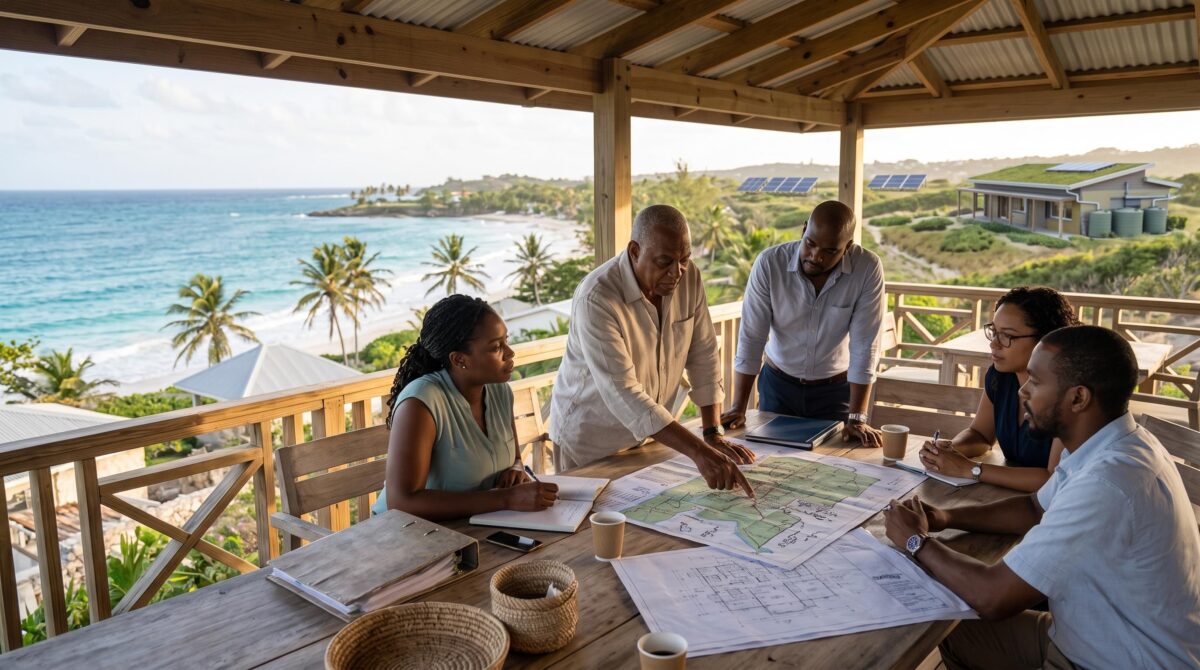
Catalytic climate capital works when investors, public institutions, entrepreneurs, and local practitioners can coordinate around place-based solutions.
The Caribbean climate economy is no longer waiting to be discovered. Across climate-smart ventures, blended-finance facilities, regenerative agriculture, waste-to-energy models, and blue economy strategies, the region is already building practical solutions under conditions of constraint. What remains missing is not ambition, but catalytic capital designed to support coordination, absorb early-stage risk, and help promising ventures move from visibility to deployment.
The Caribbean does not need to prove that its climate economy exists. Across panels, breakout sessions, and conversations at the Climate Smart Summit in Barbados, the more urgent question was not whether the region has ideas, entrepreneurs, or ambition. It was whether capital, government, climate technology, and local enterprise can organize quickly enough to act before every risk has been resolved.
That reframe, from risk as a reason to wait to risk as a design condition, was the most important signal the summit sent to the broader impact economy. The Caribbean has been building the infrastructure, talent, and entrepreneurial capacity to lead its own climate transition. Barbados made that visible.
The inaugural Climate Smart Summit, convened by the Caribbean Climate-Smart Accelerator at the Hilton Barbados Resort in Bridgetown on June 16-17, 2026, was not organized simply as a showcase. It was designed as a working session, what organizers described as a climate investment deal room, where climate-smart projects could meet the investors, policymakers, entrepreneurs, and development finance institutions able to help move them toward financial close.
Racquel Moses, CEO of the Caribbean Climate-Smart Accelerator, set the tone: the Caribbean does not suffer from a lack of ambition or intelligence. The constraint is fragmentation. Solving for it requires treating coordination as an operating requirement, not a soft value. Introductions were intentional. Lunch sessions were structured to accelerate ecosystem building. The flow of programming was designed so relationships between financiers, entrepreneurs, policymakers, and implementers could form faster than they typically would.
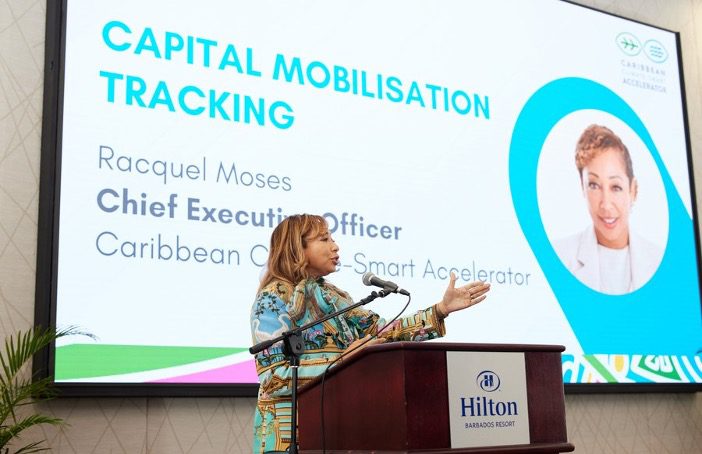
Racquel Moses, CEO of the Caribbean Climate-Smart Accelerator, discusses capital mobilization at the 2026 Climate Smart Summit in Barbados.
That design choice mattered because climate capital rarely moves on inspiration alone. It moves when risk, readiness, trust, policy, technical assistance, and local implementation capacity can be made legible to one another. The summit’s most useful contribution was not another statement of urgency. It was an attempt to organize the practical conditions under which investment can happen.
That spirit extended to the keynote stage. Anthony Sabga III, Group Chief Executive Officer of ANSA McAL Group of Companies, a Caribbean conglomerate with 150 years of history, offered a reflection both humble and instructive: the challenges of business continue to evolve for everyone, startups and century-old institutions alike. His commitment to sustainability, offered as strategic orientation rather than corporate pledge, sent an important signal: climate-smart thinking is becoming part of the operating logic of the region’s established players, not only its newest ventures.
What was most striking in Barbados was not the identification of problems. It was the concentration of solutions already operating across the region. Entrepreneurs are building regenerative supply chains, deploying renewable energy adapted to island infrastructure, designing coastal resilience strategies that integrate community knowledge, and developing financial tools that reframe climate risk as investable opportunity.
The summit’s Investor Forum made that visible. Rum and Sargassum, the Barbados-based venture led by Dr. Legena Henry, won the forum’s top prize for its work turning sargassum seaweed and rum distillery wastewater into clean biogas. The company’s model builds on experimental work showing that biomethane from rum distillery waste and sargassum can be used as an alternative transportation fuel in Barbados, and its prototype has already demonstrated the practical promise of bio-compressed natural gas for island mobility.
The Caribbean does not need to prove that its climate economy exists.
GrenadaGrows, led by Dr. Judlyn Telesford-Checkley, offers a different but equally important example: a community-rooted effort to strengthen Grenada’s agricultural sector through education, innovation, organic-waste recovery, and soil regeneration. Its work is captured in the founder’s words: “Caring for the environment is a sacred expression of gratitude. It reveals how we honour the Giver of all life and the blessings He has entrusted to us.”
Kee Farms, led by Nicholas Kee in Jamaica, is pursuing another form of climate-smart enterprise through regenerative ocean farming. The venture trains artisanal fisherfolk to cultivate seaweed, oysters, sea cucumbers, and seagrass, creating alternative livelihoods while supporting nutrient absorption, carbon sequestration, and marine biodiversity. Its model connects ecosystem restoration with sustainable aquaculture and the development of products derived from marine biomass.
These are not abstract proof points. They are Caribbean entrepreneurs solving Caribbean problems with approaches that have relevance beyond the region: waste-to-energy systems, regenerative agriculture, circular resource flows, resilient tourism, coastal protection, and blue economy models designed under the pressures of small markets, fragmented infrastructure, limited capital access, and repeated climate exposure.
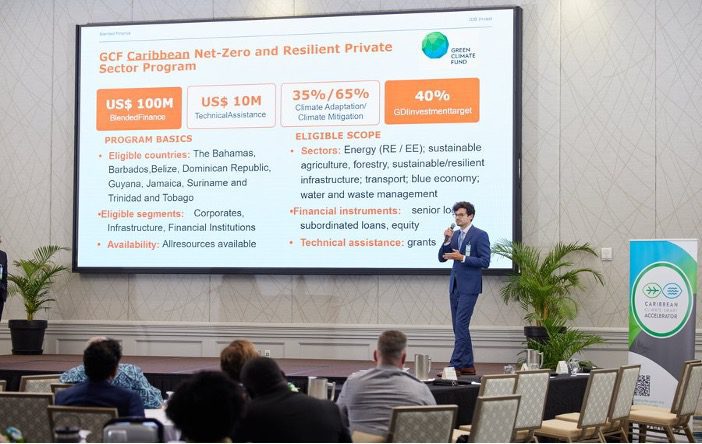
Nikolai Orgland of IDB Invest presents the GCF Caribbean Net-Zero and Resilient Private Sector Program, designed to mobilize private climate investment across the region.
That program is now under implementation, and IDB Invest has described its broader ambition as mobilizing up to $400 million by combining advisory services, blended finance, and risk-bearing capital. This matters. It signals that large institutions are beginning to adopt non-conventional risk postures because the accelerating pace of climate impact has made conventional approaches insufficient.
But large facilities do not automatically solve the deployment challenge faced by smaller ventures and local ecosystems. The Caribbean’s financing gap remains significant. The IMF has estimated that Caribbean adaptation investment needs exceed $100 billion, while private climate finance in the region remains far below what is required. The issue is therefore not simply whether capital exists somewhere in the system. It is whether the right kinds of capital can reach the right actors, on terms suited to the region’s realities.
Risk is not simply a reason to wait. It is a design condition
The summit data made the coordination challenge unusually visible. According to the official 2026 Climate Smart Summit Report, Entrepreneurial Day 1 ventures were seeking $11.5 million in investment, while $12.685 billion in development finance was identified as available across the region. National and larger-scale projects — inclusive of the entrepreneurial pipeline — require an estimated $17.205 billion in investment. The figures do not suggest that capital or projects are absent. They point instead to a persistent alignment and deployment gap between available finance, large national priorities, and the comparatively modest amounts needed by climate entrepreneurs to move from visibility to implementation.
Global climate discourse has long framed the Caribbean through the lens of vulnerability. That framing is not false, but it is incomplete. Caribbean entrepreneurship is practical, relational, and built to function under constraint. Small markets, recurring climate exposure, high energy costs, fragile supply chains, and limited access to patient capital have not produced only fragility. They have also produced a distinctive form of innovation that prioritizes adaptation, collaboration, and efficient resource use over scale for its own sake.
That is why the summit’s coordination function should be taken seriously. The region’s ability to move quickly from diagnosis to practical alignment — asking not just what needs to happen, but who pays, who coordinates, and what makes participation viable — reflects a maturity that deserves more recognition and more investment.
What remains underfunded is the connective tissue.
For impact investors and philanthropies, this requires a shift in posture. The Caribbean should not be treated only as a frontline of climate harm or a recipient of resilience programming. It should be treated as a site of innovation: a place where small-island constraints are generating models of circularity, resource efficiency, distributed energy, blue economy restoration, and community-rooted enterprise that can inform the climate transition far beyond the region.
For impact investors, philanthropies, and development finance institutions paying attention to the Caribbean, the signal from Barbados was clear: the pipeline is real, the entrepreneurs are ready, and the coordination infrastructure is building. What remains underfunded is the connective tissue. Individual climate solutions across the Caribbean — in renewable energy, resilient tourism, regenerative agriculture, waste-to-energy, the blue economy, and coastal protection — exist in various stages of development. What many need is the layer of catalytic capital that helps promising initiatives reach scale: funding patient enough to support coordination, flexible enough to absorb early-stage uncertainty, and structured to activate larger pools of commercial capital waiting for clearer pathways to deployment.
The Caribbean should be treated as a site of innovation, not just resilience.
This is not a call for charity. It is a call for sophisticated, impact-aligned investment in a region that has demonstrated it can deploy ingenuity under pressure, build practical institutional relationships, and produce solutions with relevance beyond its own shores.
The Caribbean does not need to prove its case for investment. It needs investors willing to engage with the region on its own terms — as a site of innovation, not just resilience, and as a partner in designing the climate economy, not just a recipient of its outputs.
The Climate Smart Summit revealed that the Caribbean is not in the early stages of figuring out what climate resilience requires. It is in the execution stage. The gap between where things are and where they need to be is no longer primarily a gap in ideas or ambition.
It is a gap in capital alignment.
Closing it will require investors and philanthropies to ask different questions: not only whether a solution is sound, but whether the ecosystem around it is supported. Not only whether a project has a business case, but whether the coordination layer is funded. Not only whether capital can be protected from risk, but whether risk can be designed around intelligently enough to move before the window for action narrows further.
The conversations in Barbados were not merely aspirational. At their best, they were operational. That is exactly where catalytic climate capital should go next.
--
Disclosure: The author attended the Climate Smart Summit as a participant and observer. Through Resilient Impact Partners, he works on climate resilience, sustainable finance, sustainable tourism, agriculture, and economic development in Jamaica and across the Caribbean.


Related Content
How collateral rules and payment terms keep impact capital out of reach
106
0
Why free education tools need reliable access, credible evidence, and lasting support
118
0
What Islamic finance and impact investing can learn from each other
206
0

After the flood, recovery capital must do more than replace what was lost
 314
0
314
0
Comments
Deep Dives
RECENT
 319
0
319
0
 288
0
288
0
 399
0
399
0
Editor's Picks
 106
0
106
0
 118
0
118
0
 206
0
106
0
106
0
118
0
206
0
206
0
106
0
106
0
118
0
206
0
Webinars
Signed by the author. Collected at the door at Lipton Hall, NYU School of Law,…
Signed and personally inscribed — you'll write the inscription as you order. Limited · 50…
News & Events

The foundation begins putting the larger pool to work in 2027

Federal policy uncertainty and limited grants top 2026 risks

An introductory program for foundations and family offices
Subscribe to our newsletter to receive updates about new Magazine content and upcoming webinars, deep dives, and events.
Become a Premium Member to access the full library of webinars and deep dives, exclusive membership portal, member directory, message board, and curated live chats.

0 Comments