Love and Care in the Future of Public Markets
Gabriel Grant on giving shareholders a way to express what matters to them


Gabriel Grant on giving shareholders a way to express what matters to them

 67
67
 0
0

For mission-led organizations, a change of manager tests whether workplace inclusion is built to last.
 71
0
71
0

Artist Rob Strati on inherited objects, the limits of market price, and the creative possibilities…
109
0

Why free education tools need reliable access, credible evidence, and lasting support
 324
0
324
0

What Islamic finance and impact investing can learn from each other
 405
0
405
0

After the flood, recovery capital must do more than replace what was lost
 388
0
388
0

 485
0
485
0
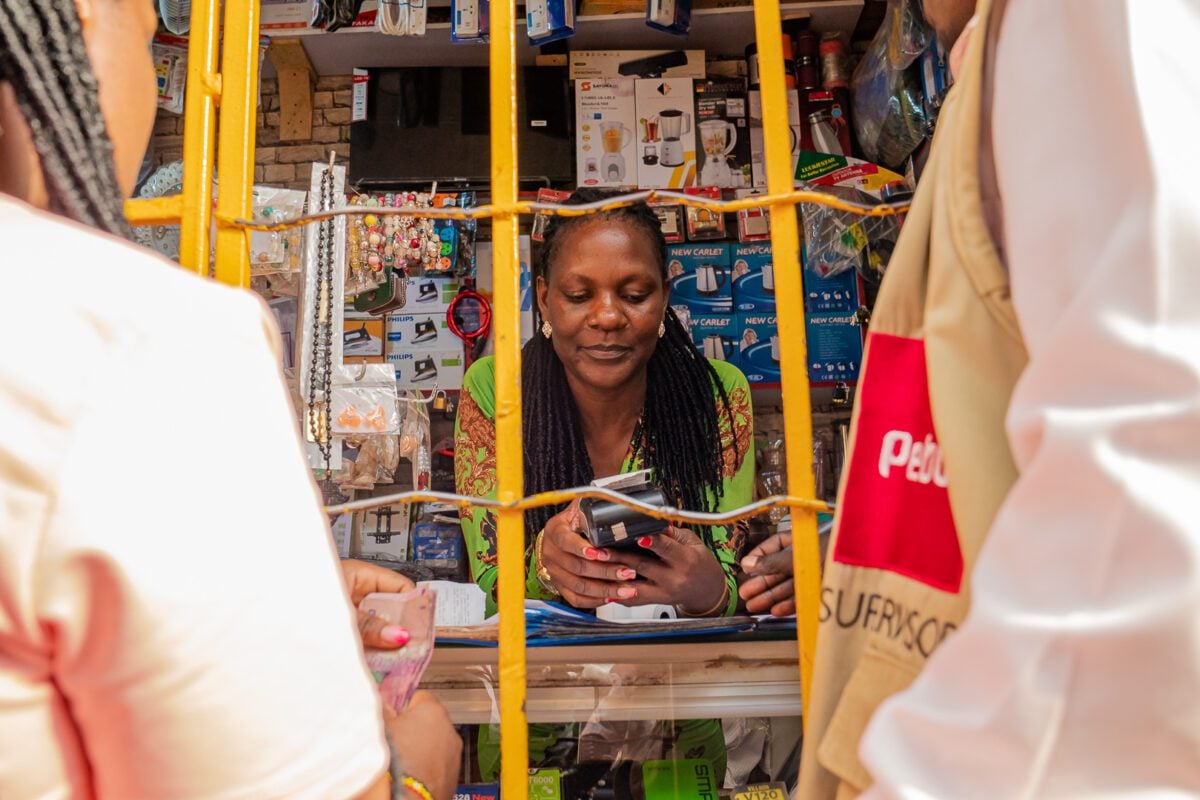
At a Pebuu-supported agent point in Uganda, a local agent completes a transaction. The scene captures the human infrastructure — trust, cash flow, equipment, and local presence — that makes digital finance usable. Photo courtesy of Pebuu.
Uganda’s rapid expansion of digital finance depends on more than apps and accounts. Pebuu’s field-based model shows how trust, language, supervision, and agent liquidity determine whether financial inclusion actually works at the last mile.
On a dusty street in Uganda, the infrastructure of financial inclusion can look deceptively ordinary: a small shopfront, a cash drawer, a point-of-sale device, a mobile phone, and a local agent trusted enough to turn digital finance into something usable.
That is the space Pebuu, a Ugandan technology company founded about a decade ago, has chosen to occupy. The company’s work sits in a specific gap between the promise of digital finance and the practical systems that make it function for people far from formal bank branches.
“We are technology first,” says Leonard Mutebi, Pebuu’s Chief Operating Officer. “But we target ordinary people who would otherwise look at technology as something very distant from their day-to-day life.”
That distance — between the mechanics of digital finance and the lived reality of rural and remote communities — is where Pebuu’s model becomes interesting. It suggests that financial inclusion is not only a matter of apps, accounts, or transaction volumes. It is also a matter of people, trust, supervision, liquidity, language, and local presence.
Agency banking extends financial services through independent small businesses acting on behalf of licensed banks. In Uganda and across much of sub-Saharan Africa, these agents can become the point of access for communities far from formal branches — one person, one booth, sometimes serving several villages.
Uganda’s financial-inclusion landscape has shifted quickly. FinScope Uganda 2023 found overall adult financial inclusion at 81%, up from 77% in 2018, and formal inclusion at 68%, up from 58%. Mobile money remains the most-used service provider, and IMF data available through FRED show that Uganda had more than 50 million registered mobile money accounts in 2024 — a sign of rapid adoption, even though registered accounts are not the same as unique active users.
But disparities remain. Rural communities, women, youth, and small-scale businesses still face compounding barriers: limited financial and digital literacy, income instability, documentation requirements, affordability, and services that do not always fit the realities of informal or low-margin enterprises.
Financial inclusion is not only a matter of apps, accounts, or transaction volumes. It is also a matter of people, trust, supervision, liquidity, language, and local presence.
Uganda’s agent-banking regulations require financial institutions to train agents, supervise their networks, monitor compliance, uphold consumer-protection standards, and report periodically to the central bank. That burden becomes more complex as banks scale into remote areas. That is where Pebuu comes in, partnering with banks to deploy field teams that monitor compliance, address operational problems, and work in local languages.
“In Uganda, we have 50-plus languages and dialects,” explains Simona Simkute, Pebuu’s Impact Initiative Program Officer. “It’s important that you have somebody talking your language.” A compliance officer calling from a bank’s head office might feel more stressful and bureaucratic than a Pebuu field supervisor from the same community checking in.
Caroline Akatukunda, 28, a Pebuu supervisor, echoes this observation. A trained teacher, she watched COVID-19 hollow out the education sector before a manager’s recommendation brought her to Pebuu. She is now a supervisor and spends her days in the field. “It has connected me with big people,” she says. “People respect me as their supervisor.”

A Pebuu field team member travels between agent locations in Uganda, where last-mile banking depends on local supervision and support as much as technology. Photo courtesy of Pebuu.
Masereka Nazil, a 37-year-old father and bank agent, also came from teaching. He saw a gap he could fill between pressing demand and low competition and became a bank agent. His income has increased, his community trusts him in financial matters, and his customers now have access to banking services that were not there before he arrived.
Both speak of genuine economic mobility. They also point to questions worth exploring further.
Caroline’s challenges are telling. When agents call for help, her role limits what she can do: she submits reports and follows up, but resolution often lies upstream with the bank, and small issues can take time. When she reports compliance problems, agents sometimes push back. Her salary, she notes, “is still small.”
Masereka’s concerns echo the sector evidence: unreliable network connectivity and daunting capital requirements can make agency banking difficult to enter and sustain. A Uganda Bankers’ Association study of agent banking in northern Uganda identified high initial investment costs, low agent liquidity, the need for credit facilities, and reliable ICT infrastructure as major factors shaping whether the model works for agents and customers alike.
These are not Pebuu’s problems alone. They are structural conditions of last-mile financial inclusion. What distinguishes Pebuu is its willingness to treat those conditions as design challenges rather than background noise. Pebuu’s Academy trains participants in financial literacy, customer management, compliance, and digital operations. Its employee-driven Building Society provides members with savings and low-interest loans and has also extended small loans to community members. These initiatives address different parts of the ecosystem, but they do not, by themselves, resolve the agent-liquidity problem. Masereka’s request for “unsecured loans to agents to smoothly run banking activities” points to a larger unresolved need: working-capital products designed for agents whose businesses depend on maintaining sufficient float.
According to Pebuu, 71% of the businesses its teams engage with during monthly visits are run by women. Many operate in communities where migration, underemployment, and limited access to formal finance have reshaped household livelihoods. Pebuu’s field supervisors are largely young people — recent university graduates or secondary-school leavers — recruited from the communities they serve.
“We found ourselves employing more youth and women,” says John Paul Ssemyalo, Pebuu’s CEO. “And then when it comes to the labor force we had to use to execute the kind of work we are doing, we found that reaching from the communities where we support was more achievable and more valuable and scalable.”
These are not Pebuu’s problems alone. They are structural conditions of last-mile financial inclusion.
This aligns with Uganda’s National Financial Inclusion Strategy 2023–2028, which identifies women, youth, rural dwellers, forcibly displaced people, older people, and people with disabilities as underserved groups and highlights barriers including low financial and digital literacy, limited collateral, documentation requirements, and weak financial infrastructure in rural areas.
Pebuu’s website says the company supports over 35,000 youth and women entrepreneurs monthly, has created more than 1,000 jobs, and reaches 18 million customers. Company leaders also describe efforts to connect business performance with household-level outcomes, not just transaction volumes, and to tell stakeholders’ stories in more accessible formats.
One example is Naaki: The Chronicles of a Bank Agent, a comic-book project designed to translate financial-literacy and business-planning lessons into a format aimed at bank agents, small-business owners, entrepreneurs, and their families. Pebuu says the 12-issue series will be distributed free through bank-agent and merchant networks across Uganda.
Agency banking in Uganda creates access for communities that had little or none. It also creates economic pressure points for the supervisors and small-business owners who hold the system together. That tension is what makes Pebuu’s story more than a company profile.
What Pebuu appears to be doing, imperfectly but with clear intent, is trying to address the second problem while operating within the first. Caroline’s testimonial is telling: “Seeing people in deep villages getting bank services and being well served by agents. It pushes me.” The question is how to improve the conditions that harness this genuine drive and deliver value for all involved.
“We make the money,” Mutebi says, “and we make sure by making that money, it shows those effects which would otherwise require someone to give you money to go and do.”
It is a reminder that, at its best, impact entrepreneurship does not sit outside the market. It redesigns market infrastructure so that value creation and social benefit are harder to separate. The harder question is whether that infrastructure can be designed so the people making access possible also share in the stability that access is meant to create. That, more than the technology itself, may be where Pebuu’s model will be tested.


Related Content
Gabriel Grant on giving shareholders a way to express what matters to them
67
0
For mission-led organizations, a change of manager tests whether workplace inclusion is built to last.
71
0
Artist Rob Strati on inherited objects, the limits of market price, and the creative possibilities…
109
0

Counting what we fail to prevent, sixty seconds at a time
101
0
Comments
Deep Dives
RECENT
 324
0
324
0
 405
0
405
0
 388
0
388
0
Editor's Picks
 67
0
67
0
 71
0
71
0
 109
0
67
0
67
0
71
0
109
0
109
0
67
0
67
0
71
0
109
0
Webinars
Signed by the author. Collected at the door at Lipton Hall, NYU School of Law,…
News & Events
The 2025–2026 edition also tries to count benefit corporations

The only craft-focused project in Catalytic Capital Consortium’s new cohort.

The September 14 program and a live IFI Tool demo are online
Subscribe to our newsletter to receive updates about new Magazine content and upcoming webinars, deep dives, and events.
Become a Premium Member to access the full library of webinars and deep dives, exclusive membership portal, member directory, message board, and curated live chats.


0 Comments