Building an Impact Economy in Georgia
Connecting Georgia’s social enterprises to markets and capital



Connecting Georgia’s social enterprises to markets and capital

 69
69
 0
0
Gabriel Grant on giving shareholders a way to express what matters to them
 90
0
90
0

For mission-led organizations, a change of manager tests whether workplace inclusion is built to last.
 73
0
73
0

Why free education tools need reliable access, credible evidence, and lasting support
 363
0
363
0

What Islamic finance and impact investing can learn from each other
 422
0
422
0

After the flood, recovery capital must do more than replace what was lost
 399
0
399
0

 529
0
529
0

For thousands of established businesses approaching succession, the question is not only who buys the company, but what kind of ownership comes next.
Australia’s retirement-driven SME succession wave could open a new route to durable charitable funding. The real test is whether ownership, governance, and capital can be designed to make the impact last.
Picture a commercial plumbing business in outer Melbourne. Forty years old, 30 staff, reliably profitable, its customer list built on the owner’s handshake. He is 68 and wants out. His children are not interested, the foreman cannot raise the money, and trade buyers conclude that too much of the value lives in the owner’s head. The likeliest outcome is a wind-down, not a sale.
Multiply it. At June 30, 2026, Australia had more than 2.8 million actively trading businesses. A 2025 MYOB survey found that 48 percent of Baby Boomer business owners planned to exit within one to five years, while only 24 percent of surveyed SME owners had a succession plan. Not every firm will survive its founder, but the scale of the transition is hard to dismiss.
Now place that beside another structural weakness. Charities are expected to build durable capacity with income renewed grant by grant and donor by donor. The Productivity Commission’s 2024 philanthropy inquiry found that the system determining which charities can receive tax-deductible donations is “not fit for purpose.”
These are normally treated as two problems. What happens if they are treated as one?
Permanent charitable ownership works like this. A charitable entity — or a structure created to advance charitable purposes — acquires an established, profitable business from a retiring owner. The business keeps trading commercially, with its staff, customers, suppliers, and invoices. What changes is who ultimately holds the economic interest and where distributable profits go.
Instead of flowing to private shareholders, those profits support defined charitable purposes. Governing documents can mission-lock that destination and make reversal difficult. The claim worth testing is that ownership itself becomes a funding mechanism: no annual campaign, new grant round, or donor who must be persuaded again.
The broader charitable-ownership thesis behind this experiment has been developed over the past four years by attorney Brad West through Project COA, which calls its testable proposition the Charitable Ownership Advantage: all else equal, stakeholders may prefer a company whose residual profits flow to charity. PPR Capital is now collaborating with Project COA and The Life You Can Save on a pilot acquisition designed to test the model. The question here is broader than whether the business becomes more valuable: can ownership itself become durable impact infrastructure?
Australia offers an established pathway for commercially active companies to qualify as charities, but not automatically. The Australian Charities and Not-for-profits Commission explicitly recognizes that even a proprietary limited company can be registered as a charity if it is not-for-profit, has only charitable purposes for the public benefit, and entrenches those purposes and distribution restrictions in its governing documents. Registered charities must then be endorsed by the Australian Taxation Office to access income-tax exemption.
The central precedent is Commissioner of Taxation v Word Investments Ltd. Word conducted a funeral business and other commercial activities to advance its charitable purposes. In 2008, the High Court rejected the argument that commercial activity and charity necessarily form a “false dichotomy.” An institution can undertake substantial business activity and remain charitable when its own purpose is charitable.

Changing who owns a company does not remove the work of stewardship. Governance, reinvestment, worker outcomes, and operating discipline ultimately determine whether charitable ownership creates durable impact; Photo by Getty Images
That does not mean charitable ownership alone is enough. The operating entity must satisfy the charity-registration rules in its own right, comply with its governing purposes, and retain endorsement. The legal constraint is on private extraction, not on earning a profit or maintaining prudent reserves for working capital and reinvestment.
The US contrast is sharp. Private foundations are generally limited to a 20 percent interest in an unrelated business. A 2018 exception permits full ownership only when the foundation holds 100 percent of the voting stock and acquired its interest by means other than purchase, such as a gift or bequest. A US private foundation may inherit the right business; it generally cannot buy one under that exception.
The businesses best suited to this model are dull by design: predictable demand, low customer concentration, a defensible local position, modest maintenance capital expenditure, and managers who can operate without the founder. Reliability matters more than growth.
The claim worth testing is that ownership itself becomes a funding mechanism.
That follows from the structure. There is no eventual listing, sale, or multiple to re-rate. The charity’s return is cash from operations, so the quality and durability of that cash are the entire model — and where much of the risk sits.
Accounting profit is not distributable cash. A business reporting $2 million of EBITDA may distribute only a fraction of it after working capital, taxes where applicable, debt service, and the capital expenditure required simply to stand still. Promising a charity the headline profit is the fastest way to break the model, because the charity will plan around money the business needs back.
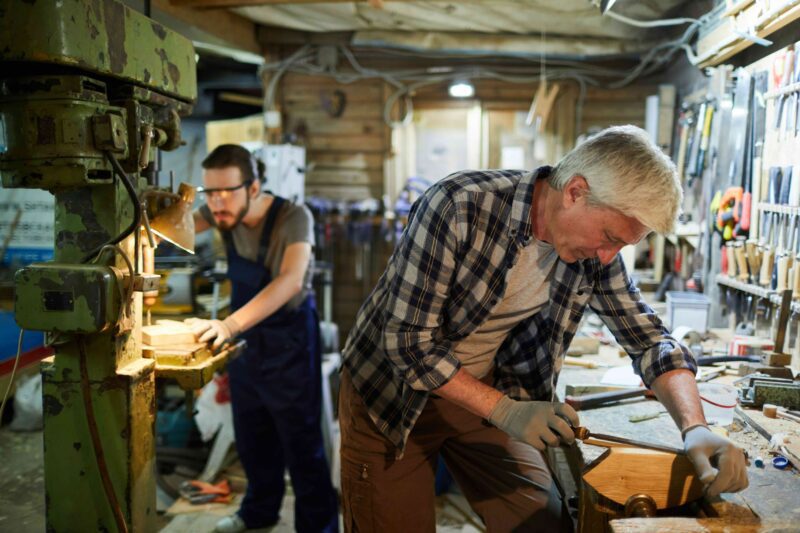
Many small businesses carry decades of accumulated skill, customer relationships, and local economic value — assets that can disappear when an owner retires without a successor; Photo by Getty Images
Acquisition financing is another unresolved question. Seller notes, senior debt, philanthropic guarantees, donations, and catalytic capital produce very different outcomes. Patient capital can preserve jobs and allow the company to reinvest before distributing. Expensive leverage can force the opposite — extracting cash from the business to meet debt obligations while little reaches the intended beneficiaries.
Nor does the business’s succession problem disappear at settlement. If customer relationships, pricing knowledge, or operating judgment remain concentrated in the departing owner, the charitable buyer has purchased a transition problem rather than an income stream.
Remove conventional shareholders and you also remove some of the people who complain. There is no takeover threat, activist investor, or analyst call. A permanent owner can be patient, but it can also become insulated.
Henry Hansmann and Steen Thomsen, studying 110 foundation-owned Danish firms, found a strong relationship between foundation governance and the performance of the companies beneath it. Read that as a warning, not a reassurance. Governance is the variable that decides the outcome, and no market stands by to supply it.
A credible structure needs independent commercial expertise, separation between owner and management, a disciplined capital-allocation policy, and transparent distribution rules. It should give workers and affected stakeholders meaningful voice. The board’s duty cannot be only to maximize transfers; it must steward the enterprise that generates them.
Impact investing usually locates impact in what a business does, whom it serves, and how it operates. Permanent charitable ownership adds another dimension: who holds the economic rights and where residual value ultimately goes.
Steward ownership begins with control, separating voting power from financial extraction so a company can remain independent and purpose-led. Charitable ownership begins with destination. Bosch combines both, placing most economic rights in a charitable foundation while entrepreneurial voting rights sit elsewhere.
Employee ownership distributes wealth — and sometimes governance — to the people who work in the company. Charitable ownership directs value to causes outside it. These are choices among beneficiaries and forms of accountability, not a simple ranking. Hybrids are possible: employees could hold an economic stake or board representation while a charitable entity retains long-term control.
Governance is the variable that decides the outcome, and no market stands by to supply it.
Foundation-owned enterprise is the closest relative. Industrial foundations control a quarter of Denmark’s 100 largest corporations, and prior studies summarized by Hansmann and Thomsen find their profitability roughly comparable to conventionally owned firms. But most were created to preserve a company, with philanthropy among their purposes. This model inverts that relationship: charitable purpose leads, and the company is the instrument. That changes what a board may optimize for — and remains unproven at portfolio scale.
Destination of profit cannot be the only test. A business does not become impact infrastructure merely because its owner gives money away. Products, labor practices, emissions, supply chains, tax behavior, and community effects remain part of the equation. Otherwise, charitable ownership could become impact-washing: extracting value through the company and returning a smaller portion through philanthropy.
The model therefore needs minimum operating guardrails alongside its distribution commitment. These might include exclusions for harmful products and practices; decent-work standards; worker voice; responsible environmental and tax policies; adequate reinvestment; and public reporting on debt, capital expenditure, wages, workforce retention, stakeholder outcomes, and the amount distributed against the amount promised.
Destination of profit cannot be the only test.
Permanence, too, is a claim about difficulty rather than impossibility. Constitutions get amended. Boards drift. Charitable status can be lost. The structure raises the cost of defection; it does not remove it.
Sometimes. Conditionally. And only if the unglamorous parts are done well.
The case for Australia is not that the idea is entirely new. It is that the country has an unusual convergence of established businesses approaching succession, a legal environment that can accommodate carefully structured charitable business activity, and social-purpose organizations seeking more durable sources of income.
What is missing is not a compelling theory but evidence. Evidence will not come from another argument. It will come from acquiring and operating a portfolio of ordinary companies for a decade, comparing the outcome with other succession paths, and publishing what happened: jobs retained, capital reinvested, debt repaid, stakeholder outcomes, and cash distributed against cash promised.
Until then, permanent charitable ownership should be described accurately: not as a substitute for responsible business or impact investing, and not as a guaranteed solution to the succession wave, but as a hypothesis with structural logic and a thin track record. That is precisely why it is worth testing.
--
Disclosure: Nikita Gossain is the founder of PPR Capital, which is collaborating with The Life You Can Save and Project COA on a pilot acquisition intended to test charitable ownership of an established business. PPR Capital is leading the transaction; The Life You Can Save is intended to serve as the charitable owner and is helping develop governance and raise philanthropic capital; and Project COA founder Brad West, who originated the Charitable Ownership Advantage thesis, is providing legal support and designing pre- and post-acquisition measurement. The model remains under development and has not been demonstrated by PPR Capital at portfolio scale.


Related Content
Connecting Georgia’s social enterprises to markets and capital
69
0
Gabriel Grant on giving shareholders a way to express what matters to them
90
0
For mission-led organizations, a change of manager tests whether workplace inclusion is built to last.
73
0

Artist Rob Strati on inherited objects, the limits of market price, and the creative possibilities…
113
0
Comments
Deep Dives
RECENT
 363
0
363
0
 422
0
422
0
 399
0
399
0
Editor's Picks
 69
0
69
0
 90
0
90
0
 73
0
69
0
90
0
69
0
90
0
73
0
73
0
69
0
90
0
69
0
90
0
73
0
Webinars
Signed and personally inscribed — you'll write the inscription as you order. Limited · 50…
News & Events

The board can add 2% for each 50% rise in the company’s value
Applications close December 2, or sooner once 250 arrive

Repeat borrowers in Colombia and Indonesia took it over the line
Subscribe to our newsletter to receive updates about new Magazine content and upcoming webinars, deep dives, and events.
Become a Premium Member to access the full library of webinars and deep dives, exclusive membership portal, member directory, message board, and curated live chats.


0 Comments