Beyond Investment Readiness
How collateral rules and payment terms keep impact capital out of reach




How collateral rules and payment terms keep impact capital out of reach

 80
80
 0
0

Why free education tools need reliable access, credible evidence, and lasting support
 76
0
76
0

What Islamic finance and impact investing can learn from each other
164
0

How states can crowd in local early-stage capital
302
0

Why last-mile healthcare needs an operating model, not just more mobile clinics
 266
0
266
0

How Australia’s succession wave could turn ownership into a funding model
 375
0
375
0
 266
0
266
0

Last-mile healthcare depends on trusted local relationships and continuity of care as much as on clinical access itself. Photo by Getty Images
Disclosure: The author leads Swasthgram Global Foundation and founded Accuster Technologies. This article draws in part on operating models he developed through those organizations.
Mobile clinics can reach patients, but reach alone does not create a functioning health system. Drawing on rural India and U.S. evidence, Amit Bhatnagar argues that durable rural care depends on local operators, follow-through, interoperable infrastructure, and financing designed to survive beyond the grant cycle.
Snow Shoe, Pennsylvania, did not lose its healthcare all at once. First went the pharmacy, then the federally qualified health center. When Penn State researchers returned to the community, they found residents rationing medications, cutting insulin doses, sharing prescriptions, delaying care, and relying more heavily on emergency services. The usual reading of a story like that is scarcity: a small town could not hold onto its services. Read the economics instead and it says something more specific. A market failed there, and no viable first layer of care arrived to take its place.
That failure is playing out in many places at once. A Health Affairs study found that 29.4 percent of U.S. retail pharmacies operating between 2010 and 2020 had closed by 2021. The Chartis Center for Rural Health reports that more than 40 percent of rural hospitals are operating at a loss and 417 are vulnerable to closure. ECRI ranks reduced access to rural healthcare as the second-highest patient-safety concern for 2026, warning of delayed diagnosis, delayed treatment, and worse outcomes. In Chadron, Nebraska, KFF Health News reported this spring that a hospital closed its dialysis unit after losing roughly $1 million a year on the service; four private companies declined to take it over, leaving some patients to travel hours for treatment. The lesson is not that nobody cared. The economics were never built to hold.
The reflex answer is mobile care: put the service on wheels and drive it to the patient. I have spent close to two decades working on versions of that problem in rural India, and I can report that the vehicle is the easy part. Recent Georgetown health-policy research reaches a similar conclusion in the U.S. context. Mobile health can expand access, but durable programs depend on stable financing, community partnerships, referral networks, integration with existing health systems, and billing infrastructure. A van by itself is not a system.
Three design habits repeatedly undermine sustainability: short-term grant dependence, incentives that are disconnected from whether patients actually reach the next stage of care, and centralized operating structures that load too much cost onto the last mile. Ask any outreach program the question that matters most: what holds the service together once the initial money is gone?
In the deployments I have led, four design choices have mattered most.
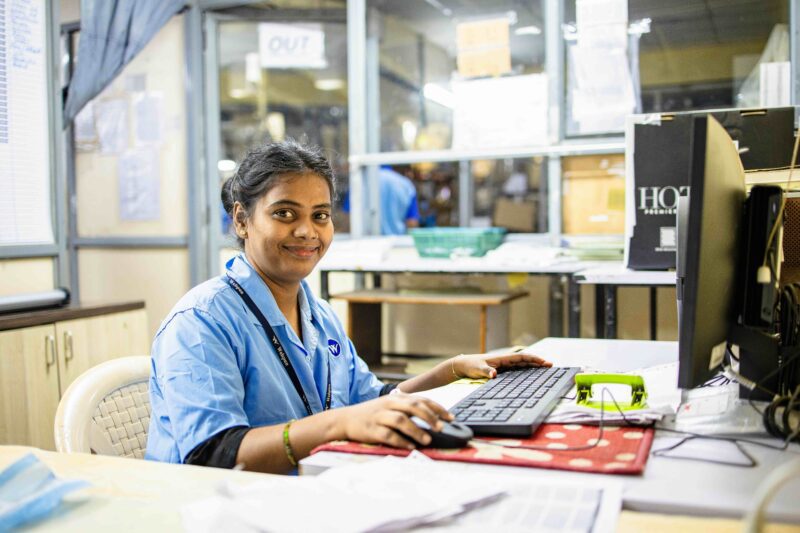
The infrastructure of rural care includes not only diagnostics, but also local operators, patient records, referral systems, and reliable follow-through; Photo by Equal Stock
Built to reach, plug in, and repeat
The first is a delivery architecture built for the terrain rather than adapted to it. Each deployment is a self-contained module: device, consumables, and trained operator move as one unit, light enough to reach a doorstep, powered for unreliable infrastructure, weatherized for difficult conditions, and able to capture records offline and sync them when connectivity returns. Units deploy through clinics, governments, and partners already on the ground, with fleet-level oversight of quality and stock. The point is replicability. Reach should not have to be rebuilt from scratch in every village.
From result to care: the link that breaks
The second choice addresses mobile care's least-discussed failure: follow-through. In 2022, researchers reviewing more than 1,300 abnormal screening mammograms found that only 45 percent of patients screened on a mobile unit obtained recommended follow-up within 60 days, compared with 72 percent of patients screened at a fixed site. After adjustment, mobile patients were roughly twice as likely to experience delay. The unit had reached far enough to find the problem but not far enough to resolve it. Screening is only valuable when the result triggers care.
The economics were never built to hold.
The literature also points toward a remedy. A systematic review of abnormal-mammogram follow-up found that patient navigation, case management, education, and more deliberate communication can improve timely follow-up. In the model I have led, follow-through is therefore an explicit operating responsibility. Compensation is tied to verified care delivered rather than simply to tests run, and abnormal results are designed to escalate toward clinical follow-up instead of ending at the screening event. The aim is to make somebody responsible for the next step.
The third choice is who operates the system. In our deployments, trained local operators are drawn from the communities they serve and work as micro-entrepreneurs rather than as a temporary outside workforce. Local ownership can strengthen continuity, trust, and cost discipline while creating livelihoods alongside the care layer itself. The entrepreneurial structure is not the only way to build a local workforce, but it aligns the operator's economic stake with the durability of the service.
The United States is not starting from zero. Community health workers embody a related principle: care is more effective when trusted local people help patients navigate systems that are otherwise hard to reach. Milbank Memorial Fund reports that just over half of state Medicaid programs covered community health worker services as of January 2024, with coverage continuing to expand. And beginning in 2024, Medicare added new services specifically designed to include care involving community health workers. Community health workers are not the same as micro-entrepreneurs, but these financing rails show that a locally rooted care layer can be incorporated into the U.S. reimbursement system.
Follow the money and the deeper bottleneck comes into view. The Global Impact Investing Network estimates that more than 3,900 organizations manage $1.571 trillion in impact-investing assets worldwide. At the same time, the OECD estimates an annual $4 trillion gap between the financing required to achieve the Sustainable Development Goals in developing and emerging economies and the resources being mobilized. Those two numbers do not mean that capital is easy to raise. They show something more useful: large pools of mission-oriented capital can coexist with enormous unmet need because capital still requires investable, accountable delivery models.
A van by itself is not a system.
In the model I currently operate in India, patients who can afford care pay for services, while people unable to afford care — along with patients age 70 and older — receive care free. Revenue from paying patients helps cross-subsidize free care, while corporate and donor funding supports technology, training, and platform development. The exact economics will not transfer directly to the United States, where labor costs and reimbursement structures are very different, but the principle can: use catalytic capital to establish the infrastructure, then design recurring revenue to sustain delivery and preserve access for people who cannot pay.
India offers other evidence that healthcare economics can be deliberately engineered for broad access. Aravind Eye Care has built a high-volume model in which paying patients help cross-subsidize care for people who cannot afford it, while Narayana Health has used scale, standardized processes, and cross-subsidy to reduce the cost of complex tertiary care. These models are not templates for rural America. They are proof of a more basic proposition: affordability is partly a design problem.
A U.S. version would blend the economics differently: Medicaid and Medicare reimbursement, community health worker payments, value-based payer contracts, employer screening, philanthropy as catalyst, and perhaps patient fees where appropriate. But the connective principle holds: local delivery needs an operating model with clear ownership, incentives, referral pathways, and recurring revenue.
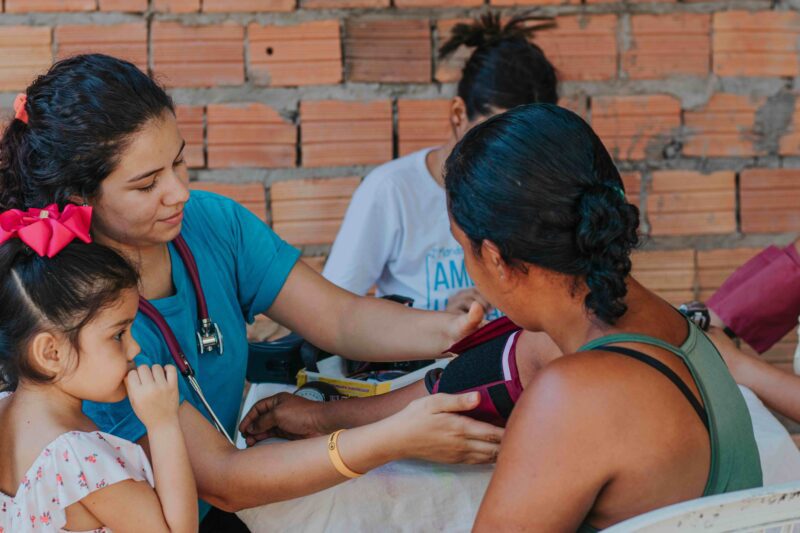
Community-based health workers can bring screening and primary care closer to patients who face barriers to conventional healthcare access; Photo by Carlos Magno
Honesty requires saying which parts of this travel. The modular logic can travel. Local operators can travel. Deployment through existing clinics and partners can travel. The training pipeline can travel. What does not travel is the wiring: the regulatory perimeter deciding who may run which tests, reimbursement and billing infrastructure in place of cash-and-donor revenue, data handling and interoperability that put a field record into an American chart, and liability and scope-of-practice rules for the operators themselves. All of that has to be rebuilt locally. Importing the plumbing instead of rebuilding it is how transplanted models fail.
The moment for getting that design right is unusually consequential. In December 2025, CMS awarded all 50 states funding under the $50 billion Rural Health Transformation Program, with $10 billion available annually from 2026 through 2030. Georgetown researchers found that as many as 42 states proposed some form of mobile health in their plans. The money and the vehicles are therefore entering the system now. The harder question is whether states will also build the financing, workforce, referral, data, and accountability infrastructure that makes access durable.
The question is not only how to save the rural healthcare system. It is what has to exist before the hospital — at what cost, under whose ownership, and on whose balance sheet — so that the hospital is not the only option left.


Related Content
How collateral rules and payment terms keep impact capital out of reach
80
0
Why free education tools need reliable access, credible evidence, and lasting support
76
0
What Islamic finance and impact investing can learn from each other
164
0

After the flood, recovery capital must do more than replace what was lost
 295
0
295
0
Comments

Deep Dives
RECENT
 302
0
302
0
 266
0
266
0
 375
0
375
0
Editor's Picks
 80
0
80
0
 76
0
76
0
 164
0
80
0
80
0
76
0
164
0
164
0
80
0
80
0
76
0
164
0
Webinars

Signed by the author. Collected at the door at Lipton Hall, NYU School of Law,…
Signed and personally inscribed — you'll write the inscription as you order. Limited · 50…
News & Events

Federal policy uncertainty and limited grants top 2026 risks

An introductory program for foundations and family offices

Backers include UnitedHealth Group and the Ford Foundation
Subscribe to our newsletter to receive updates about new Magazine content and upcoming webinars, deep dives, and events.
Become a Premium Member to access the full library of webinars and deep dives, exclusive membership portal, member directory, message board, and curated live chats.

0 Comments