Beyond Investment Readiness
How collateral rules and payment terms keep impact capital out of reach




How collateral rules and payment terms keep impact capital out of reach

 130
130
 0
0

Why free education tools need reliable access, credible evidence, and lasting support
 185
0
185
0

What Islamic finance and impact investing can learn from each other
256
0

How states can crowd in local early-stage capital
334
0

Why last-mile healthcare needs an operating model, not just more mobile clinics
 304
0
304
0

How Australia’s succession wave could turn ownership into a funding model
 424
0
424
0

 332
0
332
0

Across Nepal’s mountain communities, climate resilience is inseparable from questions of where people live, how infrastructure is built, and whether recovery capital reduces future risk rather than recreating it; Photo by Sushanta Rokka
A devastating Himalayan flood wiped out homes, businesses, roads, and hydropower assets across Nepal. Now a nearly US$4.8 billion recovery bill is forcing a larger question: will reconstruction restore the same vulnerabilities, or finance a safer economy?
Before August 26, Tara Tamang’s bakery in Betrawati earned between NPR 10,000 and 15,000 a day. The income paid for her three children’s education and gave the 33-year-old mother a measure of economic independence. Then the Bhotekoshi flood swept away both her home and her business. Tara, her 12-year-old twin daughters, and her six-year-old son survived by running uphill to higher ground.
Weeks later, she is renting a room in Devighat. The government is providing NPR 15,000 per month to families of up to four people displaced by the flood, but Tara says relief alone cannot restore what she lost. “I cannot educate my children with money given by others,” she told Impact Entrepreneur. What she wants most is seed money to start another business.
Her problem is Nepal’s in miniature. The immediate task is relief. The harder task is deciding whether recovery capital simply replaces destroyed assets — or finances a safer economy.
The scale of that choice is enormous. As of September 18, 1,410 bodies had been recovered and 6,145 people remained unaccounted for after the August 26 disaster. A new analysis by World Weather Attribution found that a massive rock-wall and glacier-ice collapse on Langtang Lirung transformed into a rock-ice avalanche, debris flood, and then a devastating flash flood. The researchers concluded that climate change likely acted as a destabilizing factor in an already fragile high-mountain environment, rather than as a single direct cause of the collapse.
Nepal’s preliminary assessment estimates roughly NPR 408.28 billion in damage and economic losses — with more than two-thirds falling on the private sector. The government’s Rapid Damage and Needs Assessment puts total recovery and reconstruction needs at NPR 723.31 billion, about US$4.8 billion. Infrastructure alone accounts for NPR 473.57 billion of that need.
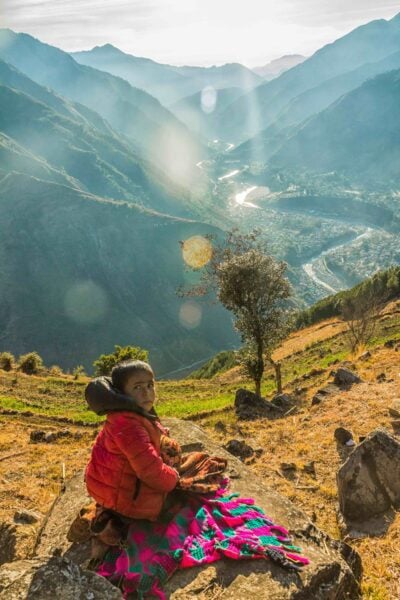
The choices Nepal makes about reconstruction today will shape the safety, livelihoods, and economic opportunities of communities living along Himalayan river systems for decades to come; Photo by Sushanta Rokka
Those numbers reveal the central challenge. Rebuilding after the flood is not only a humanitarian obligation. It is an investment decision about where Nepal places scarce capital, how it protects productive assets, and whether the country reconstructs the vulnerabilities the flood exposed.
Lilanath Neupane was working on a powerhouse in Rasuwa when floodwater entered a three-kilometer tunnel. At first, he thought the water had entered accidentally. Then workers heard people shouting that a flood was coming. Neupane and 10 others moved about a kilometer uphill through the rising water before escaping.
“We took off our shoes and crawled out of the tunnel on our hands and feet,” he said. The tunnel was later filled with mud.
The disaster hit an energy system central to Nepal’s development strategy. The rapid assessment says 13 hydropower projects with a combined capacity of about 759 megawatts and five solar plants were affected. Restoring the energy and grid system is projected to require more than NPR 390 billion.
The shock also reversed Nepal’s regional power position almost overnight. Before the flood, Nepal had approval to export roughly 1,200 megawatts of electricity to India and Bangladesh, with wet-season surpluses becoming an important source of revenue. After damaged hydropower facilities reduced generation, exports to Bangladesh stopped and sales to India fell. By mid-September, India had approved exports of up to 654 megawatts back into Nepal through the end of December to help cover the shortfall.
In a matter of weeks, infrastructure designed to generate export income became a source of domestic energy vulnerability.
Dharmaraj Upreti, executive chief of Nepal’s National Disaster Risk Reduction and Management Authority (NDRRMA), says the government is now discussing with private hydropower operators how damaged facilities can be rebuilt more safely. Rasuwagadhi, he notes, is a concentration point for major hydropower investment, making resilience an economic as well as an engineering question.
That means treating climate-resilient infrastructure not as an added cost after a project is designed, but as part of the investment itself.
The flood also exposed weaknesses in how risk information moves from mountains to communities. Former NDRRMA chief Anil Pokhrel says Nepal needs stronger risk assessment and safer settlement planning. “Nepal appears to be weak in risk management,” he told Impact Entrepreneur. “We need to assess risks and identify safe places for people to live.”

Nepal’s reconstruction challenge reaches beyond roads and power systems to the communities embedded in increasingly exposed mountain landscapes; Photo by Alexandra White
A functioning early-warning system therefore depends on more than alarms. It requires monitoring equipment, reliable communications, institutional coordination, cross-border data, public trust, and communities that know how to act when an alert arrives.
Before the flood, Nepal and China had begun discussing stronger real-time data sharing for glacier hazards, flood forecasting, and mountain monitoring. Binod Parajuli, a senior hydrologist with Nepal’s Flood Forecasting Section, told Impact Entrepreneur that a planned second round of talks has not yet taken place.
The financing problem is as difficult as the engineering one. Nepal entered the disaster with public debt of about NPR 2.98 trillion — 45.08 percent of GDP as of mid-May 2026 — leaving the government to balance reconstruction against health, education, sanitation, and other development priorities.
Upreti says the government plans to provide NPR 400,000 to each affected family for reconstruction, but acknowledges that public budgets are limited. International support is beginning to arrive, although at a scale far below the overall need. The Asian Development Bank approved a US$5 million emergency grant for immediate rescue and relief. Nepal has also secured US$20 million from the Fund for Responding to Loss and Damage under proposals submitted before the flood, while a separate emergency request related to the Bhotekoshi disaster remains under consideration.
More than two-thirds of the flood’s estimated damage and economic losses fell on the private sector.
The gap between millions in immediate assistance and nearly US$4.8 billion in estimated recovery needs shows why this cannot be treated as an aid story alone. More than two-thirds of the measured economic losses fell on private businesses and assets. Reconstruction will require governments, development institutions, insurers, infrastructure operators, and public and private capital to decide not only who pays after disaster, but who invests in reducing risk beforehand.
For climate-vulnerable countries such as Nepal, international climate finance and loss-and-damage mechanisms will remain important. But resilience also has to be built into the economics of the assets themselves — where they are located, how they are insured, what standards govern them, and whether private developers bear an appropriate share of the cost of making them safer.
Upreti says the government does not want to recreate the same settlement patterns in the places the flood destroyed. Geological teams are identifying safer locations for relocation and reconstruction, while officials are considering how hydropower tunnels and other critical infrastructure can be redesigned for floods and landslides.
“We are not in favor of rebuilding settlements in the same places that were devastated by the floods,” he said.
That principle sounds simple, but it changes the meaning of recovery. Rebuilding safer may cost more upfront. It may require relocating communities, redesigning power projects, strengthening basin-level planning, improving cross-border monitoring, and funding disaster risk reduction before the next emergency. In economic terms, it means moving capital upstream — from repeated rescue and replacement toward prevention and resilience.
For Tara Tamang, the distinction is immediate. Monthly assistance helps her family survive, but it does not replace the bakery that paid for her children’s education. She wants the means to earn again, preferably without rebuilding in the same vulnerable place.
“We managed to survive as a family,” she said. “Property can be earned again.”
Nepal now faces the same choice at national scale. The country can spend billions restoring what the flood erased, or use reconstruction to reduce the cost of the next disaster. For Tara, that may begin with enough seed capital to open another business somewhere safer. For Nepal, it begins with treating reconstruction not as replacement, but as investment in a different future.


Related Content
How collateral rules and payment terms keep impact capital out of reach
130
0
Why free education tools need reliable access, credible evidence, and lasting support
185
0
What Islamic finance and impact investing can learn from each other
256
0

How Mishkā links women’s livelihoods to Cairo’s regeneration
 393
0
393
0
Comments

Deep Dives
RECENT
 334
0
334
0
 304
0
304
0
 424
0
424
0
Editor's Picks
 130
0
130
0
 185
0
185
0
 256
0
130
0
130
0
185
0
256
0
256
0
130
0
130
0
185
0
256
0
Webinars

Signed by the author. Collected at the door at Lipton Hall, NYU School of Law,…
News & Events

Their Built platform helps teams design, launch and run funds

The SBA barred 7(a) refinancing of merchant cash advances in 2025

The foundation begins putting the larger pool to work in 2027
Subscribe to our newsletter to receive updates about new Magazine content and upcoming webinars, deep dives, and events.
Become a Premium Member to access the full library of webinars and deep dives, exclusive membership portal, member directory, message board, and curated live chats.


0 Comments