What a Broken Plate Reveals About Value
Artist Rob Strati on inherited objects, the limits of market price, and the creative possibilities…



Artist Rob Strati on inherited objects, the limits of market price, and the creative possibilities…

 60
60
 0
0

Counting what we fail to prevent, sixty seconds at a time
72
0

How collateral rules and payment terms keep impact capital out of reach
 181
0
181
0

How states can crowd in local early-stage capital
356
0

Why last-mile healthcare needs an operating model, not just more mobile clinics
 332
0
332
0

How Australia’s succession wave could turn ownership into a funding model
 442
0
442
0
 389
0
389
0

A prevention lens turns ordinary places into strategic assets: here, transit, green infrastructure, and cross-sector planning converge in the kind of upstream investment that strengthens communities before harm arrives.
Institutions meticulously price what happens after harm, but rarely compare it with what they spend preventing harm in the first place. Prevention Economics offers a common ledger — and a discipline of proof — for institutions, funders, investors, and founders ready to move capital upstream.
Everyone in the impact economy knows the parable. Villagers stand at the river’s edge, pulling drowning strangers from the current, more each hour, until at last someone asks who keeps throwing them in and walks upstream. For fifty years, the story has served as shorthand for prevention: stop rescuing, start preventing. It is a good parable. It is also missing its most important page.
It never mentions that the village keeps books.
Somewhere in that village is a ledger, recording the cost of the boats, the watchers on the bank, the healers, the burials, the rebuilding after every season of bodies. And if the villagers ever sat down to read it, they would find the strangest entry of all: vast sums spent hauling consequences out of the water, and comparatively little spent walking upstream. The parable presents prevention as a moral awakening. The ledger reveals it as an accounting correction, which is, for institutions, a far more actionable thing to be.
Budgets are like that. An institution’s budget is the truest autobiography it will ever write. Mission statements record what an institution wishes to believe; allocations record what it actually believes — committed annually, defended politically, signed in ink. Read as autobiography, many institutional budgets reveal the same tilt: far more money allocated to absorbing consequences than reducing their likelihood. In preliminary applications of the Prevention Ratio™, preventive shares have often landed around 10 to 20 percent, depending on the perimeter and horizon chosen. Those early readings are not yet a benchmark. They are a signal.
Here I use security in the broad sense: the systems that protect people, places, institutions, and enterprises from social, ecological, economic, and physical harm. That broader definition matters because the prevention–reaction split is usually hidden across organizational silos. The pattern runs from the top of the world’s accounts to the bottom. Global military expenditure reached $2.887 trillion in 2025, the eleventh consecutive year of growth, pushing the world’s military burden to its highest share of global GDP since 2009. Beneath that reactive summit, every city, company, university, and foundation maintains its own smaller fortress budget, mostly unread.
Economists have, of course, studied the economics of prevention for decades, particularly in public health. What is missing is a cross-domain discipline that asks the same institutional allocation questions across security, health, climate, ecology, finance, and enterprise: How much do we spend before harm versus after it? What value follows when that allocation changes? Who captures that value? I have come to believe that this unread ledger is one of the largest unclaimed opportunities in the impact economy, and that the discipline of reading it deserves a name. Call it Prevention Economics: the study and practice of how institutions allocate resources between reacting to harm and preventing it, and of the value created when that allocation begins to move.
What follows is an offering toward that field: two core measures, seven principles, three kinds of practitioner, and a set of open problems that I hope better hands will take up, because young fields earn trust by naming their own unfinished business.
Prevention Economics begins with a measurement so simple it is almost embarrassing that institutions do not already publish it. The Prevention Ratio™ is the share of security-related spending directed to prevention rather than reaction: preventive spending divided by the sum of both. Expressed in cents, it asks a question anyone can hold: of every security dollar, how many cents go upstream? The ratio is not a claim of perfect classification. It is a declared estimate, bounded by an institution’s chosen perimeter and time horizon. A free public instrument, The Prevention Ledger, lets any institution compute a first-pass ratio privately in a browser. The exercise takes minutes; its power is not false precision but legibility. It converts a diffuse institutional instinct — “we are too reactive” — into a figure a board can see, interrogate, track, and move.
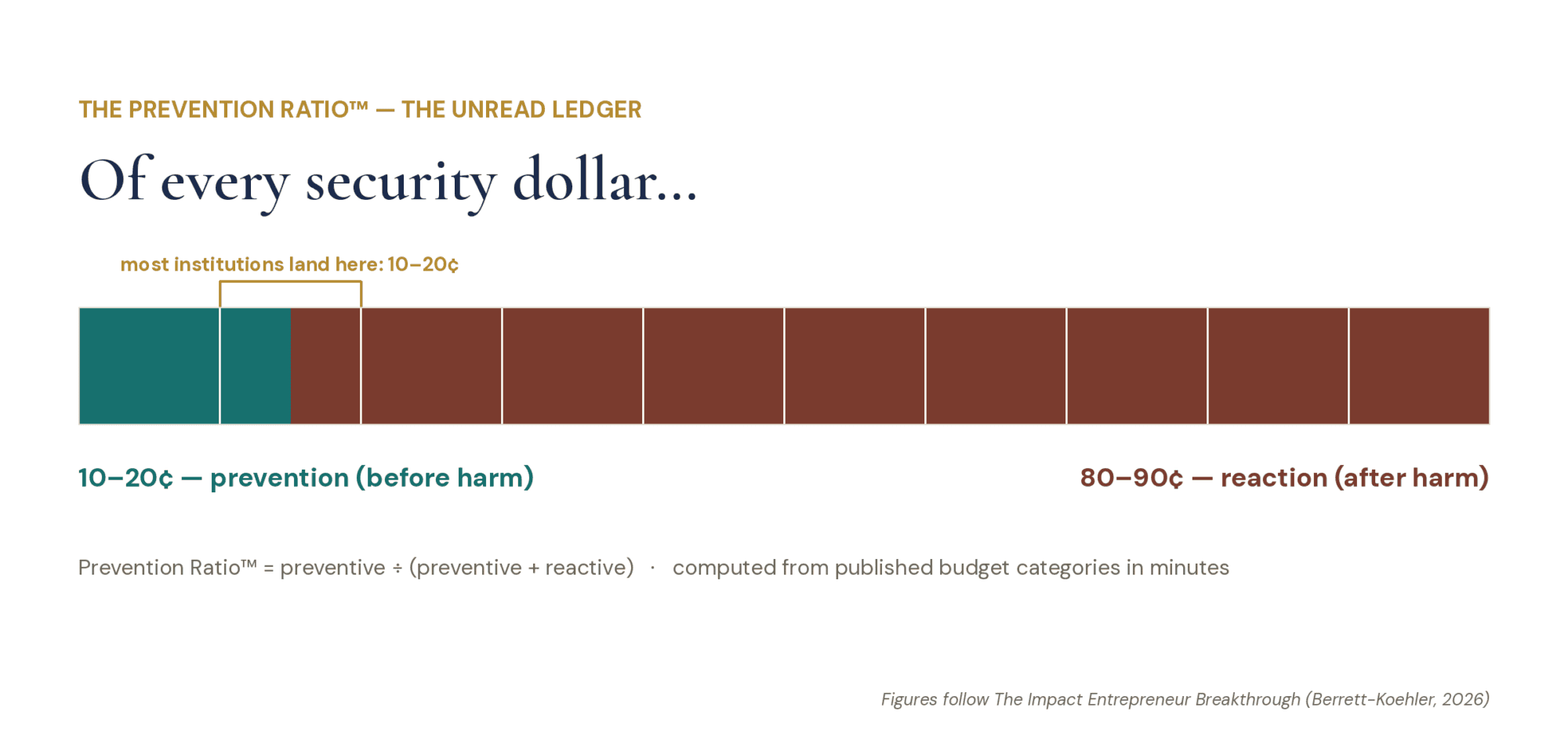
Figure 1. The unread ledger: preliminary applications of the ratio often place preventive spending in the 10–20-cent range. Results depend on the perimeter, horizon, and classification rules declared; the range is not yet a field benchmark.
The second construct describes what movement is worth. The Prevention Dividend™ is the economic value generated when spending shifts from reaction to prevention. Unlike the Prevention Ratio, it is not one standardized number. It is a family of return measures — benefit–cost ratios, annual social rates of return, and averted-loss estimates among them — that answer different questions and must travel with their class, source, horizon, and limits. Nor is the claim that prevention automatically pays for itself. It does not. Poorly designed or badly targeted prevention can waste money just as poor reaction can. The stronger claim is that well-designed preventive investments have repeatedly generated substantial economic value across independent domains.
Natural-hazard mitigation offers one example: twenty-three years of U.S. federal mitigation grants produced an average benefit of about $6 for every $1 spent, with other mitigation measures returning roughly $4 to $7 or more depending on category. Restoring degraded landscapes has been estimated to generate $7 to $30 in economic benefits per dollar invested. In violent-conflict prevention, the Institute for Economics and Peace puts the cost-effectiveness ratio of peacebuilding at 1 to 16. In its model, every dollar invested in the most fragile and conflict-affected countries would reduce the cost of conflict by $16 over the long run. High-quality early-childhood programs have produced estimated annual social returns ranging from roughly 7 to 13 percent, depending on the program. And Jameel Institute modeling estimated that, in a U.S. COVID-like pandemic scenario, each dollar invested in preparedness could avert $1,102 in expected GDP loss. These figures are not interchangeable. Their convergence is directional: across very different systems, moving resources upstream can create value that conventional budgets systematically fail to see.
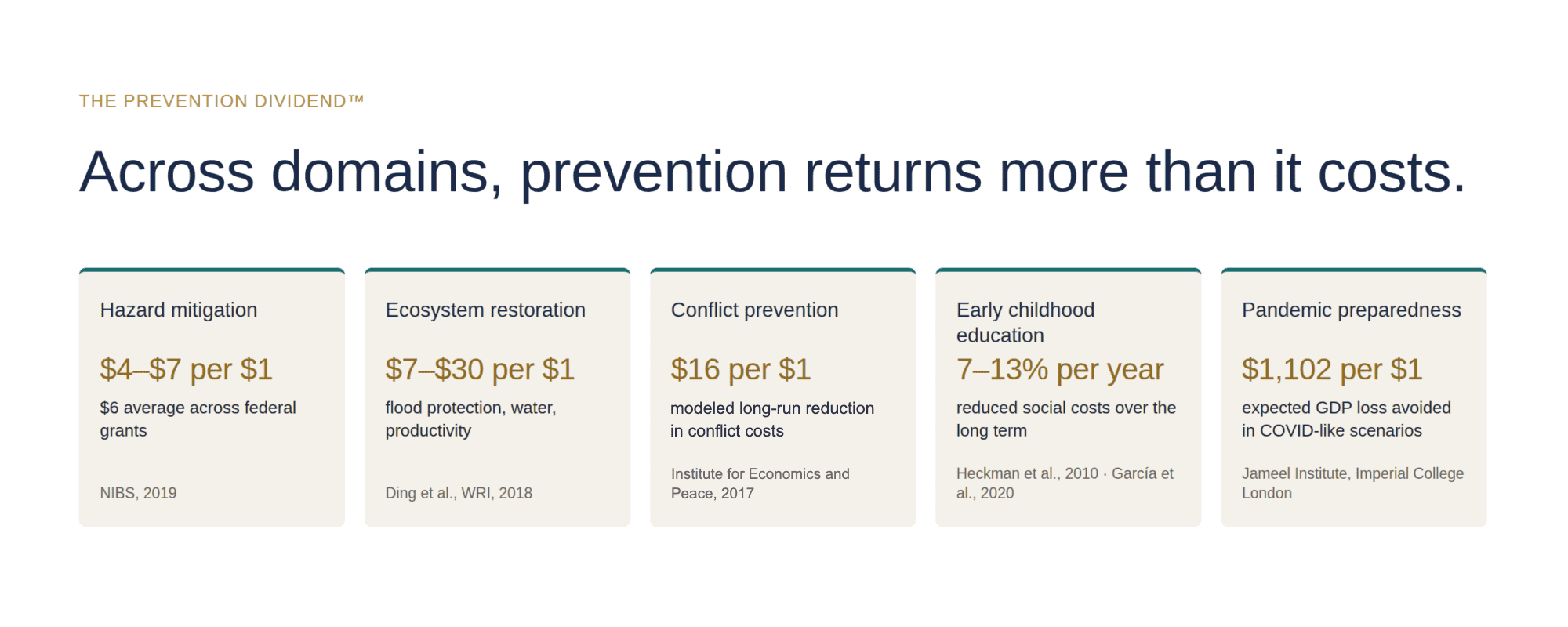
Figure 2. The Prevention Dividend™: selected evidence across five domains. The figures represent different metric classes and should be read with their source, horizon, and limits.
Watch: “The Prevention Dividend — Impact Investing’s Best-Kept Secret,” the author’s talk at SuperCrowd26 (25 minutes).
If Prevention Economics is to become a commons rather than a brand, it needs principles that anyone can hold its practitioners to, beginning with me. Here are seven.
1. Read the ledger first. Every institution’s true security doctrine is already written: not in its mission statement but in its allocation. The ratio renders that doctrine as a number, and the number starts conversations that adjectives never could. You cannot steward what you refuse to count; you cannot move what you have never measured.
2. Not all returns are the same kind of number. A benefit–cost ratio, an annual rate of return, and an averted-loss estimate answer different questions. The Prevention Dividend is therefore a discipline of classification before it is a claim of return. Every figure travels with its class, source, horizon, and limits.
3. Prevention compounds; reaction repeats. Reactive spending purchases the same year over and over: the same response, the same recovery, the same premium. Preventive spending can purchase different futures: avoided losses that stack, capacities that persist, trust that accrues. The two expenditures sit side by side in a budget and belong to different economic species.
4. The wrong pocket is often the binding barrier. Public finance already has a name for the problem: the “wrong pockets” problem. The actor who pays for prevention is often not the actor who captures the savings. The restored wetland saves the insurer and the city; the childhood program may save the state years later. Underinvestment in prevention is therefore often a routing failure, not a knowledge failure.
5. The optimum is not one. A ratio of 1.0 would be as pathological as zero: fires will burn, storms will land, and some reactive capacity is irreducible. Prevention Economics seeks the right ratio, not the maximal one, and admits plainly that the theory of the optimum remains unwritten. That admission is not a weakness; it is the field’s first research question.
6. Open the standard; verify the claims. The definitions belong to everyone: a metric no one else can compute is a service, not a standard. What must be guarded is not the formula but the integrity of its use — declared perimeters, declared horizons, transparent classification rules, and verified rather than merely self-reported claims. Fields are constituted by benchmarks; benchmarks survive by verification.
7. Every reactive line item is a design brief. Read backward, the ledger is a map of things waiting to exist: the enterprise that converts emergency response into predictive resilience, the portfolio that moves grantmaking upstream, the policy that turns remediation into stewardship. The generative half of this field begins the moment the ledger is read in reverse.
A field earns its keep by serving people with different jobs. Prevention Economics serves at least three. The deeper point is that it serves them with a single shared instrument. Institutions read the ledger. Funders steer across many ledgers. Founders originate from them.
For institutions, the ratio changes the conversation available. A city manager who knows her institution sits at 0.07 possesses something no strategic plan provides: a visible baseline, a declared perimeter, and a direction of travel that can survive the next election cycle. The debate shifts from whether to prevent — everyone favors prevention, the way everyone favors good weather — to the only question a budget can actually answer: what should the next five cents buy?
The ledger can be read at any scale; Costa Rica offers an instructive national case. After its 1948 civil war, the country abolished its army; the 1949 constitution then prohibited a standing military. A 2025 synthetic-control study finds that Costa Rica’s long-run per-capita GDP growth outperformed a counterfactual path and identifies three reinforcing mechanisms: resources moved toward infrastructure, education, and health; political institutions gained stronger checks and balances; and demilitarization helped those reforms endure. The authors are careful not to attribute the result to army abolition alone. That caveat matters. Prevention Economics is not a story about moving one line item and declaring victory. It is about how reallocations interact with institutions over time to produce different futures.
Funders hold a portfolio of other institutions’ ledgers, and a ledger of their own. Philanthropy, for all its upstream language, is repeatedly pulled toward visible crises: relief outruns resilience, treatment outruns prevention, and any foundation that computes the ratio of its own grantmaking may learn something it did not plan to know. But the funder’s deeper assignment is the field’s hardest puzzle. Prevention’s returns often land in the wrong pocket. Prevention Economics therefore asks three questions of every opportunity: Who pays? Who saves? Who captures? From there, it reaches for instruments designed to repair the misalignment: outcomes contracts and impact bonds that tie payment to verified results; blended capital stacks in which catalytic or first-loss capital absorbs risks others will not; resilience bonds and related structures that monetize avoided losses and improved risk. Value creation is not value capture. The gap between them is not a flaw in prevention. It is the design space of prevention finance — and some of the most consequential funding careers of the next decade will be built inside it.
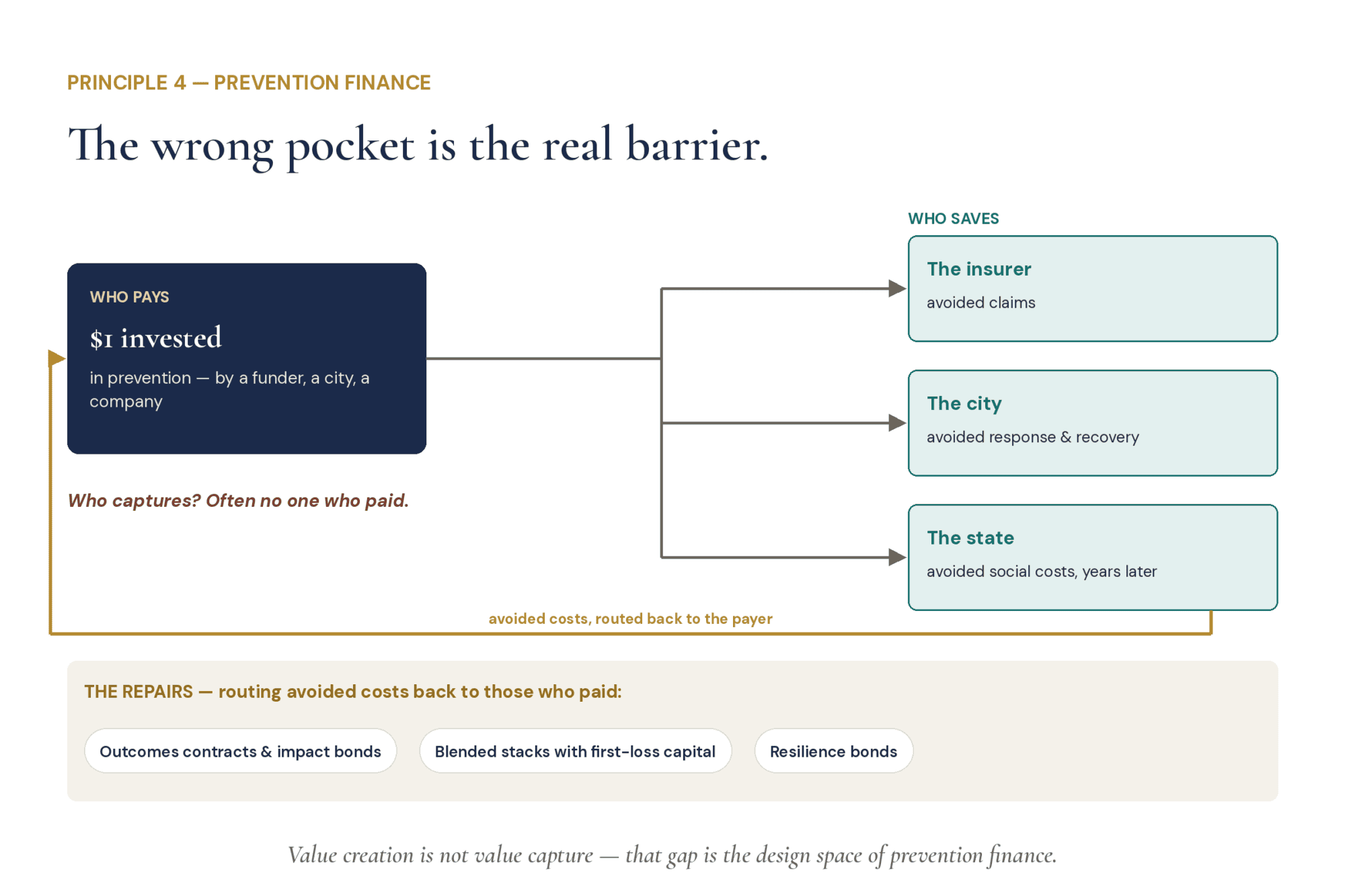
Figure 3. The wrong-pocket problem: prevention’s returns often accrue to actors who did not make the original investment. Prevention finance seeks mechanisms that route part of that value back toward those who paid.
For entrepreneurs, the field offers something rarer: a new way for companies to be born. Conventional venture formation teaches demand discovery: interview customers, hypothesize the pain, validate willingness to pay. It works, as far as it goes. But notice what it produces: knowledge of preferences — what people say they would pay for, on a good day, to a friendly interviewer. Preferences are weather. Budget lines are climate.
A reactive line item is pain already quantified, already priced, renewed annually and politically defended: a commitment, not an opinion. So Prevention Economics teaches founders demand archaeology instead: do not imagine the market; excavate it. I know of no mainstream incubator or accelerator that puts this question first: whose reactive spending does this venture convert into prevention? Ask it, and the ledger becomes a map. The emergency-response budget may conceal a predictive-resilience venture; the remediation budget, a restoration enterprise; the insurance premium, a new kind of underwriting. Institutions are already funding their problems, lavishly and in perpetuity. The founder’s work is to give them something better to buy.
Seen whole, Prevention Economics reframes four persistent problems in the impact economy at once.
Origination. Deal flow is often thin because founders and funders wait for inspiration. Ledger-anchored origination replaces some of that guesswork with excavation: markets are pre-quantified, incumbent spending is visible, and prospective customers are identifiable.
Additionality. A reactive budget line does not prove causal impact, but it can make the baseline more concrete. The intervention has something real to beat: the cost and outcome pattern of the spending it seeks to displace.
Measurement. Credibility improves when the field refuses to launder one metric class into another. Averted-loss estimates are not benefit–cost ratios; annual social returns are not cash yields. Precision begins with naming what the number actually is.
Capital alignment. The pocket map turns a familiar lament into an address. It shows where value escapes, who captures it, and which financial instrument might retrieve some of it.
Underneath all four runs the larger reframe. The impact economy has never lacked passion, capital, or evidence. It has lacked a shared diagnostic that travels: a common question that a city, company, foundation, investor, and founder can all ask of their own allocations. Prevention Economics offers the impact economy something close to a common ledger, a common question, and a common discipline of proof.
A young field should be judged by the problems it admits. Four stand open, and I would rather state them here than have them discovered as gotchas.
First, classification is perimeter- and horizon-relative. Insurance finances recovery yet prices risk; maintenance is prevention relative to failure and operations relative to design; in the long run, everything is a reaction to something further upstream. Ratios are comparable only under declared perimeters, declared horizons, and transparent classification rules. The field’s first task of standardization is therefore definitional — and that work belongs in peer-reviewed literature and open standards, not anyone’s marketing.
Second, there is as yet no theory of the optimal ratio. A ratio of one would be as pathological as a ratio of zero, and the right allocation will vary with an institution’s hazard profile, insurance markets, mandate, and existing capacities. The field seeks the right ratio, not the maximal one; the theory of that optimum is unwritten, waiting for economists and practitioners to claim it.
Third, the dividend’s epistemics are genuinely hard. Averages are not marginals; the first dollar of mitigation does not return what the millionth does. Avoided costs are estimated against modeled counterfactuals. Published benefit–cost ratios can skew toward programs that worked, while failed interventions disappear from view. Honest practice therefore speaks in ranges with stated confidence, distinguishes realized from modeled returns, and never turns a point estimate into a promise.
Fourth, Goodhart waits at the door: the day the ratio becomes a target, institutions will reclassify spending to look preventive. The remedy is old and proven. Fields are constituted by benchmarks, and benchmarks survive by verification; the difference between self-reported and audited will matter here as it has mattered everywhere else.
These are not footnotes. They are the field’s research agenda, and they are open. To economists, public-finance scholars, accountants, risk professionals, and the benefit–cost community: the definitional and theoretical work sketched here is an invitation. The measures will be better for your hands on them.
For fifteen years, my work has proceeded from a conviction I have called impact alchemy: that one of the deepest opportunities of our era is the conversion of extractive and reactive patterns into regenerative value. Prevention Economics is that conviction given a ledger: alchemy with an accounting department.
I offer its principles as a founding draft, not a finished doctrine — the kind of document a field should revise the moment better evidence and better hands arrive. The measures carry marks because instruments need stewards; the ideas are meant to travel free.
And the parable? Keep walking upstream; its counsel still holds. But on the way, stop at the counting-house. The village has been keeping books all along. Those books are the most persuasive case prevention has ever had, and they are waiting — in your institution as in mine — to finally be read.
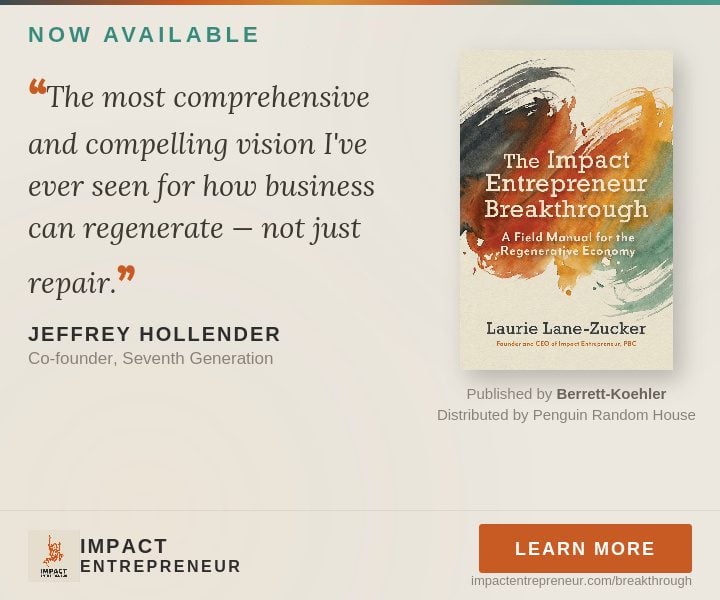
Laurie Lane-Zucker is founder and CEO of Impact Entrepreneur, PBC, and author of The Impact Entrepreneur Breakthrough: A Field Manual for the Regenerative Economy (Berrett-Koehler, 2026). He coined the term “impact entrepreneur” in 2011. Prevention Ratio™ and Prevention Dividend™ are trademarks of Laurie Lane-Zucker. The Prevention Ledger, a free public instrument for computing an institution’s ratio, is available here.


Related Content
Artist Rob Strati on inherited objects, the limits of market price, and the creative possibilities…
60
0
Counting what we fail to prevent, sixty seconds at a time
72
0
How collateral rules and payment terms keep impact capital out of reach
181
0

Why free education tools need reliable access, credible evidence, and lasting support
 236
0
236
0
Comments
Deep Dives
RECENT
 356
0
356
0
 332
0
332
0
 442
0
442
0
Editor's Picks
 60
0
60
0
 72
0
72
0
 181
0
60
0
60
0
72
0
181
0
181
0
60
0
60
0
72
0
181
0
Webinars
Signed by the author. Collected at the door at Lipton Hall, NYU School of Law,…
News & Events

The September 14 program and a live IFI Tool demo are online

Pre-seed and seed startups can apply on a rolling basis

Their Built platform helps teams design, launch and run funds
Subscribe to our newsletter to receive updates about new Magazine content and upcoming webinars, deep dives, and events.
Become a Premium Member to access the full library of webinars and deep dives, exclusive membership portal, member directory, message board, and curated live chats.


0 Comments