What a Broken Plate Reveals About Value
Artist Rob Strati on inherited objects, the limits of market price, and the creative possibilities…


Artist Rob Strati on inherited objects, the limits of market price, and the creative possibilities…

 31
31
 0
0

Counting what we fail to prevent, sixty seconds at a time
57
0

How collateral rules and payment terms keep impact capital out of reach
 166
0
166
0

How states can crowd in local early-stage capital
347
0

Why last-mile healthcare needs an operating model, not just more mobile clinics
 320
0
320
0
How Australia’s succession wave could turn ownership into a funding model
 435
0
435
0
 31
0
31
0
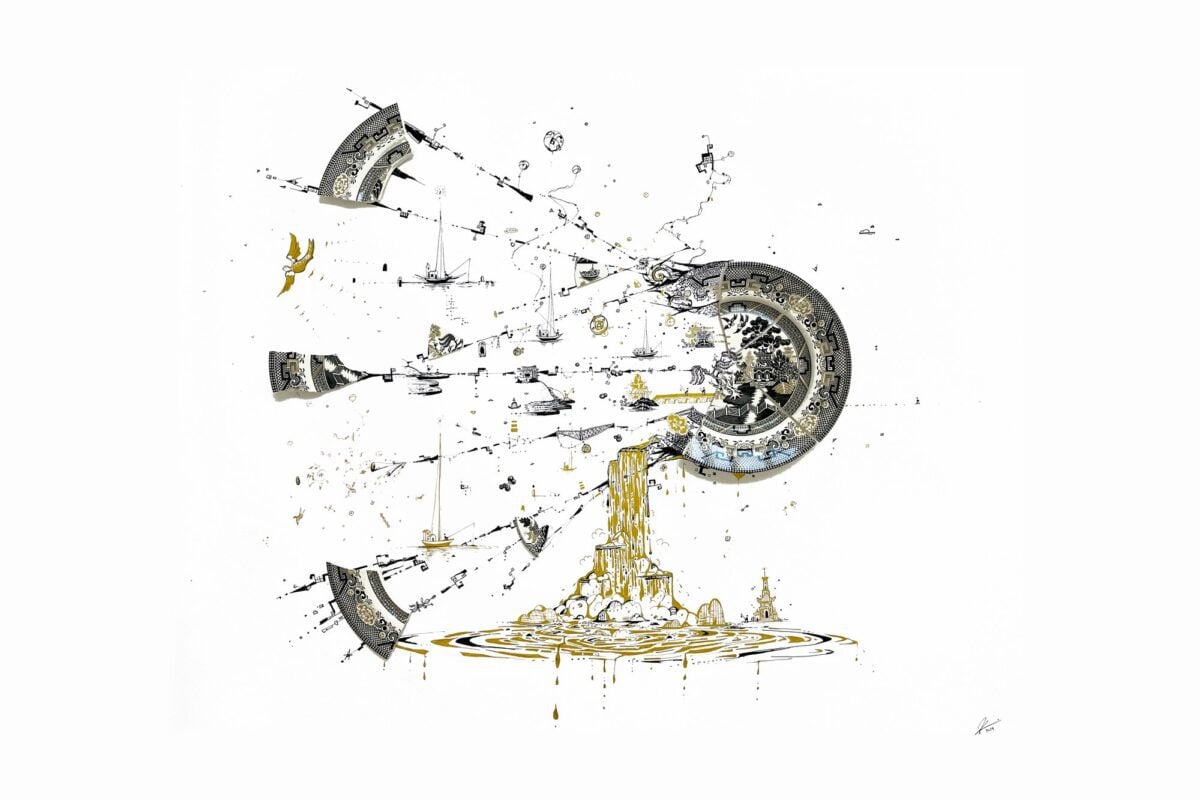
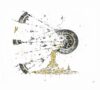
Rob Strati’s Fragmented in Black and Gold combines a broken plate with ink on paper, extending its imagery into a larger composition; Image courtesy of Rob Strati
A broken plate can carry more than its resale price suggests. Artist Rob Strati explores the relationship between market value, family memory, preservation, and the imagination needed to see new possibilities.
A porcelain plate that had belonged to Rob Strati’s late mother-in-law, Barbara Cox, broke. Its decorative imagery survived in fragments. Strati began extending those images in ink onto the surrounding paper, allowing scenes that had once been contained by the plate’s edges to unfold beyond them.
That experiment became his Fragmented series. Ships, landscapes, and figures emerge from pieces of antique and vintage porcelain, connecting the objects’ existing imagery with his drawings. Their histories remain visible within something newly made.
The work opens a question with relevance beyond the studio: what makes something worth keeping? A plate may command a modest resale price while carrying generations of family memory. Its transformation into an artwork may attract new attention and a much higher price, yet the care that preserved it began long before it entered a gallery.
For people working to build an impact economy, that distinction invites reflection on what prices reveal — and what they leave out. In this email interview, Strati considers preservation, his participation in the art market, and how creative practice can help people imagine other possibilities for things they might otherwise discard.
This interview has been edited for length and clarity.
Impact Entrepreneur: What does an inherited object reveal about the gap between market price and personal value?
Rob Strati: I think our economic culture is too narrowly focused. It looks at a limited number of factors in determining value: scarcity, utility, amount of labor, cost of production, provenance, comparables. Market prices fail to fully reflect personal and emotional value.
Think of one of these plates that sat in a china cabinet for 70 years and was seen by multiple generations. Family members were informed by it, subconsciously or consciously, as they went through their lives together.
I might be able to buy a plate like that for $15 on eBay. But when someone sees it in a different context — where an art object is understood to require consideration — it can bring back memories of family members through different phases of life. The value for that person is infinitely more than what our economic culture would put on it.
Market prices fail to fully reflect personal and emotional value.
You’ve described turning a modestly priced plate into an artwork that sells for tens of thousands of dollars. Do we need a high price to justify caring for something?
There are definitely cases where high prices are tied to expectations of conservation, but there are important examples where that isn’t the case.
Many of these plates were already preserved and passed down even when their monetary value was relatively modest. They retained a kind of status because people cared enough about them and the environments they came from to keep them. So I don’t think conservation necessarily has a direct relationship to price.
We see something similar with historic homes whose monetary value may not be enormous because they are falling apart, but groups of people still rally around them because they believe those places are worth preserving.
How do you navigate conventional measures of value when pricing your own work?
The art world has a baseline set of conventional measures of value: scarcity, the amount of time or labor involved, provenance, and similar factors. For me, it is about understanding that those conventional measures exist while recognizing that they are only a starting point.
With my own work, I started pricing at the lower end. As more people bought it and I listened to why it resonated with them, the prices grew with the demand.
At the same time, I realized that what a work means to someone can move beyond anything the market can measure, opening up the possibility of pricelessness.
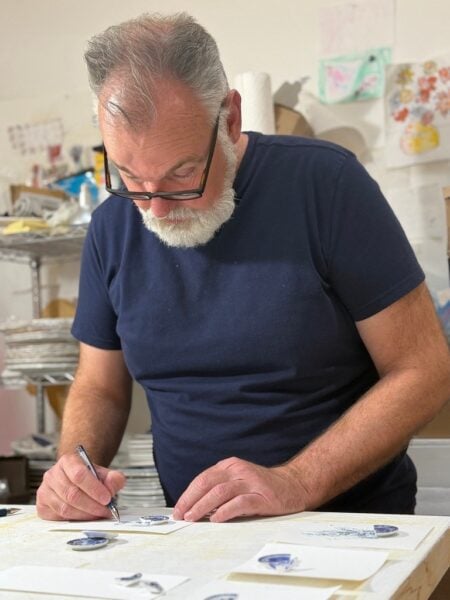
Rob Strati works on drawings incorporating porcelain fragments in his studio; Photo courtesy of Rob Strati
You also lead workshops using torn paper and disconnected images. What have you observed about how participants respond?
People often come up to me afterward and tell me about plates they have broken and say that they now have an idea of what they might do with them rather than simply throwing them away.
At Ships of the Sea Maritime Museum in Savannah, Georgia, we had planned a thirty-minute exercise in which participants drew connections between torn sheets of paper containing different graphics. People became so engaged that many wanted to continue for an hour.
They enjoyed finding ways of tying together disconnected images that they had not expected to relate, and they were also inspired by seeing what other people were creating.
For me, part of what makes that exercise work is the removal of preciousness by using discarded materials. There is a combination of fun and freedom, along with a few constraints, that allows people’s imaginations to move in directions they might not otherwise have considered.
Art alone does not build a new economic system, but it can exercise the imagination that makes alternatives conceivable.
What can art contribute to imagining an economy that better supports people and the living world?
My practice is rooted in creativity, but also in understanding the systems of the art world and the larger systems we exist within socially and economically. One of the great things about contemporary art is its ability to challenge systems.
Sometimes that may mean breaking parts of a system apart and creating something new, rather than simply rebuilding what was already there, with a more comprehensive understanding of what it means to support people and the living world.
Art alone does not build a new economic system, but it can exercise the imagination that makes alternatives conceivable. What ultimately produces the most meaningful results is the collaboration and involvement of viewers and other people who then carry those ideas into the systems in which they actually live and work.
This is why I listen to people when they tell me what they see in my broken plates. That exchange helps it all to grow.


Related Content
Counting what we fail to prevent, sixty seconds at a time
57
0
How collateral rules and payment terms keep impact capital out of reach
166
0

Why free education tools need reliable access, credible evidence, and lasting support
 224
0
224
0

What Islamic finance and impact investing can learn from each other
279
0
Comments
Deep Dives
RECENT
 347
0
347
0
 320
0
320
0
 435
0
435
0
Editor's Picks
 31
0
31
0
 57
0
57
0
 166
0
31
0
31
0
57
0
166
0
166
0
31
0
31
0
57
0
166
0
Webinars
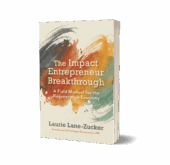
Signed by the author. Collected at the door at Lipton Hall, NYU School of Law,…
News & Events

Pre-seed and seed startups can apply on a rolling basis

Their Built platform helps teams design, launch and run funds
The SBA barred 7(a) refinancing of merchant cash advances in 2025
Subscribe to our newsletter to receive updates about new Magazine content and upcoming webinars, deep dives, and events.
Become a Premium Member to access the full library of webinars and deep dives, exclusive membership portal, member directory, message board, and curated live chats.


0 Comments