The Money Is Downstream
Why prevention economics changes the math of SDG finance



Why prevention economics changes the math of SDG finance

 27
 0

How culture shapes who benefits from AI
 56
0

At OFN42, leaders explored new ways to fund affordable community finance.
 84
0

For mission-led organizations, a change of manager tests whether workplace inclusion is built to last.
 185
0

Artist Rob Strati on inherited objects, the limits of market price, and the creative possibilities…
215
0

Counting what we fail to prevent, sixty seconds at a time
189
0
Upcoming Events
 27
0

A floodplain can hold water before it reaches homes and roads. Financing that protection starts with identifying who would otherwise pay for the damage; Photo by Andrey Kukharenko
The Sustainable Development Goals face an estimated annual financing gap of $4 trillion in developing countries, and aid is shrinking. Prevention economics proposes a sea change in where our field looks for capital. Far larger sums are already spent after harm is done, and investors, funders, founders and public officials can move part of them upstream.
Each spring the United Nations publishes the number that haunts our field. This year’s Financing for Sustainable Development Report puts the annual financing gap for the Sustainable Development Goals in developing countries at an estimated $4 trillion. That same month the OECD’s preliminary count put official development assistance at $174.3 billion in 2025, down 23.1 percent in real terms. It was the largest one-year drop on record. Aid at that level is less than a twentieth the size of the gap.
Our field’s answer for two decades has been to find new money, then blend it, de-risk it, label it and coax it off the sidelines. That work matters, and Impact Entrepreneur has chronicled it for fifteen years. It rests on an assumption I think we should now drop, which is that the money for a safer and fairer world does not yet exist.
It exists. It is downstream.
Take disasters alone. The UN Office for Disaster Risk Reduction estimates that they cost the world more than $2.3 trillion a year once cascading and ecosystem costs are counted. Part of that toll arrives as insurance claims, emergency appropriations and household bills, and part as lost income and damaged ecosystems. Of the $133 billion in disaster-related aid from 2010 through 2019, the same office found, 4.1 percent went to reducing risk before disaster struck and 90.1 percent to emergency response.
The pattern extends beyond disasters. The illness left untreated turns up in the emergency room, and the wetland drained for development can turn up as a flood claim. The world already pays for the goals it has missed. It pays afterward, at the emergency rate.
Money appears at scale when a threat is believed. In the year aid fell by nearly a quarter, governments spent approximately $2.9 trillion on their militaries, by the Stockholm International Peace Research Institute’s count. I have come to see the financing gap and the reactive bill as one failure entered twice, once as money we cannot find and once as money we cannot stop spending.
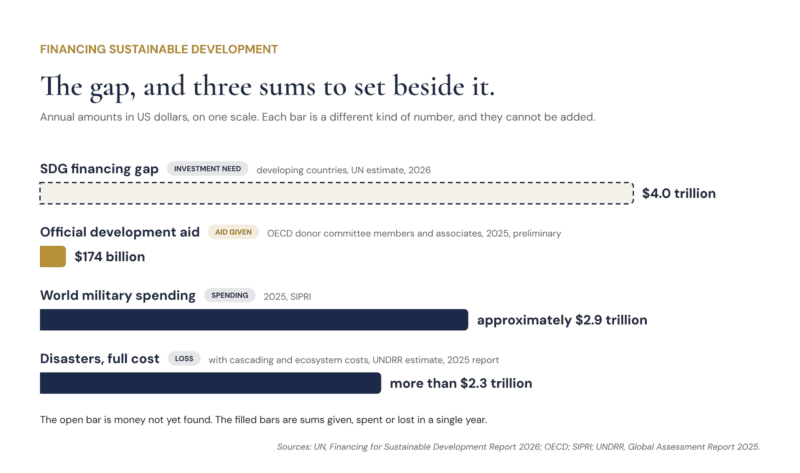
Figure 1. The yearly financing gap for the Sustainable Development Goals, set beside one year of aid, military spending and disaster costs. The four are different kinds of number and cannot be added.
Prevention economics is the discipline of reading that second entry and acting on it. Impact finance has organized itself around additionality, the test of whether capital would otherwise have flowed. Prevention economics adds a second organizing idea, which I call conversion. A converted dollar was going to be spent anyway on the consequences of a harm. It is spent earlier instead, on the causes, and where prevention works it buys more.
Additional capital will always be rationed by generosity and by the appetite for concessionary returns. Convertible spending has a different ceiling, the part of the reactive bill that sits in somebody’s budget and can be avoided. How large that part is remains an open question, and answering it is the discipline’s first job. Against a bill counted in trillions and renewed in every budget cycle, even a modest fraction would be a different order of money.
The world already pays for the goals it has missed. It pays afterward, at the emergency rate.
Conversion also changes the customer. The enterprise goes to the institution already paying for the harm, whether a water utility, a health insurer or a city’s risk manager, and offers to cut a cost it already carries. I would put one question to every founder and every investment committee: whose reactive spending does this venture convert into prevention? A venture with a precise answer has a customer with a budget line and a price to beat. A deal then depends on how much of that cost the venture can remove and who has authority to buy.
Quito shows what such a customer looks like. A municipal ordinance directs 2 percent of what the city’s water utility collects on its customers’ bills into FONAG, a trust that protects the watersheds supplying the city. The protection of Quito’s water has a payer, a recurring source of funds and an institution charged with spending them.
The discipline rests on two measures I introduced in The Impact Entrepreneur Breakthrough. The Prevention Ratio™ is the share of an institution’s security-related spending that goes to preventing harm, as against responding to it. I use security broadly, to include health, ecosystems, livelihoods and civic life. By the book’s estimate, institutions often land between 10 and 20 percent. The Prevention Dividend™ is what a dollar earns when it moves upstream.
A converted dollar was going to be spent anyway on the consequences of a harm.
The evidence for that dividend arrives in different kinds of number. The National Institute of Building Sciences studied twenty-three years of U.S. federal mitigation grants and found about $6 in benefits to society for every $1 spent, which is a benefit–cost ratio. Studies by James Heckman and colleagues, of the Perry Preschool program and of a later early-childhood program, put the annual return to society at roughly 7 to 13 percent, which is a rate of return. The two cannot be added or averaged, and neither says how much of the benefit lands in the budget of the institution that pays. Saying which kind you are quoting is the first habit the field asks of its practitioners. The fuller evidence, with its sources and limits, is set out in “Prevention Economics.”
No mayor cuts a ribbon on a flood that stayed in its banks. Markets, less sentimental, pay for such non-events every day. An insurance premium is a price on losses that mostly never occur. In 2022 England’s National Health Service began paying the makers of two antibiotics a fixed annual fee, whatever the number of doses used, so that the drugs stay available and are used sparingly.
Then there is the catastrophe bond, which pays investors to carry the risk of storms that usually miss. Investors bought a record $23.9 billion of property catastrophe bonds in 2025, according to the trade publication Artemis. When a storm does not miss, the terms are already settled. Jamaica’s $150 million World Bank catastrophe bond paid out in full after Hurricane Melissa crossed the thresholds in the contract, and the government had the money within five weeks.
Set that market beside the instrument our own field built to finance outcomes. The Brookings Institution counts 259 social and development impact bonds ever contracted, with about $524 million of upfront capital on record as of its May 2025 snapshot, a total it calculates from available data. A single year of catastrophe bonds raised about forty-five times that sum.
No mayor cuts a ribbon on a flood that stayed in its banks.
Catastrophe bonds have four things in place: a standard model of the risk, a buyer who holds that risk on a balance sheet, a pool wide enough to diversify and a trigger nobody can argue with. Prevention finance has rarely had all four at once. Supplying them is the work of prevention economics, and much of the design can be borrowed.
Impact investors hold an advantage here that they have not yet claimed. A single prevention project can almost never prove itself. A town facing a one-in-twenty-five-year flood has about a two-in-three chance of passing a decade without one, so ten dry years tell a mayor little about whether the restored wetland upstream worked. Spread the same investment across a book of forty towns in different river basins and the arithmetic changes. Those towns should expect sixteen such floods in a decade, and in most decades they will see between eleven and twenty-one, provided they do not all sit under the same storm. Counting floods is the easy half, and what each one would have cost without the work is a separate estimate.
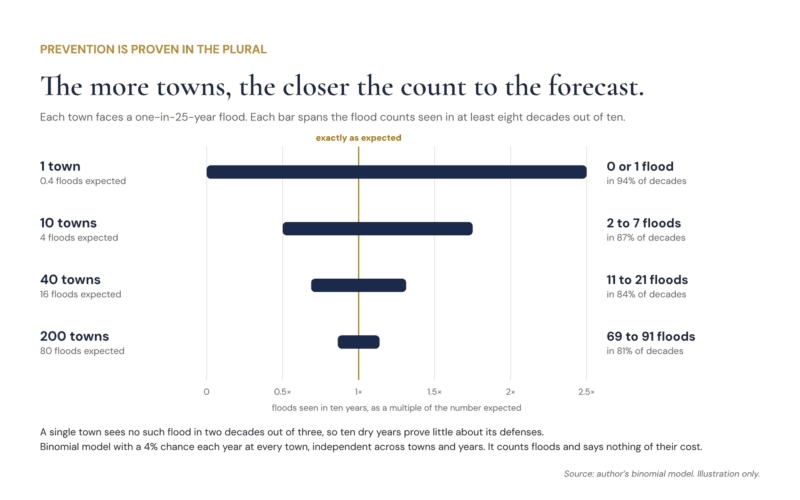
Figure 2. The arithmetic of a wide book. In ten years one town will usually see no such flood, and two hundred independent towns will see close to the eighty expected. Author’s model, for illustration.
Building that book is an asset manager’s craft. A prevention portfolio holds many enterprises across several domains, with risks chosen so they do not fail together, each position registered against a baseline before the work begins and reported afterward as a range. Fund managers, community development lenders, foundations making program-related investments and the pooled vehicles of the development banks already know how to assemble one. They have lacked a reason to file wetland restoration, community health workers, early learning and violence interruption under one heading. Prevention is the heading.
Scale helps in a second way. The wrong-pocket problem, in which one party pays for prevention and another collects the saving, shrinks as the pocket grows. A pension fund or sovereign wealth fund that owns a slice of the whole economy stands to collect much of what prevention saves, and a national treasury can do the same across its ministries. Turning those gains into funding still takes an agreement among the beneficiaries, or a budget rule that lets one ministry spend against the savings of another.
Prevention economics is young, and its claims have edges. Prevention does not always pay, and average returns on past projects say only so much about what the next one will earn. Baselines can be inflated, as the long dispute over forest carbon credits has shown, so every claim needs a baseline registered in advance and a result others can test. Some harms have no payer with a balance sheet. The cost of frayed civic trust falls on everyone and is booked by no one. There, and wherever those who stand to gain cannot pay up front, public budgets and philanthropy remain the buyers.
The goals come due in 2030. Aid is in retreat, and the search for new money, pursued alone, will not close a gap of this size. A great deal of money is already in motion. It passes us in every budget cycle on its way to the emergency. Prevention economics gives us a way to walk upstream and meet it.
Laurie Lane-Zucker is founder and CEO of Impact Entrepreneur, PBC, and author of The Impact Entrepreneur Breakthrough: A Field Manual for the Regenerative Economy (Berrett-Koehler, 2026). He coined the term “impact entrepreneur” in 2011. He is also the founder of Defense as a Service™ (DaaS™), a venture created to put prevention economics to work inside institutions (defenseasaservice.net). Defense as a Service™, DaaS™, Prevention Ratio™ and Prevention Dividend™ are trademarks of Laurie Lane-Zucker.


Related Content
How culture shapes who benefits from AI
56
0
At OFN42, leaders explored new ways to fund affordable community finance.
84
0

Can impact investing’s flagship gathering become more than a meeting ground?
 117
0

Why verified human judgment remains essential to digital scale
 163
0
Comments
Deep Dives

December 3 - 12:00 PM EST
RECENT
 185
0
 215
0
 189
0
Editor's Picks
 27
0
 56
0
 84
0
27
0
27
0
56
0
84
0
Webinars
Featuring
Amit Bouri
CEO & Co-Founder, Global Impact Investing Network
December 17 - 12:00 PM EST
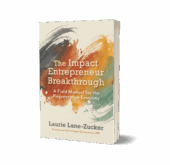
Signed and personally inscribed — you'll write the inscription as you order. Limited · 50…
News & Events

Most have heard of social innovation; about a third understand it

A GIIN survey finds capital concentrated and confidence steady

Each donor gets one vote, whatever the size of the gift
Subscribe to our newsletter to receive updates about new Magazine content and upcoming webinars, deep dives, and events.
Become a Premium Member to access the full library of webinars and deep dives, exclusive membership portal, member directory, message board, and curated live chats.


0 Comments