CDFIs Seek Capital Innovation With a Community Focus
At OFN42, leaders explored new ways to fund affordable community finance.



At OFN42, leaders explored new ways to fund affordable community finance.

 28
 0

Can impact investing’s flagship gathering become more than a meeting ground?
 82
0

Why verified human judgment remains essential to digital scale
 131
0

For mission-led organizations, a change of manager tests whether workplace inclusion is built to last.
 163
0

Artist Rob Strati on inherited objects, the limits of market price, and the creative possibilities…
 187
0

Counting what we fail to prevent, sixty seconds at a time
164
0
 28
0

Harold Pettigrew, CEO of Opportunity Finance Network, offers keynote remarks; Photo by Sam Levitan Photography / Opportunity Finance Network (OFN)
Community lenders are seeking new funding sources as policy and philanthropic support shift. Reporting from OFN42, Elizabeth Gilbert Kaetzel examines an interest-rate subsidy pilot, donor-advised funds, and capital-market structures alongside the need to keep community finance affordable.
Community development financial institutions (CDFIs) are preparing to grow amid uncertainty about the capital that supports their work. At the Opportunity Finance Network’s 2026 annual conference in New Orleans, discussions focused on a practical question: how can CDFIs broaden their sources of funding while preserving the affordability and relationships that distinguish community finance?
Community development leaders, funders, policymakers, and partners gathered October 20–23 for OFN42. Across plenaries and packed breakout sessions, attendees considered how to adapt to a shifting capital and regulatory environment while continuing to finance affordable housing, small businesses, and underserved communities.
Federal funding decisions, proposed changes to bank regulation, and shifting philanthropic support were top of mind for attendees. In September, the U.S. Treasury’s CDFI Fund announced remaining awards for its fiscal 2025 CDFI and Native American CDFI Assistance programs following prolonged delays. Meanwhile, a proposal published in August by the Office of the Comptroller of the Currency and Federal Deposit Insurance Corporation would change how banks are classified and evaluated under the Community Reinvestment Act (CRA).
The CRA encourages banks to help meet the credit needs of their communities, including low- and moderate-income neighborhoods. The proposed changes would raise bank-size thresholds, reducing the number of banks subject to separate investment and community development tests.
According to OFN’s analysis, approximately 376 banks would move from large-bank to intermediate-bank treatment, while about 800 would move from intermediate-small to small-bank treatment and lose the separate community development test. Banks would remain subject to the CRA, but OFN warns that the changes would weaken incentives for community investment.
“This is not modernization, it’s subtraction,” OFN President and CEO Harold Pettigrew said in his keynote remarks.
Yet CDFIs are planning for expansion. In the Federal Reserve’s 2025 CDFI Survey, 87% of respondents wanted to increase financing over the next five years, through 2030. However, staffing, technology, and capital constraints complicate those ambitions. At OFN42, CDFIs looked beyond familiar donor relationships to financial tools and shared infrastructure that could support growth and financial sustainability.
OFN’s interest-rate buydown pilot offers one concrete example. The program uses grant funding to help CDFIs afford new debt financing, addressing the gap between the cost of new borrowing and their existing cost of capital.
In August, OFN announced $1.5 million in grant awards to 13 CDFIs through a pilot designed to support nearly $20 million in third-party debt financing. Jessel Amin, OFN’s executive vice president and chief investment officer, said from the main stage that “these grants were able to reduce the effective interest rates on these facilities by 200 basis points…beyond that, 10 of the 13 recipients were actually able to bring new lenders onto that balance sheet.”
The grant dollars support interest payments over the terms of the loans. For CDFIs facing more expensive debt, that subsidy can make a new lending relationship affordable.
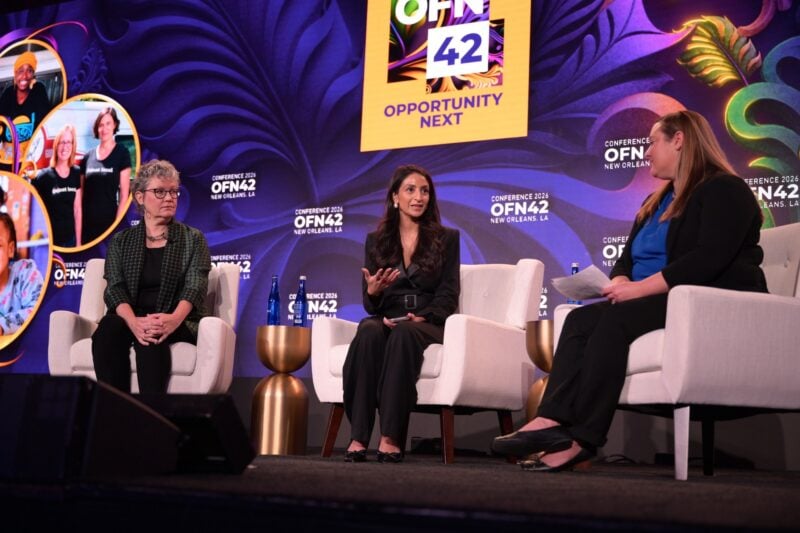
Jessel Amin, executive vice president and chief investment officer at Opportunity Finance Network, joins Annie Donovan, president and CEO of RDF, and Michelle Egan, executive director of Impact Finance at JPMorgan Chase, to discuss capitalization on the OFN main stage; Photo by Sam Levitan Photography / Opportunity Finance Network (OFN)
Another route for capitalization is through donor-advised funds (DAFs). A 2025 OFN report found that donors expressed strong interest in supporting community development finance once they learned about CDFIs. Building that awareness could connect community lenders with a substantial pool of charitable capital: U.S. DAFs held approximately $328 billion in assets and distributed $64.6 billion in grants in fiscal 2024, according to updated research published in April 2026.
“We’ve seen some CDFIs being able to tap into the donor-advised fund market, but we want to see this being done at more scale,” Amin said.
DAFgiving360 and CapShift also highlighted recoverable grants as an underutilized funding structure for CDFIs to discuss with donors. They provide flexible grant capital that may return to a DAF or foundation for further charitable use if agreed conditions are met.
For CDFIs and funders, the appeal is the possibility of using charitable capital more than once to support affordable financing. Recoverable grants and program-related investments can complement conventional grants and bank loans, helping to recycle capital for charitable purposes when funds are returned.
Alongside pursuing new funding sources, CDFIs are considering new capital structures with existing funders. Private and corporate foundations are looking for ways to extend the reach of their resources, including pooling or restructuring funds with community lenders.
For CDFIs and funders, the appeal is the possibility of using charitable capital more than once to support affordable financing.
Investment notes offer another avenue, although access remains limited. A recent white paper by the Local Initiatives Support Corporation (LISC) and Enterprise Community Partners, featured during a conference session, identified nine CDFIs that had accessed public capital markets with rated offerings and 25 with direct-issue note programs as of year-end 2025.
Discussions at OFN42 also explored secondary loan markets, coordination among peer organizations, and pools involving multiple investors. These approaches seek to broaden participation and expand lending capacity.
Part of building this infrastructure involves OFN adapting its role as a convener and intermediary. The buydown pilot illustrates one way a network can use grant support to help members establish new financing relationships. The DAF and capital-market discussions point to other routes for bringing more investors and donors into community finance.
“When a community is under strain, proximity matters, trust matters, flexible capital matters, institutions that were there before the crisis and will remain after the headlines matter,” Pettigrew said.
Across the conference, CDFIs were looking ahead to how they would continue their work. That will require balancing new flexibility and capital diversification with the affordability and community relationships that make CDFIs’ work distinctive.
Disclosure: The author attended OFN42 on a media pass that Opportunity Finance Network provided at Impact Entrepreneur’s request.


Related Content
Can impact investing’s flagship gathering become more than a meeting ground?
82
0
Why verified human judgment remains essential to digital scale
131
0

Whose evidence counts
 87
0

The emerging movement to reshape capitalism using purpose-driven M&A
 129
0
Comments
Deep Dives
RECENT
 163
0
 187
0
 164
0
Editor's Picks
 28
0
 82
0
 131
0
28
0
28
0
82
0
131
0
Webinars

Signed and personally inscribed — you'll write the inscription as you order. Limited · 50…
News & Events

Most have heard of social innovation; about a third understand it

A GIIN survey finds capital concentrated and confidence steady

Each donor gets one vote, whatever the size of the gift
Subscribe to our newsletter to receive updates about new Magazine content and upcoming webinars, deep dives, and events.
Become a Premium Member to access the full library of webinars and deep dives, exclusive membership portal, member directory, message board, and curated live chats.


0 Comments