SOCAP’s Next Test: Turning Connections Into Action
Can impact investing’s flagship gathering become more than a meeting ground?


Can impact investing’s flagship gathering become more than a meeting ground?

 25
 0
Why verified human judgment remains essential to digital scale
 112
0
Whose evidence counts
 79
0

For mission-led organizations, a change of manager tests whether workplace inclusion is built to last.
 154
0

Artist Rob Strati on inherited objects, the limits of market price, and the creative possibilities…
 172
0
Counting what we fail to prevent, sixty seconds at a time
154
0
 25
0
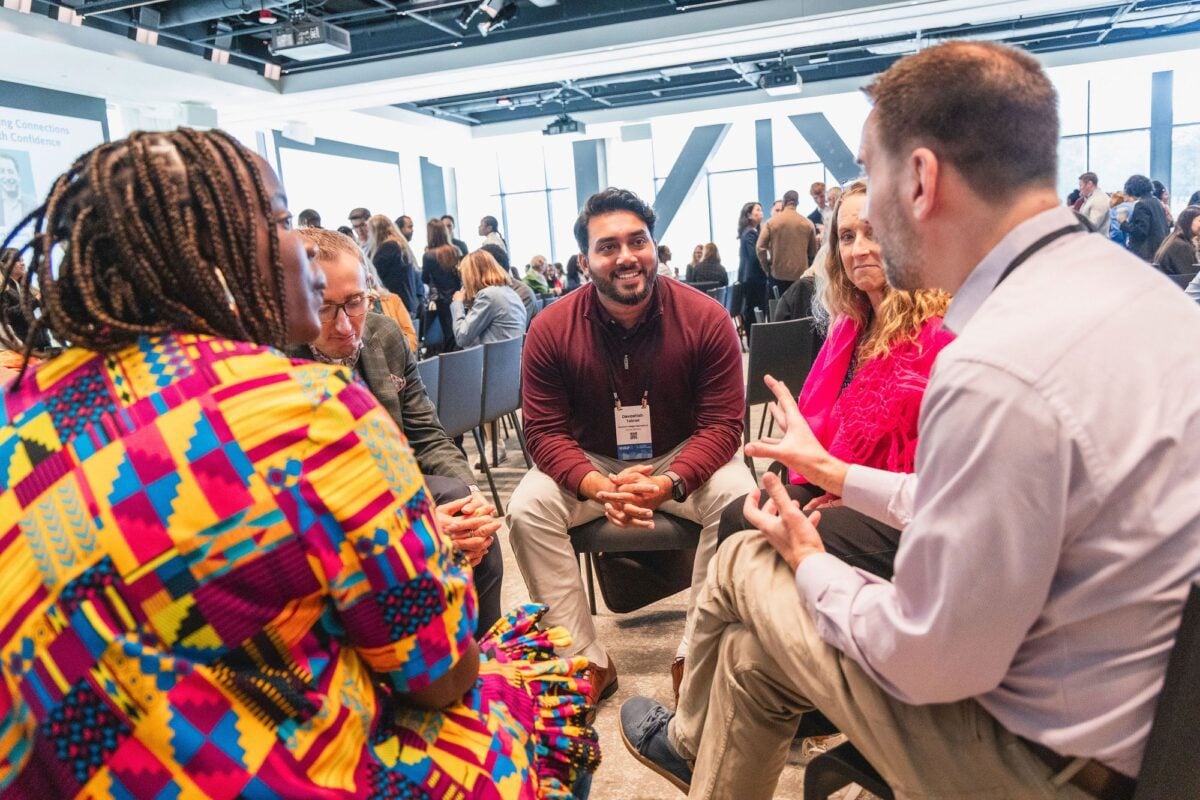
Attendees in conversation at SOCAP26’s newcomer welcome session in Chicago, October 12, 2026; Photo by Hardwig Media
This was my first SOCAP. Billed as a premier social impact conference, it ran October 12–14 in Chicago, the first time it had moved outside San Francisco. I went in as a newcomer, and I came out with the question that I believe matters most today: what should such a convening contribute to building the Impact Economy?
After three days, my answer is that in its current avatar SOCAP is an excellent meeting ground. Yet what this moment needs is an enabler. Or, putting it another way: is speed dating going to change the game, or is nurturing healthy partnerships among people who would not otherwise meet each other the real opportunity?
SOCAP clearly holds the interest of a large group of changemakers from across the world, though U.S.-based representation appeared distinctly high. Among the people I met, there was a distinct skew toward first-timers: people exploring where the impact world is going, and open to networking and collaboration. Robert Munson, President and CEO of SOCAP Global, put it this way: “We’ve never had rooms so full of new people to SOCAP. At times, more than half of the seats were filled with enthusiastic newcomers.”
The SOCAP Open format, with its global open call to changemakers, showcases new and diverse voices who might otherwise not get airtime. That is a real service. (Disclosure: I applied and was not selected.)
The opening ceremony, on October 12, honored Indigenous Peoples’ Day. In a packed room, it began with a land acknowledgment from SOCAP26’s Elder in Residence, Dr. Dorene Wiese, and a welcome from SOCAP26’s Advisors on Indigenous-Led Content, Vanessa Roanhorse and Alexander Sterling. These were powerful signals.
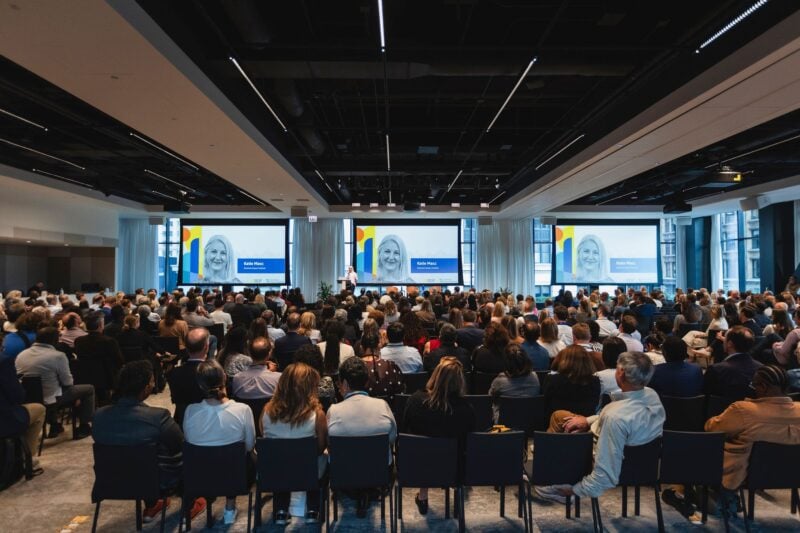
SOCAP26’s opening ceremony, which honored Indigenous Peoples’ Day, drew a packed room in Chicago on October 12, 2026; Photo by Hardwig Media
You win some, you lose some. Attendees who had been to several SOCAPs told me turnout felt lower than in San Francisco. I can’t verify that, and a packed opening ceremony suggests the picture is mixed. Yet several first-timers told me the move made it easier for them to join.
What Chicago clearly brought was Place. At a time when the place-based paradigm — place-based investing, place-based education, place-based impact — is gaining ground, this is a shift worth celebrating. The city’s diversity showed up in the venues: a palpable sense of a vibrant city, with its unique history and geography, working its way into the Impact Economy.
The first-ever experiential Community Sessions took attendees out of the conference venue and into neighborhoods across the city, to meet local leaders, innovators, and changemakers directly. Sessions on Chicago’s neighborhoods and community-based initiatives did the same inside the venue. Here was a promising way to connect conference conversations with the work happening in a real place.
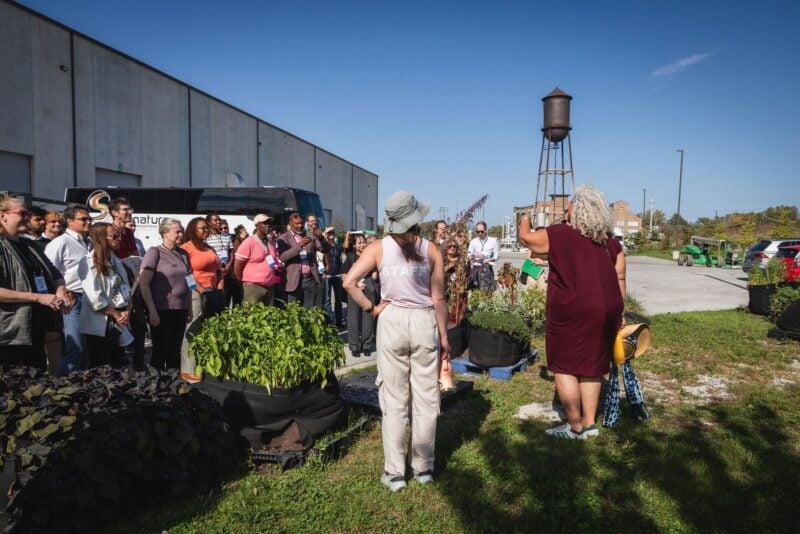
SOCAP26 attendees on a Community Session tour in Chicago’s Greater Auburn Gresham, October 12, 2026; Photo by Hardwig Media
To me, Chicago was a hit. And SOCAP had already committed to return to Chicago in 2027.
The most common refrain at the registration desk was “Are you my next date?”, as people used Brella, the networking app, to find people they had not met before. It sparked engaging conversations, including for me. Yet, in itself, it highlighted the problem.
The sharpest observation I heard came from a fellow attendee, which I paraphrase: there are two levels of interaction going on. One is among the Doers — the on-the-ground small enterprise, the passionate changemaker looking to build a network; and the other is among the Haves — those who have been here before, know each other well, and are in the money. Where, this attendee wondered, is the bridge between them?
Other voices from the floor, again paraphrased, carried the same undercurrent. One person had met a lot of people but was unsure whether any of those meetings would lead to collaboration. Another wondered what conversations were happening behind closed doors, and who could participate. I did not attend any unlisted sessions myself, so I report that as an attendee’s question, not my finding.
To be fair, SOCAP did not leave connections entirely to chance. Its Capital Provider Experience included curated discussions, facilitated introductions, and invitation-only networking for capital allocators. The organizers were clearly trying to make connections more intentional. But that raises the question more sharply: how many of those connections become partnerships between people building solutions and people able to finance them?
A packed schedule of meetings is not, by itself, evidence that capital or opportunity moved.
The content reflected a similar tension. There were fresh ideas, reported in SOCAP’s own updates: that deposits, unlike grants or equity, are a lever everyone has; that aging, like climate, is a megatrend we can no longer ignore; that AI has real opportunities in the care economy; and that a just energy future for Tribal Nations is a just energy future for everyone.
But several panel discussions I attended remained decidedly old school. The session on outcome bonds retold the story of their promise — a story many in this audience already know. The well-attended session on donor-advised funds lingered on the headline of “almost $326 billion in DAF assets,” rather than how to move more of that capital. And then there was the opening exhortation not to approach someone for money directly, as if a room of impact changemakers needs a lesson in etiquette. I wanted more on how to get from insight to action.
SOCAP describes itself as “intentionally designed to reduce friction, unlock resources, and accelerate capital deployment.” In my view, it remains a great place for Doers to meet and, with luck, get selected for a talk. But I left unconvinced that it has done enough to reduce the friction between the Doers and the Haves. A packed schedule of meetings is not, by itself, evidence that capital or opportunity moved.
I am not the only one asking this. In “Why I am breaking up with SOCAP,” Astrid Scholz questioned what the conference gives back to the changemakers who invest time and money to attend. I heard a version of that frustration from an attendee who had to raise funds to cover what they considered a whopping registration fee. As a first-timer, every ping from Brella made me wonder what would happen after we all went home.
The Indigenous community focus at this SOCAP brought the question into especially sharp relief. The opening set it up beautifully. Dr. Wiese’s call was clear: “Urban native development is the key, and it is centered in our People. Let us do it together for the future, and for seven generations.” SOCAP also convened a practitioner council at the Center for Native Futures, exploring Indigenous-led approaches to capital. That is meaningful programming. But what is the continuing structure, beyond the venue, for sustaining the relationships and turning the ideas into commitments?
In that sense, the Impact Economy transition still risks getting stuck in a “let’s talk about it” model. I believe the opportunity is for SOCAP to enable it through action plans that live beyond the event.
The transition we need as a community is toward an Impact Economy of regenerative enterprises. SOCAP, with its reach, credibility, and everything it does well, has the chance to help lead that momentum. To do so, it needs to make its own transition: from convening ground to enabling platform.
I would be happy to be part of a group of present and past attendees working out what SOCAP’s role and focus should be, not just for next year but for the rest of this decade. The conversations have begun. Now, what will they make possible?
Disclosure: The author attended SOCAP26 on a complimentary media pass that SOCAP Global provided to Impact Entrepreneur.


Related Content
Why verified human judgment remains essential to digital scale
112
0
Whose evidence counts
79
0

The emerging movement to reshape capitalism using purpose-driven M&A
 122
0

Connecting Georgia’s social enterprises to markets and capital
 149
0
Comments
Deep Dives
RECENT
 154
0
 172
0
 154
0
Editor's Picks
 25
0
 112
0
 5292
0
25
0
112
0
25
0
112
0
 79
0
Webinars
Signed and personally inscribed — you'll write the inscription as you order. Limited · 50…
News & Events

A GIIN survey finds capital concentrated and confidence steady

Each donor gets one vote, whatever the size of the gift

Most deals will run from $500,000 to $2 million
Subscribe to our newsletter to receive updates about new Magazine content and upcoming webinars, deep dives, and events.
Become a Premium Member to access the full library of webinars and deep dives, exclusive membership portal, member directory, message board, and curated live chats.


0 Comments