When Impact Stops at the Office Door
For mission-led organizations, a change of manager tests whether workplace inclusion is built to last.




For mission-led organizations, a change of manager tests whether workplace inclusion is built to last.

 44
44
 0
0

Artist Rob Strati on inherited objects, the limits of market price, and the creative possibilities…
 85
0
85
0

Counting what we fail to prevent, sixty seconds at a time
89
0

How states can crowd in local early-stage capital
 368
0
368
0

Why last-mile healthcare needs an operating model, not just more mobile clinics
 351
0
351
0

How Australia’s succession wave could turn ownership into a funding model
 466
0
466
0
 439
0
439
0

Institutions meticulously track what they spend responding to danger, but rarely calculate what they invest in preventing it. A proposed Prevention Ratio could give the peace and security field the common accounting language it needs to redirect capital upstream.
Every institution keeps two ledgers. The first is public. It records what we spend on guards, walls, weapons, insurance, surveillance, and emergency response — the machinery of reaction. It is audited, benchmarked, and defended in budget hearings.
The second ledger is the one almost nobody keeps. It records what we spend to make the emergency less likely in the first place.
We do not read that ledger because we have never learned to write in it. The result is a global security architecture that has become, in the most literal accounting sense, unaccountable.
On July 22, 2026, the MacArthur Foundation announced a new Peace Program and named the problem with unusual precision: governments are prioritizing defense spending over diplomacy, conflict prevention, and human rights. That sentence should be read twice. It is not only a moral complaint. It describes a ratio — money flowing toward one conception of security rather than another. And a ratio can be measured.
Yet almost nobody measures it.
Imagine a building that spends $11 million a year on a fire department: trucks, hydrants, hoses, a standing crew, and a command center. Now imagine that the same building spends $400,000 on smoke detectors, sprinklers, wiring inspections, and fire-resistant materials — and that no one has ever placed those figures on the same page because they live in different budgets, are approved by different committees, and answer to different definitions of safety.
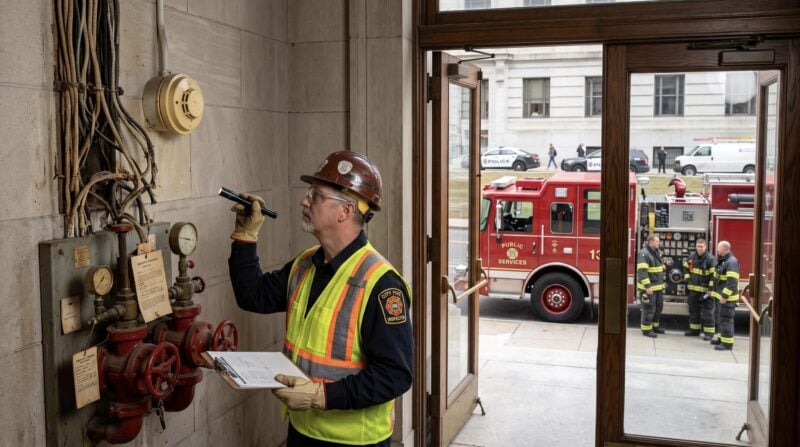
Security budgets favor the visible machinery of response, while the quieter work of inspection, maintenance, and prevention struggles for resources and recognition.
Ask the building manager whether the building is secure, and he will point to the fire trucks. They are large, visible, and expensive. He will not point to the wiring, because the wiring has no constituency. Nobody gets promoted for a fire that did not happen.
The numbers are illustrative. The pattern is not. Municipalities, corporations, universities, hospital systems, and nation-states routinely separate preventive investments from the security expenditures they are meant to reduce. Public health, climate resilience, community development, employee wellbeing, cyber hygiene, diplomacy, and conflict mediation sit in different budgets. Police, weapons, surveillance, insurance, and crisis response are counted as security. The conditions that make crisis less likely often are not.
We do not read that ledger because we have never learned to write in it.
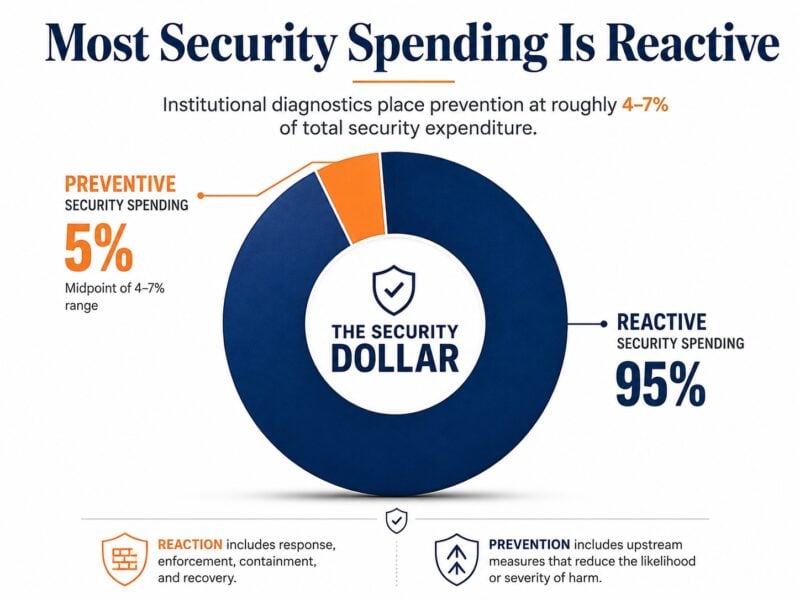
In the institutional diagnostics I have conducted, the share of security expenditure directed toward prevention rather than reaction has typically fallen between 4% and 7%. Definitions vary by institution, but the pattern has been consistent: 93 to 96 cents of every security dollar is spent waiting for something to go wrong. And none of the institutions knew its own number before the exercise began.
That number has a name. I call it the Prevention Ratio™.
Here is the difficulty facing MacArthur — and every funder trying to move capital toward peace.
The peace and security field has excellent arguments. It has moral clarity, decades of scholarship, and a remarkably consistent body of economic evidence. Research across disaster preparedness, ecosystem restoration, pandemic readiness, early childhood education, and conflict prevention shows that prevention routinely returns multiples of each dollar invested — commonly four to seven dollars, and in some domains substantially more. The joint United Nations–World Bank Pathways for Peace study, for example, estimated that scaled-up preventive action could save between $5 billion and $70 billion annually. This is the Prevention Dividend™: the value created when institutions address causes before paying for consequences.
What it does not have is a generally accepted instrument. It cannot yet walk into a finance committee and say: Your Prevention Ratio is 0.05. Comparable institutions average 0.09. These categories are driving the gap. Here is what a shift would cost, which risks it would reduce, and how progress will be reported.
Compare this with climate. For decades, climate advocates also had excellent arguments and no common institutional instrument. Then came carbon accounting: organizational boundaries, standardized categories, inventories, baselines, disclosures, and targets. The Greenhouse Gas Protocol did not win because accounting was morally stirring. It won because accounting made emissions legible to institutions. Once a CFO had a number, the number acquired a trajectory; the trajectory acquired a target; and the target acquired capital.
Peace has not had its carbon-accounting moment. That is the gap.
And it is precisely the sort of gap a field-support program can fill. MacArthur says it intends to invest not only in projects, but in the people, institutions, ideas, knowledge, networks, and infrastructure that make the field more effective. Measurement infrastructure is among the least glamorous and most durable forms of such investment. Nobody wins a prize for building the ruler. Everyone builds with it afterward.
An accounting standard cannot begin and end with a single percentage. The Prevention Ratio should be the headline indicator, not the entire system.
At minimum, a credible standard would do five things: define what counts as total security expenditure; classify spending as upstream prevention, preparedness, protection, response, or recovery; establish organizational boundaries and time horizons; disclose assumptions, exclusions, and confidence levels; and connect expenditure to evidence of reduced risk, stronger resilience, and more equitable security.
The purpose is not to declare reaction illegitimate. Fire departments are necessary. The question is whether institutions have systematically overbuilt response while neglecting the wiring.
Nobody gets promoted for a fire that did not happen.
Nor should a higher ratio automatically be treated as better. Institutions can relabel ordinary spending, fund ineffective programs, or optimize the metric while leaving underlying vulnerabilities intact. The standard must be transparent enough to audit and rigorous enough to resist impact-washing.
The climate analogy is a warning as well as a model. Carbon accounting created comparability and accountability; it also created boundary disputes, disclosure theater, offset games, and new forms of greenwashing. A prevention standard should therefore be governed as a shared field asset rather than a proprietary score sold back to the institutions being measured.
There is a longer history worth naming because it explains why this moment feels less like a new argument than an old one arriving on time.
In 2003, at a conference at Pocantico convened with the Rockefeller Brothers Fund, a group of us worked through a set of scenarios for the coming century. One was called Fortress World: a future in which societies respond to mounting ecological, economic, and social stress not by addressing the stress, but by hardening against it — walls, enclaves, private security, surveillance, and the steady conversion of public goods into defended perimeters.
Fortress World was not simply a prediction of war. It was a prediction of misallocation: societies spending themselves into insecurity by buying more reaction and less prevention.
Peace has not had its carbon-accounting moment.
MacArthur observes that post-9/11 national security approaches have, in many cases, contributed to democratic backsliding and the erosion of civil liberties. That is Fortress World arriving roughly on schedule. It was built incrementally, one defensible reactive expenditure at a time, by institutions that had no way to see the aggregate pattern their individual decisions were producing.
You cannot govern a drift you cannot see. That is what a ratio is for.
Suppose the field had this instrument. Three things follow.
Prevention becomes comparable. A city, a utility, and a university cannot be compared in every respect, but each can disclose how much security expenditure is directed upstream, which categories are included, and how the balance changes over time. Comparison creates scrutiny, learning, and peer pressure.
Prevention becomes investable. Capital does not flow toward virtue merely because virtue is persuasive. It flows toward defined risks, expected returns, evidence, and accountability. A defensible Prevention Dividend can convert peacebuilding and resilience from philanthropic categories into underwriting questions. That matters because global military expenditure reached $2.887 trillion in 2025, according to SIPRI. Philanthropy will never out-fund the machinery of reaction. It can, however, help change what institutions count, what finance committees see, and what a fraction of that capital is for.
You cannot govern a drift you cannot see. That is what a ratio is for.
Prevention becomes a job. Ratios create roles. Someone has to own the number, improve the data, report progress, and guard against gaming. Fields professionalize around shared practices and standards, not missions alone.
MacArthur says its Peace Program will be shaped by practitioners and partners, and that a director and team are still to be hired. That creates an unusual interval — the window before a strategy hardens, when a framework can become part of the architecture rather than merely an application to it.
So the argument is simple, and it is addressed to MacArthur and to every funder watching.
Do not only fund peace. Fund the ledger.
Support a transparent, participatory process to develop, test, and govern a prevention-accounting standard across institutions and sectors. Let cities, companies, universities, philanthropies, and public agencies discover — one uncomfortable budget meeting at a time — how much they spend managing the consequences of insecurity and how little they spend changing its conditions.
The moral argument for prevention has been made for a century. It has not moved the money at the scale required. A shared number might.
The fortress was built without anyone deciding to build it. It can be dismantled the same way — decision by decision, line item by line item — but only if we can finally read the second ledger.
Laurie Lane-Zucker is Founder and CEO of Impact Entrepreneur, PBC, and author of The Impact Entrepreneur Breakthrough: A Field Manual for the Regenerative Economy (Berrett-Koehler, September 2026). He leads Defense as a Service™, a prevention-economics consulting practice.
Defense as a Service™, DaaS™, Prevention Dividend™, and Prevention Ratio™ are trademarks of Laurie Lane-Zucker (applications pending, USPTO).


Related Content
For mission-led organizations, a change of manager tests whether workplace inclusion is built to last.
44
0
Artist Rob Strati on inherited objects, the limits of market price, and the creative possibilities…
85
0
Counting what we fail to prevent, sixty seconds at a time
89
0

How collateral rules and payment terms keep impact capital out of reach
195
0
Comments
Deep Dives
RECENT
 368
0
368
0
 351
0
351
0
 466
0
466
0
Editor's Picks
 44
0
44
0
 85
0
85
0
 89
0
44
0
85
0
44
0
85
0
89
0
89
0
44
0
85
0
44
0
85
0
89
0
Webinars
Signed by the author. Collected at the door at Lipton Hall, NYU School of Law,…
News & Events

The September 14 program and a live IFI Tool demo are online

Pre-seed and seed startups can apply on a rolling basis

Their Built platform helps teams design, launch and run funds
Subscribe to our newsletter to receive updates about new Magazine content and upcoming webinars, deep dives, and events.
Become a Premium Member to access the full library of webinars and deep dives, exclusive membership portal, member directory, message board, and curated live chats.


0 Comments