Building an Impact Economy in Georgia
Connecting Georgia’s social enterprises to markets and capital



Connecting Georgia’s social enterprises to markets and capital

 71
71
 0
0
Gabriel Grant on giving shareholders a way to express what matters to them
 92
0
92
0

For mission-led organizations, a change of manager tests whether workplace inclusion is built to last.
 75
0
75
0

Why free education tools need reliable access, credible evidence, and lasting support
 385
0
385
0

What Islamic finance and impact investing can learn from each other
 433
0
433
0

After the flood, recovery capital must do more than replace what was lost
 405
0
405
0
 4602
0
4602
0
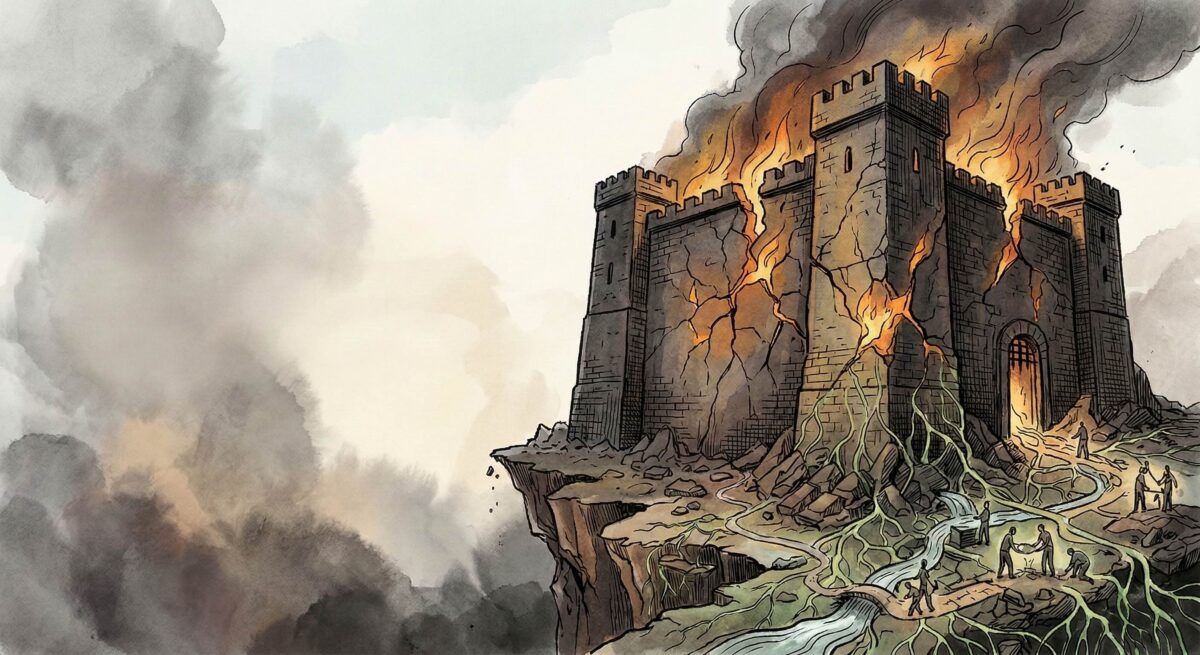
The fortress burns from within — but at its base, the first roots of a different kind of security are already emerging.
We live in the most heavily defended moment in human history. And we have never been more vulnerable.
As I write this, US and Israeli forces are bombarding Iran for a fifth consecutive day in the largest American military buildup in the Middle East since the 2003 invasion of Iraq. The Supreme Leader is dead. Over a thousand civilians have been killed, including children in a girls' elementary school. Iranian counter-strikes are hitting targets across the Gulf — Qatar, Kuwait, the UAE, Bahrain, Saudi Arabia — and shipping through the Strait of Hormuz has ground to a near-standstill, with key tanker freight rates surging to record highs as shippers flee the risk. The US Senate has voted down a War Powers resolution that would have constrained the president — the eighth such failed vote since June, effectively rubber-stamping an unauthorized war after the fact. And the stated justifications for the strikes — an imminent Iranian attack, an active nuclear weapons program — are reportedly contradicted by the Pentagon's own intelligence assessments.
Meanwhile, the war in Ukraine grinds through its fourth year. By credible Western estimates, Russia has sustained over 1.2 million casualties — killed, wounded, and missing — a toll for a major power not seen since the Second World War, and all for territorial gains that can be measured in yards per day. A recent CSIS analysis found that Russian daily advances in key sectors — 16 yards a day in Chasiv Yar, 25 in Kupiansk, 76 in Pokrovsk — are slower than what Allied troops achieved during the Battle of the Somme in 1916. This is what fortress logic looks like when it meets reality: catastrophic human cost for gains that would be invisible on a classroom map. Peace talks remain deadlocked over territorial demands that Russia cannot win militarily but refuses to relinquish diplomatically. On a single night in late February, Russia launched a massive strike package — some 50 missiles and nearly 300 drones — against Ukrainian civilian infrastructure — energy systems, water treatment, heating — while negotiators in Geneva discussed the finer points of ceasefire monitoring. The "peace architecture" being assembled by a coalition of 35 nations consists almost entirely of troop deployments, weapons depots, and military deterrence mechanisms. The paradigm that produced the war is being asked to end it.
These are not separate crises. They are the same crisis — the terminal expression of what I call, in my forthcoming book The Impact Entrepreneur Breakthrough, fortress thinking: the deeply held assumption that safety means higher walls, bigger weapons, and the capacity to dominate.
In the book's Part III, "Protection: The Five Pillars of Real Security," I trace what I call the Great Misallocation — the nearly $3 trillion the world spends annually on militarized defense while leaving the actual foundations of human security structurally starved. We protect borders but not the rivers that feed us. We protect financial markets from volatility but not our children from hunger or our elders from isolation. We have built enormous capacity to fight the wars we remember while remaining catastrophically unprepared for the crises we face.
This week, the Misallocation isn't an abstraction. It is playing out on live television.
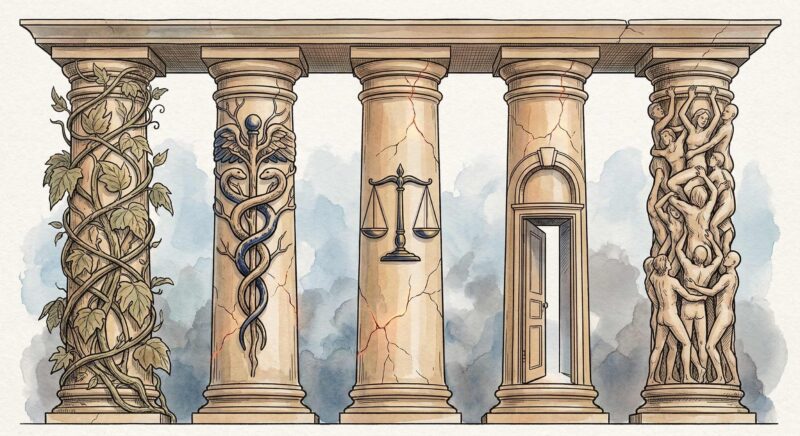
The Five Pillars of Real Security: ecological stability, public health, economic equity, democratic infrastructure, and community cohesion. Weaken any one, and the entire structure becomes brittle.
In The Impact Entrepreneur Breakthrough, I argue that security, properly understood, rests on five interdependent pillars. Weaken any one, and the entire system becomes brittle. Strengthen all five, and you create conditions where threats are less likely to emerge and easier to absorb when they do.
Now consider what the Iran conflict is doing to each of these pillars — not strengthening them, but systematically degrading them:
Weakness in any pillar destabilizes the whole. This week, all five are cracking simultaneously.
If Iran reveals fortress logic in its aggressive mode — the paradigm unleashed — Ukraine reveals something equally troubling: fortress logic capturing even the pursuit of peace.
This is what fortress logic looks like when it meets reality: catastrophic human cost for gains that would be invisible on a classroom map.
I noted above that the "peace architecture" being assembled by a coalition of 35 nations consists almost entirely of troop deployments, weapons depots, and military deterrence mechanisms. It is worth pausing on what that phrase — "peace architecture" — actually contains. The coalition of the willing proposes military hubs on Ukrainian soil, armed response within 72 hours of any ceasefire breach, force deterrence layered across land, sea, and air. These are serious people making serious plans — and every element of their architecture assumes that the way to prevent the next war is to prepare more efficiently for it.
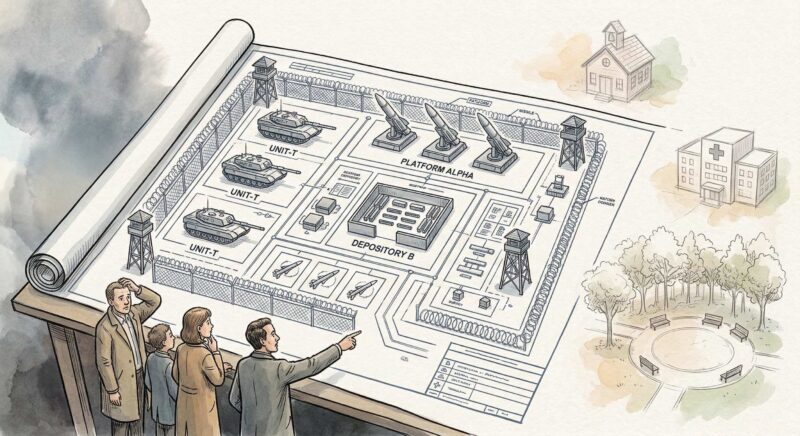
The "peace architecture" in bold relief — and the schools, hospitals, and ecosystems sketched faintly at the margins, still waiting to be built.
But where in these negotiations is the investment in the ecological restoration of a landscape devastated by four years of combat? Where is the commitment to economic equity in a country whose population has been displaced, impoverished, and traumatized? Where is the plan for rebuilding democratic infrastructure that can withstand both Russian pressure and the corrosive effects of prolonged martial law? Where is the strategy for community cohesion in a society where millions have lost homes, livelihoods, and loved ones?
Once a society invests heavily in weapons and dominance-based doctrine, it tends to see more and more of life through that lens.
These are not soft concerns to be addressed after the "real" security work is done. They are the security work. Without them, every ceasefire is a pause, not a peace. As Eric Ciaramella, a senior fellow at the Carnegie Endowment for International Peace, observed on the war's fourth anniversary, even those who believe a ceasefire is achievable concede it would likely be just that — a pause, not a peace. Without the structural foundations in place, he warned, it would simply pave the way for another war.
This is what I mean by the gravitational pull of militarization. Once a society invests heavily in weapons and dominance-based doctrine, it tends to see more and more of life through that lens. Problems become threats. Neighbors become adversaries. And the quieter, slower work that actually builds durable safety — trust, reciprocity, shared resilience, root-cause prevention — gets dismissed as naive, when in fact it is the most strategic investment available.
In the book, I argue for a fundamentally different approach — one built not on fortress logic but on foundation building. The data is unambiguous: conflict prevention returns $16 for every dollar invested. Ecosystem restoration yields $7–30. Pandemic preparedness — at an estimated cost of just $5 per person per year — would have been orders of magnitude cheaper than the $16 trillion COVID-19 ultimately cost. The economic disruption from the Strait of Hormuz closure alone — measured in spiking oil prices, frozen shipping lanes, emergency insurance mechanisms — will almost certainly exceed what a generation of preventive diplomacy and root-cause investment would have cost.
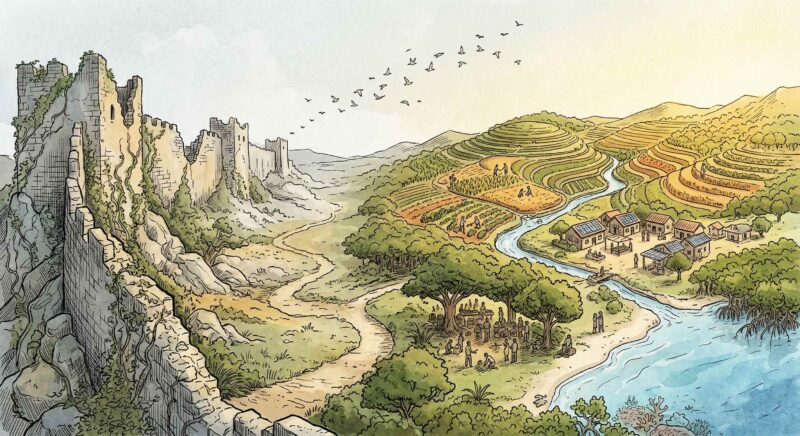
From fortress to foundation: the old paradigm returns to earth while a regenerative landscape — terraced, watershed-fed, solar-powered, communal — takes root.
Costa Rica abolished its military in 1948 and redirected those resources to health, education, and environmental protection. Seventy-five years later, its citizens live longer than Americans, achieve near-universal literacy, protect over a quarter of their land, and enjoy political stability rare in their region. This is not utopian aspiration. It is operational proof that the mutualist paradigm works.
The question this week forces upon us is not whether the fortress is strong enough. The fortress is burning, and the fire is spreading to the neighbors. The question is whether we are ready — finally — to build something different: security architectures rooted in ecological stability, public health, economic equity, democratic governance, and the social bonds that enable collective action.
We have spent centuries building fortresses. It is time to build foundations.
For those of us in the impact economy — entrepreneurs, investors, practitioners building enterprises where financial return and systemic regeneration are inseparable — this is not someone else's problem. The instability radiating from these conflicts will touch every supply chain, every portfolio, every community we serve. And the alternative we are building — distributed resilience, prevention infrastructure, cooperative security — is not merely a better business model. It is the only durable form of defense.
The choice I frame in the book as Fortress World or Great Transition — borrowed from the Global Scenario Group's work — has never been more starkly illuminated. The fortress is failing in real time. The transition remains possible, but not indefinitely.
The frog is jumping. The question is whether we jump with it.
--
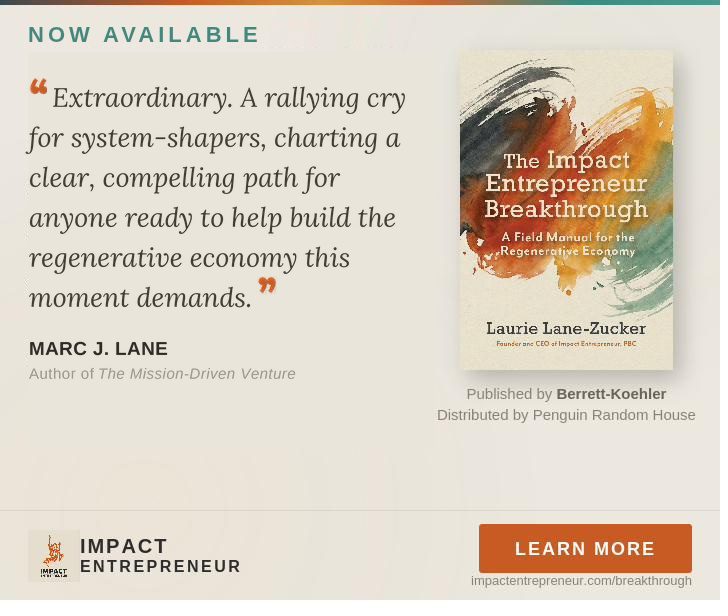
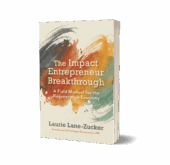
The Five Pillars of Real Security and the concept of "The Great Misallocation" are developed fully in Laurie Lane-Zucker's forthcoming book, The Impact Entrepreneur Breakthrough: A Field Manual for the Regenerative Economy (Berrett-Koehler Publishers, September 2026).

Related Content
Connecting Georgia’s social enterprises to markets and capital
71
0
Gabriel Grant on giving shareholders a way to express what matters to them
92
0
For mission-led organizations, a change of manager tests whether workplace inclusion is built to last.
75
0

Artist Rob Strati on inherited objects, the limits of market price, and the creative possibilities…
115
0
Comments
Deep Dives
RECENT
 385
0
385
0
 433
0
433
0
 405
0
405
0
Editor's Picks
 71
0
71
0
 92
0
92
0
 75
0
71
0
92
0
71
0
92
0
75
0
75
0
71
0
92
0
71
0
92
0
75
0
Webinars
Signed and personally inscribed — you'll write the inscription as you order. Limited · 50…
News & Events

The board can add 2% for each 50% rise in the company’s value

Applications close December 2, or sooner once 250 arrive

Repeat borrowers in Colombia and Indonesia took it over the line
Subscribe to our newsletter to receive updates about new Magazine content and upcoming webinars, deep dives, and events.
Become a Premium Member to access the full library of webinars and deep dives, exclusive membership portal, member directory, message board, and curated live chats.


0 Comments