What a Minute Costs
Counting what we fail to prevent, sixty seconds at a time



Counting what we fail to prevent, sixty seconds at a time

 50
50
 0
0

How collateral rules and payment terms keep impact capital out of reach
 164
0
164
0

Why free education tools need reliable access, credible evidence, and lasting support
 223
0
223
0

How states can crowd in local early-stage capital
345
0

Why last-mile healthcare needs an operating model, not just more mobile clinics
 319
0
319
0

How Australia’s succession wave could turn ownership into a funding model
 433
0
433
0

 434
0
434
0

Self-directed IRAs can open retirement portfolios to private impact assets, but investors must navigate additional fees, illiquidity, due-diligence responsibilities, and strict compliance rules.
Disclosure: Alicia Robb is Vice President of Kachuwa Impact Fund and serves on its board and investment committee. Kachuwa Impact Fund is discussed below as one example of an impact investment vehicle that some investors access through self-directed retirement accounts.
This article is for informational purposes only and is not legal, tax, investment, or financial advice. Investors should consult qualified advisors before using retirement assets for private or alternative investments.
Many impact investors hold most of their retirement assets in conventional IRAs or employer-sponsored plans invested primarily in public markets. That can create a practical disconnect. People may want their capital to support climate resilience, community wealth, women-led enterprises, worker ownership, or other impact priorities, but the largest pool of their long-term savings may not be available for those kinds of investments.
A self-directed IRA can help address that gap. It allows investors, under specific rules and with a qualified custodian, to hold certain alternative assets — including private funds, private companies, real estate, notes, and other non-public investments — inside a tax-advantaged retirement account. For experienced investors who understand the risks, that flexibility can open another path for aligning retirement capital with impact.
It is also a path that requires caution. Self-directed IRAs are more complex than ordinary brokerage IRAs. They can involve higher fees, illiquid assets, valuation challenges, fraud risk, and strict compliance rules. For that reason, the question is not simply, “Can I use retirement capital for impact investing?” It is, “Can I do so responsibly, affordably, and in compliance with the rules?”
The terminology can be confusing. A SEP IRA is a retirement plan often used by business owners, freelancers, and self-employed individuals. A self-directed IRA, by contrast, refers to an IRA structure that permits a broader range of investments than most mainstream custodians allow. A self-directed account can be a traditional IRA, Roth IRA, SEP IRA, or another eligible retirement account, depending on the investor’s situation and the custodian’s offerings.

Self-directed retirement investing requires more than choosing an asset: investors must understand custodial rules, transaction restrictions, fees, and the suitability of the underlying investment.
About 10 years ago, I established a SEP IRA that allowed me to invest in alternative assets. Through that account, I invested in one real estate deal and one private company. Over time, however, the fees associated with holding only two assets were significant. When I eventually liquidated those investments, I rolled the proceeds back into a more traditional IRA.
Recently, as I revisited the possibility of using retirement funds for current impact-investment activity, I reviewed several self-directed IRA providers used by members of Kachuwa Impact Fund, an investment cooperative of which I am a member and officer. The provider landscape has expanded, but costs and fee structures still vary widely.
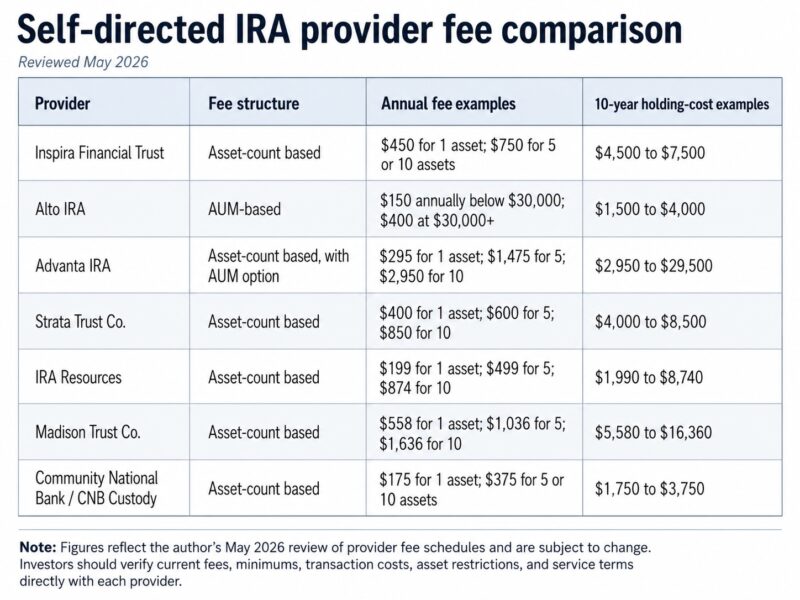
Most self-directed IRA providers charge some combination of setup fees, transaction fees, wire or paperwork fees, annual account fees, asset-holding fees, or fees based on assets under management. The biggest differences often appear in annual costs. Some providers charge primarily by number of assets held, while others charge based on account value.
Self-directed IRAs can be powerful tools, but they are not simple tools.
That distinction matters. An investor holding one private fund may face very different costs from an investor holding 10 separate private investments. Over a 10- or 20-year holding period, seemingly modest annual differences can become meaningful. Fees are especially important in impact investing, where investors may hold illiquid positions for long periods and may accept more patient or moderate financial returns in exchange for social or environmental value.
The table below summarizes fee information I reviewed in May 2026 for providers commonly used by Kachuwa members. It is not a ranking or recommendation. Fee schedules change frequently, and investors should verify current pricing directly with each provider.
Kachuwa Impact Fund is an evergreen impact fund structured as both a public benefit corporation and a cooperative. The fund owns and operates impact real estate and invests in privately held impact companies and funds. Because Kachuwa is evergreen rather than a typical fixed-term fund, investors may be able to hold exposure to a diversified impact portfolio over a longer time horizon.
As of 2026, Kachuwa reports more than 300 member investors and more than $61 million in assets across impact real estate, funds, and private companies. Several members invest in Kachuwa through self-directed retirement accounts. For those investors, one retirement-account investment can provide exposure to a diversified portfolio rather than requiring separate custody and fee arrangements for many individual private investments.
Recent examples from Kachuwa’s portfolio illustrate the range of possible impact themes. In 2026, the fund made a $1.3 million real estate investment in North Charleston, South Carolina, in partnership with the tenant nonprofit The Sustainability Institute, which works on resilient communities, home energy upgrades, and conservation leadership. Kachuwa also made a $250,000 debt investment in Friendship Bridge, a Colorado-based nonprofit social enterprise that provides microfinance, education, and health services to women entrepreneurs in Guatemala.
These examples are not presented as a recommendation to invest in Kachuwa or any specific fund. Rather, they show the kind of portfolio alignment some investors are seeking: long-term retirement capital directed toward enterprises and assets with social and environmental purpose.
Self-directed IRAs can be powerful tools, but they are not simple tools. The IRS rules on prohibited transactions are strict. IRA owners and other disqualified persons generally cannot use IRA assets for personal benefit, borrow from the IRA, sell property to it, use it as security for a loan, or otherwise engage in improper self-dealing. Violations can have serious tax consequences.
Retirement capital is one of the largest pools of long-term capital in the economy.
Investors also need to understand the risks of the underlying assets. Private investments may be illiquid, difficult to value, and unsuitable for required minimum distributions or near-term cash needs. Custodians typically do not perform investment due diligence or assess whether an investment is prudent. Regulators have repeatedly warned that self-directed IRAs can be used by promoters to lend credibility to risky or fraudulent offerings; NASAA and the SEC both urge investors to proceed carefully.
The practical takeaway is straightforward: before opening or funding a self-directed IRA, investors should compare custodians, understand all fees, confirm whether the intended investment is eligible, consult a tax advisor or attorney, and do independent due diligence on the investment itself.
For many investors, a self-directed IRA will not be the right choice. The complexity, costs, and compliance risks are significant. But for experienced investors with long time horizons, adequate diversification, and access to qualified advice, self-directed retirement accounts can open a meaningful pathway for impact allocation.
The larger point is not that everyone should move retirement assets into private impact investments. It is that retirement capital is one of the largest pools of long-term capital in the economy. If even a carefully selected portion of that capital can be responsibly aligned with community wealth, climate resilience, gender equity, affordable housing, and other impact priorities, self-directed IRAs may become one more tool for moving capital from passive ownership toward purposeful investment.


Related Content
Counting what we fail to prevent, sixty seconds at a time
50
0
How collateral rules and payment terms keep impact capital out of reach
164
0
Why free education tools need reliable access, credible evidence, and lasting support
223
0

What Islamic finance and impact investing can learn from each other
275
0
Comments
Deep Dives
RECENT
 345
0
345
0
 319
0
319
0
 433
0
433
0
Editor's Picks
 50
0
50
0
 164
0
164
0
 223
0
50
0
164
0
223
0
223
0
50
0
164
0
223
0
Webinars
Signed by the author. Collected at the door at Lipton Hall, NYU School of Law,…
News & Events

Pre-seed and seed startups can apply on a rolling basis

Their Built platform helps teams design, launch and run funds

The SBA barred 7(a) refinancing of merchant cash advances in 2025
Subscribe to our newsletter to receive updates about new Magazine content and upcoming webinars, deep dives, and events.
Become a Premium Member to access the full library of webinars and deep dives, exclusive membership portal, member directory, message board, and curated live chats.


0 Comments