Building an Impact Economy in Georgia
Connecting Georgia’s social enterprises to markets and capital



Connecting Georgia’s social enterprises to markets and capital

 74
74
 0
0
Gabriel Grant on giving shareholders a way to express what matters to them
 95
0
95
0
For mission-led organizations, a change of manager tests whether workplace inclusion is built to last.
 77
0
77
0

Why free education tools need reliable access, credible evidence, and lasting support
 409
0
409
0

What Islamic finance and impact investing can learn from each other
 443
0
443
0
After the flood, recovery capital must do more than replace what was lost
 411
0
411
0
 409
0
409
0

Free test preparation needs to help students find their next step when an answer is wrong or a concept remains unclear; Photo by Kateryna Hliznitsova
What happens after a student gets a question wrong? Starting with a $10 prep book, Luke Finigan explores why free education tools need useful feedback, accessible design, credible evidence, and someone accountable for keeping them working.
When I started studying for the SAT, my budget was a $10 prep book and whatever I could find free online.
The hard part came after I got a question wrong. An answer key could tell me that the answer was C, but not why my method failed or what to practice next. I would search another site or move on without understanding the mistake.
That dead end is why I started building 1600.now. It changed what the word “free” means to me. Removing the price matters, but so does what happens after the price reaches zero.
I use the word “infrastructure” to ask a blunt question: Can a student actually use the thing from beginning to end?

Useful feedback connects practice to understanding, giving students a way to learn from mistakes and try again without paying; Photo by Kateryna Hliznitsova
Imagine a student misses a systems-of-equations question. The screen says C. Now what?
The student needs to see where their reasoning went off track and try the same skill again at a sensible difficulty. If the concept itself is missing, they may need a lesson first. They should leave knowing what to do tomorrow, not with one more red X.
This is where some free products stop being free. The diagnostic is free, but the score report costs money. The questions are free, but the useful explanations require a subscription.
Removing the price matters, but so does what happens after the price reaches zero.
There are already strong free SAT options. College Board offers full-length Bluebook tests and thousands of official questions in its Student Question Bank. Khan Academy has lessons, videos, hints, and practice at different difficulty levels. Schoolhouse.world runs free small-group tutoring with trained peer tutors.
Bluebook is the place to practice in the official testing app. Khan Academy helps when a student needs to learn a concept. Schoolhouse gives the student a person who can answer the next question. I am not trying to replace them.
The tools can stay separate. A student should not need an expert map of the SAT-prep market to find the next step.
I have become slightly obsessive about details that sound unimportant until they stop someone from studying.
A page should load on a school Chromebook. Search should respond quickly on a phone. A student using a screen reader should be able to complete the same work. If the internet disappears for a minute, the student’s progress should not disappear with it.
Bluebook’s full-length practice tests run in an application that must be downloaded. A browser site removes that download, but it can still be miserable to use on a phone.
National averages can hide gaps in internet access. In the Census Bureau’s 2021 American Community Survey, 96 percent of U.S. households with children under 18 reported a broadband internet subscription, a category that includes cellular data plans. In separate household categories, the rates were about 80 percent for limited English-speaking households and 84 percent for households with a member with a disability. Those last two figures cover households with or without children.
Ninety-six percent sounds close to solved. It does not help the student whose connection is unreliable tonight.
A free education site should be tested under the conditions students actually have. That may mean lighter pages, printable material, or controls tested against accessibility guidance. It also means admitting what is missing. Browser translation does not make a lesson multilingual. Good intentions do not make a page accessible.
Education products use words like “personalized,” “research-backed,” and “effective” very easily. I think those words should be expensive. A company should have to earn them with evidence.
A College Board observational study examined SAT takers from the high school graduating class of 2025. In its matched sample, students who completed one, two, or at least three Bluebook practice tests scored about 25, 45, and 60 points higher than similar students who completed none. That does not prove that taking the practice tests caused the score differences. The study’s authors say unobserved differences between the groups may remain.
The results and that caveat belong together. Leave out the second part, and research turns into advertising.
The same honesty should apply to student data. The Federal Trade Commission has warned education technology providers covered by the Children’s Online Privacy Protection Act, or COPPA, not to require children to disclose more personal information than is reasonably necessary to participate. I use a simpler rule too: do not collect information merely because the software can.
Content ownership should be equally clear. “Free to read,” “publicly available,” and “open” do not mean the same thing. UNESCO defines open educational resources as materials in the public domain or under an open license that permits reuse, adaptation, and redistribution. A zero-dollar price does not create those rights.
That standard has to apply to my own project. All educational material on 1600.now is original. None is reproduced or adapted from released College Board material. Automated systems may help create explanations, but I manually review and test each one before publication. I check the answer, the reasoning, and how the explanation works on the page. Students can report anything I miss.
A free site can fail slowly. Search drags. An explanation sits uncorrected. The test changes, but the practice does not. Eventually, the tool starts wasting a student’s time.
Publishing the first version is the exciting part. Updating it six months later is the part that determines whether students can depend on it.
Money is part of that problem, even when students are never charged. Donations, schools, philanthropy, public money, and volunteer work each come with limits. I do not think there is one perfect model. For a small site like mine, the long-term answer is not settled. I do not want to pretend otherwise.
Once a school or library starts sending students to a tool, maintenance is no longer only the founder’s problem. The institution recommending it now has a stake in whether it still works next year. Funders can pay for the unglamorous work: accessibility audits, security updates, corrections, and support. Schools and public agencies can set standards for privacy and evidence.
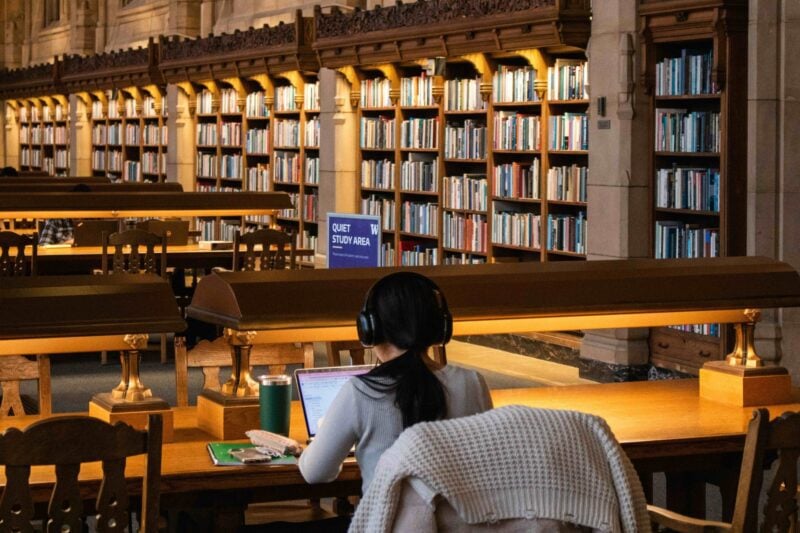
Schools and libraries that recommend free learning tools have a stake in their upkeep, accessibility, and long-term reliability; Photo by Zoshua Colah
Open-source communities can make a project less dependent on one person, but someone still has to review changes and respond when something breaks. Whatever the model, students deserve to know who is accountable, how errors are corrected, and what happens to their work if the project runs out of money or closes.
OpenStax, a nonprofit initiative at Rice University, offers one model. It publishes peer-reviewed textbooks free online and as PDFs under Creative Commons terms. Philanthropy helps keep the library free; low-cost print copies are also available.
A small SAT practice site cannot copy OpenStax. It can still be just as clear about ownership, review, licensing, and funding.
UNESCO’s recommendation on open educational resources treats inclusive access and sustainability as distinct areas of action. Both have to be addressed. Publishing the first version is the exciting part. Updating it six months later is the part that determines whether students can depend on it.
If I were a school, library, or funder deciding whether to recommend a free education site, I would ask:
Free SAT preparation cannot provide a quiet place to study, reliable broadband, a counselor, disability support, or strong classroom instruction. It cannot fix the larger inequities of college admissions.
But it can stop making those inequities worse.
I began with a $10 book because that was what I could afford. I am still building around the same question: after a student gets something wrong, can they keep going without paying?
That is what infrastructure means to me. A student can finish the work, understand what the site does with their data, and come back next semester to something that still works.
Disclosure: The author created 1600.now, a free SAT practice platform discussed in this article. The platform is not affiliated with or endorsed by College Board.
--
This article is part of Impact Entrepreneur’s Impact Journalism Institute, which nurtures emerging Gen Z journalistic voices covering the parts of the Impact Economy they know firsthand.


Related Content
Connecting Georgia’s social enterprises to markets and capital
74
0
Gabriel Grant on giving shareholders a way to express what matters to them
95
0
For mission-led organizations, a change of manager tests whether workplace inclusion is built to last.
77
0

Artist Rob Strati on inherited objects, the limits of market price, and the creative possibilities…
115
0
Comments
Deep Dives
RECENT
 409
0
409
0
 443
0
443
0
 411
0
411
0
Editor's Picks
 74
0
74
0
 95
0
95
0
 77
0
74
0
95
0
74
0
95
0
77
0
77
0
74
0
95
0
74
0
95
0
77
0
Webinars
Signed and personally inscribed — you'll write the inscription as you order. Limited · 50…
News & Events

The board can add 2% for each 50% rise in the company’s value
Applications close December 2, or sooner once 250 arrive
Repeat borrowers in Colombia and Indonesia took it over the line
Subscribe to our newsletter to receive updates about new Magazine content and upcoming webinars, deep dives, and events.
Become a Premium Member to access the full library of webinars and deep dives, exclusive membership portal, member directory, message board, and curated live chats.


0 Comments