When Impact Stops at the Office Door
For mission-led organizations, a change of manager tests whether workplace inclusion is built to last.



For mission-led organizations, a change of manager tests whether workplace inclusion is built to last.

 65
65
 0
0

Artist Rob Strati on inherited objects, the limits of market price, and the creative possibilities…
 102
0
102
0

Counting what we fail to prevent, sixty seconds at a time
95
0

How states can crowd in local early-stage capital
 392
0
392
0

Why last-mile healthcare needs an operating model, not just more mobile clinics
 373
0
373
0
How Australia’s succession wave could turn ownership into a funding model
 492
0
492
0
 467
0
467
0

At the July 30 Deep Dive, Laurie Lane-Zucker gave the first public presentation of The Impact Entrepreneur Breakthrough — and argued that the impact economy's next threshold is not scale, but architecture. The full recording is now available.
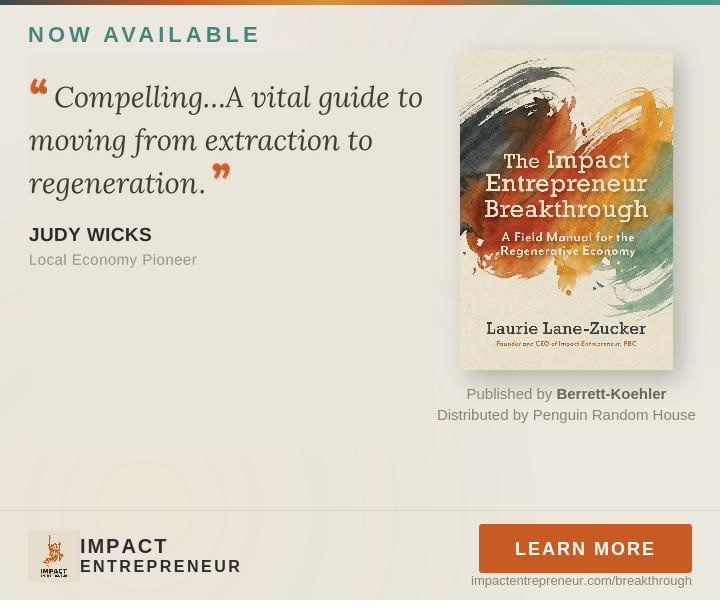
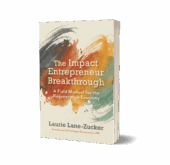
There is a particular moment in the life of a movement when it stops needing to be explained and starts needing to be built. On July 30, before an audience drawn from Impact Entrepreneur's global network — the community in which the term "impact entrepreneur" was coined fifteen years ago — Laurie Lane-Zucker gave the first public presentation of The Impact Entrepreneur Breakthrough: A Field Manual for the Regenerative Economy (Berrett-Koehler, September 1), and made the case that the impact economy has crossed exactly that threshold.
The arrival is measurable. Impact assets under management have reached $1.6 trillion, growing 21 percent annually against 5 percent for the asset-management market as a whole (GIIN, State of the Market 2025). B Corp certification now covers roughly one million employees across more than 10,000 companies. The network convened around this magazine spans more than 70,000 practitioners in over 200 countries. The question, as the presentation framed it, is no longer whether a civilizational alternative to extraction is possible. It is how fast that alternative can scale — and whether the people building it have the architecture to do so with integrity.
That second clause carried the weight of the hour. The presentation's spine was not celebration but a set of three critiques, delivered with the candor of someone assessing a field he helped call into being.
The first: scale without structure. Ninety-eight percent of surveyed impact assets are managed from investors headquartered in developed markets — capital that has grown faster than the governance required to keep it honest.
The second: certification without concentration examined. When Danone completed full global certification in November 2025, roughly 90,000 employees entered the movement's ledger at once — nearly a tenth of its certified workforce, inside a single company. "Arrival?" the slide asked. "Or concentration wearing the movement's clothes?"
The third: frameworks without integration. Measurement standards, ownership models, climate finance, security policy — nearly all of it built in separate rooms. Nobody has drawn the whole building.
"That third one," Lane-Zucker told the room, "is why I wrote this book."
What follows from that admission is the book's structure: five parts and sixteen chapters, read — as he put it — from the bedrock up. Foundations establishes what the impact economy is and why systemic intelligence matters. Possibility maps the technical architecture: enterprises that heal, ownership as justice, capital as custodian, markets that reflect what matters. Protection introduces the Five Pillars of Real Security, the Prevention Dividend™, and Defense as a Service™ — a reframing of security as shared resilience rather than fortified isolation. Integration argues that structure without culture does not endure. Reclamation closes with the commons, and with a civilization worth the name.
Every chapter ends the same way: with a tool kit — a canvas, diagnostic, or exercise meant to be applied to a real enterprise, portfolio, policy, or community. The discipline behind that design surfaced in the presentation's most quotable line: "Frameworks are only worth what someone does with them on a Tuesday morning."
Laurie Lane-Zucker's presentation of his book The Impact Entrepreneur Breakthrough: A Field Manual for the Regenerative Economy. Also available on YouTube.
The recording runs forty-six minutes. For the time-constrained: the state of the movement and the three critiques begin at 5:15; the architecture of the book — beginning at a lighthouse on Cape Cod in 1991 — at 8:30; and the tour of what's freely available now, from the eighteen-canvas Frameworks Workshop Pack to the complete educator suite, at 38:09. The Deep Dive's question-and-answer conversation, in keeping with the intimacy of those sessions, stayed in the room.
Everything referenced in the presentation lives in one place: impactentrepreneur.com/breakthrough — every pre-order option, the media kit, the frameworks, and the educator resources, all of it free except the book itself. The book arrives September 1; pre-orders placed before that date carry disproportionate weight, shaping retail placement, review attention, and list eligibility before publication day arrives. For faculty, the educators page includes three complete course models, a student-facing Reader's Companion — and a standing offer from the author to join, virtually, any classroom that adopts the book.
The Impact Entrepreneur Breakthrough: A Field Manual for the Regenerative Economy publishes September 1, 2026, from Berrett-Koehler, distributed by Penguin Random House.


Related Content
For mission-led organizations, a change of manager tests whether workplace inclusion is built to last.
65
0
Artist Rob Strati on inherited objects, the limits of market price, and the creative possibilities…
102
0
Counting what we fail to prevent, sixty seconds at a time
95
0

How collateral rules and payment terms keep impact capital out of reach
231
0
Comments
Deep Dives
RECENT
 392
0
392
0
 373
0
373
0
 492
0
492
0
Editor's Picks
 65
0
65
0
 102
0
102
0
 95
0
65
0
102
0
95
0
95
0
65
0
102
0
95
0
Webinars
Signed by the author. Collected at the door at Lipton Hall, NYU School of Law,…
News & Events
The only craft-focused project in Catalytic Capital Consortium’s new cohort.

The September 14 program and a live IFI Tool demo are online

Pre-seed and seed startups can apply on a rolling basis
Subscribe to our newsletter to receive updates about new Magazine content and upcoming webinars, deep dives, and events.
Become a Premium Member to access the full library of webinars and deep dives, exclusive membership portal, member directory, message board, and curated live chats.


0 Comments