Beyond Investment Readiness
How collateral rules and payment terms keep impact capital out of reach




How collateral rules and payment terms keep impact capital out of reach

 94
94
 0
0

Why free education tools need reliable access, credible evidence, and lasting support
 85
0
85
0

What Islamic finance and impact investing can learn from each other
182
0

How states can crowd in local early-stage capital
310
0

Why last-mile healthcare needs an operating model, not just more mobile clinics
 279
0
279
0
How Australia’s succession wave could turn ownership into a funding model
 384
0
384
0

 367
0
367
0
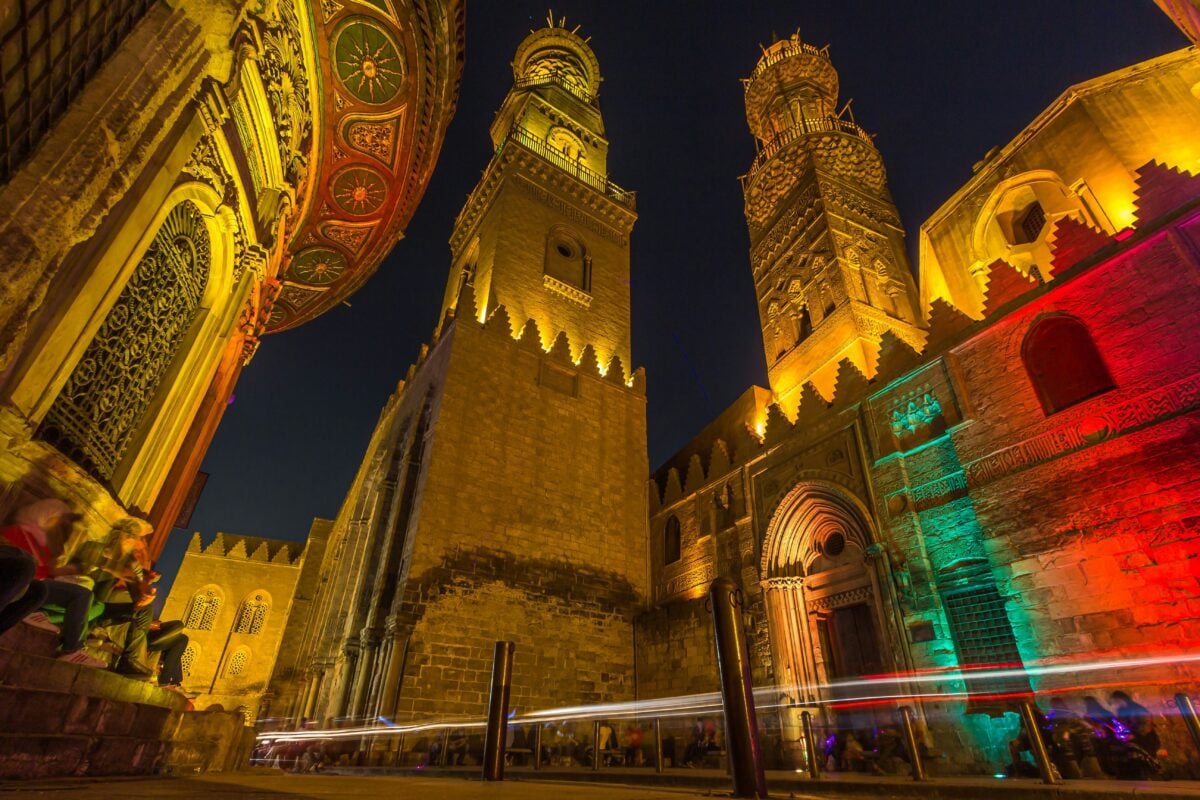
The historic architecture of Cairo’s City of the Dead forms the backdrop for Mishkā’s effort to connect cultural heritage, women’s livelihoods, and local enterprise; Photo Getty Images
In Cairo’s City of the Dead, Mishkā is turning Mamluk heritage into something more than a tourist attraction. By connecting restoration, craft training, market access, cultural tourism, and women’s livelihoods, the social enterprise offers a compelling model — and a caution — for heritage-led economic regeneration.
In what was once a disused cellar in Cairo’s City of the Dead, a group of women are practicing crafts as old as the city around them: jewelry making and leatherwork.
Mishkā, which means “lantern” in Arabic, is a social enterprise operated by the Sultan Foundation that trains women from the surrounding neighborhood in jewelry making and leathercraft. After training, women receive tools and materials they can use at home to make bracelets, bangles, necklaces, handbags, and other products. Once a week, they gather at Mishkā’s workshop to troubleshoot problems, deliver finished work, and stay connected to the enterprise.
For Nehad Zakaria, who has been involved with Mishkā since 2019, that pathway led beyond supplemental income. “Over time, my dedication allowed me to grow within the brand, ultimately leading to my current role as the Jewelry Production Manager,” she says. Her ambition now is global: “My dream for the near future is to see Mishkā’s products in every corner of the world.”
What makes Mishkā especially relevant to the Impact Economy is not simply that women are earning income. It is the system around the enterprise. In the Qaitbay area of Cairo’s historic northern cemetery, heritage preservation, cultural programming, tourism, skills training, and local business have been deliberately connected. The result is a useful case of how heritage can function as economic infrastructure rather than as a museum object.
The City of the Dead is a vast historic landscape of cemeteries, mausoleums, mosques, schools, homes, and workshops. The Qaitbay complex at its center was built in the 15th century by Mamluk Sultan al-Ashraf Qaitbay and remains one of Cairo’s most important surviving ensembles of Mamluk architecture.
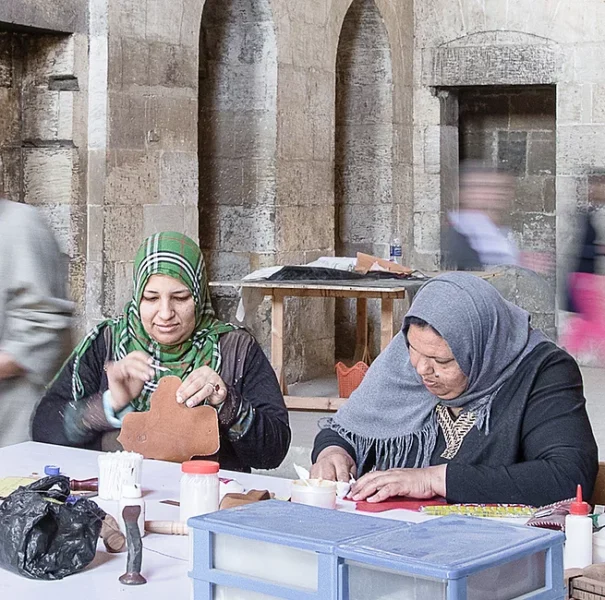
Mishkā connects women’s livelihoods to Cairo’s cultural heritage through jewelry and leatherwork rooted in the City of the Dead; Photo courtesy of Mishkā
The regeneration effort around Qaitbay was designed from the beginning to do more than stabilize stone. In 2018, the European Union launched a third phase of its Heritage for the Living in the City of the Dead program with a €945,000 contribution. Its stated purpose linked architectural conservation to improved services, a better urban environment, and expanded economic opportunities for local small businesses through increased cultural tourism.
That broader heritage program helped create the setting in which Mishkā could grow, but the enterprise’s own funding history is distinct. According to Mishkā, it was launched with a one-year grant from the Alfanar Foundation, while the DROSOS Foundation supported staff training and the outfitting of workshops and the retail gallery from 2018 through 2024. Mishkā says that support helped it become fully sustainable.
Heritage can function as economic infrastructure rather than as a museum object.
Agnieszka Dobrowolska, founder of Archinos Architecture and a driving force behind the Sultan Foundation’s work in the neighborhood, describes the regeneration strategy as three connected pillars: restoration of the Mamluk monuments, cultural events and bazaars, and social development. Mishkā grew from that third pillar, but its value depends on the other two. Restored monuments attract visitors; exhibitions and tours create reasons to stay; local businesses give residents a way to capture some of the value created.
Asmaa Khattab, founder of Cairo tour company Walk Like an Egyptian, says the change is visible on the ground. “The whole area has developed a lot,” she says. More guides now offer regular walking tours, and, in her words, “it’s nice to see how it’s showing hope.” That is the logic of place-based regeneration: the physical asset matters, but so does who participates in the economy that develops around it.
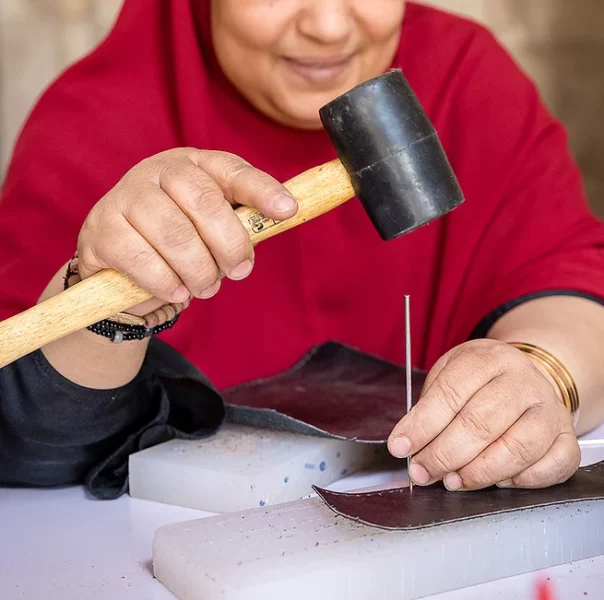
Mishkā’s model combines practical craft training with tools, materials, design support, and routes to market; Photo courtesy of Mishkā
Mishkā’s operating model is deliberately flexible. Women can work from home and organize production around family responsibilities, while the weekly workshop provides quality control, peer support, and connection to the brand. The products themselves draw on geometric and floral motifs found in the surrounding Mamluk architecture, turning the neighborhood’s visual heritage into a contemporary design language.
The enterprise has also relied on outside expertise to build skills and product quality. London leather designer Bill Amberg began working with the women in 2017, using materials and tools available locally to develop simple leather goods. Designer Tania Clarke Hall later helped expand the collection into leather jewelry, building on skills the women had already acquired. The approach resembles other women-led artisan enterprises that pair traditional or place-based craft with design support and stronger routes to market.
They’re not just souvenirs. There’s a story of real life behind it.
The cultural story is part of the product, but it is not the product’s only selling point. Mishkā’s jewelry and leather goods are priced for a broader visitor market, sold through its shop and online, and increasingly supported by workshops open to the public. During peak season, Dobrowolska says, two or three tour groups may visit the shop in a day. “They’re not just souvenirs,” she says of the products. “There’s a story of real life behind it.”
T
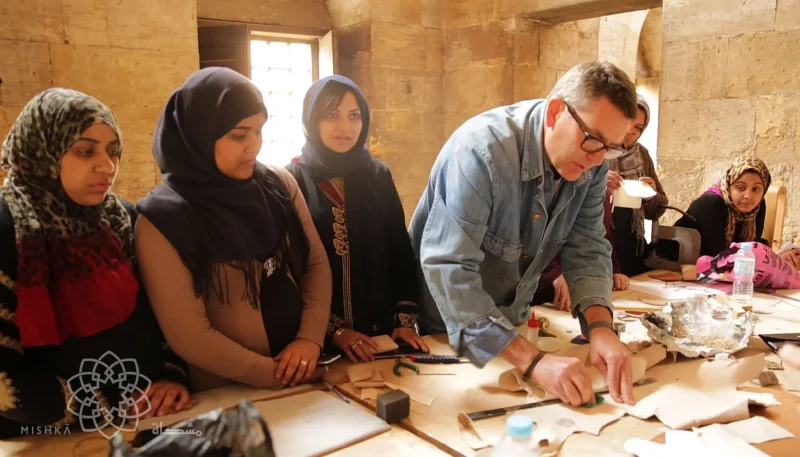
Leather designer Bill Amberg works with Mishkā artisans during an early training session in Cairo; Photo courtesy of Mishkā
That story received an international boost during the Spanish royal visit to Egypt in September 2025, when Queen Letizia wore earrings made by Mishkā artisans after visiting the workshop. The endorsement brought visibility, but celebrity attention is not a business model. Durable artisan enterprises still need recurring buyers, product development, and reliable market access.
According to Dobrowolska and Cathy Giangrande, who helped develop Mishkā, the enterprise has been self-sufficient for the past two years. That matters. Training programs are common; enterprises that continue after grant support ends are rarer. Mishkā’s next steps include public jewelry-making workshops, new home-decor products, and a proposed weaving workshop — efforts that could diversify both revenue and skills.
Mishkā’s progress should not be mistaken for proof that the wider City of the Dead has been “saved.” The necropolis is enormous, politically contested, and under pressure from Cairo’s infrastructure expansion. In other parts of the cemetery, demolitions and resident displacement have disrupted historic structures, social networks, and local livelihoods. Preservation and destruction are unfolding at the same time.
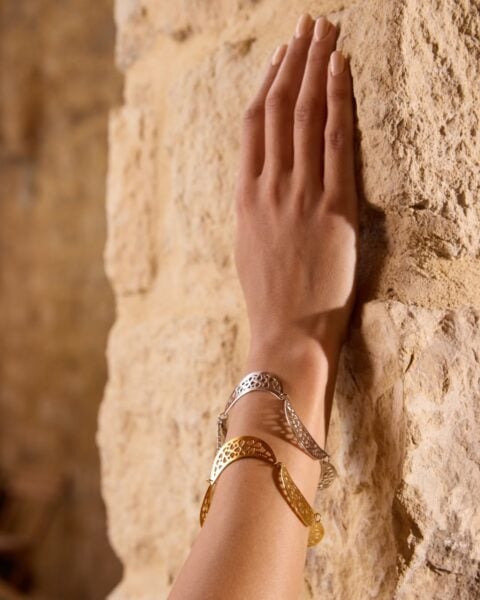
Mishkā’s designs draw on the geometric forms and architectural heritage of Cairo’s Mamluk monuments; Photo courtesy of Mishkā
The Qaitbay area itself has also continued to attract major conservation investment. In July 2026, the Mausoleum of Sultan Qaitbay reopened after a five-year conservation project. That reopening reinforces the area’s cultural draw, but it also sharpens the central question for heritage-led development: can the economic value created by restored places remain connected to the people who live and work around them?
Tourism is another source of both opportunity and risk. Egypt welcomed nearly 19 million tourists in 2025, up about 21% from the previous year. Strong national tourism numbers, however, do not eliminate the vulnerability of a small enterprise tied partly to cultural visitation. Mishkā’s growing online presence, workshops, and product diversification are therefore more than marketing choices; they are resilience strategies.
First, connect conservation capital to local value creation from the start. Restoration budgets often stop at the building envelope. The Qaitbay model explicitly connected heritage conservation to services, cultural programming, and economic opportunity, while separate philanthropic support helped build the enterprise capacity needed to turn visitors into local income.
Second, train for markets, not training counts. Mishkā did not stop at teaching a craft. It paired skills with tools, design development, quality control, retail space, storytelling, visitor flows, and online sales. As Impact Entrepreneur has explored in other artisan contexts, those pieces of cultural infrastructure determine whether creative skill becomes a durable livelihood.
Third, design the grant exit as carefully as the grant entry. If Mishkā’s self-sufficiency holds, the most important outcome is not how many women attended a training session but whether the enterprise can keep generating demand and income after foundation support ends.
Finally, measure who captures the value of regeneration. Heritage investment can make a place more attractive to visitors and investors, but those gains are not automatically inclusive. The real test is whether residents gain income, skills, ownership, bargaining power, and the ability to remain in the neighborhood as its value rises.
The lesson from Mishkā is not that every historic district needs a jewelry workshop. It is that cultural preservation can become economic infrastructure when restoration, local enterprise, market access, and community benefit are designed as one system. Mishkā’s challenge now is to scale without losing that local connection — and to remain resilient amid the wider pressures reshaping the City of the Dead.
In a district where restoration and demolition exist side by side, that is no small test. It is the difference between restoring monuments and regenerating a place.


Related Content
How collateral rules and payment terms keep impact capital out of reach
94
0
Why free education tools need reliable access, credible evidence, and lasting support
85
0
What Islamic finance and impact investing can learn from each other
182
0

After the flood, recovery capital must do more than replace what was lost
 304
0
304
0
Comments
Deep Dives
RECENT
 310
0
310
0
 279
0
279
0
 384
0
384
0
Editor's Picks
 94
0
94
0
 85
0
85
0
 182
0
94
0
94
0
85
0
182
0
182
0
94
0
94
0
85
0
182
0
Webinars
Signed by the author. Collected at the door at Lipton Hall, NYU School of Law,…
Signed and personally inscribed — you'll write the inscription as you order. Limited · 50…
News & Events

Federal policy uncertainty and limited grants top 2026 risks

An introductory program for foundations and family offices

Backers include UnitedHealth Group and the Ford Foundation
Subscribe to our newsletter to receive updates about new Magazine content and upcoming webinars, deep dives, and events.
Become a Premium Member to access the full library of webinars and deep dives, exclusive membership portal, member directory, message board, and curated live chats.

0 Comments