What a Broken Plate Reveals About Value
Artist Rob Strati on inherited objects, the limits of market price, and the creative possibilities…



Artist Rob Strati on inherited objects, the limits of market price, and the creative possibilities…

 60
60
 0
0

Counting what we fail to prevent, sixty seconds at a time
73
0

How collateral rules and payment terms keep impact capital out of reach
 181
0
181
0

How states can crowd in local early-stage capital
357
0

Why last-mile healthcare needs an operating model, not just more mobile clinics
 332
0
332
0
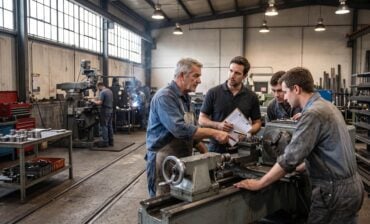
How Australia’s succession wave could turn ownership into a funding model
 442
0
442
0
 1460449
0
1460449
0

For retiring owners, employee ownership offers a succession pathway that protects what they’ve built — not just the enterprise itself, but the people, relationships, and local economic fabric that sustain it.
As trillions of dollars in business assets approach generational transition, employee ownership is emerging as a scalable, market-based solution — one capable of delivering competitive financial returns while broadening access to wealth for frontline workers and their communities.
Employee ownership investing has never been better positioned for growth. Decades of research from organizations such as the National Center for Employee Ownership (NCEO), Rutgers University, and Project Equity demonstrate what practitioners have long observed: employee ownership models strengthen business performance, improve retention, deepen worker engagement, and create meaningful wealth-building opportunities. Employee-owned firms often outperform through downturns, offering a resilience profile that investors increasingly value.
What has been missing is not proof of concept, but the infrastructure required for scale. The field is beginning to move from isolated initiatives toward more coordinated strategy, shared standards, and emerging investment platforms.
The approaching wave of retiring business owners presents both risk and opportunity. Without aligned capital, many locally rooted businesses face closure or sales that extract value from communities and result in job losses. With the right investment and policy tools, a meaningful share could transition ownership to employees — anchoring jobs, preserving local supply chains, and expanding wealth creation.
The Employee Ownership Capital Roadmap, released by Ownership Capital Lab in December 2025, reflects this shift. Rather than focusing on a single financing mechanism, the roadmap outlines the full marketplace infrastructure needed to scale employee ownership with integrity — including capital products, policy levers, data, narrative strategy, and field coordination.

Scaling employee ownership requires more than good intent. It depends on financial infrastructure — capital stacks, underwriting standards, and policy frameworks — that allow long-term value creation to compete with extractive alternatives.
“The opportunity in front of us is unprecedented,” said Alison Lingane, Founder and CEO of Ownership Capital Lab. “Recent research shows that over a million firms employing approximately 58 million workers are viable candidates for employee ownership today. Without aligned capital, too many will otherwise be acquired by absentee buyers or closed entirely, with negative consequences for workers and local economies.”
Despite decades of evidence demonstrating stronger firm performance, higher retention, and meaningful wealth-building outcomes, employee ownership has not yet reached the scale its results would suggest. The primary constraints are not related to effectiveness, but to the financial and informational infrastructure surrounding the model.
The most persistent barrier remains access to appropriate capital.
For employee ownership to compete effectively with traditional buyers in the succession marketplace, owners need timely, well-structured, and competitively priced financing options. Yet the capital stack for employee ownership transactions — particularly the subordinated or junior layer — has historically been underdeveloped.
Employee ownership represents a capital strategy that aligns enterprise durability, workforce wealth-building, and community stability.
According to Jack Moriarty, Executive Director of the Lafayette Square Institute, “These factors have resulted in a dearth of institutional capital in the ESOP market, which in turn has resulted in an overreliance on long-term, subordinated seller notes — not an attractive value proposition for the vast majority of exiting owners considering an ESOP sale.” Many owners compare this structure unfavorably to all-cash strategic or private equity transactions that provide immediate liquidity. Without capital products designed specifically for employee ownership transitions, even mission-aligned owners often struggle to make the economics work.
A second barrier is awareness and education.
While employee ownership has a long track record, it remains unfamiliar to many of the intermediaries who shape business transitions, including wealth advisors, M&A professionals, lenders, accountants, and policymakers. Most business owners never encounter employee ownership as a mainstream option, and many advisors lack the training to evaluate or recommend EO structures. This informational gap has created a substantial “silent pipeline” of owners who might consider employee ownership if they better understood how it works and what it requires.

Employee ownership is ultimately about continuity — preserving skills, institutional memory, and shared purpose across generations as businesses transition ownership rather than exit their communities.
Market leaders increasingly recognize that capital innovation and education must advance together. New funds are developing EO-aligned financing vehicles, while field builders invest in advisor training, clearer playbooks, and narrative change. Until these elements mature and are more widely understood, employee ownership will continue to perform well in practice while remaining underutilized in the marketplace.
Policy can act as a force multiplier in a maturing market. The American Ownership and Resilience Act (AORA) seeks to address persistent capital gaps by establishing a zero-subsidy investment facility at the U.S. Department of Commerce. The goal is to unlock lower-cost junior capital, crowd in private investment, and make employee ownership a more competitive option for sellers.
AORA also offers a bipartisan pathway to strengthening domestic supply chains while expanding worker ownership and wealth-building.
Regulatory signals are shifting as well. The Department of Labor’s recent decision to remove ESOPs from its National Enforcement Project list may provide fiduciaries and investors with a clearer operating environment — creating space for innovation while maintaining appropriate safeguards.
This moment presents real opportunity. The field now has a strong research base, emerging capital innovations, and meaningful policy tailwinds. What is required next is coordinated action:
Taken together, these efforts can move employee ownership from a promising but underutilized alternative into a scalable, durable option for business owners, investors, advisors, and workers alike.
For impact investors focused on long-term value creation, employee ownership represents a capital strategy that aligns enterprise durability, workforce wealth-building, and community stability — not as a concession to mission, but as a coherent investment thesis.
With sustained coordination across capital providers, policymakers, and field builders, employee ownership can evolve from a niche strategy into a durable marketplace — one where workers build wealth, businesses remain rooted, and investors participate in a more resilient and inclusive economy.


Related Content
Artist Rob Strati on inherited objects, the limits of market price, and the creative possibilities…
60
0
Counting what we fail to prevent, sixty seconds at a time
73
0
How collateral rules and payment terms keep impact capital out of reach
181
0

Why free education tools need reliable access, credible evidence, and lasting support
 240
0
240
0
Comments
Deep Dives
RECENT
 357
0
357
0
 332
0
332
0
 442
0
442
0
Editor's Picks
 60
0
60
0
 73
0
73
0
 181
0
60
0
60
0
73
0
181
0
181
0
60
0
60
0
73
0
181
0
Webinars
Signed by the author. Collected at the door at Lipton Hall, NYU School of Law,…
News & Events

The September 14 program and a live IFI Tool demo are online

Pre-seed and seed startups can apply on a rolling basis
Their Built platform helps teams design, launch and run funds
Subscribe to our newsletter to receive updates about new Magazine content and upcoming webinars, deep dives, and events.
Become a Premium Member to access the full library of webinars and deep dives, exclusive membership portal, member directory, message board, and curated live chats.


0 Comments