Building an Impact Economy in Georgia
Connecting Georgia’s social enterprises to markets and capital



Connecting Georgia’s social enterprises to markets and capital

 103
103
 0
0
Gabriel Grant on giving shareholders a way to express what matters to them
 107
0
107
0

For mission-led organizations, a change of manager tests whether workplace inclusion is built to last.
 84
0
84
0

Why free education tools need reliable access, credible evidence, and lasting support
 463
0
463
0

What Islamic finance and impact investing can learn from each other
 468
0
468
0

After the flood, recovery capital must do more than replace what was lost
 425
0
425
0

 842
0
842
0

From left, Jacobien Viets of Alliance Business Counsels; Emiliano Giovine of the Global Alliance of Impact Lawyers; Betty Francisco of Boston Impact Initiative; and moderator Laurie Lane-Zucker, founder of Impact Entrepreneur, during the Meeting the Finalists session at the 2026 IILWG/Grunin Center Annual Conference at NYU School of Law. ©NYU Photo Bureau: Hollenshead.
From giving ecosystems a place in corporate governance to opening impact funds to everyday investors, the 2026 Grunin Prize finalists show how legal design can change whose interests count.
Lawyers are trained to work within rules. Increasingly, they are also finding ways to repurpose those rules to address problems the rules were not designed to solve.
As social, environmental, and economic systems face intensifying strain, legal practitioners can help build the impact economy not only by ensuring compliance, but also by designing structures that redirect capital, broaden ownership, and embed social and ecological considerations into governance. Just as accountants influence which externalities are recognized and valued, lawyers shape the corporate charters, investment vehicles, contracts, and public frameworks through which capital and power move.
The Grunin Center for Law and Social Entrepreneurship at NYU School of Law has emerged as a leading hub for teaching students and legal professionals how legal work can advance social and environmental impact.
Since 2018, the center has administered the Grunin Prize for Law and Social Entrepreneurship, which celebrates lawyers advancing social entrepreneurship, impact investing, and sustainable development.
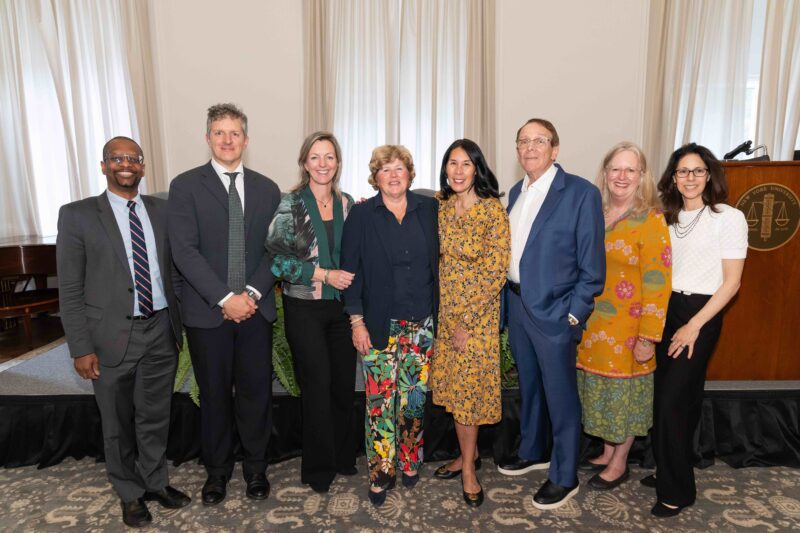
Participants in the 2026 Grunin Prize program, from left: Dean Troy McKenzie, NYU School of Law; Emiliano Giovine, Global Alliance of Impact Lawyers; Tessa van Soest, B Lab Benelux; Jacobien Viets, Alliance Business Counsels; Betty Francisco, Boston Impact Initiative; Jay Grunin, Grunin Center for Law and Social Entrepreneurship; Deborah Burand, NYU School of Law and the Grunin Center for Law and Social Entrepreneurship; and Zvia Schoenberg, Grunin Center for Law and Social Entrepreneurship. ©NYU Photo Bureau: Hollenshead.
Impact Entrepreneur was on site for the 2026 IILWG/Grunin Center Annual Conference at NYU Law to celebrate the prize finalists and hear how legal innovators are rewriting some of the rules of the impact economy. Impact Entrepreneur founder Laurie Lane-Zucker moderated the conference’s Meeting the Finalists session.
Businesses depend on nature and biodiversity, while their decisions can materially affect both. Yet plants, animals, and ecosystems rarely have an institutional voice in corporate or investment decision-making.
Recent frameworks have made those dependencies and impacts more visible — including the recommendations of the Taskforce on Nature-related Financial Disclosures, the goals of the Kunming-Montreal Global Biodiversity Framework, and the European Union’s sustainability-reporting architecture, including the Corporate Sustainability Reporting Directive and related standards.
“Instead of changing the law, we are repurposing the law.”
The through line is a growing recognition that nature is a material stakeholder for businesses and other institutions. What has been less available is a practical governance framework, rooted in existing law, that formalizes when and how nature’s interests enter organizational decision-making.
The Onboarding Nature Toolkit & Movement — winner of the 2026 Grunin Prize — seeks to close that gap by turning “the nature of business” into “nature’s business.”
Developed through an initial collaboration among B Lab Benelux, the Earth Law Center, and Nyenrode Business University, and supported by legal professionals including Mhairi Letcher of B Lab Europe, Jacobien Viets of Alliance Business Counsels, and Emiliano Giovine of the Global Alliance of Impact Lawyers, the toolkit helps organizations move from human-centered decision-making toward nature-inclusive governance.
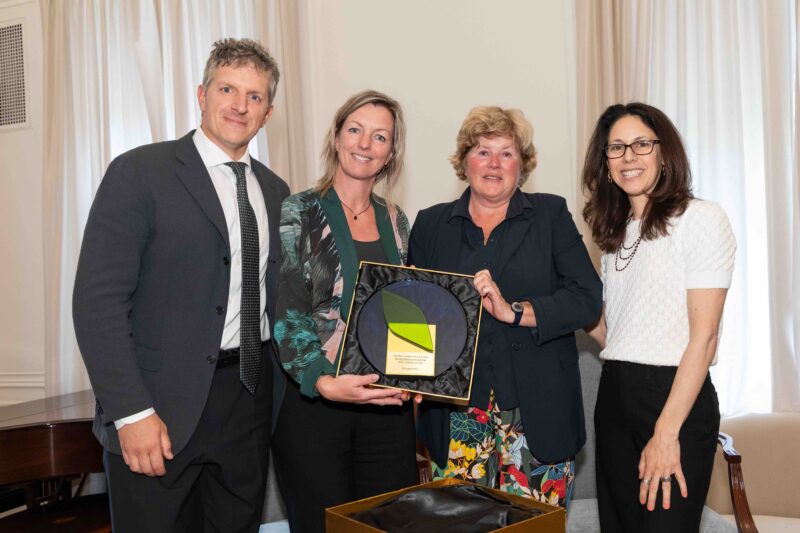
At the presentation of the 2026 Grunin Prize to the Onboarding Nature Toolkit & Movement, from left: Emiliano Giovine of the Global Alliance of Impact Lawyers; Tessa van Soest of B Lab Benelux; Jacobien Viets of Alliance Business Counsels; and Zvia Schoenberg of the Grunin Center for Law and Social Entrepreneurship. ©NYU Photo Bureau: Hollenshead.
It sets out four models for embedding nature into corporate structures:
“Companies will not be able to do this on their own,” said Alexandra Pimor, director of nature governance at the Earth Law Center. “They will need lawyers to help them navigate the legal infrastructures of their company and of their national jurisdiction.”
The toolkit complements the four models with case studies of companies experimenting with nature-inclusive governance, including Patagonia, Tony’s Chocolonely, Willicroft, and Faith in Nature, which has made nature a director of the company.
“When you know that ultimately Nature is going to have input, what that does is bring a nature-positive way of making decisions into the process much earlier,” said Anne Hopkins, creative and brand director at Faith in Nature.
Legal innovation is not a back-office function of the impact economy; it is part of its enabling infrastructure.
The toolkit also includes supporting legal research on how nature can be represented in corporate decision-making, as well as jurisdiction-specific templates intended to support implementation across different legal systems.
“Social norms have changed,” said Viets during a panel featuring the Grunin Prize finalists. “Treating nature as a stakeholder isn’t just an activist cause, but something that can actually be enforceable by law.”
Pimor added: “The role of lawyers here is crucial because, instead of changing the law, we are repurposing the law. We are transforming the law, and we are transforming the culture or business model from within. The law defines the reality that we experience, and if we cannot change the law through legislation, then we can still change our understanding and our relationality to the law.”
The other two Grunin Prize finalists demonstrated how legal design can widen access to impact investment and help public institutions recognize forms of value that conventional market mechanisms often miss.
Boston Impact Initiative(BII), a nonprofit impact investment fund and certified community development financial institution, closed its $22 million Fund II at the end of 2025 using a tiered note structure that allowed non-accredited investors to participate alongside accredited investors. With support from the legal team at Morgan Lewis, BII placed non-accredited investors in a senior position in the capital stack, ahead of accredited investors — effectively turning the conventional waterfall and risk ladder on its head. The fund drew commitments from nearly 240 investors, including individuals, donor-advised funds, nonprofits, foundations, faith-based organizations, and impact funds.

The Grunin Prize recognizes legal projects with the potential to advance social entrepreneurship, impact investing, and sustainable development. ©NYU Photo Bureau: Hollenshead.
“Our biggest challenge was figuring out how to sell impact securities when the law restricts access to retail investors,” said Betty Francisco, CEO of BII and a guest on IE’s Luminarias Series. “But exemptions exist for non-accredited investors, and this model helps shift wealth-building opportunities to those least able to tolerate risk.”
Cottino Social Impact Campus, based in Turin, Italy, is an education and research center focused on building a culture of social impact. Through a partnership with the City of Torino and a network of academic and institutional partners, a multidisciplinary team developed a legally grounded framework that enables municipalities to integrate social, environmental, and economic impact into the management and regeneration of public real estate.
Rather than relying solely on traditional market valuation, the model allows public authorities to recognize the social and environmental benefits generated by different uses of public assets. The aim is to guide urban regeneration toward public value while remaining compliant with public finance law, transparency duties, equal-treatment requirements, and administrative accountability.
“The heart of the issue was figuring out how to allow the administration to assign economic relevance to non-monetary obligations undertaken by the operator, such as environmental and social commitments, and how we can translate that value into a possible reduction of the monetary consideration due for the asset,” said Emiliano Giovine, lawyer and scientific director of the Legal Impact Pillar for Cottino Social Impact Campus. “The legal innovation lies precisely in this combination of impact measurement and public law compliance.”
Taken together, the three finalists showed that legal innovation is not a back-office function of the impact economy; it is part of its enabling infrastructure. By changing who can invest, whose interests count, and what public institutions are permitted to value, lawyers can turn broad impact ambitions into durable rules, rights, and accountability.
Learn more about the 2026 Grunin Prize winner and finalists.


Related Content
Connecting Georgia’s social enterprises to markets and capital
103
0
Gabriel Grant on giving shareholders a way to express what matters to them
107
0
For mission-led organizations, a change of manager tests whether workplace inclusion is built to last.
84
0

Artist Rob Strati on inherited objects, the limits of market price, and the creative possibilities…
122
0
Comments
Deep Dives
RECENT
 463
0
463
0
 468
0
468
0
 425
0
425
0
Editor's Picks
 103
0
103
0
 107
0
107
0
 84
0
103
0
107
0
84
0
84
0
103
0
107
0
84
0
Webinars
Signed and personally inscribed — you'll write the inscription as you order. Limited · 50…
News & Events

The board can add 2% for each 50% rise in the company’s value
Applications close December 2, or sooner once 250 arrive

Repeat borrowers in Colombia and Indonesia took it over the line
Subscribe to our newsletter to receive updates about new Magazine content and upcoming webinars, deep dives, and events.
Become a Premium Member to access the full library of webinars and deep dives, exclusive membership portal, member directory, message board, and curated live chats.


0 Comments