When Impact Stops at the Office Door
For mission-led organizations, a change of manager tests whether workplace inclusion is built to last.




For mission-led organizations, a change of manager tests whether workplace inclusion is built to last.

 44
44
 0
0

Artist Rob Strati on inherited objects, the limits of market price, and the creative possibilities…
 85
0
85
0

Counting what we fail to prevent, sixty seconds at a time
89
0

How states can crowd in local early-stage capital
 368
0
368
0

Why last-mile healthcare needs an operating model, not just more mobile clinics
 351
0
351
0

How Australia’s succession wave could turn ownership into a funding model
 466
0
466
0


 2540
0
2540
0
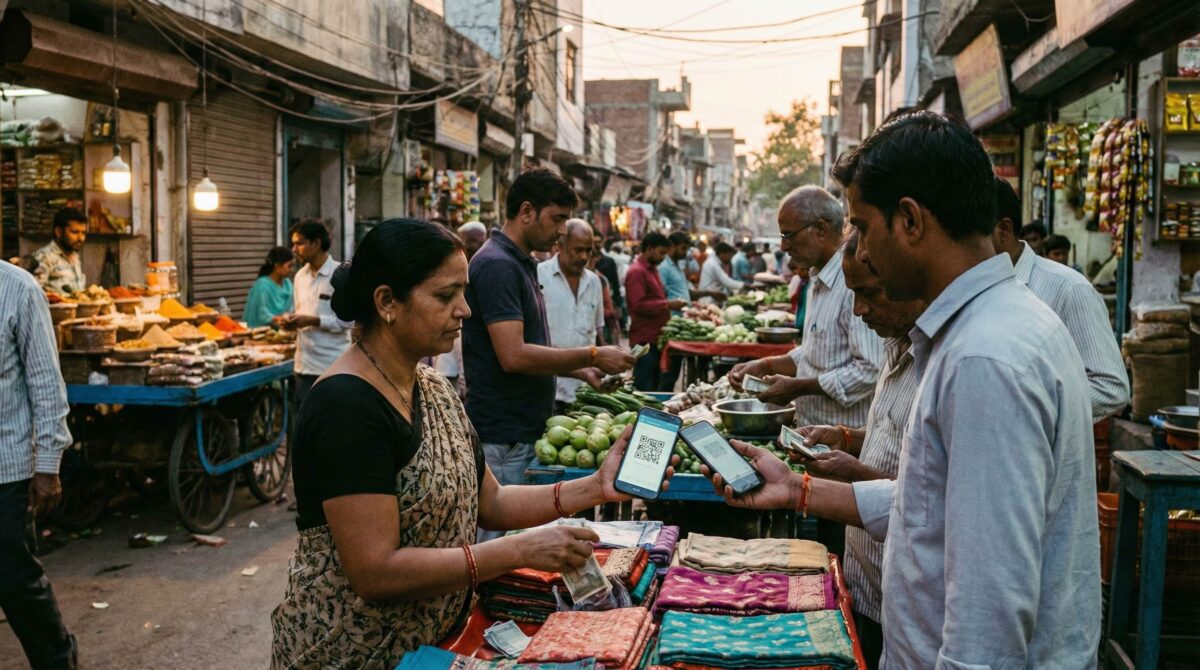
Digital tools are increasingly woven into informal and small-scale commerce, blending traditional market practices with new financial and communication technologies that expand access while reshaping local value chains.
Across much of the Global South, innovation does not begin with abundance — it begins with constraint. As grassroots solutions scale into formal markets, questions of ownership, governance, and value capture become central to whether innovation truly serves communities or reshapes power away from them.
In much of South Asia, innovation does not start with a new product, a venture round, or a breakthrough technology. It starts when systems fail to show up.
Farmers with smartphones still turn to neighbours for advice because public extension services arrive too late — or not at all. Cities generate surplus faster than they can distribute it, while rural communities lack basic necessities. Informal settlements pool labour and capital to build sanitation and roads years before the state arrives to regulate them.
These are not edge cases. They are the conditions under which innovation actually happens.
 Collective labor and shared infrastructure often emerge where formal systems fall short — demonstrating how community coordination and practical ingenuity build resilient local economies from the ground up.
When formal markets and institutions fail to reach large segments of the population, communities adapt. They build infrastructure collectively, circulate knowledge through trusted networks, and redistribute value outside both the state and formal markets. This is innovation shaped by scarcity, uneven state capacity, and the need for reliability over novelty — not by abundance or venture capital.
Frugal innovation is therefore not technological inferiority. It is intentional design under constraint.
Long before “frugal innovation” entered management literature, these systems were already operating at scale. They were low-cost, socially embedded, and resilient precisely because they aligned with local incentives and constraints. For investors and policymakers, they pose a harder question: why do models built under constraint often endure longer than those designed for rapid scale?
Innovation under constraint prioritizes affordability, accessibility, and reliability over sophistication. Solutions emerge through participation rather than invention, with users acting as co-creators rather than passive consumers. In these contexts, the distinction between producer and user, inventor and adopter, often collapses.
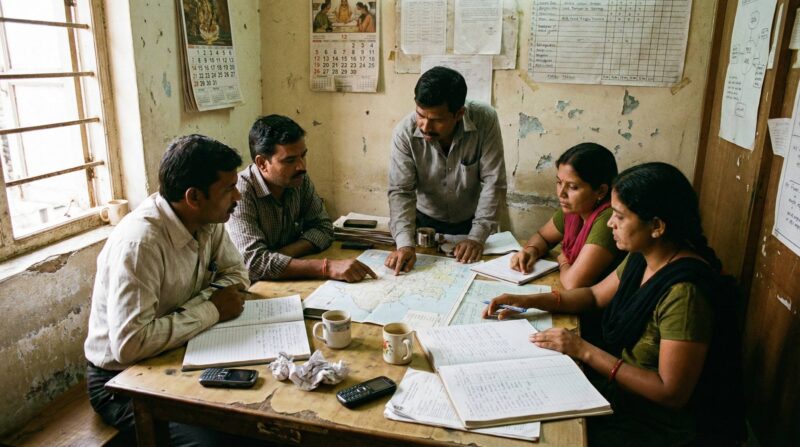 Behind many visible enterprises are interior spaces of planning and collaboration, where entrepreneurs and community actors coordinate resources, share knowledge, and design practical responses to structural constraints.
Frugal innovation is therefore not technological inferiority. It is intentional design under constraint.
Across South Asia, this approach is embedded in traceable practices: community-financed sanitation systems in Karachi, participatory agricultural knowledge platforms in India, agent-based mobile money infrastructures in Bangladesh, and civil-society-led material reuse networks that transform waste into livelihood opportunities. These are not isolated technologies but lived systems, shaped by informal governance, trust networks, and institutional gaps.
Informal economies play a central role in this process. Rather than signifying inefficiency, informality often functions as a site of experimentation where systems are iteratively refined in response to lived experience.
Enabling environments — patient capital, adaptive regulation, and long-term public–private coordination — are essential if grassroots innovations are to scale without being absorbed or distorted by formal systems.
Yet innovation born of necessity should not be romanticized. Persistent reliance on informal solutions often reflects systemic failures in public service provision, labor protection, and welfare systems. The burden of resilience is disproportionately borne by marginalized communities — particularly women and informal workers — whose adaptive strategies compensate for institutional absence rather than substitute for structural reform.
The dynamics of constraint-driven innovation become most visible when local solutions encounter formal capital, regulation, and institutional scale.
Digital Green, for example, emerged to address gaps in agricultural extension services by enabling farmers to produce and share locally relevant knowledge through low-cost digital tools. Adoption was driven less by technology than by trust: content reflected local conditions and was validated through peer experience rather than distant experts.
 Grassroots economic activity is not static — it evolves in dynamic tension with urbanization, formal capital, and global supply chains, revealing both the promise and pressures facing locally embedded innovation systems.
As platforms like Digital Green scale, however, new questions arise. Governance structures, data ownership, and funding sources increasingly shape who benefits. Community knowledge becomes data infrastructure. Decisions once made locally move upward into institutional and platform governance.
The Orangi Pilot Project in Karachi offers a different model of scale. By enabling low-income communities to finance and implement sanitation infrastructure themselves, while the state provided trunk connections, OPP demonstrated that communities can deliver cost-effective and durable urban services when institutional roles are redesigned. Yet replication depends on political will, regulatory flexibility, and sustained public investment — conditions that are not always present.
Goonj in India illustrates both the potential and the limits of civil-society-led innovation. Beginning as a grassroots effort to redistribute discarded clothing, it evolved into a nationwide development model that transforms textile waste into community assets. As Goonj expanded, however, logistical complexity increased, regulatory requirements intensified, and reliance on corporate surplus introduced new vulnerabilities. Growth extended reach but also reshaped governance and value capture.
Across these cases, scale expands impact but also redistributes power.
Frugal and grassroots innovations often emerge from deeply embedded local systems. That embeddedness builds trust and adoption but can limit replication across regions. When formal capital, regulatory frameworks, and digital platforms enter the picture, priorities shift.
Investors seek efficiency and growth. Regulators require uniformity. Platforms centralize coordination. Each step can expand reach while simultaneously concentrating control.
 Informal markets and micro-enterprises form the backbone of everyday economic life across much of the Global South — spaces where constraint becomes the catalyst for continuous adaptation, exchange, and locally rooted innovation.
Digital finance platforms such as bKash illustrate this tension clearly. Agent-based networks have expanded financial inclusion across Bangladesh, but ownership and governance structures increasingly determine who captures value — users, agents, shareholders, or the state. Financial inclusion may expand even as value flows upward.
These are not abstract paradoxes. They are structural trade-offs that shape the trajectory of innovation under constraint.
Neither full standardization nor complete localization offers a solution. Hybrid approaches — modular design, decentralized implementation, adaptive regulation, and aligned capital — are required if constraint-driven innovations are to scale without losing local relevance.
For impact investors and policymakers, this raises difficult questions. Scale should not be treated as an unquestioned good. Growth that erodes community agency or redistributes value upward risks undermining the very impact it seeks to achieve. Ownership and governance structures matter as much as innovation itself.
Innovation under constraint offers lessons — but not templates — for the impact economy.
As climate stress intensifies and inequality deepens, resource constraints are becoming global rather than regional. Approaches developed across South Asia and the broader Global South demonstrate how systems can function with limited capital, fragmented infrastructure, and uneven institutional support. But they also reveal the structural conditions required for such models to endure.
Enabling environments — patient capital, adaptive regulation, and long-term public–private coordination — are essential if grassroots innovations are to scale without being absorbed or distorted by formal systems. Short-term project funding and pilot-driven approaches are insufficient. Ecosystem-level alignment is required.
For the impact economy, the central challenge is not replication but responsibility. If scale reshapes power, then impact-aligned capital must take responsibility for how that power is structured and where value ultimately accrues.
Innovation in South Asia and across the Global South is neither new nor derivative. It is a cumulative legacy of adaptation and collective problem-solving developed over generations. As the world confronts climate stress, inequality, and limits to growth, these approaches offer critical lessons — not only in doing



Related Content
For mission-led organizations, a change of manager tests whether workplace inclusion is built to last.
44
0
Artist Rob Strati on inherited objects, the limits of market price, and the creative possibilities…
85
0
Counting what we fail to prevent, sixty seconds at a time
89
0

How collateral rules and payment terms keep impact capital out of reach
195
0
Comments
Deep Dives
RECENT
 368
0
368
0
 351
0
351
0
 466
0
466
0
Editor's Picks
 44
0
44
0
 85
0
85
0
 89
0
44
0
85
0
44
0
85
0
89
0
89
0
44
0
85
0
44
0
85
0
89
0
Webinars

Signed by the author. Collected at the door at Lipton Hall, NYU School of Law,…
News & Events

The September 14 program and a live IFI Tool demo are online

Pre-seed and seed startups can apply on a rolling basis

Their Built platform helps teams design, launch and run funds
Subscribe to our newsletter to receive updates about new Magazine content and upcoming webinars, deep dives, and events.
Become a Premium Member to access the full library of webinars and deep dives, exclusive membership portal, member directory, message board, and curated live chats.


0 Comments