What a Broken Plate Reveals About Value
Artist Rob Strati on inherited objects, the limits of market price, and the creative possibilities…



Artist Rob Strati on inherited objects, the limits of market price, and the creative possibilities…

 78
78
 0
0

Counting what we fail to prevent, sixty seconds at a time
84
0

How collateral rules and payment terms keep impact capital out of reach
 191
0
191
0

How states can crowd in local early-stage capital
362
0

Why last-mile healthcare needs an operating model, not just more mobile clinics
 343
0
343
0

How Australia’s succession wave could turn ownership into a funding model
 461
0
461
0
 886
0
886
0

For values-aligned investors, the challenge is not only choosing what to own, but understanding what ownership means.
Values-aligned investing is no longer just a question of investor intention. It is a question of infrastructure. Ziggma, a broker-agnostic portfolio intelligence platform, is trying to help self-directed investors see not only how their portfolios perform, but what their holdings represent in the real world.
There is a certain kind of founder who does not begin with a product idea so much as a discomfort — a sense that something in the system is not quite working as it should. That is the thread that runs through Ziggma. When I sat down with founder Ulrich Ebensperger, what stood out was not a pitch, but a quiet frustration with how modern investing has been built. Not broken, exactly, but incomplete.
Ziggma is a broker-agnostic portfolio intelligence and research platform built for a new generation of self-directed investors: people who want strong long-term returns without losing sight of their values.
It is important to be clear on what Ziggma is not. It is not a broker. It does not execute trades or hold assets. Instead, it uses open banking infrastructure — currently most effective in the U.S. — to let investors link their existing brokerage accounts to the platform. Once connected, Ziggma becomes a layer of intelligence on top of those accounts.

Ulrich Ebensperger, founder of Ziggma. Source: Ziggma
The platform is designed to make portfolios more legible. It shows investors how their holdings are constructed, what they are exposed to, how they are performing, and what kinds of real-world impacts those holdings are connected to. I used the platform myself over the last couple of weeks. As someone at the beginning of my investing journey, early in my career, I found it less a tool that tells investors what to do than one that helps them see more clearly.
That distinction matters. You begin to understand your portfolio as a system rather than a list of positions. It becomes something you can interrogate, optimize, and gradually align with your intentions. Ziggma does not make decisions for you, but it can change the quality of the decisions you make.
Ebensperger’s path into this work was not straightforward. He studied economics in the U.S., initially hoping to work in the NGO sector before moving into finance when that route proved difficult to access. The tension stayed with him. As an economist, he was drawn to questions of capital and labor: how resources are allocated, who makes those decisions, and what those allocations ultimately shape in the real world.
Owning a stock, whether directly or through an ETF, makes investors partial owners of real corporate behaviour.
Over time, that interest developed into a broader dissatisfaction with the retail investing tools available to self-directed investors. In his view, most platforms still fall short of what many investors actually need: transparency, structure, and context around both financial performance and impact.
Ziggma was first conceived around 2018, then paused, and restarted in earnest in 2021. Since then, it has been built slowly by a small team of four, spread between Toronto, the Bay Area, and Europe. One of the co-founders works at Google in an AI research role while also contributing part-time. The company has remained entirely self-funded, with the founders paying themselves modestly and building around part-time commitments.
The product has been shaped by constant iteration. The team only recently moved from WordPress to a more scalable setup. More importantly, the company’s own narrative has shifted: from a focus primarily on returns to one that integrates impact as a core component of investment intelligence.
At a product level, Ziggma combines several layers. While it is often framed as a portfolio intelligence tool, one of its newer entry points is values-aligned screening, which allows users to shape what enters their portfolios in the first place. Investors can filter companies and funds based on sustainability-related criteria, including exposure to fossil fuels, deforestation risk, and broader environmental metrics such as recycling intensity.
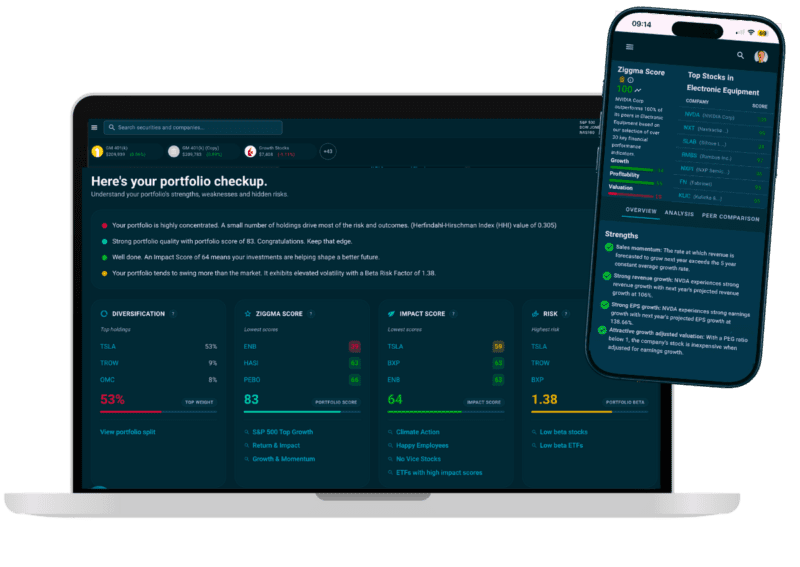
Ziggma’s portfolio checkup gives users a clearer view of financial performance, portfolio structure, and sustainability-related exposure.
Only after this filtering layer does the platform expand into its portfolio analytics engine, including a proprietary “Ziggma Score” developed using Python-based models to normalize and compare companies across financial and impact metrics. The aim is to make trade-offs more visible, helping users compare companies not only on performance but on a more structured set of criteria. There is also an optimization tool that lets users simulate a trade before making it, showing how the change would affect the overall portfolio.
Together, these features point toward a larger ambition: helping investors act more deliberately rather than reactively.
A key part of the platform’s data infrastructure comes from ACA Ethos, a specialist provider of ESG and impact data acquired by ACA Group. That data relationship allows Ziggma to move beyond company self-reporting and incorporate external sustainability and impact metrics into investment decisions.
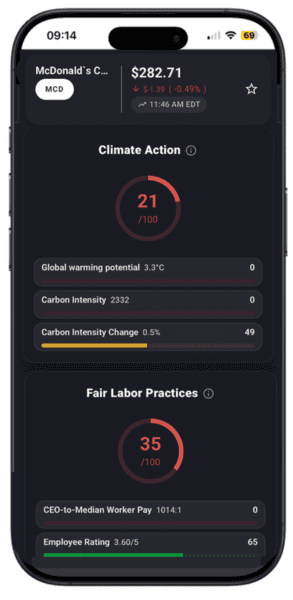
Climate action score displayed on mobile, showing example for McDonald’s. Source: Ziggma
Ebensperger is critical of the traditional ESG paradigm, which he sees as too inward-looking. In his view, much ESG analysis focuses on how environmental, social, and governance factors may affect a company’s financial performance. Ziggma is trying to ask a different question: what do companies actually do in the world, and how should investors understand their exposure to that activity?
That distinction is especially important at a moment when ESG has become both politically contested and conceptually strained. Many investors remain interested in values-aligned investing, but they are also wary of greenwashing, inconsistent ratings, and sustainability claims that do not translate into measurable real-world outcomes. For retail investors, the problem is even sharper: the information exists in fragments, but rarely in a form that is easy to interpret or act on.
For Ebensperger, the issue goes beyond ESG altogether. It is fundamentally about corporate accountability, and how little visibility most investors actually have into what ownership implies in practice. Today, there is no single place where corporate stewardship is clearly synthesized. Some of it sits in sustainability reports, some in filings or disclosures, and some in third-party datasets. Even in their most complete form, these documents are often long, technical, and fragmented. Expecting a retail investor to extract meaningful insight from a 100-page sustainability report is unrealistic.
That gap is part of what Ziggma is trying to address: turning dispersed, often inaccessible information into something structured and usable at the point of investment decision-making.
Once that information becomes visible, the framing changes. Owning a stock, whether directly or through an ETF, makes investors partial owners of real corporate behavior. That raises a more uncomfortable question: not only what returns a company delivers, but what those returns represent.
There is a clear ambition behind this work: to help shift capital toward more responsible corporate behavior and increase transparency around sustainability in an investment context. Ziggma positions itself among a still-small group of retail investing tools attempting to integrate external impact data directly into portfolio decision-making.
But the work has not been frictionless. When the platform began leaning more heavily into impact, it lost some users. The reality is that while many investors say they want sustainability integrated into decision-making, behavior does not always follow. The challenge now is less about proving the concept than finding the right audience: people already receptive to this way of investing, but still lacking the tools to put it into practice.
The company has had meaningful early traction. According to Ziggma, roughly 30,000 to 40,000 users have registered over time, with a few hundred paying subscribers and about 4,000 monthly active users. It remains early-stage, and the product is still evolving quickly.
Open banking has also shaped the company’s geographic trajectory. The U.S. was the natural starting point because account linking is more mature and financial data is more standardized. Europe, by contrast, is more fragmented, especially around brokers and multi-currency support, and has only recently begun standardizing financial filings in a more meaningful way. At the same time, the team has noticed a behavioral difference: European investors tend to be more engaged with sustainability themes, while the U.S. offers stronger infrastructure for data integration.
The team itself remains intentionally small. Ebensperger also has a background in hybrid capital structures for insurance companies and has worked within mutual fund ecosystems in France, where sustainability reporting pressure has been notably strong. He describes some of those institutions as unusually proactive on sustainability, driven less by narrative than by regulatory and structural incentives.
On the user side, Ziggma’s ideal investor is clearly defined: a mid-career optimizer, typically 35 to 50, university-educated, middle to high income, focused on long-term financial outcomes but increasingly interested in aligning investments with personal values. At the same time, the platform clearly resonates with earlier-stage investors as well, especially those looking to build these habits from the outset.
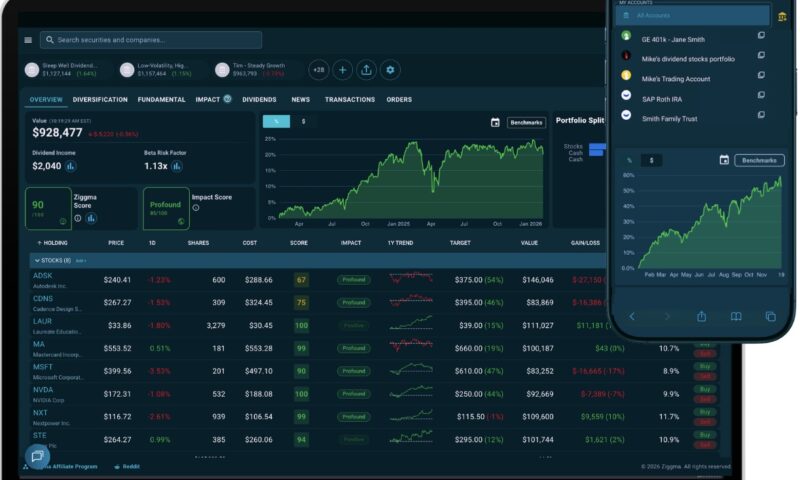
Ziggma’s dashboard aims to make a portfolio more legible as a system of holdings, exposures, and trade-offs.
Looking ahead, the next 6 to 12 months are focused less on adding new features and more on execution. Ziggma’s team plans to clarify the message, improve unit economics, and reach users who already have some version of this intent.
A significant recent milestone is the launch of the portfolio optimizer, which allows users to simulate trades before executing them and see how those changes affect both returns and portfolio structure. It is part of a broader push to make investing more deliberate, more transparent, and more connected to real outcomes.
For retail investors, the problem is even sharper: the information exists in fragments, but rarely in a form that is easy to interpret or act on.
As Ebensperger put it, things have changed significantly in just the last couple of months. The product is now at a point where it feels usable and coherent. The challenge is no longer whether it works, but whether enough people will actually engage with it.
“People say they want it,” he told me. The challenge now is getting that message in front of the right people, and showing what that looks like in practice.
That may be the central tension for values-aligned investing more broadly. The issue is not only whether investors care about impact. Many clearly do. The harder question is whether the infrastructure exists to help them translate that care into disciplined, informed, everyday investment decisions. Ziggma is one attempt to build that missing layer — not by replacing financial analysis, but by making visible the real-world consequences that have too often remained outside the retail investor’s field of view.


Related Content
Artist Rob Strati on inherited objects, the limits of market price, and the creative possibilities…
78
0
Counting what we fail to prevent, sixty seconds at a time
84
0
How collateral rules and payment terms keep impact capital out of reach
191
0

Why free education tools need reliable access, credible evidence, and lasting support
 250
0
250
0
Comments
Deep Dives
RECENT
 362
0
362
0
 343
0
343
0
 461
0
461
0
Editor's Picks
 78
0
78
0
 84
0
84
0
 191
0
78
0
78
0
84
0
191
0
191
0
78
0
78
0
84
0
191
0
Webinars
Signed by the author. Collected at the door at Lipton Hall, NYU School of Law,…
News & Events

The September 14 program and a live IFI Tool demo are online

Pre-seed and seed startups can apply on a rolling basis

Their Built platform helps teams design, launch and run funds
Subscribe to our newsletter to receive updates about new Magazine content and upcoming webinars, deep dives, and events.
Become a Premium Member to access the full library of webinars and deep dives, exclusive membership portal, member directory, message board, and curated live chats.


0 Comments