Shared Threads of Recovery
Risk-sharing, resilience, and post-genocide Rwanda



Risk-sharing, resilience, and post-genocide Rwanda

 1768
1768
 0
0

Blended finance, resilience bonds, and the emerging infrastructure of the impact economy
 1859
0
1859
0

What frontline job quality reveals about value, resilience, and scalable impact
 1552
0
1552
0

Can immersive experiences move people beyond consumption toward lasting change?
 2378
0
2378
0

As the extractive model sheds human workers to AI, a new regenerative economy is emerging
 1979
0
1979
0

How narrow strategies are helping ventures survive volatile ecosystems
 1931
0
1931
0

 4740
0
4740
0
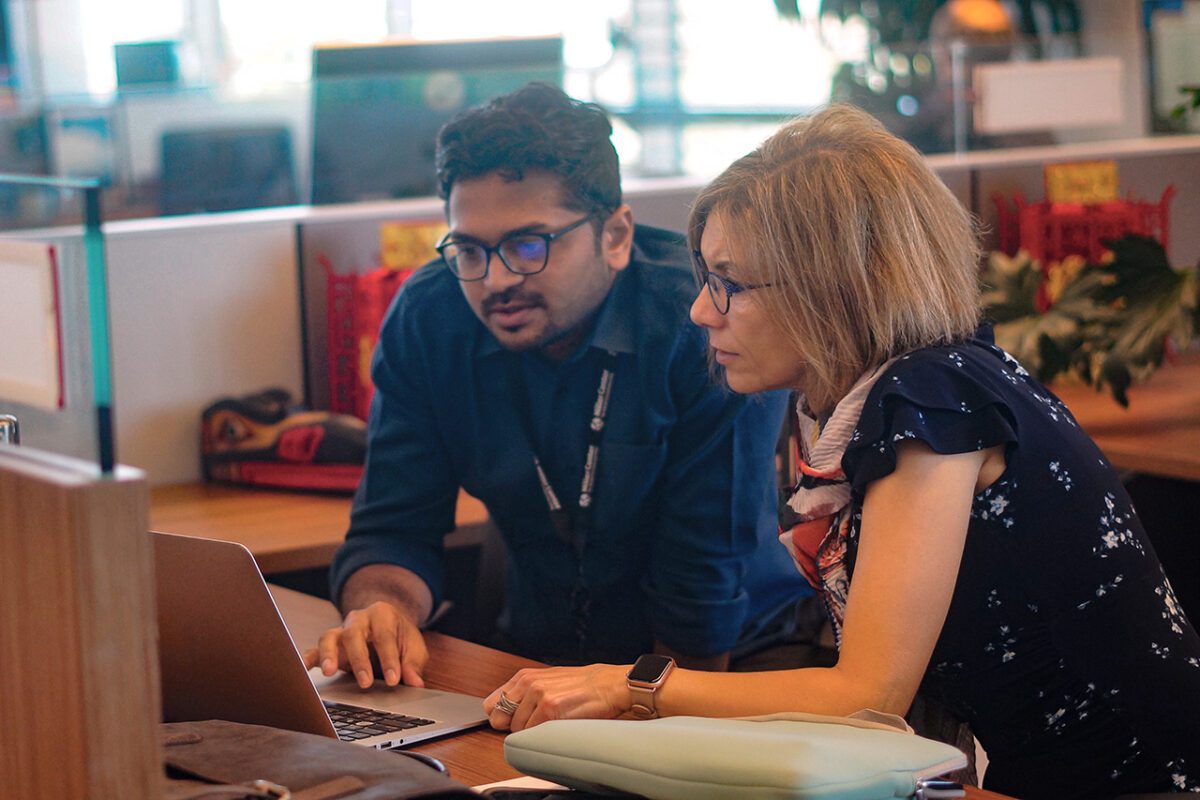
Executive mentor Mervat Mina working alongside Dr. Shantanu Pathak, founder and CEO of CareMother, at Miller Center’s In-Residence program; Courtesy of Miller Center
Recently, I sat in on a mentorship session between a seasoned executive mentor and a social entrepreneur from Uganda. The entrepreneur, full of passion for her mission, had poured every detail of her idea onto a dozen slides. Her mentor listened intently, asked a few clarifying questions, and then paused. Instead of critiquing, he asked, “What problem are you solving for your customer in the simplest possible terms?”
The question shifted the entire conversation. The entrepreneur re-centered her story, stripped away the jargon, and found the clarity she needed. Later, she told me that this moment gave her the confidence to approach investors with a renewed sense of purpose. What struck me most was that the mentor walked away just as energized, telling me, “I came here to help her, but I think I learned more from her about courage and conviction than she did from me.”
That is the heart of mentorship. It is never a one-way street. It is an exchange that benefits both sides, giving mentors meaningful opportunities to give back while social entrepreneurs gain guidance and encouragement. In the impact space, where access to seasoned mentors can be limited, these relationships are especially valuable because they not only strengthen individual enterprises but also strengthen the entire social impact ecosystem.
Our experience at Miller Center and our observations of other mentoring relationships illustrate that the strongest mentor-entrepreneur relationships thrive on reciprocity.
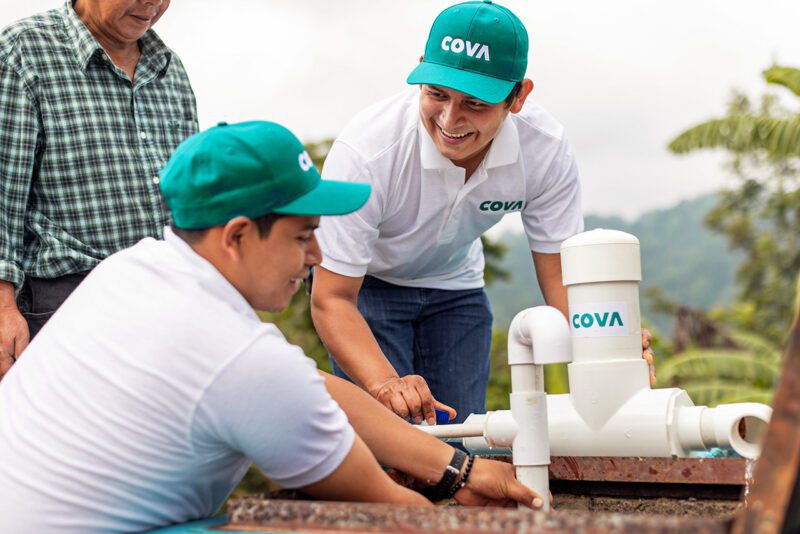 Cova team members installing community-centered safe water solutions in Central America. CEO Wesley Meier credits his mentors with helping build his financial model; Photo courtesy of Cova
What Entrepreneurs Gain
Sharper business models. Mentors challenge assumptions and help refine business strategies, grounding big visions with practical steps. Wesley Meier, co-founder and CEO of Cova in Central America, shared how his mentors, Aimee Brown and Diana Walke, brought deep financial expertise that proved pivotal. He explained, “They asked me the tough questions about why and how my ideas would work. They pushed me to think deeper. Aimee and Diana played a major role in building our financial model, and that model has been at the center of the progress we’ve made since.”
 Be Girl customer benefiting from the company’s dignified, stigma-free period care. Mentor support and key introductions helped CEO Diana Sierra secure a $2.4 million contract from UNFPA Angola; Photo courtesy of Be Girl
Networks and credibility. A mentor’s endorsement carries weight, and some entrepreneurs secure their first funding opportunities through mentor introductions. That stamp of approval can make doors swing open. Diana Sierra, founder and CEO of Be Girl, built a close relationship with her mentors, Peter O’Riordan and Linda Keegan, who stayed by her side long after the program ended. A few months later, Diana was staring at a $2.4 million contract from UNFPA Angola, nearly 24 times larger than Be Girl’s usual order size. The team was excited but also nervous. The only missing piece was purchase order financing. Her mentor stepped in and said, “Why don’t you reach out to Miller Center Capital? I can connect you.” Diana describes that introduction as a turning point for Be Girl, catalyzing enough financing from multiple investors to fill the order.
The future of social entrepreneurship depends not only on bold ideas and capital but on relationships built on trust and accountability.
Emotional resilience. Leadership can often feel isolating, and every founder faces moments of setback or doubt. Having someone who believes in their vision, even in the hardest moments, can make the difference between giving up and pushing through. Anushri Alva, CEO of Adhyayan Quality Education Foundation in India, nearly walked away after losing critical funding during COVID. “I almost felt like Adhyayan would not survive,” she admitted. Her mentor, Lakshmi Karan, offered both strategic guidance and personal support at a time when she felt she was falling apart. “She nudged me just enough, in the most compassionate way, and helped me parse through my options,” Anushri reflected. Five years later, Adhyayan has grown from a single state with a shrinking team to a staff of 50 working across five states and more than 10,000 schools. She credits that resilience to the steady mentorship that helped her see that when doors close, windows can open.
What Mentors Gain
Perspective and purpose. Exposure to passionate leaders tackling global challenges can re-center mentors in their own lives and careers. Veteran business executive Richard Haiduck, who has mentored over two dozen social entrepreneurs, describes the experience as invigorating. “Making a difference is the reward. Social entrepreneurs arrive with important goals and enthusiasm, but providing outside perspective and hard-earned experience can be the missing piece they need to scale to the next level.”
Watching an entrepreneur succeed is profoundly rewarding.
Continuous learning. Mentors encounter innovative business models and frontier markets they might never otherwise see. They often describe being stretched and inspired in ways that conventional work or corporate boardrooms rarely offer. Since 2016, Dima Khoury has mentored entrepreneurs working in financial inclusion, education, and sustainable agriculture in Africa, Latin America, and the Middle East. She explained, “It’s humbling and extremely rewarding. Mentoring gives me an opportunity to make an impact with enterprises solving some of the world’s toughest problems. I feel deeply connected to their success."
Connection and fulfillment. Watching an entrepreneur succeed is profoundly rewarding. Beyond professional satisfaction, mentors often build lasting relationships that enrich their personal lives as well. As one of our longtime mentors, Cynthia Lang, put it, “It’s not charity. It’s a partnership. And I walk away more inspired every time.”
After years of seeing mentorship across different contexts, we know that the most effective relationships share a few common practices:
The future of social entrepreneurship depends not only on bold ideas and capital but on relationships built on trust and accountability. Mentorship is the thread that weaves these elements together, creating space for honest dialogue that can turn promising ideas into powerful solutions impacting thousands of lives.



Related Content

What FLY paper reveals about the limits of bespoke financial tools
 1496
0
1496
0

How impact and revenue can scale together
2100
0

Purpose language is not enough
 2473
0
2473
0

Why climate advocates need a stronger narrative
 1749
0
1749
0
Comments

Deep Dives
RECENT
 2378
0
2378
0
 1979
0
1979
0
 1931
0
1931
0
Editor's Picks
 9731
0
9731
0
 12358
0
12358
0
 10157
0
10157
0
 1768
0
1768
0
 1859
0
1859
0
 1552
0
1552
0
Webinars
News & Events
Subscribe to our newsletter to receive updates about new Magazine content and upcoming webinars, deep dives, and events.
Become a Premium Member to access the full library of webinars and deep dives, exclusive membership portal, member directory, message board, and curated live chats.

Join our global community of systems-minded changemakers.
Subscribe to the Impact Entrepreneur newsletter for the latest insights, magazine features, and invitations to exclusive webinars, Deep Dives, and events.





0 Comments