We Are Not Counting the Full Economy




 1448
1448
 0
0

Why militarized security keeps making us less safe
 1675
0
1675
0

Risk-sharing, resilience, and post-genocide Rwanda
 1582
0
1582
0

Can immersive experiences move people beyond consumption toward lasting change?
 2212
0
2212
0

As the extractive model sheds human workers to AI, a new regenerative economy is emerging
1809
0

How narrow strategies are helping ventures survive volatile ecosystems
1784
0

 6004
0
6004
0
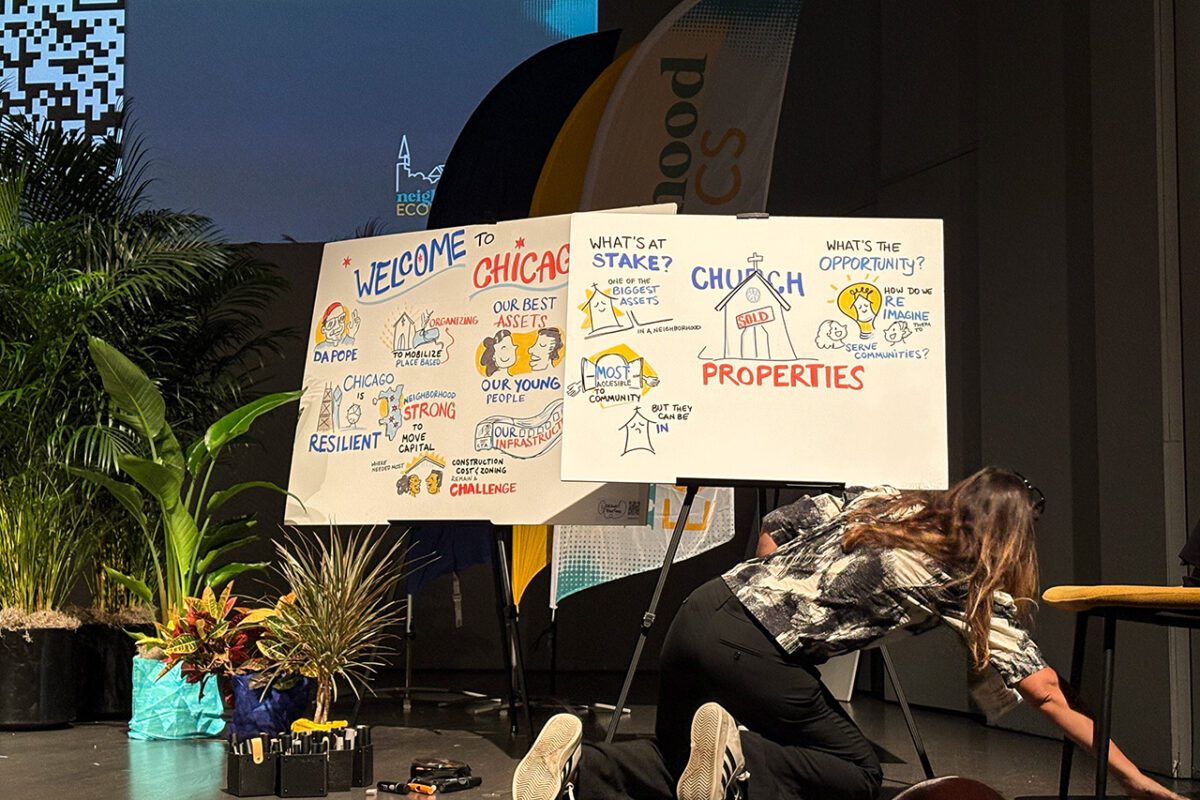
Photo courtesy of Neighborhood Economics
Chicago is a city of many monikers — The Windy City, Chi-Town, the Second City. “Second City” originally came from population rankings, but it also reflects Chicago’s rebirth after the Great Fire of 1871, when rebuilding from the ground up attracted architectural and industrial innovators like Frank Lloyd Wright and Aaron Montgomery Ward. Today, modern Chicagoans are again reshaping their city — this time through collaborative, community-driven economic models.
That spirit set the tone for the Fall 2025 Neighborhood Economics conference, a two-day, place-rooted exploration of capital strategies to repair local economies. Sessions brought impact investors, CDFIs, funders, community organizations, and faith leaders together to learn from neighborhood-led projects driving innovation and equity across Chicago.
In opening remarks, Allison Clark, Associate Director of Impact Investments at the MacArthur Foundation, described Chicago as “based on discovery, recovery, and evolution” — a cycle increasingly visible in how faith institutions are stepping into new roles as partners in local economic revitalization.
Churches in evolution Across the U.S., churches and other faith institutions are wrestling with declining membership, rising costs, and questions of purpose. Yet these institutions — often community anchors for more than a century — remain some of the country’s largest landowners, with significant cultural capital and deep neighborhood roots.
 Rev. Dr Sidney Williams
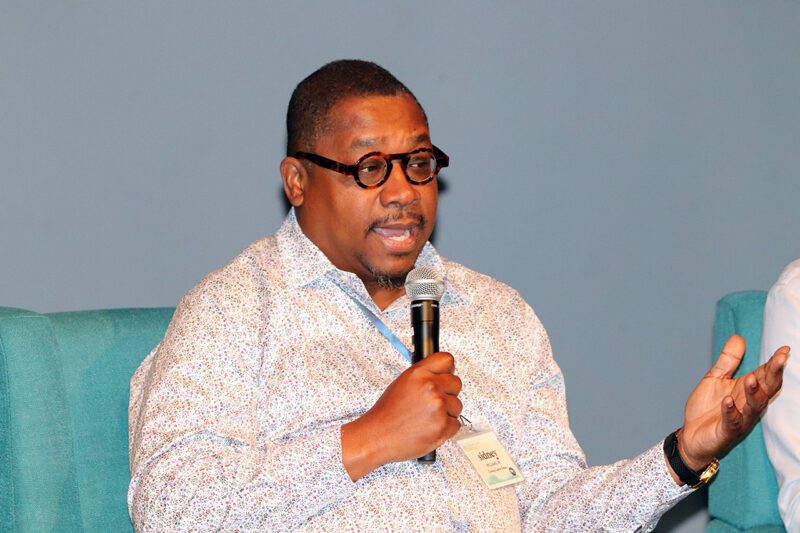
This creates a unique but often underused opportunity: churches are asset-rich but cash-poor. According to Rev. Dr. Sidney Williams, this dynamic is particularly acute among historically Black churches in gentrifying neighborhoods, where property values rise sharply even as congregational giving shrinks. Their buildings are valuable — but often inaccessible as engines of community prosperity.
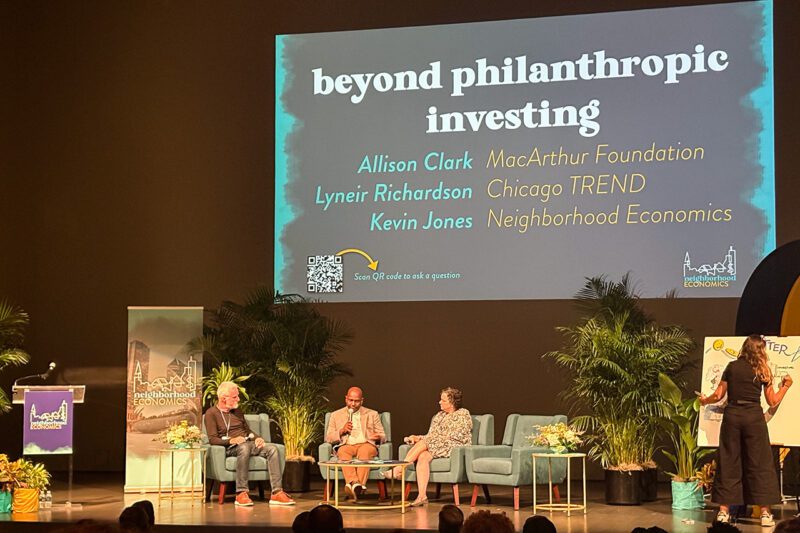
Neighborhood Economics positions itself as a “faith-friendly” convening that welcomes religious institutions into the conversation around community investment and local wealth creation. Churches already provide essential mutual-aid services — food support, childcare, shelter — and serve as social infrastructure in neighborhoods lacking civic centers. Their participation in place-based investing represents a natural next step.
The question many communities now face is less whether churches will survive, and more: What is lost if they close — and what is possible if they reinvent?
On Chicago’s West Side, Lawndale Christian Community Church (LCCC) shows what reinvention can look like. In 1987, LCCC founded the Lawndale Christian Development Corporation (LCDC) to address disparities and build community wealth. Since then, LCDC has channeled more than $120 million into affordable housing and commercial development, positioning North Lawndale residents to benefit from value created where they live.
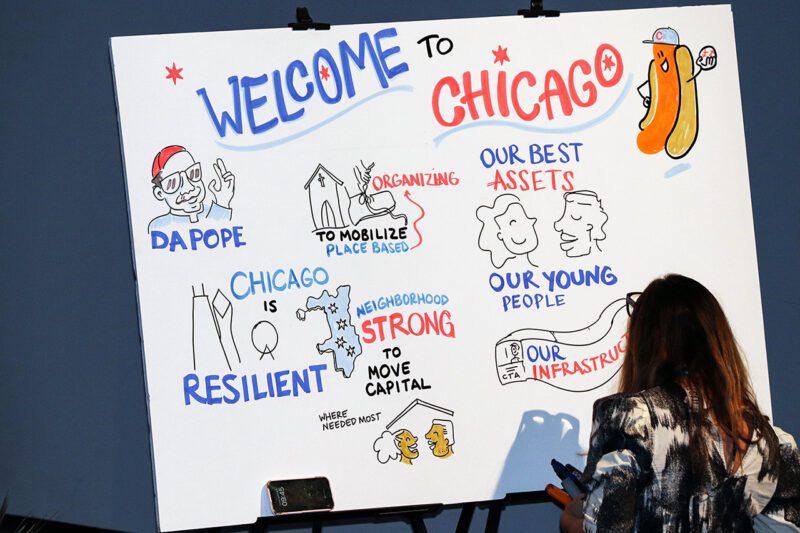 Photo courtesy of Neighborhood Economics
LCDC has cultivated trusted, cross-sector partnerships — with investors, CDFIs, philanthropic funders, and local leaders — all tied to residents’ priorities. Housing projects emphasize mixed-use design, affordability, and homeownership, aiming to build long-term economic mobility without displacement.
This year’s conference highlighted the Reclaiming Chicago Campaign, co-chaired by LCDC’s Dr. Richard Townsell and supported by funders including the Steans Family Foundation. Its goal: build 2,000 homes on Chicago’s south and west sides, at a pace calibrated to existing community capacity. The campaign focuses on affordable homeownership and wealth building to counteract structural disinvestment.
Over time, LCCC’s place-based ministries have expanded organically — the Lawndale Christian Health Center, Lawndale Christian Legal Center, and partnerships through the Christian Community Development Association (CCDA) — showing how faith institutions can seed multiple forms of community infrastructure as needs evolve.
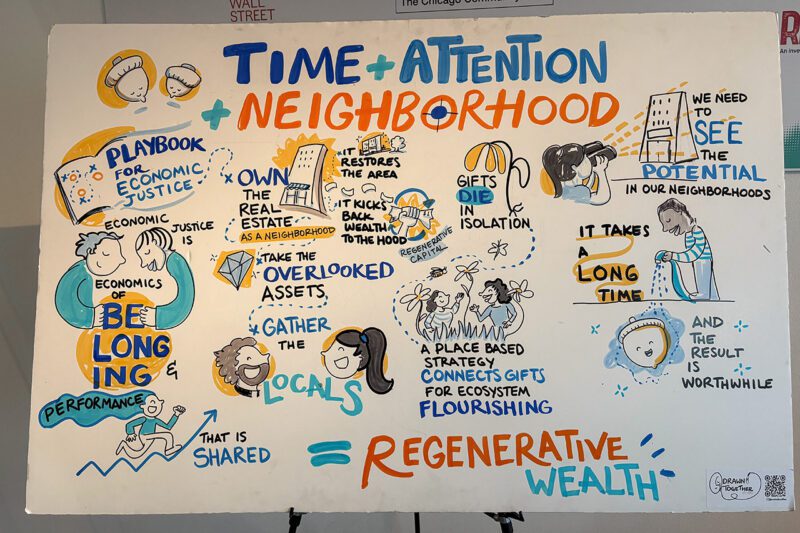 Photo courtesy of Neighborhood Economics
In New York City, Trinity Church Wall Street uses its property assets to address neighborhood needs directly. With limited public space for young people after school, Trinity opened its hall as a free community space for students — and gradually expanded offerings to include tutoring, sports, and music.
Many congregations will need outside expertise and bridge capital to get projects off the ground.
Trinity has also taken steps to help other congregations replicate mission-aligned redevelopment. Through Trinity Church Wall Street Philanthropies, the church supports grantmaking and impact investing that helps congregations launch local programs. Mission Real Estate Development (MRED) advises churches on planning, finance, and project management for income-generating developments. In 2024 alone, MRED supported proposals for over 800 affordable housing units — and has helped advance projects ranging from early-childhood education facilities in Pennsylvania to a solar farm in Zimbabwe.
These models demonstrate how religious institutions can reimagine underused buildings and land as platforms for community wealth rather than liabilities.
Faith institutions are the original place-based organizations — embedded physically, relationally, and culturally. This position gives them:
As such, they are uniquely positioned to negotiate development outcomes that prioritize long-term community benefit over short-term returns.
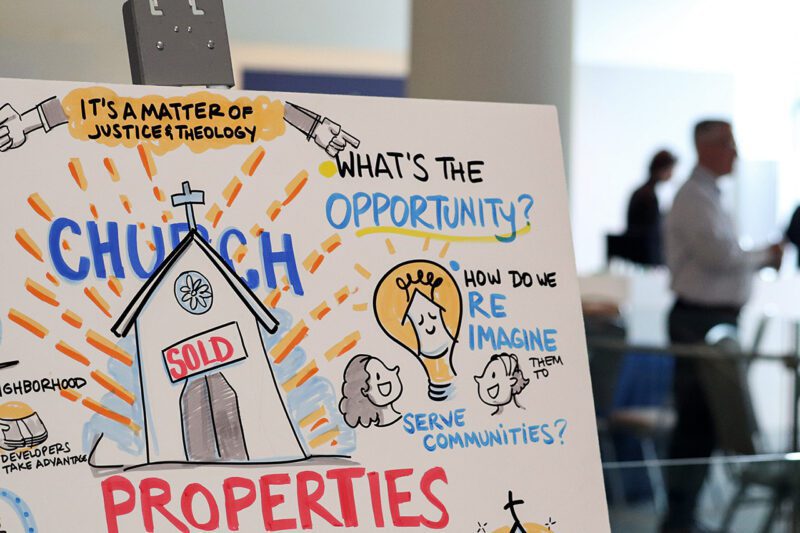 Photo courtesy of Neighborhood Economics
But success depends on partnerships — including:
These partnerships help navigate complexity, underwrite early-stage capacity, and activate land assets in ways that reflect community intent.
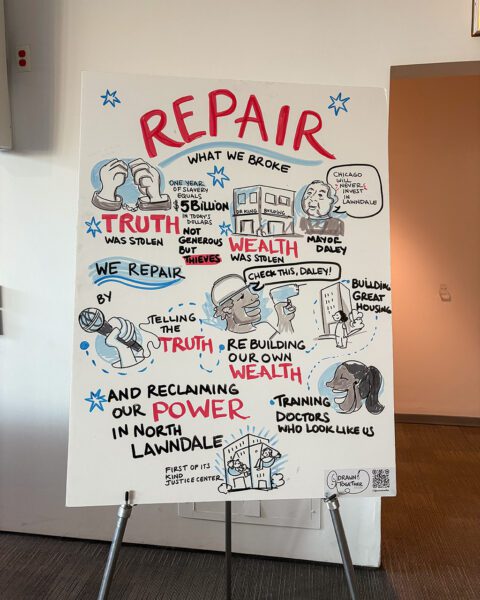 Photo Courtesy of Neighborhood Economics
While the promise is significant, faith-based community redevelopment faces challenges:
Recognizing these tensions helps avoid romanticizing the work. Many congregations will need outside expertise and bridge capital to get projects off the ground — and not every church will have the runway to pursue large-scale development.
From Chicago to New York, several principles are emerging:
Faith institutions are at an inflection point. As congregations shrink and inherited models evolve, churches have the opportunity to shift from charity and crisis response toward long-term, place-based economic stewardship. Whether through neighborhood CDCs, after-school programs, or mission-aligned development, they are helping communities build wealth for and with residents.
In a time of overlapping crises — housing, affordability, disinvestment — partnerships between churches, community organizations, and capital providers are among the most promising models for restoring neighborhoods without displacement, strengthening local ownership, and anchoring the architecture of a more inclusive, regenerative economy.


Related Content

What FLY paper reveals about the limits of bespoke financial tools
 1385
0
1385
0

How impact and revenue can scale together
 1978
0
1978
0
Purpose language is not enough
 2355
0
2355
0
Why climate advocates need a stronger narrative
 1662
0
1662
0
Comments

Deep Dives
RECENT
 2212
0
2212
0
 1809
0
1809
0
 1784
0
1784
0
Editor's Picks
 12178
0
12178
0
 10003
0
10003
0
 10250
0
10250
0
 1448
0
1448
0
 1675
0
1675
0
 1582
0
1582
0
Webinars
News & Events
Subscribe to our newsletter to receive updates about new Magazine content and upcoming webinars, deep dives, and events.
Become a Premium Member to access the full library of webinars and deep dives, exclusive membership portal, member directory, message board, and curated live chats.

Join our global community of systems-minded changemakers.
Subscribe to the Impact Entrepreneur newsletter for the latest insights, magazine features, and invitations to exclusive webinars, Deep Dives, and events.





0 Comments