Why Impact Finance Innovation Struggles to Scale
What FLY paper reveals about the limits of bespoke financial tools



What FLY paper reveals about the limits of bespoke financial tools

 3566
3566
 0
0
Why reconnecting education, work, and opportunity matters
 3938
0
3938
0
 2803
0
2803
0

What Colombia’s ex-FARC cooperatives reveal about reintegration
 613
0
613
0

What EOTs reveal about trust, transparency, and long-term value creation
894
0

Why the impact economy must reprice security — and fund prevention before the crisis
 757
0
757
0
 2590
0
2590
0
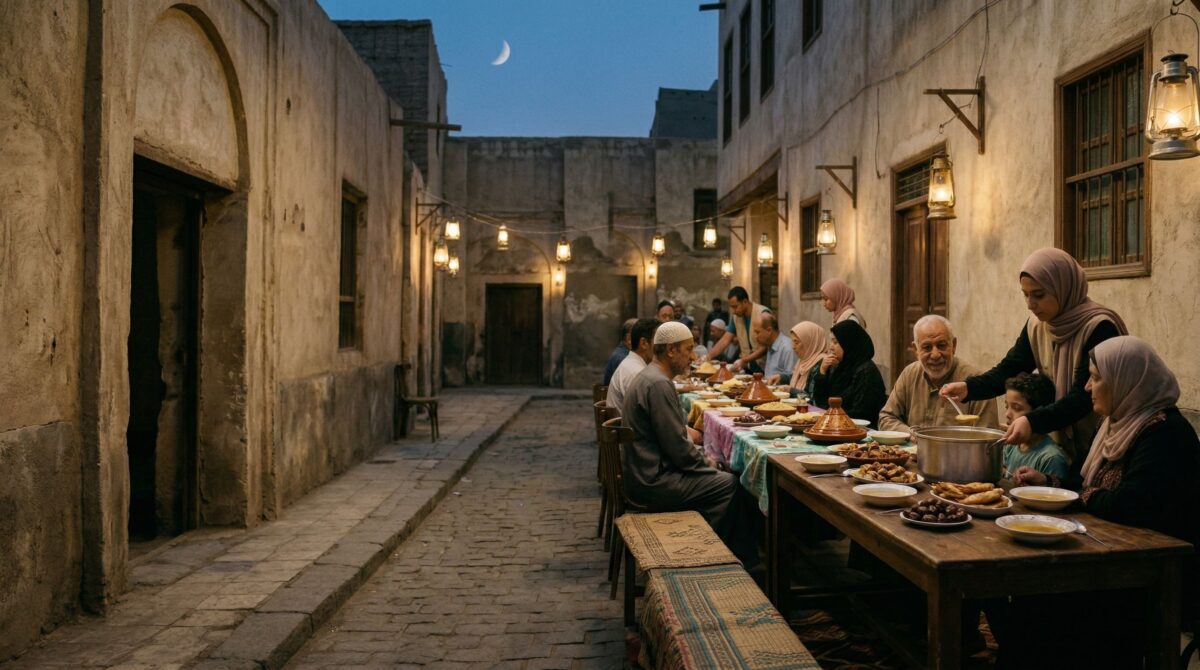
Ramadan is more than a spiritual season. It is a living demonstration of how redistribution, reciprocity, and mutual obligation can function at scale — and what that might mean for building more inclusive economies year-round.
For one month every year, the world witnesses one of the largest redistributions of wealth and resources on the planet — and it happens without a global institution, economic program, or government policy. It happens during Ramadan.
More than 1.9 billion Muslims observe Ramadan — one of the five pillars of Islam — as a month of fasting, reflection, and renewed moral attention. But beyond its spiritual dimension, Ramadan is also a season of sharing and collective responsibility that transcends borders and socio-economic lines.
Across cities and villages, routines shift. Working hours shorten, and evenings come alive with gatherings as families and neighbours break the fast together. Acts of giving, volunteering, and mutual aid move from the margins to the center of everyday life. Neighborhood solidarity kitchens appear, community groups distribute food, and digital donation platforms raise millions in a matter of days. Taken together, these countless acts of generosity trigger one of the largest decentralized waves of giving in the world. And it happens reliably every year.
For impact entrepreneurs, investors, and ecosystem builders, this raises an important question: what if we stopped treating solidarity as a seasonal surge of generosity and instead began designing institutions that extend its social logic throughout the year?
What makes Ramadan remarkable is not only the scale of generosity, but its decentralized nature. No central authority coordinates it. No global system manages it. Yet across continents, millions of people simultaneously activate networks of giving and mutual aid.
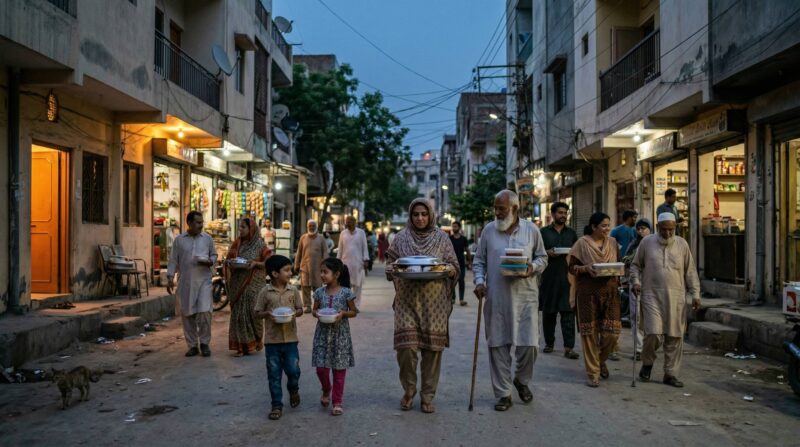
Ramadan’s deeper lesson may be that solidarity is already present in social life — the challenge is how to build institutions that sustain it beyond the season itself.
In cities and villages alike, acts of solidarity multiply almost organically, driven by a shared sense of responsibility toward others. What emerges, quietly but unmistakably, is a vast web of care — an informal infrastructure sustained from the ground up by communities themselves. Informal solidarity kitchens appear almost overnight. Volunteers prepare meals for those who cannot afford them. Local businesses donate ingredients. Families contribute what they can, sometimes food, sometimes time, sometimes simply an extra plate prepared for someone in need.
In Tunis, community associations organize collective iftars that bring together entire districts. From Cairo to Jakarta, streets transform into open dining spaces where strangers sit side by side to break the fast. In parts of rural Yemen, food circulates through extended family networks where each household contributes what it can — bread, dates, vegetables, or rice — helping ensure that everyone in the community can break the fast with dignity. What may appear as small individual gestures quickly accumulates into something much larger.
These initiatives are not isolated gestures of charity. They reflect a broader culture of shared responsibility that becomes especially visible during Ramadan. The result is a temporary but remarkably effective system of redistribution. Resources move quickly toward those who need them most. Wealth circulates rather than accumulates. Food reaches vulnerable households without complex bureaucracy or administrative layers. At the same time, social bonds deepen as communities reconnect around shared values of care, trust, and reciprocity.
For economists, such dynamics might resemble a decentralized social protection system — an informal safety net activated through cultural norms rather than public policy. For the communities themselves, however, the explanation is far simpler.
It is simply Ramadan.
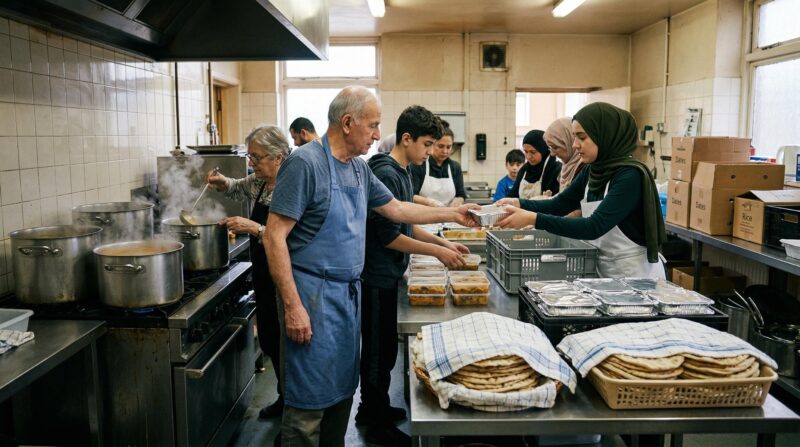
Informal food networks and neighborhood kitchens show how communities can mobilize resources quickly, without centralized systems, when care is treated as a shared obligation.
This spontaneous wave of solidarity is not accidental. It draws from deeper economic and ethical traditions embedded within Islamic values — traditions that have shaped systems of redistribution and collective responsibility for centuries.
Long before policymakers began discussing “social economy” models, Islamic traditions had already embedded redistribution into economic life.
Wealth was never viewed as purely individual accumulation, but as a trust carrying obligations toward the wider community. Two institutions illustrate this philosophy particularly clearly.
The first is zakat, the obligation to give a share of one’s wealth to those in need.
The second is waqf, charitable endowments that historically funded schools, hospitals, and other public infrastructure.
For centuries, these mechanisms functioned as structured forms of solidarity-based economics, helping wealth circulate rather than remain concentrated among a few. Beyond the scale of the funds involved lies a deeper philosophy: wealth is not only a private asset; it also carries a social function.
As one Tunisian development practitioner explained:
“What we call today the social economy is, in many societies, simply how communities have always organized themselves — through trust, responsibility, and mutual support.”
In fragile contexts, these principles are not theoretical. They are practical survival strategies.
In rural Yemen, Samia — a mother of four — supports her family by transforming agricultural waste into natural compost and growing organic vegetables that she sells in local markets.
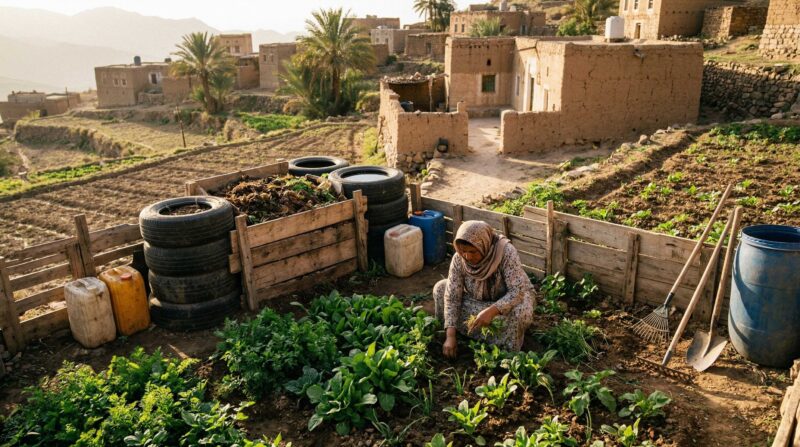
In fragile settings, resourcefulness, repair, and local exchange are not trends but survival strategies — and often the foundation of small-scale enterprise.
Her work did not begin as a business plan. It began as necessity.
“We don’t call it a business,” she told me with a smile. “We just use what we have, help each other, and make sure nothing is wasted.”
What Samia describes echoes practices found across many communities: repairing instead of discarding, sharing instead of accumulating, circulating resources locally. Today these approaches are often described with modern terms — circular economy, regenerative systems, local resilience. But for many communities, they have simply long been part of everyday life.
In that sense, Ramadan becomes a recurring proof of concept. It reveals something economic debates often miss: solidarity is not a scarce resource. It is a social capacity, already alive in culture, faith, and community life.
Today, these long-standing traditions of solidarity are increasingly intersecting with modern financial systems — giving rise to new possibilities for ethical finance and social entrepreneurship.
At a time when traditional development aid is under pressure and global financing gaps continue to widen, faith-based financial practices rooted in Islamic principles are gaining renewed attention as possible pathways for inclusive development.
The Islamic finance sector — spanning banks, sukuk (Islamic bonds), insurance, and investment funds — continues to expand across the Middle East, Southeast Asia, Africa, and increasingly global markets. What distinguishes it is not only scale, but philosophy: ethical investment, risk-sharing, asset-backed financing, and the avoidance of speculative practices.
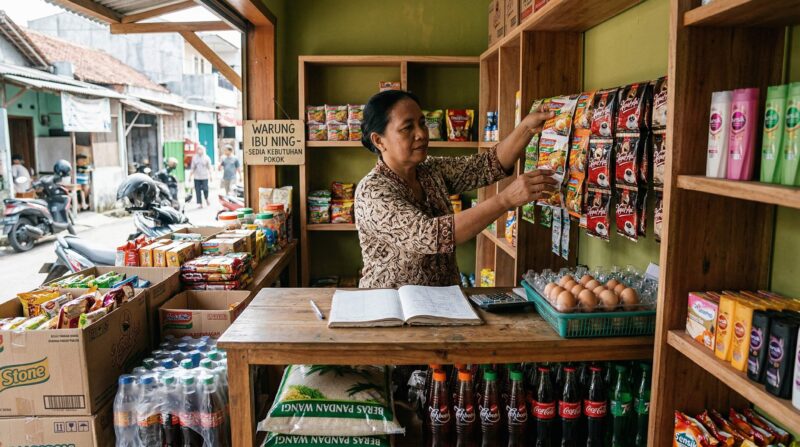
When zakat is linked to enterprise support, it can help strengthen microbusinesses through practical tools such as working capital, shop improvements, and basic financial guidance.
Indonesia, the world’s largest Muslim-majority country, offers one of the clearest contemporary examples of how zakat can move beyond relief and toward enterprise support. Through programs run by the national zakat agency, BAZNAS, some recipients receive not only productive, non-interest-bearing financing, but also business training and mentoring. In one recent case, a woman entrepreneur in West Sumatra reportedly increased her monthly business turnover after receiving support through one such program. In other initiatives, such as the ZMart program, zakat funds have helped neighborhood shop owners with working capital, storefront improvements, and basic financial management support.
In this sense, zakat can do more than provide short-term relief. Under the right institutional conditions, it can also become a pathway toward economic participation and microenterprise resilience.
Alongside institutional finance, diaspora communities are emerging as another powerful source of impact capital. According to the World Bank, remittances to low- and middle-income countries reached approximately $685 billion in 2024, surpassing official development assistance. Increasingly, these flows are being discussed not only as household support, but as capital that can help sustain community initiatives, local resilience, and small enterprise activity.
Every year, for one month, millions of people demonstrate that redistribution, ethical obligation, and community responsibility can function at scale — even without formal economic frameworks.
Ramadan reminds us that the social economy is not something we need to invent from scratch. In many parts of the world, it has been practiced quietly for generations. Trust networks are already present. Norms of reciprocity are already embedded. Mechanisms for circulating resources already exist.
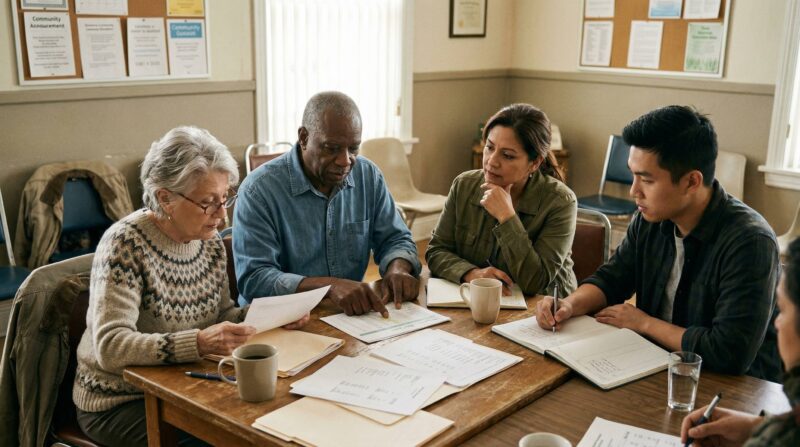
Ethical finance becomes most meaningful when it is rooted in real relationships, helping communities circulate capital in ways that reinforce trust, responsibility, and resilience.
In that sense, Ramadan becomes a recurring proof of concept. It reveals something economic debates often miss: solidarity is not a scarce resource. It is a social capacity, already alive in culture, faith, and community life.
The opportunity is not simply to admire these traditions, but to build from them — to connect long-standing practices of mutual obligation with modern tools of entrepreneurship, finance, and institutional design. Social enterprises, cooperative finance models, community investment funds, and solidarity-based businesses all offer ways to translate episodic generosity into durable structures.
If solidarity can mobilize entire communities for thirty days each year, it can also help inspire economic systems designed to serve people the rest of the year.
Perhaps the future of more inclusive economies does not lie in inventing something entirely new, but in recognizing forms of wisdom and organization that have long existed — and choosing to strengthen them with intention.


Related Content
How legal design reshapes voice, risk, capital, and value
 827
0
827
0
A Calabar case for climate resilience
 546
0
546
0
Why income policy needs a systems-accounting lens
 678
0
678
0
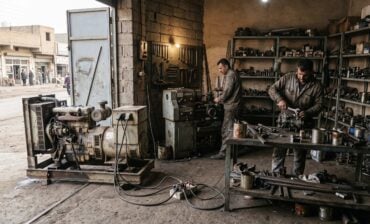
Why recovery depends on the systems that move capital, power, and goods
 618
0
618
0
Comments
Deep Dives
RECENT
 613
0
613
0
 894
0
894
0
 757
0
757
0
Editor's Picks
 25488
0
25488
0
 14569
0
14569
0
 13536
0
13536
0
 3566
0
3566
0
 3938
0
3938
0
 2803
0
2803
0
Webinars
Signed and personally inscribed — you'll write the inscription as you order. Limited · 50…
News & Events

Helps foundations, DAF holders, and family offices model how impact-first investing can extend charitable capital

To amplify entrepreneur voices in impact investing
Subscribe to our newsletter to receive updates about new Magazine content and upcoming webinars, deep dives, and events.
Become a Premium Member to access the full library of webinars and deep dives, exclusive membership portal, member directory, message board, and curated live chats.


0 Comments