What a Broken Plate Reveals About Value
Artist Rob Strati on inherited objects, the limits of market price, and the creative possibilities…



Artist Rob Strati on inherited objects, the limits of market price, and the creative possibilities…

 61
61
 0
0

Counting what we fail to prevent, sixty seconds at a time
73
0

How collateral rules and payment terms keep impact capital out of reach
 182
0
182
0

How states can crowd in local early-stage capital
357
0

Why last-mile healthcare needs an operating model, not just more mobile clinics
 333
0
333
0

How Australia’s succession wave could turn ownership into a funding model
 442
0
442
0

 3437
0
3437
0
India’s construction boom generates enormous waste — and opportunity. This article examines how a profitable circular economy enterprise transforms demolition debris into building materials, and what its growth constraints reveal about the real limits of scaling impact.
India is urbanizing at a pace often described as “building a new Chicago every year.” This growth comes at a steep material cost. Over one billion tons of virgin sand and five billion tons of crushed stone are extracted annually for construction, alongside vast quantities of raw soil. At the same time, India generates more than 150 million tons of construction and demolition (C&D) waste each year — less than one percent of which is recycled.
This waste clogs water bodies, pollutes public spaces, and contributes significantly to airborne dust and particulate pollution. The paradox is stark: an economy hungry for building materials discards enormous volumes of structurally viable debris while continuing to extract ever more virgin resources.
 Keyur Mahendra Sarda, founder and Director, Kesarjan Building Center Pvt Ltd
It is within this contradiction that Kesarjan Building Center, an Ahmedabad-based enterprise, has quietly built a profitable circular economy business — and in doing so, exposed a deeper challenge facing impact enterprises globally: how to scale material-intensive solutions without undermining their environmental logic or financial viability.
For Keyur Sarda, a construction engineer by training, the problem became apparent decades ago. In the late 1990s, when fly-ash bricks were already gaining popularity, he saw a flaw in their sustainability claims. While marketed as “green,” they still relied heavily on river sand and natural aggregates — resources under increasing ecological stress.
Demolition waste, he believed, could be a better substitute. But early experiments were economically unviable. Transporting debris and pulverizing it made upcycled bricks roughly 25 percent more expensive than conventional alternatives. The idea was sound; the system was not.
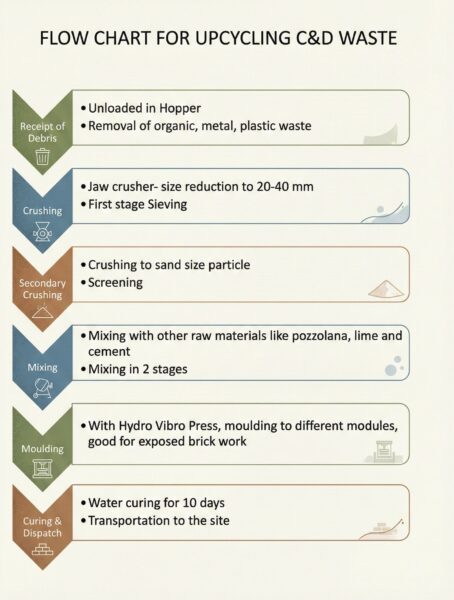
Rather than abandon the concept, Sarda spent the next decade experimenting. From 2010 onward, Kesarjan began combining C&D waste with ceramic tile debris, lime, textile sludge, foundry slag, fiberglass, thermocol, and other industrial by-products. The result was a range of custom bricks that offered better strength, consistent shape, multiple sizes, and color options — all while using dramatically fewer virgin inputs.
Today, Kesarjan’s products are competitive not despite their circularity, but because of it.
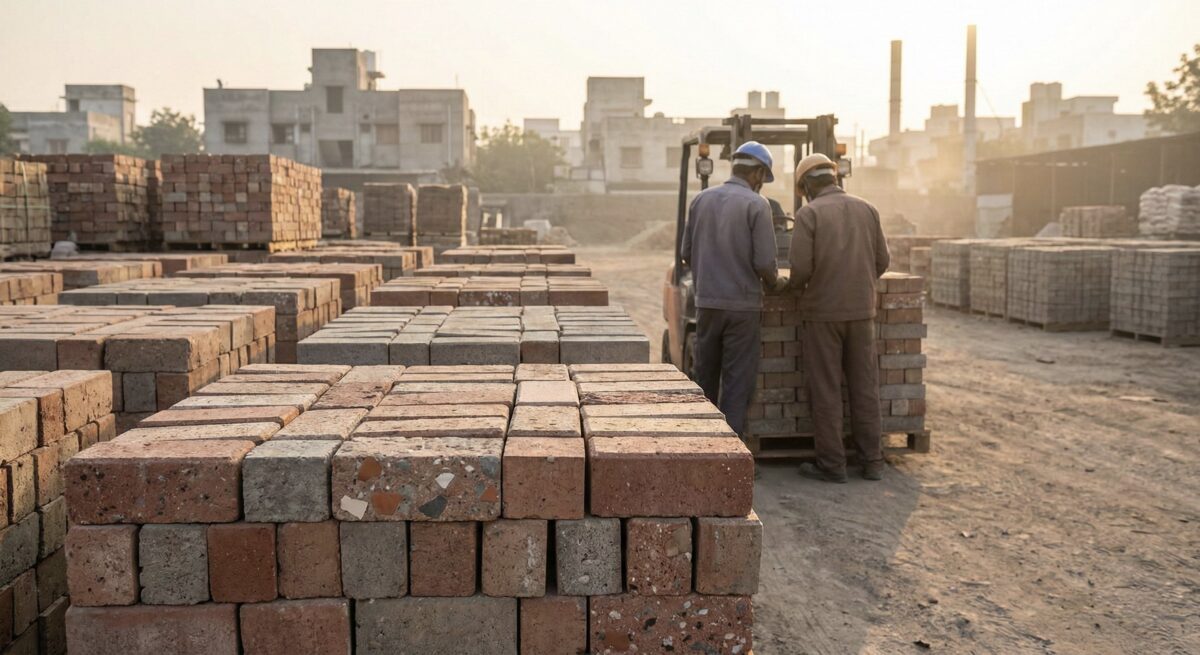
Kesarjan’s bricks now contain 85–90 percent recycled waste, compared to roughly 10 percent for comparable products. The company also produces lime mortar, marble powder, paver blocks, fired clay substitutes, and hand-finished materials for specialized applications.
A niche but steady market has emerged among eminent institutions, schools, private residences, and architects seeking both performance and sustainability. Kesarjan’s custom bricks are priced 30–50 percent lower than equivalent specialty clay-fired bricks. Lime mortar, used in place of cement, offers both an aesthetic finish and lower environmental impact.
After years of refining product-market fit, Kesarjan has been profitable for the past two years. Revenues grew more than 50 percent to approximately USD 350,000, with forecasts projecting steady annual growth of 15–20 percent at net profit margins near 15 percent.
Yet despite commercial viability, the enterprise faces familiar challenges: working capital constraints, operational complexity, founder remuneration, talent retention, and the recent exit of a partner.
Last year alone, Kesarjan diverted 3,000 tons of waste to produce 1.3 million bricks. Its process saves roughly one ton of water per ton of waste processed compared to other recycling methods.
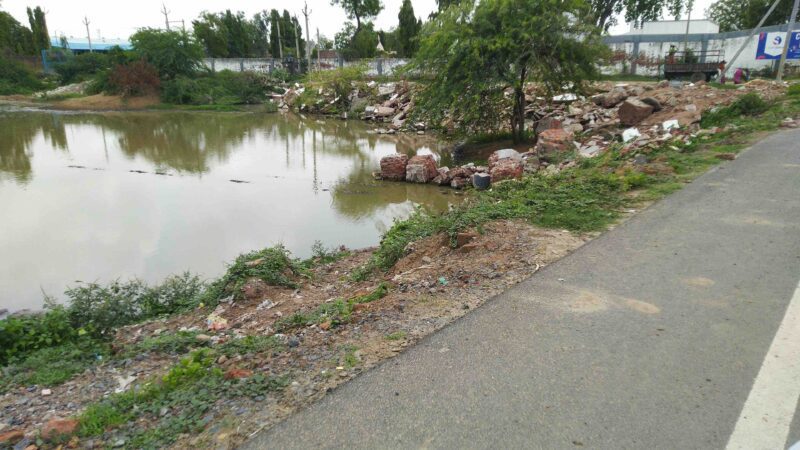 Indiscriminate dumping of C&D waste in a water body
Equally important — and often under-recognized — is the company’s social impact. Kesarjan employs 30 full-time workers, 40 percent of whom are women, many from socio-economically disadvantaged or minority communities.
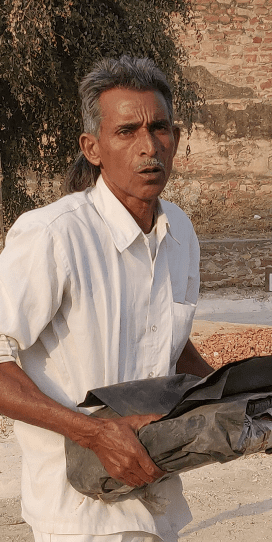 Master Artisan Fezu Khan
The work also sustains traditional craftsmanship. Master artisan Fezu Khan, for example, comes from a lineage of lime craftsmen who contributed to the construction and restoration of historic forts such as Mehrangarh and Naugar. In an era dominated by standardized materials, this preservation of skill represents cultural as well as economic value.
Kesarjan’s work has been recognized by institutions including the Asian Infrastructure Investment Bank, India’s Housing & Urban Development Corporation, and several industry bodies. Notably, however, a comprehensive analysis of greenhouse gas savings from reduced embodied carbon remains outstanding — underscoring a common gap between real-world impact and formal measurement.
The core constraint facing Kesarjan is not demand, but logistics. Approximately one quarter of its operating expenses are transportation-related. To limit both costs and emissions, the company sources waste within a 50-kilometer radius — a necessary environmental choice that caps volume growth.
This creates a strategic dilemma:
Should Kesarjan scale production to achieve economies of scale, increasing transport emissions in the process? Or should it remain small, decentralized, and local — maximizing environmental benefit but limiting financial growth?
To expand capacity, Kesarjan is seeking approximately USD 600,000 in capital investment for a new facility capable of processing 100 tons of waste per day, targeting annual revenues of USD 1.3 million at an estimated 18–20 percent return on investment.
Some impact enterprises are not designed for exponential growth — and forcing them into that mold may erode the very value they create.
Absent such capital, alternative scale pathways include:
Each option favors replication over centralized growth — a model that distributes impact but challenges traditional investment logic.
Kesarjan’s experience raises a question that extends far beyond India’s construction sector: who bears responsibility for scaling impact?
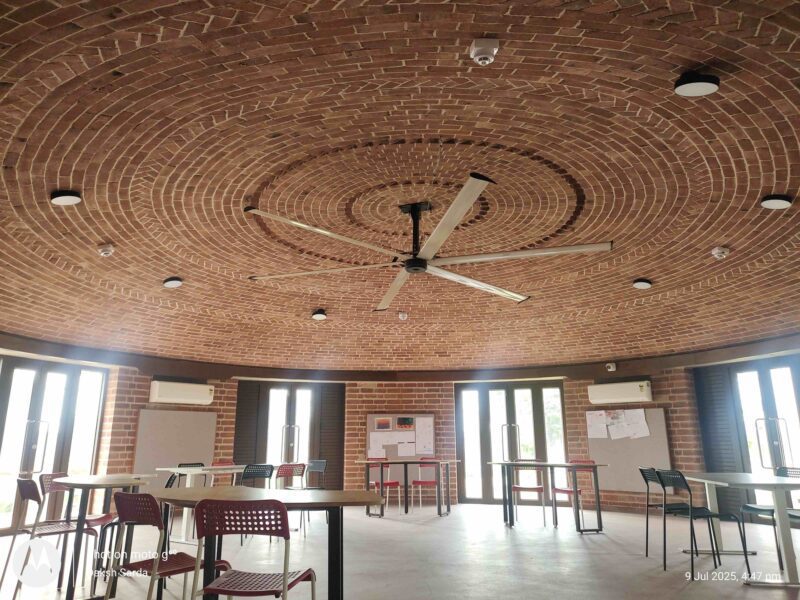 Upcycled bricks in school
Is it solely the burden of the entrepreneur? Or does responsibility extend to investors, developers, municipalities, and policymakers who benefit from cleaner cities, reduced extraction, and job creation?
Some impact enterprises are not designed for exponential growth — and forcing them into that mold may erode the very value they create. Instead, they require patient capital, blended finance, public procurement support, and ecosystem coordination to enable replication without distortion.
In this sense, Kesarjan is not merely a circular economy success story. It is a test case for the maturity of the impact economy itself.
If the sector is serious about delivering triple-bottom-line returns, it must learn to support enterprises whose greatest contribution lies not in scale alone, but in proving what is possible — and then helping others adopt it.
The future of impact may depend less on finding the next unicorn, and more on building the systems that allow enterprises like Kesarjan to multiply their effect without losing their soul.


Related Content
Artist Rob Strati on inherited objects, the limits of market price, and the creative possibilities…
61
0
Counting what we fail to prevent, sixty seconds at a time
73
0
How collateral rules and payment terms keep impact capital out of reach
182
0

Why free education tools need reliable access, credible evidence, and lasting support
 241
0
241
0
Comments
Deep Dives
RECENT
 357
0
357
0
 333
0
333
0
 442
0
442
0
Editor's Picks
 61
0
61
0
 73
0
73
0
 182
0
61
0
61
0
73
0
182
0
182
0
61
0
61
0
73
0
182
0
Webinars
Signed by the author. Collected at the door at Lipton Hall, NYU School of Law,…
News & Events

The September 14 program and a live IFI Tool demo are online

Pre-seed and seed startups can apply on a rolling basis

Their Built platform helps teams design, launch and run funds
Subscribe to our newsletter to receive updates about new Magazine content and upcoming webinars, deep dives, and events.
Become a Premium Member to access the full library of webinars and deep dives, exclusive membership portal, member directory, message board, and curated live chats.


0 Comments