What Civil Rights Leaders Can Teach Impact Investors
Democracy, narrative, and systems change


Democracy, narrative, and systems change

 266
266
 0
0
Lessons from Atlanta’s BeltLine and Pittsburgh Yards
 320
0
320
0

Jeremy Nicholls on building an accounting system fit for the impact economy
385
0

Local economies as a bulwark against cross-border extraction and violence
 885
0
885
0

Balancing production and preservation
1005
0

The metaphysics, the machine, and the future of the Impact Economy
 1019
0
1019
0

 4240
0
4240
0

A region with the world’s highest youth entrepreneurial ambition — yet among the lowest rates of actual business creation.
The MENA region is home to one of the world’s youngest and most ambitious populations. This demographic powerhouse is bursting with creativity, resilience, and entrepreneurial drive. Yet much of this potential remains untapped. According to the World Bank, one in every three young people in the region is unemployed — the highest rate globally. Local job markets cannot absorb the growing wave of graduates, the public sector is saturated, and private businesses often lack the scale and dynamism needed to generate meaningful opportunities for emerging talent.
In this context, entrepreneurship is not a luxury or fallback plan — it is a vital pathway forward. Nowhere is the need for a vibrant, youth-driven entrepreneurial culture more urgent, or more promising, than in MENA.
According to the Global Entrepreneurship Monitor (GEM) — a leading study tracking entrepreneurship across more than 100 countries — young people in parts of the MENA region consistently express some of the world’s highest levels of entrepreneurial intent. The desire to innovate, build businesses, and shape their own futures is strong and widespread.
But here lies the paradox: while ambition is high, the actual rate of new business creation lags behind regions like Sub-Saharan Africa, Southeast Asia, and Latin America. GEM’s Total Early-Stage Entrepreneurial Activity (TEA) index — which measures the percentage of adults actively starting or managing a new business — shows that many MENA countries trail significantly.

This gap between intent and execution reflects deeper structural challenges. Support systems across the region are not equipped to help young people turn entrepreneurial ideas into reality. As formal job markets shrink, many youths remain unemployed or turn to informal, survival-driven ventures with little chance to grow. These micro-enterprises often operate on razor-thin margins, without access to finance, mentorship, or legal recognition — trapping young entrepreneurs in subsistence mode rather than enabling them to thrive.
Entrepreneurship is not a luxury or fallback plan — it is a vital pathway forward.
Frustrated by these barriers, growing numbers of young people in countries such as Lebanon, Tunisia, and Egypt are looking abroad to fulfill their aspirations. This emigration is draining local economies of bright minds and bold ideas, transforming what could have been a demographic dividend into a missed opportunity. Energy that could have fueled local innovation and renewal instead powers other economies.
The combination of high youth ambition and entrenched barriers calls for bold action — not just to prepare the next generation for the future of work, but to prepare them to lead resilient, adaptive societies.
The 21st century is shaped by artificial intelligence, climate change, digital disruption, and geopolitical instability. Resilience, creativity, and leadership are no longer optional; they are essential. At its core, entrepreneurship is not just about launching businesses. It is a mindset — the ability to see opportunity where others see barriers, to act rather than wait, to learn through failure, and to build solutions from the ground up. Entrepreneurial thinking also fosters collaboration, empathy, and experimentation: skills most needed for the new economy.
Entrepreneurship must be treated as a core development pillar, not a niche initiative.
This mindset must move beyond startups and tech hubs into classrooms, communities, and everyday life. Young people must be equipped not only to weather uncertainty but to lead purposefully across sectors. Entrepreneurial thinking, like literacy or numeracy, can be taught — and must be introduced early. Waiting until university, or until a young person is unemployed, is far too late.
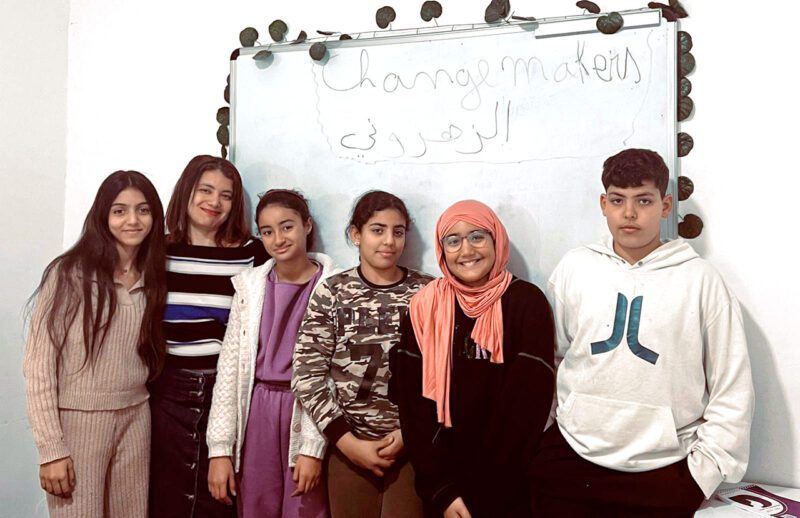 Changemaker Club members
Entrepreneurial education should begin in primary school, embedded in national curricula and reinforced through project-based learning, mentorship, and exposure to real-world challenges. It must not remain a privilege for elite schools or innovation hubs, but a right for all youth, accessible in every neighborhood across the region.
Despite significant gains in school enrollment, the MENA region faces a deep learning crisis. The World Bank reports that more than 50% of children in the region live in “learning poverty” — unable to read and understand a simple text by age 10. On global benchmarks like the PISA (Programme for International Student Assessment) tests, which evaluate 15-year-olds in reading, mathematics, and science, many MENA countries score among the lowest worldwide, particularly in skills tied to problem-solving, critical thinking, and creativity.
This crisis is not primarily a result of underfunding. Countries like Egypt, Tunisia, and Jordan allocate a substantial share of GDP or public spending to education. The deeper issue lies in outdated curricula and rote learning methods that fail to prepare students for a rapidly evolving, knowledge-driven world.

To truly prepare youth, classrooms must become environments that reflect real life — spaces that inspire curiosity, reward creativity, and cultivate resilience. Here’s how:
The challenges ahead — climate change, unemployment, inequality, and digital disruption — are too large for any single actor to tackle. Building a generation of entrepreneurial leaders in MENA demands a whole-of-society effort. Schools, civil society, the private sector, and governments must work together to cultivate a culture of innovation, problem-solving, and social impact.
Entrepreneurial thinking, like literacy or numeracy, can be taught — and must be introduced early.
Entrepreneurship must be treated as a core development pillar, not a niche initiative. Civil society can provide grassroots mentorship, the private sector can invest in youth ventures and internships, and governments can embed innovation in curricula, policies, and funding.
When these forces align, the impact goes beyond job creation. It catalyzes cultural transformation — where problem-solving is second nature, failure is embraced as growth, and youth are empowered not just to adapt to the future, but to shape it.
MENA youth already have the ideas, the drive, and the heart. With the right systems and support, they can be a force for inclusive growth and renewal across the region.


Related Content
Lessons from Atlanta’s BeltLine and Pittsburgh Yards
320
0
Jeremy Nicholls on building an accounting system fit for the impact economy
385
0

How portfolio theory could make cultural infrastructure more investable
 423
0
423
0
Why research infrastructure is the missing middle in climate-smart agriculture
 664
0
664
0
Comments

Deep Dives
RECENT
 885
0
885
0
 1005
0
1005
0
 1019
0
1019
0
Editor's Picks
 5749
0
5749
0
 3736
0
3736
0
 3667
0
3667
0
 266
0
266
0
 320
0
320
0
 385
0
385
0
Webinars
News & Events


Recognizing America’s fastest-growing purpose-driven companies

Across the cohort, founders are creating solutions at the intersection of sustainability and social impact
Subscribe to our newsletter to receive updates about new Magazine content and upcoming webinars, deep dives, and events.
Become a Premium Member to access the full library of webinars and deep dives, exclusive membership portal, member directory, message board, and curated live chats.

Join our global community of systems-minded changemakers.
Subscribe to the Impact Entrepreneur newsletter for the latest insights, magazine features, and invitations to exclusive webinars, Deep Dives, and events.


0 Comments