Impact Investing in APAC
A status report on talent, demand, and emerging pathways



A status report on talent, demand, and emerging pathways

 3084
3084
 0
0

 3207
0
3207
0
Building rural impact markets in Nepal
 3536
0
3536
0

The strategic shift transforming Singapore’s SMEs
 3319
0
3319
0

Why intangible assets matter more than you think
 4362
0
4362
0

Matching jobs with targeted, gamified, and accessible learning
 3072
0
3072
0
 2054
0
2054
0
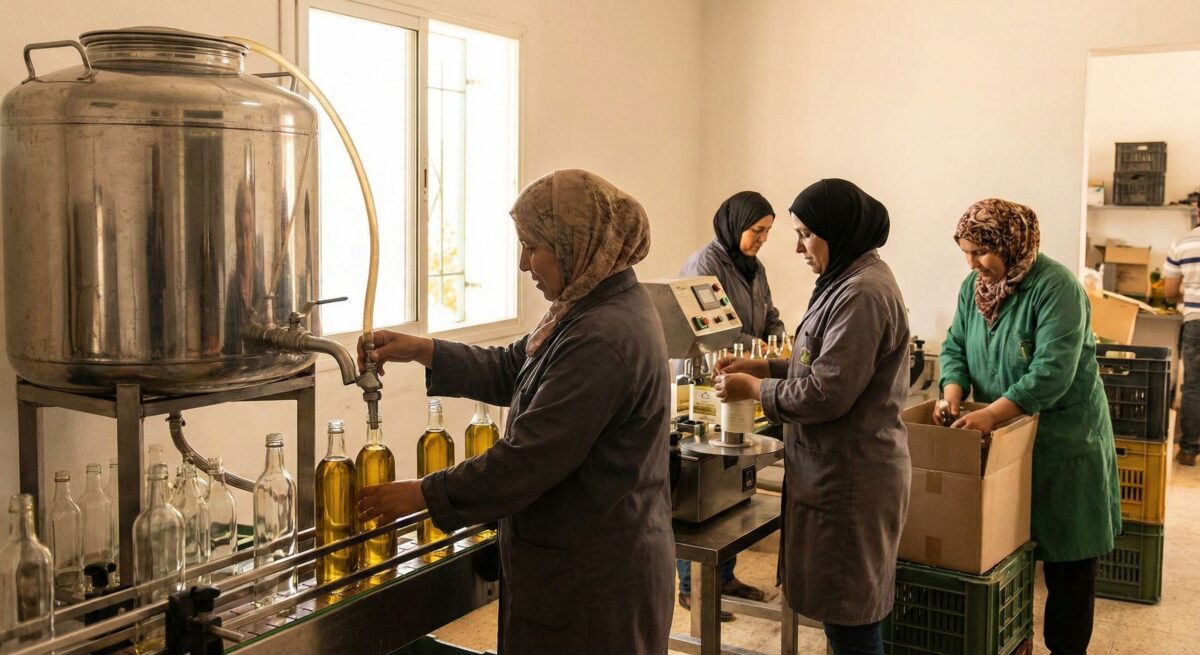
Tunisia is one of the world’s leading olive oil producers — yet many Tunisian families can no longer afford to cook with it. This paradox reveals how export-first agricultural models can generate foreign currency while undermining domestic access. Reimagining value chains, cooperative distribution, and public procurement could help ensure that national abundance once again supports everyday wellbeing.
Tunisia produces some of the world’s finest olive oil — yet many Tunisians can no longer afford to cook with it.
Olive oil sits at the heart of the Mediterranean diet and of Tunisia’s cultural identity. With more than 100 million olive trees stretching from north to south, olive groves shape the country’s landscapes and livelihoods so deeply that Tunisians often say: if the crescent and star did not adorn the national flag, the olive tree would.
Today, olive oil is also a cornerstone of Tunisia’s economy. The country consistently ranks among the world’s leading producers, with annual harvests ranging between 300,000 and 500,000 tonnes. The sector employs hundreds of thousands of people, generates vital foreign currency, and produces oils that regularly win international quality awards. Nearly 80% of Tunisia’s olive oil is organic, giving the country a strong comparative advantage in global markets increasingly shaped by sustainability and quality.
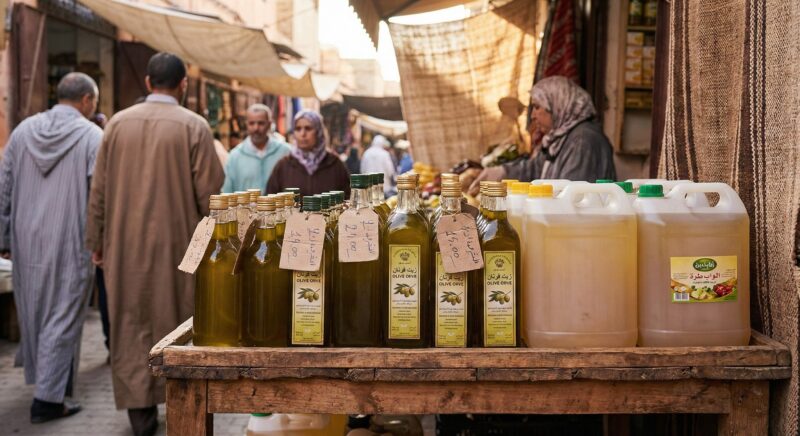
Global market pricing and subsidised imports have reshaped consumption patterns, pushing many households toward lower-cost oils despite Tunisia’s vast olive harvests.
And yet, despite this abundance, much of the benefit leaves the country. Each harvest season, celebration gives way to frustration as Tunisian families face high prices and dwindling access to one of their own most emblematic products.
Average domestic consumption stands at roughly three litres per person per year — among the lowest in the Mediterranean and far below consumption levels in Italy, Spain, or Greece. In a country rich in olive oil, many households can no longer afford to use it regularly.
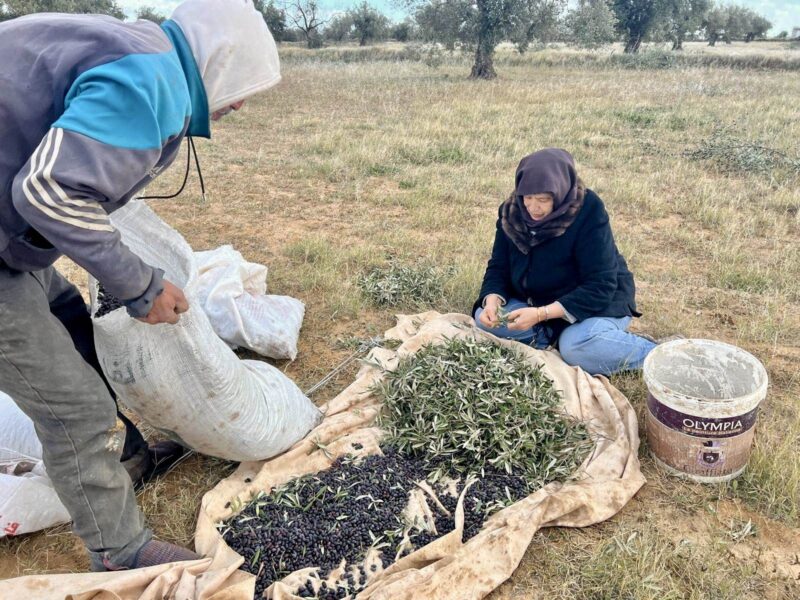
Harvesting olives in rural Tunisia — a centuries-old practice that sustains livelihoods and national identity, even as rising prices place this foundational food increasingly out of reach for many Tunisian households.
Understanding this paradox requires looking beyond harvest volumes to the structure of Tunisia’s olive-oil economy.
Tunisia’s olive-oil sector is built primarily around exports. More than 80% of national production is sold abroad, largely to the European Union. Italy and Spain — both competitors and buyers — absorb a substantial share, often purchasing Tunisian oil in bulk to blend, bottle, and re-export under their own brands. As a result, much of Tunisia’s high-quality production remains invisible to global consumers as a Tunisian product.
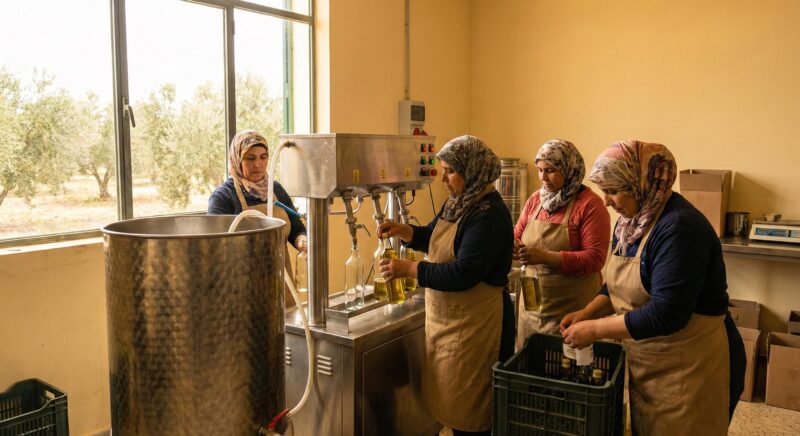
Cooperative and social-enterprise models offer pathways to retain value locally while keeping high-quality olive oil accessible within Tunisia.
This export-oriented model generates essential foreign currency but also limits domestic value capture. Selling unbottled oil abroad shifts branding, marketing, and price premiums outside Tunisia. Farmers and millers earn income, yet much of the higher-margin value accrues elsewhere, reinforcing dependence on export volumes rather than building a diversified domestic market.
The structure has direct consequences at home. Domestic prices are shaped less by local demand than by global markets. When international prices rise, Tunisian prices follow, exposing families to what many describe as “world prices without world incomes.” As export revenues increase, local consumers are priced out, turning instead to cheaper imported vegetable oils for everyday cooking.
Countries rich in agricultural production often export abundance while local populations struggle to access the very goods their economies produce.
Olive oil produced in abundance at home becomes increasingly inaccessible at home — a structural outcome of a system designed to export first and serve domestic consumers last.
Tunisia’s long-standing food subsidy system further complicates the picture. To protect household purchasing power, the state subsidises basic staples including imported vegetable oils. These oils are sold at controlled prices far below market cost, with the government absorbing a significant share of the expense — an estimated $40 million annually.
While socially motivated, this subsidy structure has created distortions. Limited quotas mean subsidised oil often disappears from shelves quickly, fuelling shortages and informal resale. Increasing quotas would deepen fiscal pressures on already strained public finances. Meanwhile, imported vegetable oils remain far cheaper than olive oil, pushing households toward lower-cost alternatives.
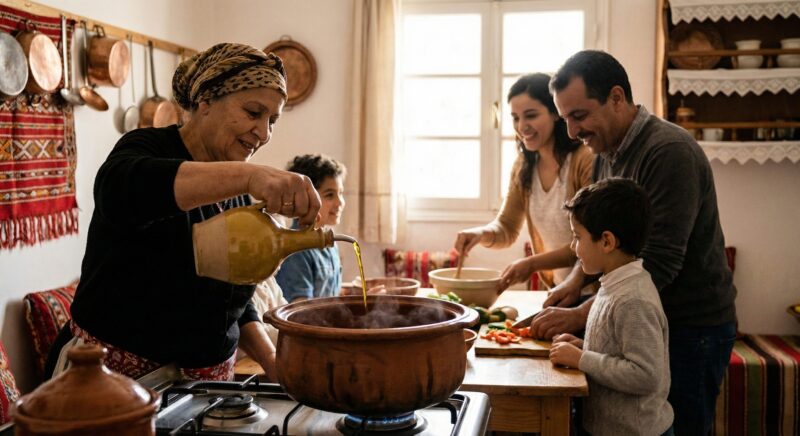
Ensuring equitable access to olive oil is not only an economic challenge but a question of cultural continuity, food heritage, and social equity.
The result is a profound shift in consumption habits. Many families now buy olive oil only in small quantities, reserving it for special occasions rather than daily use. A long-standing tradition of storing annual household supplies — the oula — is fading. For most households, the choice has become purely economic.
Short-term government interventions, such as releasing limited quantities of subsidised olive oil from state reserves, have provided temporary relief but not resolved the underlying imbalance between export orientation and domestic access.
Tunisia’s own social traditions offer clues toward a more balanced model. For generations, farmers have set aside part of their harvest as zakat — the Islamic practice of redistributing a portion of wealth to those in need. This deeply rooted culture of solidarity has quietly supported food access for many families.
While meaningful, such practices remain fragmented and limited in scale. The opportunity lies in translating this cultural foundation into structured cooperative and social-enterprise models capable of operating at systemic level.
Rebalancing the sector does not mean reducing exports, which remain essential for foreign currency and rural livelihoods. It means redesigning how value circulates so that national abundance can once again translate into everyday affordability.
A more balanced system could operate along two complementary tracks. One would continue to serve global premium markets with bottled, branded, high-quality organic oils that generate export revenues. The other would focus on domestic consumption through cooperative distribution, shorter supply chains, and bulk purchasing structures designed to keep prices affordable.
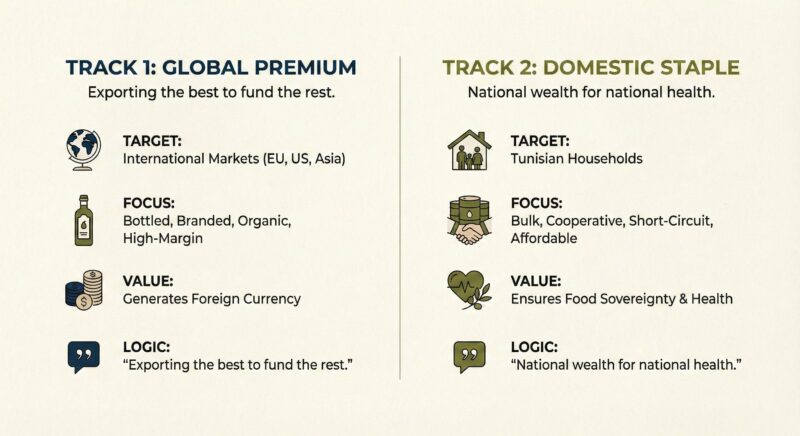
A dual-track model for Tunisia’s olive oil sector — pairing premium exports with cooperative, affordable domestic distribution — could help ensure that national abundance supports both foreign revenue and everyday access at home.
Lower prices would not rely primarily on new subsidies or charity, but on smarter system design: fewer intermediaries, cooperative logistics, and greater local value retention. Experiences in Spain, Italy, and Greece demonstrate that strong domestic consumption can coexist with robust export sectors when cooperative models and market segmentation are in place.
Public institutions could also play a stabilising role by acting as anchor buyers. Locally produced olive oil integrated into school meals, hospitals, and public programmes would support domestic demand while improving nutrition and food sovereignty. In such a model, exports continue to generate foreign currency while national production also strengthens domestic wellbeing.
Rebalancing the sector...means redesigning how value circulates so that national abundance can once again translate into everyday affordability.
As one leader in Tunisia’s women’s olive-oil network observes, rebalancing the system is not only an economic challenge but also a cultural one: olive oil must be treated as national food heritage before it is treated solely as an export commodity. Ensuring fair access is as much a matter of equity and citizenship as of markets.
Tunisia’s olive-oil paradox reflects a broader pattern across the Global South. Countries rich in agricultural production often export abundance while local populations struggle to access the very goods their economies produce — from cocoa in West Africa to staple grains in parts of Latin America.
The issue is not production alone but how value is organised, priced, and distributed. Tunisia possesses all the ingredients for a different path: world-class production, deep agricultural knowledge, strong cultural traditions of solidarity, and a growing ecosystem of cooperatives and social enterprises capable of redesigning supply chains.
Development, ultimately, is not only about producing more. It is about ensuring that what a country produces improves the lives of the people who produce it.

Related Content
Why Palestinian startups remain structurally trapped—and what might change that
1976
0
From deals to ecosystems in financing real transformation
 2869
0
2869
0

A conversation with Laura Ranzato of Clean Creatives
 2865
0
2865
0

Disability access, institutional design, and Thailand’s 2026 election
 2273
0
2273
0
Comments

Deep Dives
RECENT
 3319
0
3319
0
 4362
0
4362
0
 3072
0
3072
0
Editor's Picks
 3084
0
3084
0
 3207
0
3207
0
 3536
0
3536
0
Webinars
News & Events
Subscribe to our newsletter to receive updates about new Magazine content and upcoming webinars, deep dives, and events.
Become a Premium Member to access the full library of webinars and deep dives, exclusive membership portal, member directory, message board, and curated live chats.

Join our global community of systems-minded changemakers.
Subscribe to the Impact Entrepreneur newsletter for the latest insights, magazine features, and invitations to exclusive webinars, Deep Dives, and events.





0 Comments