When Impact Stops at the Office Door
For mission-led organizations, a change of manager tests whether workplace inclusion is built to last.



For mission-led organizations, a change of manager tests whether workplace inclusion is built to last.

 46
46
 0
0

Artist Rob Strati on inherited objects, the limits of market price, and the creative possibilities…
 85
0
85
0

Counting what we fail to prevent, sixty seconds at a time
89
0

How states can crowd in local early-stage capital
 369
0
369
0

Why last-mile healthcare needs an operating model, not just more mobile clinics
 355
0
355
0

How Australia’s succession wave could turn ownership into a funding model
 467
0
467
0

 4864
0
4864
0
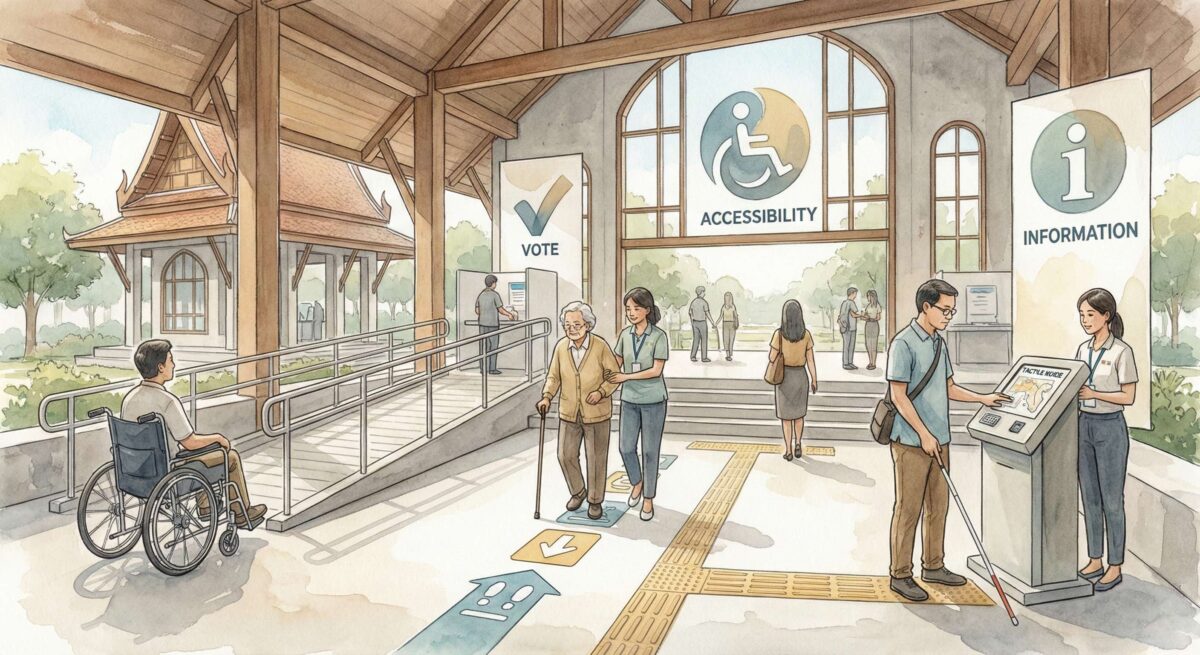
As Thailand prepares for its 2026 general election, disability access is more than a voting issue — it is a test of institutional design, democratic legitimacy, and the foundations of an inclusive impact economy.
As Thailand prepares for its general election on 8 February 2026, public attention centers on voter turnout, party competition, and the future of its democracy. Yet one critical question remains largely overlooked: will this election truly include persons with disabilities?
Thailand positions itself as a regional leader in disability policy, with progressive legislation and ratification of the UN Convention on the Rights of Persons with Disabilities (CRPD). Despite these commitments, many persons with disabilities (PWDs) continue to face persistent barriers during elections. Legal guarantees exist on paper, yet the electoral system still excludes nearly two million eligible voters — roughly 3 percent of the population.
Thailand’s 2017 Constitution affirms equality before the law and mandates state support for persons with disabilities. The Organic Act on the Election of the House of Representatives further requires the Election Commission to facilitate voting for PWDs. While the legal framework appears robust, actual inclusion remains inconsistent and fragile.
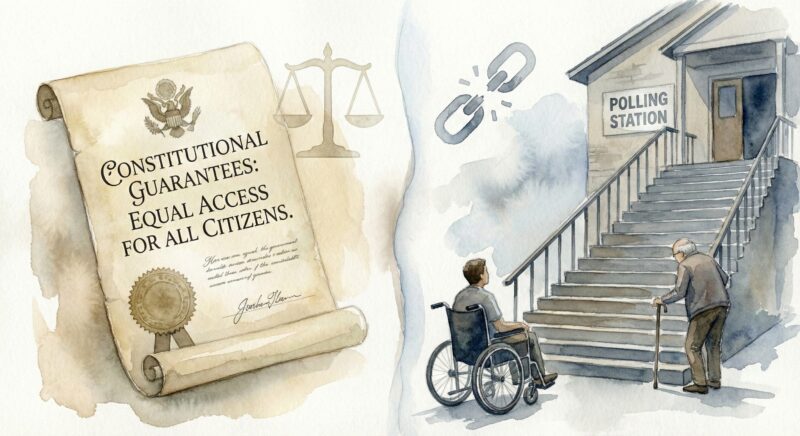 Rights on paper vs. reality
Many polling stations remain inaccessible, particularly for wheelchair users. Temporary ramps, when available, are often unstable or poorly designed. Parking areas, toilets, and walkways rarely accommodate diverse mobility needs. Voters with visual impairments may technically be permitted to vote, yet frequently lack access to appropriate assistive tools or trained support. For voters with hearing impairments, sign language interpretation is almost never provided. Reliance on others turns participation into a burden rather than a right.
Thailand allows polling officers to mark ballots on behalf of voters with disabilities under certain conditions. While intended as a form of support, this practice raises serious concerns about privacy, secrecy, and voter autonomy. Elections are meant to protect individual political will; involving another person in marking a ballot inherently compromises that protection.
Inclusive governance... strengthens accountability, responsiveness, and social cohesion — conditions that underpin sustainable development and inclusive growth.
In past elections, some polling officers hesitated to assist voters with disabilities due to unclear regulations, while others acted inconsistently, resulting in unequal treatment. This uncertainty can intimidate voters, leading some to abstain rather than risk confusion or embarrassment. True inclusion requires systems that enable independent voting, not merely additional assistance.
A persistent shortcoming in Thailand’s electoral process is the narrow focus on accessibility on election day alone. Voting begins with access to information, not at the polling station. An election that is physically accessible but informationally exclusive is not truly inclusive.

Political campaigns in Thailand rely heavily on rallies, televised debates, and social media — channels that often remain inaccessible to many PWDs. Campaign videos rarely include sign language interpretation or captions. Party platforms are seldom available in braille, audio, or easy-to-read formats, while online content frequently lacks basic accessibility features.
When voters with disabilities cannot independently access information about parties, policies, or candidates, their choices are constrained. Some rely on family members’ preferences, undermining free and informed decision-making. Others disengage entirely.
During the 2023 election, the Election Commission made notable efforts to improve communication around voting rights for PWDs through infographics, videos, and partnerships with civil society organizations. Social media campaigns helped raise awareness, particularly among younger voters with disabilities.

Yet these efforts remain fragmented and insufficient. Special polling stations for PWDs are rare, transportation support is inconsistent, and bedridden voters are effectively excluded. Thailand does not permit postal or mobile voting for most citizens, despite international evidence showing that accessibility and electoral integrity can coexist. Proposals for alternative voting methods are often dismissed on transparency grounds.
Thailand has embraced digital innovation in banking, healthcare, and taxation — but electoral inclusion has not kept pace.
This gap is not merely procedural; it reflects a deeper question about how institutions are designed — and for whom.
Why does this matter for the impact economy?

Inclusive democratic institutions are not only a moral imperative; they are a form of social and economic infrastructure. Elections shape policy priorities, regulatory frameworks, and public trust — all of which influence investment climates, labor markets, and long-term economic stability.
Excluding people with disabilities from meaningful participation weakens institutional legitimacy and reinforces patterns of marginalization that carry economic consequences. Inclusive governance, by contrast, strengthens accountability, responsiveness, and social cohesion — conditions that underpin sustainable development and inclusive growth.
The general election on 8 February 2026 will test Thailand’s commitment to democratic equality.
From this perspective, disability access in elections is not a peripheral issue. It is a signal of how well institutions are designed to include diverse stakeholders — a principle that echoes across the impact economy, from corporate governance to capital allocation.
In Thailand’s case, electoral accessibility offers a clear window into the broader health of its democratic and economic institutions.
Persons with disabilities make up a significant portion of Thailand’s population, spanning age, class, region, and political affiliation. Their exclusion weakens democratic legitimacy and reinforces broader social inequality.

Inclusive elections benefit everyone. Universal design improves access not only for PWDs, but also for older voters, pregnant women, and people with temporary injuries. Clear signage, well-trained officials, and accessible information strengthen trust in the electoral system as a whole.
More fundamentally, inclusion reflects the true meaning of democracy. When persons with disabilities are visible and empowered as voters, policymakers are more likely to address disability-inclusive policies in education, employment, transport, and healthcare. Political participation shapes outcomes.
The general election on 8 February 2026 will test Thailand’s commitment to democratic equality. Inclusion must move beyond symbolic promises and become a practical reality. Achieving this will require political will, sustained investment, and a recognition that democracy loses its meaning when participation is denied to any eligible voter.


Related Content
For mission-led organizations, a change of manager tests whether workplace inclusion is built to last.
46
0
Artist Rob Strati on inherited objects, the limits of market price, and the creative possibilities…
85
0
Counting what we fail to prevent, sixty seconds at a time
89
0

How collateral rules and payment terms keep impact capital out of reach
198
0
Comments
Deep Dives
RECENT
 369
0
369
0
 355
0
355
0
 467
0
467
0
Editor's Picks
 46
0
46
0
 85
0
85
0
 89
0
46
0
85
0
46
0
85
0
89
0
89
0
46
0
85
0
46
0
85
0
89
0
Webinars
Signed by the author. Collected at the door at Lipton Hall, NYU School of Law,…
News & Events

The September 14 program and a live IFI Tool demo are online

Pre-seed and seed startups can apply on a rolling basis

Their Built platform helps teams design, launch and run funds
Subscribe to our newsletter to receive updates about new Magazine content and upcoming webinars, deep dives, and events.
Become a Premium Member to access the full library of webinars and deep dives, exclusive membership portal, member directory, message board, and curated live chats.


0 Comments