The Economics of Belonging
How displaced Artsakhtsi are rebuilding livelihoods



How displaced Artsakhtsi are rebuilding livelihoods

 157
157
 0
0

 184
0
184
0

A common ledger for moving capital upstream
 223
0
223
0

A trust-based philanthropy model for culture change
 278
0
278
0

What Cyprus’s bicommunal enterprises reveal about trust, trade, and divided economies
 321
0
321
0

How impact entrepreneurs can build a more flexible capital stack
 361
0
361
0
Upcoming Events

 3344
0
3344
0

Aid cuts are exposing how much of financial inclusion still depends on donor scaffolding. The sector now faces a forcing function: evolve toward locally anchored capital and blended-finance transition tools — or watch critical resilience functions collapse.
For more than two decades, international aid has been a quiet but central pillar of the global financial inclusion ecosystem. Bilateral donors and development agencies have helped subsidize experimentation, absorb early risk, and extend financial services into markets and communities that private capital has historically ignored.
That pillar is now eroding.
Since 2023, several high-income countries have sharply reduced their bilateral assistance to low- and middle-income countries. Between 2023 and the 2026 budget cycle, five European countries cut aid by 14 to 27 percent, Canada by roughly 25 percent, the United Kingdom by 40 percent, and the United States is projected to reduce overseas aid by more than half. In absolute terms, these cuts amount to tens of billions of dollars annually — a contraction that rivals the total assets under management of the global private impact investment industry focused on emerging markets.
The immediate concern is obvious: fewer grants, fewer programs, fewer partnerships. But the deeper question is more uncomfortable — and more important:
What happens to financial inclusion when the donor scaffolding that helped build it is no longer there?
To better understand the implications of declining aid, a group of NGOs surveyed 86 stakeholders across 58 countries active in financial inclusion. The results were sobering. A majority reported negative effects on partnerships, financial resources, and portfolio quality. Nearly half said they are already adjusting their strategies — scaling back programs, restructuring alliances, and focusing defensively on portfolio performance.

Despite long-standing narratives about financial services being self-sustaining, the survey revealed a more complex reality. Fifty-eight percent of respondents rely on international aid to fund at least one program. As funding contracts, organizations are winding down services tied to health, gender equality, refugee inclusion, and access to clean water and sanitation.
The impacts are not evenly distributed. Financial service providers operating in fragile contexts — particularly in parts of Africa and Asia — report the strongest effects. Smaller institutions, agricultural finance providers, and those serving the poorest clients are disproportionately affected.
This is not just a funding problem. It is a stress test of the underlying model.
For years, financial inclusion has often been framed as an end in itself: more accounts, more digital wallets, more access points. Yet critics have long warned that access without resilience, agency, or real economic opportunity can be shallow at best — and extractive at worst.
The retreat of bilateral aid is undeniably disruptive. Programs will close. Organizations will struggle. Some models will fail.
The current funding retrenchment exposes this tension. Survey respondents expect the greatest negative impacts in three areas widely recognized as critical to the future of inclusion: clients’ resilience to shocks, the digital transformation of financial service providers, and financing for climate adaptation and mitigation. All three were recently identified as top priorities by sector leaders — and all three are precisely the kinds of investments that struggle to attract purely commercial capital.
If aid withdrawal leads to the collapse of these functions, the sector will be forced to confront an uncomfortable truth: not all inclusion is equally valuable, and not all models deserve to survive unchanged.
In response to shrinking donor funding, nearly half of surveyed organizations are turning to international impact investors, while close to a third are seeking local donors. Yet this pivot comes with constraints. Growth in private impact funds focused on financial inclusion has slowed markedly since 2018, and roughly one-third of the capital in these funds still originates from public sources — meaning they, too, are exposed to donor retrenchment.

This has renewed interest in domestic capital markets, not merely as a replacement for aid, but as a structural shift.
One illustrative example is Pro Mujer, which worked with local regulators to gain authorization to issue bonds, raising the equivalent of USD 2 million to support its work with women across Latin America. Beyond the capital itself, the move altered accountability relationships — anchoring funding closer to the communities served and embedding the organization more deeply within national financial systems.
Access without resilience, agency, or real economic opportunity can be shallow at best — and extractive at worst.
Domestic funding does more than fill gaps. It reshapes incentives, governance, and power — and forces financial inclusion actors to align more closely with local economic realities rather than donor priorities.
At a plenary session at the Inclusive Finance 25 (IF25) conference organized by e-MFP in Luxembourg in November 2025, sector leaders emphasized that the current moment is not simply about austerity, but about rethinking what development — and financial inclusion — are meant to achieve (see session recording).
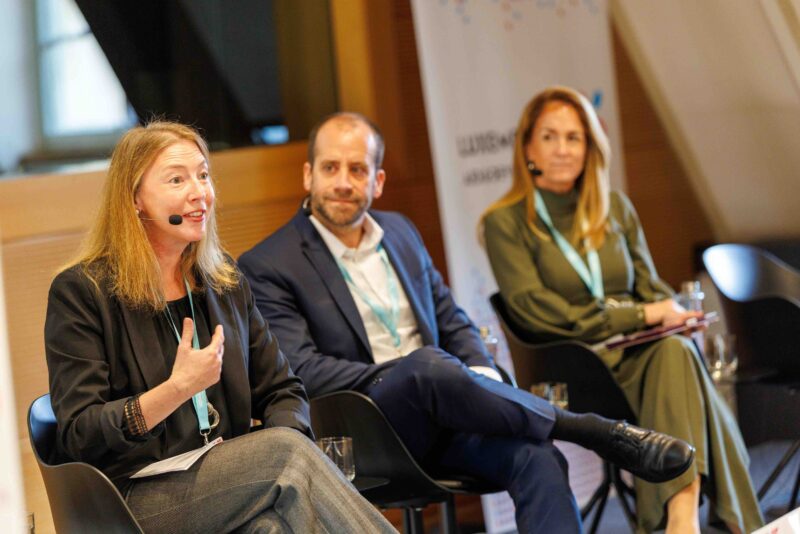
Claudia McKay of CGAP speaking at the IF25 session titled Navigating the New Funding Reality of Inclusive FInance; Photo courtesy of e-MFP
Financial service providers often function as trusted intermediaries with deep client relationships. This positions them to channel capital toward broader development objectives: climate-resilient agriculture, clean energy adoption, women’s economic empowerment, job creation, and reduced forced migration. Hundreds of billions of dollars are already flowing into climate finance, yet much of it struggles to reach last-mile users.
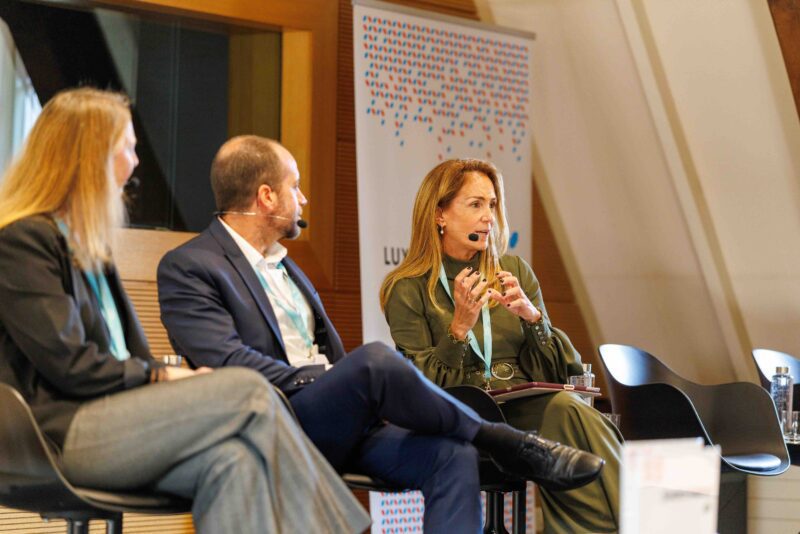
Carmen Correa speaking at the opening plenary of IF25 in Luxembourg in November 2025; Photo courtesy of e-MFP
Blended finance — combining public, philanthropic, and private capital to reduce risk — may be the connective tissue that enables this transition. Instruments such as first-loss capital, guarantees, and currency hedging can make inclusive finance investable for new categories of domestic banks, asset managers, and institutional investors.
CGAP’s recent identification of roughly 2,000 previously untracked funders — including local banks and venture capital firms — underscores both the opportunity and the challenge. Many of these actors are more profit-driven and less impact-oriented than traditional donors, requiring new narratives, incentives, and safeguards to ensure inclusion remains meaningful rather than merely transactional.
The retreat of bilateral aid is undeniably disruptive. Programs will close. Organizations will struggle. Some models will fail.
But it may also serve as a forcing function — compelling the financial inclusion sector to mature beyond donor dependence and confront deeper questions about purpose, power, and sustainability.
If the impact economy is serious about resilience, it must learn to finance inclusion in ways that are locally grounded, structurally durable, and aligned with real economic opportunity. That will require new forms of partnership, new capital architectures, and a willingness to let go of models that rely indefinitely on external subsidy.
The question is no longer whether financial inclusion can survive with less aid.
The question is whether it can finally become strong enough to stand without it.


Related Content
184
0
A common ledger for moving capital upstream
223
0

How states can crowd in local early-stage capital
216
0

Why last-mile healthcare needs an operating model, not just more mobile clinics
 154
0
154
0
Comments
Deep Dives
RECENT
 278
0
278
0
 321
0
321
0
 361
0
361
0
Editor's Picks
 157
0
157
0
 184
0
184
0
 223
0
157
0
184
0
223
0
223
0
157
0
184
0
223
0
Webinars
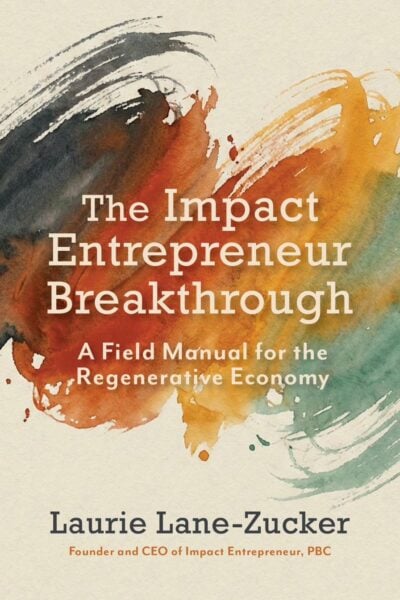
Featuring
Laurie Lane-Zucker in conversation with Jeffrey Hollender, Sarah Holloway and Sara Minard
September 30 - 6:00 PM EST
Signed by the author. Collected at the door at Lipton Hall, NYU School of Law,…
Signed and personally inscribed — you'll write the inscription as you order. Limited · 50…
News & Events


For AI governance, strategic foresight, digital economy policy, and institutional design.
Helps foundations, DAF holders, and family offices model how impact-first investing can extend charitable capital
Subscribe to our newsletter to receive updates about new Magazine content and upcoming webinars, deep dives, and events.
Become a Premium Member to access the full library of webinars and deep dives, exclusive membership portal, member directory, message board, and curated live chats.

0 Comments