When Innovation Fails to Travel
Why education pilots need government adoption, not just proof



Why education pilots need government adoption, not just proof

 343
343
 0
0

What Bosnia’s rebuilding teaches us about recovery economies
 443
0
443
0

Why durable impact requires trust, culture, and capital
 524
0
524
0
Why research infrastructure is the missing middle in climate-smart agriculture
 970
0
970
0

How verified outcomes can finance regenerative land use
 884
0
884
0

How Haverford’s student investing program pivoted toward more purpose-suited capital
 1038
0
1038
0
Upcoming Events

 1988
0
1988
0
Impact bonds, resilience facilities, and blended-finance vehicles were once experimental tools used in isolated deals. Today they may be evolving into something far more consequential: the financial infrastructure of the impact economy.
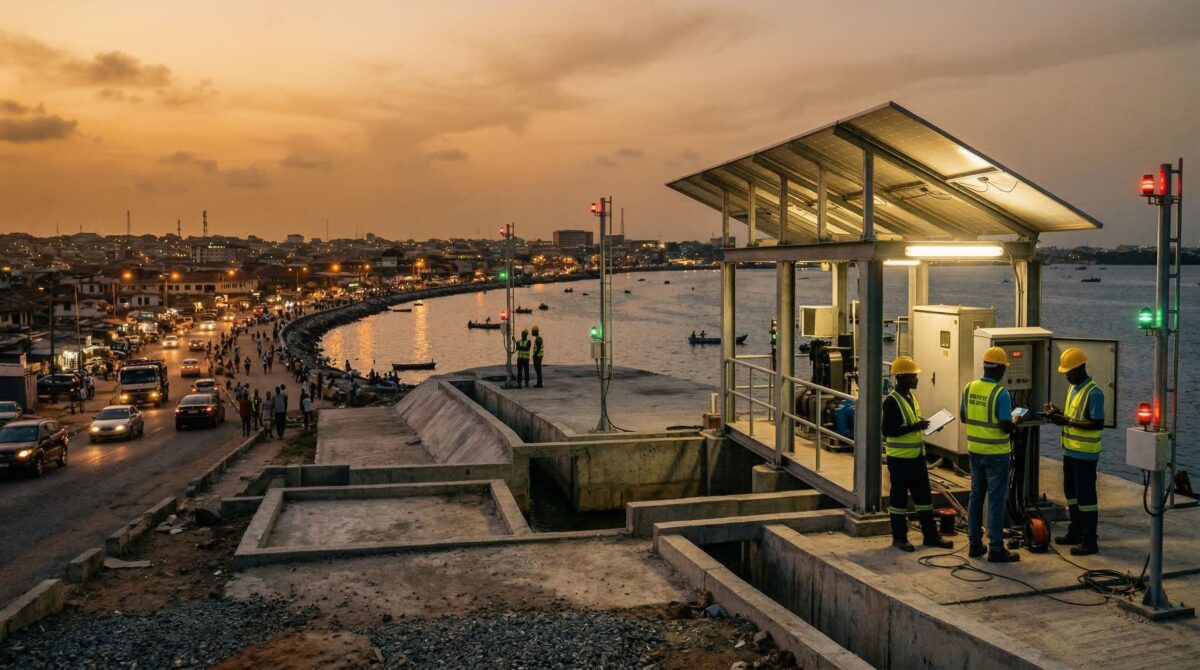
Picture a mid-sized West African city staring down another season of flooding. Instead of waiting years for a sovereign loan to trickle through, a local public–private utility works with its national development bank to tap the emerging African Climate Facility, bundling drainage upgrades, solar-powered pumping stations, and early-warning systems into a standardized proposal.
What they are connecting to, in effect, is a new kind of financial plumbing.
Behind the scenes, the deal connects to the Africa Climate Innovation Compact, an initiative aiming to mobilize roughly $50 billion annually in catalytic finance and support 1,000 African climate solutions across energy, agriculture, water, transport, and resilience by 2030.
From the city’s vantage point, the process feels less like negotiating a one-off grant and more like plugging into a new piece of financial infrastructure — a set of templates, risk-sharing rules, and eligibility criteria that others are already using.
This raises an important question for impact entrepreneurs and investors alike:
Are impact bonds, climate and resilience facilities, and modular blended-finance vehicles still niche products — or are they quietly becoming part of the core financial infrastructure of the impact economy?
To explore that question, this article stays close to three anchors rather than attempting a market-wide survey: the African Climate Facility and Africa Climate Innovation Compact, CAF’s resilience bond with UNDRR in Latin America and the Caribbean, and Amundi’s AP EGO and SEED-style blended sustainable bond funds.
Think of infrastructure here not as individual projects but as financial rails — standardized structures, shared taxonomies, and contract templates that many actors can use repeatedly.
Until recently, the financing story looked painfully familiar: a patchwork of small grants, expensive hard-currency loans from commercial banks, and long waits for bilateral development programs that rarely reached working-capital level.
Impact bonds and blended vehicles begin to resemble infrastructure when they move beyond bespoke pilots into structures that banks, municipal authorities, and investment funds can plug into without renegotiating everything from scratch.
The African Climate Innovation Compact and African Climate Facility represent an early attempt to build such rails.
Together they aim to mobilize roughly $50 billion annually in catalytic finance through cooperation among African institutions including the African Development Bank, Afreximbank, Africa50, and the Africa Finance Corporation. Their goal is to channel capital into climate and resilience investments designed and implemented by African institutions themselves.
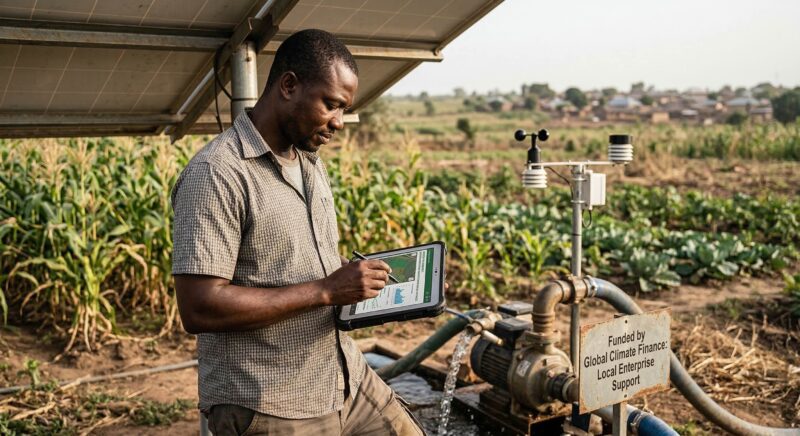 For entrepreneurs and small enterprises in emerging markets, new blended-finance vehicles and climate facilities can reshape the capital stack — extending loan tenors, lowering costs of capital, and enabling climate-resilient technologies to scale.
Crucially, these structures emphasize subnational governments, local authorities, and enterprises — attempting to build a continental layer of climate finance that does not require country-by-country reinvention.
A parallel development is emerging in Latin America and the Caribbean.
CAF’s $100 million resilience bond, developed with UNDRR and aligned with the Climate Bonds Resilience Taxonomy, channels capital toward infrastructure designed to keep water systems, sanitation, mobility, and nature-based protection functioning under climate stress. Initial projects are focused on Brazil, but the broader goal is to establish a replicable template for resilience financing across the region.
On the blended-finance side, the Amundi Planet Emerging Green One (AP EGO) fund and its successor SEED illustrate another dimension of this evolving architecture.
AP EGO used a layered capital structure — with junior and mezzanine tranches from institutions including IFC, EIB, EBRD, and Proparco — to crowd in senior capital from pension funds and insurers into emerging-market green bonds. At the same time, the fund provided technical assistance to local banks to help build sustainable-bond pipelines.
SEED extends this model into broader sustainable bonds, offering a repeatable structure that others can replicate rather than a single bespoke vehicle.
Taken together, these examples begin to resemble early components of a shared financial operating system for climate and resilience investment.
Zoom in to a single composite founder: a West African climate-tech entrepreneur building distributed resilience infrastructure — solar-powered mini-pumps, flood-resilient cold storage, and sensor networks that warn smallholder farmers about extreme weather.
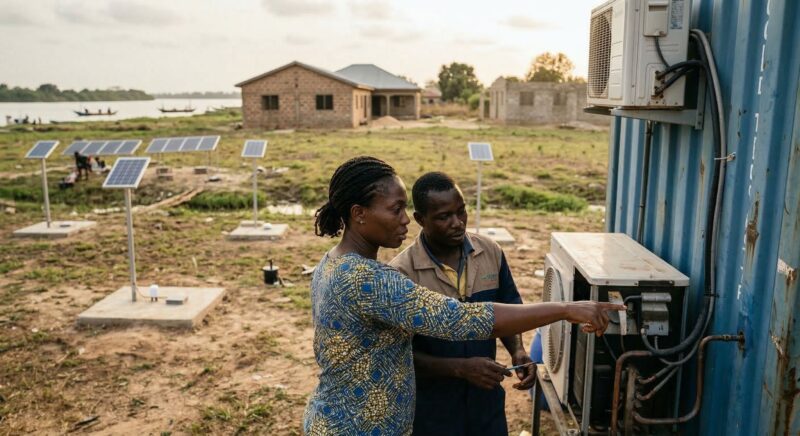 Climate finance becomes real at the infrastructure level — where engineers, utilities, and local institutions translate financial mechanisms into operational systems such as renewable energy, water management, and resilient urban services.
Until recently, the financing story looked painfully familiar: a patchwork of small grants, expensive hard-currency loans from commercial banks, and long waits for bilateral development programs that rarely reached working-capital level.
On the liability side of the balance sheet, risk was brittle.
Foreign-exchange swings could wipe out thin margins. Collateral requirements pushed personal guarantees to the limit. Impact verification was fragmented across multiple donor frameworks, each demanding different reporting systems.
As facilities like the African Climate Facility and blended vehicles such as AP EGO and SEED come online, the capital stack begins to shift.
The founder’s local bank now has access to a green-bond funding line supported by a blended fund. Technical assistance attached to the facility has helped the bank develop internal systems to evaluate climate projects.
Global issuance of green, social, sustainability, and sustainability-linked (GSSS) bonds reached roughly $1 trillion in 2024.
When the founder applies for financing, the bank is no longer starting from scratch. Instead, it matches the proposal against pre-established eligibility criteria and risk-sharing arrangements embedded upstream in these facilities.
For the founder, several things improve.
Loan tenors lengthen. Ticket sizes grow without requiring equity dilution. The cost of capital falls modestly because some of the risk is absorbed by development institutions rather than sitting entirely on the company’s balance sheet.
But new frictions also appear.
Documentation and verification requirements become heavier. Minimum ticket sizes still exclude many informal enterprises. Navigating the system increasingly requires intermediaries — specialist advisors, aggregators, and local funds capable of translating projects into investable structures.
From the founder’s perspective, the key question remains unresolved:
Is this emerging architecture truly stable infrastructure, or a sophisticated pilot that could still disappear?
Several signals suggest that, along some corridors, these tools are already behaving like infrastructure.
Global issuance of green, social, sustainability, and sustainability-linked (GSSS) bonds reached roughly $1 trillion in 2024, bringing cumulative issuance between 2018 and 2024 to about $5.1 trillion. Emerging-market issuers accounted for approximately $800 billion of that total.
In emerging markets outside China, GSSS bonds now represent more than 5 percent of total bond issuance — with multilateral and national development banks serving as anchor issuers and investors.
Impact bonds and blended vehicles begin to resemble infrastructure when they move beyond bespoke pilots into structures that banks, municipal authorities, and investment funds can plug into without renegotiating everything from scratch.
Meanwhile, the structures described above are beginning to replicate.
CAF’s resilience bond sits alongside a growing family of thematic instruments — including blue bonds and resilience-linked bonds — that reference the same climate taxonomies and Sendai- and Paris-aligned criteria.
Blended vehicles modeled on AP EGO and SEED are being adapted into new funds designed to deepen local capital markets and crowd institutional capital into sustainable bonds.
African institutions are also scaling their own initiatives. The African Climate Facility’s cooperation framework reflects a broader effort by regional development banks and financial institutions to mobilize tens of billions of dollars for climate-related investment across the continent.
But the risks are real.
Complexity and verification burdens can exclude smaller enterprises — often those most exposed to climate risk — particularly when standards assume large balance sheets and expensive external verification.
There is also a legitimate concern about over-financialization. When meeting taxonomy requirements or bond eligibility thresholds begins to dictate what projects get built, local priorities and indigenous knowledge risk being sidelined.
Underlying all of this are governance questions.
Who ultimately decides what qualifies as “green,” “resilient,” or “bankable”? And how far are those decisions from the communities and smaller institutions most affected?
Debates over multilateral development bank reform, regional financing institutions, and climate taxonomies are, in effect, debates over who gets to shape the rules of this emerging financial infrastructure.
By the end of this decade, a few simple tests may reveal whether these instruments have truly become infrastructure — or remain fragile experiments.
Access. Who can realistically use these financial rails, at what ticket sizes, in which currencies, and through which intermediaries? Are smaller enterprises, cooperatives, and municipalities actually accessing facilities and blended funds — or are they still dominated by large banks and corporates?
Resilience. When shocks hit — climate, political, or financial — do these structures keep essential services functioning and projects solvent, or do they freeze precisely when they are most needed?
Governance. Whose priorities shape eligibility criteria and project pipelines: distant taxonomies and rating agencies, or local institutions and communities with contextual knowledge?
A cautious answer to the opening question is beginning to emerge.
Along some emerging-market corridors — particularly where regional institutions are building their own facilities and where blended vehicles have helped seed local green-bond markets — these tools are starting to behave like financial infrastructure.
Elsewhere, they remain promising but fragile experiments: too complex, too centralized, or too narrow in who they serve.
For investors, founders, and ecosystem builders working to reshape global capital flows, the opportunity is clear.
The infrastructure of the impact economy is not yet fixed.
It is still being designed.
And the challenge for the next decade is to ensure that this emerging financial plumbing aligns global capital with local agency — deepening interdependence on fairer terms rather than reinforcing existing hierarchies.


Related Content
What Bosnia’s rebuilding teaches us about recovery economies
443
0
Why durable impact requires trust, culture, and capital
524
0

Community health workers offer a practical starting point
 429
0
429
0

How donor-advised funds are becoming catalytic capital platforms
 594
0
594
0
Comments

Deep Dives

Featuring
Laurie Lane-Zucker
Founder & CEO, Impact Entrepreneur
July 30 - 12:00 PM EST
RECENT
 970
0
970
0
 884
0
884
0
 1038
0
1038
0
Editor's Picks
 343
0
343
0
 443
0
443
0
 524
0
343
0
443
0
524
0
524
0
343
0
443
0
524
0
Webinars
News & Events

Helping founders and impact investors align

For three craft enterprises in India

Subscribe to our newsletter to receive updates about new Magazine content and upcoming webinars, deep dives, and events.
Become a Premium Member to access the full library of webinars and deep dives, exclusive membership portal, member directory, message board, and curated live chats.

Join our global community of systems-minded changemakers.
Subscribe to the Impact Entrepreneur newsletter for the latest insights, magazine features, and invitations to exclusive webinars, Deep Dives, and events.


0 Comments