What Civil Rights Leaders Can Teach Impact Investors
Democracy, narrative, and systems change


Democracy, narrative, and systems change

 456
456
 0
0

An introduction to our new magazine department from the Editors
 1051
0
1051
0
Balancing production and preservation
 1138
0
1138
0
How impact and revenue can scale together
 2127
0
2127
0
Purpose language is not enough
 2539
0
2539
0
Why climate advocates need a stronger narrative
1779
0
 4294
0
4294
0
In 1981, James, a retired civil servant, was involved in a road accident that changed the trajectory of his life. To save him, surgeons amputated his left leg. The months that followed were filled with disorientation: phantom pain, the weight of sudden dependency, and the agonizing process of learning to walk on a prosthetic for the first time. His early prosthesis was heavy and rigid, limiting his mobility. But over the years, he has received upgraded limbs that are lighter, better-fitted, and more responsive, helping him to progressively reclaim pieces of his independence. Today, in his 70s, James gleefully expresses how he enjoys walking long distances and even riding a bicycle! “No one even knows I have an artificial limb when I walk,” he said with unmistakable joy.
James’ story mirrors that of thousands of Kenyans every year; amputations are far more common than most people realize. Trauma from road accidents, complications from diabetes and vascular disease, cancer, industrial injuries, and congenital conditions all contribute to high amputation rates. The World Health Organization estimates that about five million Africans live with a form of limb amputation. Yet access to prosthetic care remains deeply constrained. More than 90% of amputees in Africa do not receive proper prosthetic services, a gap driven by cost, low availability of materials, limited prosthetist capacity, fragmented care systems, and unclear referral pathways. Many patients rely on makeshift mobility aids like sticks, outdated prosthetics, or donated devices not fitted to their anatomy. Others withdraw from work entirely, losing income, mobility, and dignity.
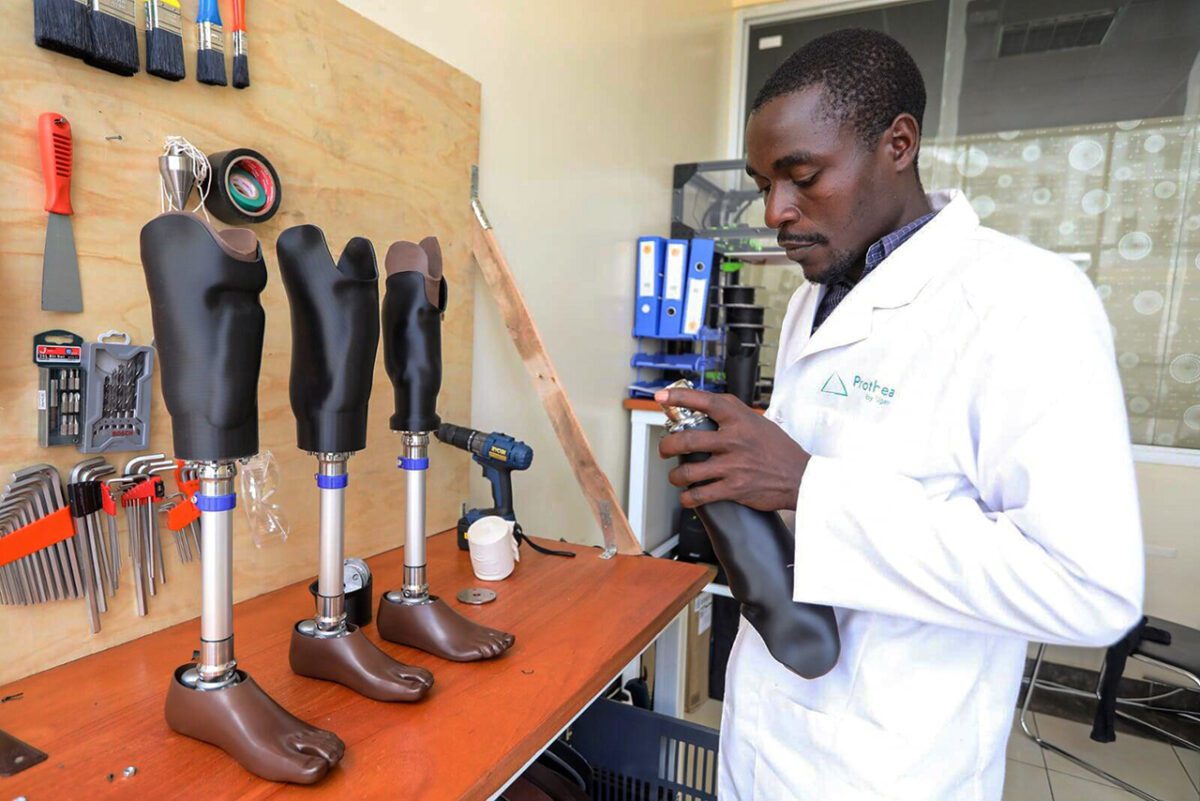
Prothea, a Kenyan medical company specializing in custom 3D-printed prostheses, is working to change this landscape. Operating at the intersection of orthopedic surgery, technology, rehabilitation, and patient education, the company integrates multiple steps of the patient journey that traditionally occur across separate institutions. The result is a more coordinated, patient-centered pathway from amputation to restored mobility.
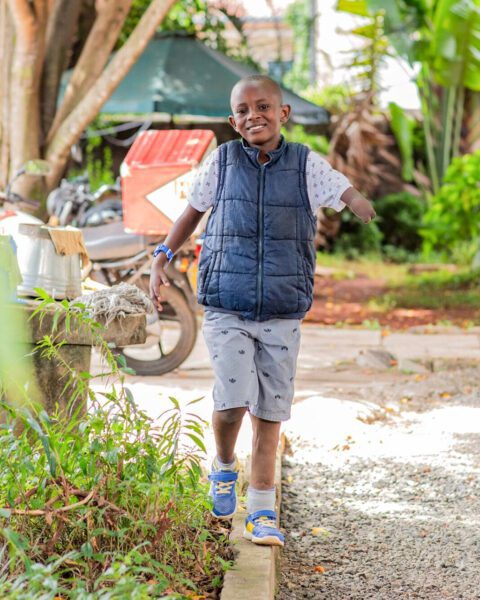 “Healthcare systems have improved over the years, meaning more patients are surviving trauma and illness,” says Dr. Nick Were, Prothea’s Co-Founder and an Orthopedic Resident. “But without accessible prosthetic services, many people live without support that could help them move, work, and age with dignity.”
Prothea’s workflow begins with digital scanning of the residual limb. Using a mobile app, prosthetists across the country capture highly accurate, millimeter-level scans and upload them to Prothea’s system. The company then manufactures a limb using lightweight 3D-printed polypropylene, a flexible material that reduces the energy required for movement. For amputees, this matters. According to Dr. Nick, amputees expend up to twice as much energy walking as non-amputees. Lighter, better-fitting prostheses directly influence endurance, comfort, and long-term mobility outcomes.
Under optimal conditions, the complete scan-to-fit process can take as little as 24 hours and typically no more than 5 days to deliver, depending on location. After printing and assembly, Prothea’s team guides patients through personalized gait training, ensuring alignment, comfort, and safe use. For a process that commonly takes weeks or months post-amputation, if at all, the speed and precision of this approach are transformative.
The broader prosthetic ecosystem in Kenya is rather frayed. Many county hospitals lack standardized post-operative pathways for amputees, meaning patients are discharged without guidance on when, where, or how to seek psychological and prosthetic care. Data gaps also limit effective planning. The National Council for Persons with Disabilities (NCPWD), a Kenyan state corporation, estimates that 15-20% of Kenyans living with a disability, yet only about 750,000 are formally registered (less than 10%), leaving millions outside social benefit systems. For amputees specifically, lack of reporting from hospitals, combined with limited awareness, obscures the true national need.
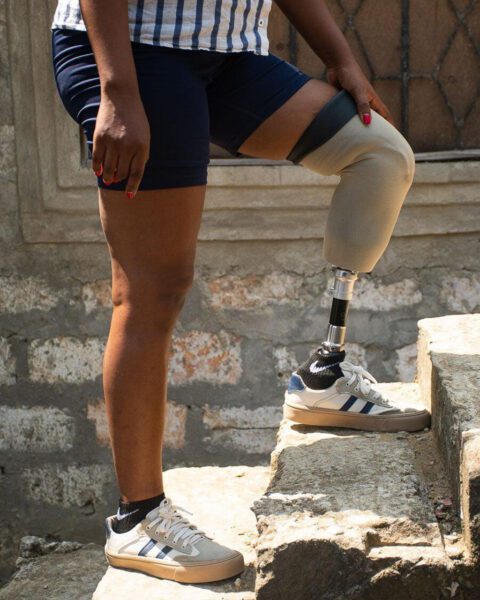 This information deficit has real consequences. Registration with NCPWD unlocks important benefits such as tax exemptions on income or special vehicles, support for assistive devices, business permit waivers, and linkages to training and employment. While some new amputees delay or avoid registration as they process their new reality, many simply lack awareness or support to navigate the process.
Insurance challenges compound the gap. Kenya’s national social health insurance scheme excludes routine prosthetic fittings from core benefits. Private insurers vary widely, with opaque coverage rules and inconsistent reimbursement policies. As a result, most amputees have to pay out of pocket for prosthetic devices.
Prothea’s integrated approach to providing post-operative care, including therapists and a network of prosthetists across the country, seeks to tackle the fragmentation challenge. However, significant access issues persist due to affordability.
The cost of prosthetic limbs remains prohibitive for the majority. Typically, the cost of prostheses in Kenya ranges from an equivalent of $930 - $1,160, which is beyond the reach of many families in a country where reportedly 85% earn less than $4,650 per annum. In its early days, Prothea was able to provide the service at nearly half the market cost, but with increased taxes, its margins were eroded. Today, it provides 3D-printed prostheses from around $745, which is below market average but still out of reach for thousands. As a result, the company is currently operating at about 10% of its maximum production capacity.
A well-fitted prosthetic is not just a device, it’s a way back to independence, to work, to joy, and to full participation in society.
These cost barriers, combined with limited insurance coverage, lead amputees to delay care or rely on unsafe alternatives, increasing the likelihood of complications such as joint strain, chronic back pain, reduced mobility, and decreased occupational capacity and earning potential. To expand access, Prothea has partnered with foundations, charity organizations, and philanthropists – including social media personality MrBeast – to deliver subsidized or fully funded prosthetics. While impactful, these efforts are small compared to the national need.
Closing Kenya’s prosthetic care gap will require a coordinated mix of policy reform, systems strengthening and financial innovation.
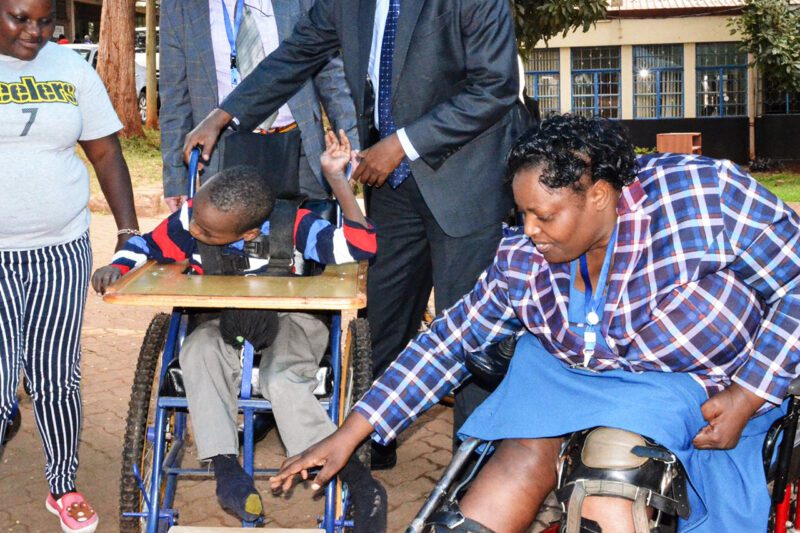 Image Courtesy of the National Council for Persons with Disabilities
Eliminating taxes on prosthetic and other custom medical devices would immediately lower production costs and expand access. Equally important is the integration of prosthetic care into national insurance benefit packages. This could include specific benefit codes for evaluation, fitting, and follow-up care, reducing out-of-pocket costs and promoting early intervention.
Hospitals need standardized post-amputation protocols that link patients to prosthetic services early, ideally starting before discharge. Formal public-private partnerships between county hospitals, private clinics, the NCPWD, prosthetic manufacturers and community health workers, amongst other relevant parties, would streamline patient referral pathways, reduce delays, and ensure that the patient is armed with information and education to ease their recovery and reintegration into society.
Finally, blended finance that supplements the limited government patient subsidies with grants and social impact funds can bridge affordability gaps, especially for low-income earners. This will also ensure providers can continue to innovate and scale.
Innovation alone cannot solve Kenya’s prosthetic care challenges, but it can demonstrate what is possible. When paired with the right policy, adequate financing, and a more coordinated ecosystem, technologies like 3D printing can meaningfully lower costs, reduce wait times, and improve patient experience.
For amputees like James, a well-fitted prosthetic is not just a device, it’s a way back to independence, to work, to joy, and to full participation in society. Prosthetic care is not only critical, but also a matter of dignity, economic inclusion, and human possibility.


Related Content
How portfolio theory could make cultural infrastructure more investable
 718
0
718
0
Why research infrastructure is the missing middle in climate-smart agriculture
 942
0
942
0

How verified outcomes can finance regenerative land use
 854
0
854
0

How Haverford’s student investing program pivoted toward more purpose-suited capital
 1000
0
1000
0
Comments

Deep Dives
RECENT
 2127
0
2127
0
 2539
0
2539
0
 1779
0
1779
0
Editor's Picks
 6155
0
6155
0
 3959
0
3959
0
 3876
0
3876
0
 456
0
456
0
 1051
0
1051
0
 1138
0
1138
0
Webinars
News & Events

Everspring Fund focuses across emerging markets


Subscribe to our newsletter to receive updates about new Magazine content and upcoming webinars, deep dives, and events.
Become a Premium Member to access the full library of webinars and deep dives, exclusive membership portal, member directory, message board, and curated live chats.

Join our global community of systems-minded changemakers.
Subscribe to the Impact Entrepreneur newsletter for the latest insights, magazine features, and invitations to exclusive webinars, Deep Dives, and events.


0 Comments