Actions Speak Louder Than Words





 20353
20353
 0
0

Focused on black business owners.
 10042
0
10042
0

Impact investors and the community as a whole has missed a leadership opportunity.
 12088
0
12088
0

A new marketplace called OutcomesX
 7527
0
7527
0

 13415
0
13415
0

Innovating and supporting women
 7929
0
7929
0

 714
0
714
0
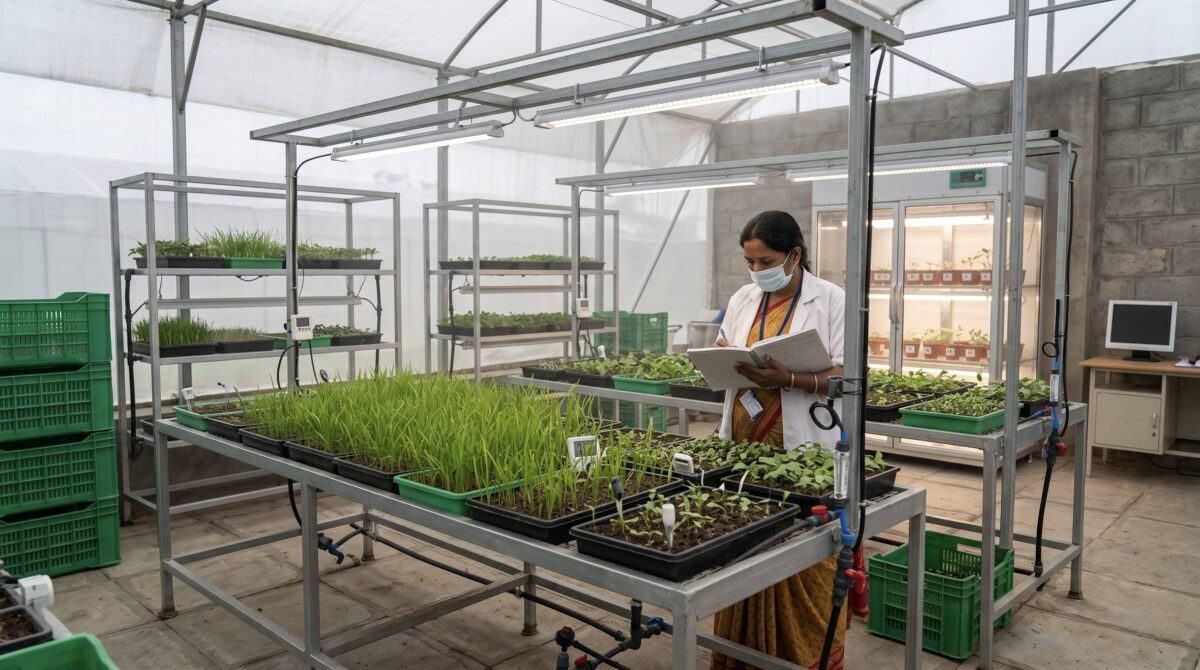
Regenerative agriculture is often framed as a farmer-adoption challenge. This article argues that the real bottleneck lies deeper in the system: research infrastructure, protected cultivation, and the weak measurement frameworks connecting innovation to farmer outcomes.
On the outskirts of Hyderabad, inside a cluster of precision greenhouses, a quieter shift in the impact economy is underway.
Sri Sai Fibres, a 40-year-old MSME founded by Panduranga Raju, builds customized protected-cultivation systems — light-deprivation units, speed-breeding chambers, ebb-flow setups — used by agronomists to develop and test new crop varieties. Innovations developed through this infrastructure can have a multiplier effect, reaching thousands of farmers, improving yields, reducing inputs, and strengthening climate resilience. The company is also beginning a broader sustainability pivot, with plans to integrate polyfilm recycling, solar energy, and biochar, while embedding impact measurement more intentionally into its operations.

Panduranga Raju, founder of Sri Sai Fibres
That evolution raises a broader question: are the systems needed to enable regenerative agriculture actually in place?
Climate stress on agriculture is no longer abstract. Rainfall is becoming more erratic, soil health and groundwater are declining, yields are under pressure, and input costs continue to rise. Small landholding farmers, in particular, are falling into greater financial distress.
In response, regenerative agriculture has gained traction as a possible pathway forward. The promise is compelling: a land-management approach that restores soil health, strengthens biodiversity, improves water retention, sequesters carbon, builds climate resilience, and, over time, may also improve farm productivity.
But regenerative agriculture is still far from mainstream. Estimates suggest that only a small share of global agricultural land — often cited in the range of 1 to 2 percent — has shifted to regenerative practices, though even that figure is difficult to verify because there is still no universally standardized definition.
That uncertainty matters. It suggests that the challenge is not simply farmer reluctance or lack of awareness.
That framing is too narrow.
What is missing is not intent, but the systems that make adoption possible at scale.
The International Crops Research Institute for the Semi-Arid Tropics, or ICRISAT, has argued that climate-smart agriculture is not driven by improved crop varieties and technologies alone. It depends on modern research systems capable of developing, testing, and scaling those innovations.
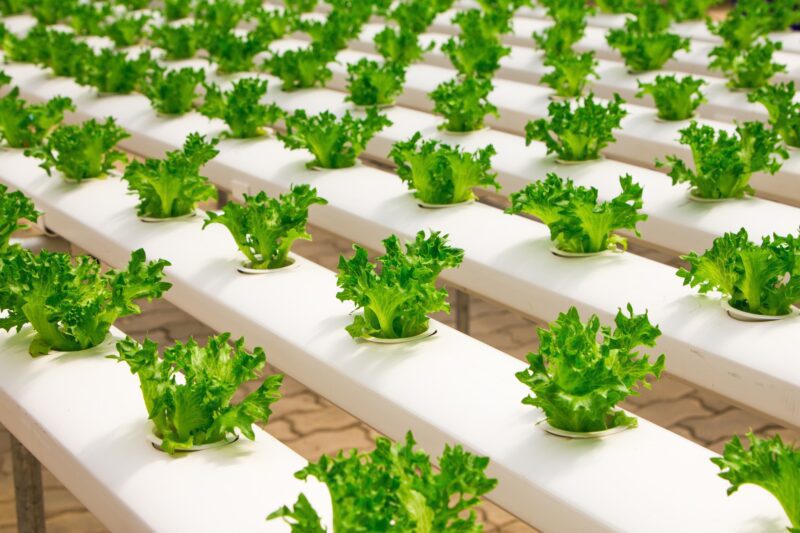
Controlled growing systems can increase efficiency and consistency, but their deeper value lies in how they connect research, infrastructure, and more resilient forms of agricultural production; Photo courtesy of Sri Sai Fibres
That infrastructure includes advanced breeding and genomics platforms, seed systems, genebanks, digital data systems, and controlled-environment facilities that allow researchers to test agricultural innovations under real climate constraints. These are not peripheral assets. They are part of the backbone of agricultural transition.
Consider custom speed-breeding facilities that reduce crop cycles from several months to just eight to ten weeks through precise control of light, temperature, and humidity. This allows researchers to screen large numbers of plant lines more quickly, identify climate-resilient traits, and accelerate the development of improved varieties that may eventually reach farmers.
Regenerative agriculture does not begin only in the field. It begins in the research systems that make new forms of cultivation possible.
In other words, regenerative or climate-smart agriculture does not begin only in the field. It begins in the research systems that make new forms of cultivation possible.
The link between research infrastructure and farmer outcomes becomes more tangible when innovation moves into farmer-facing systems.
Facilities such as research greenhouses, polyhouses, hydroponic systems, and ripening chambers function as the laboratories where climate-resilient agriculture is developed and refined before wider deployment. Equipment manufacturers build and install these systems in collaboration with research institutions, private seed companies, and agri-biotech firms.
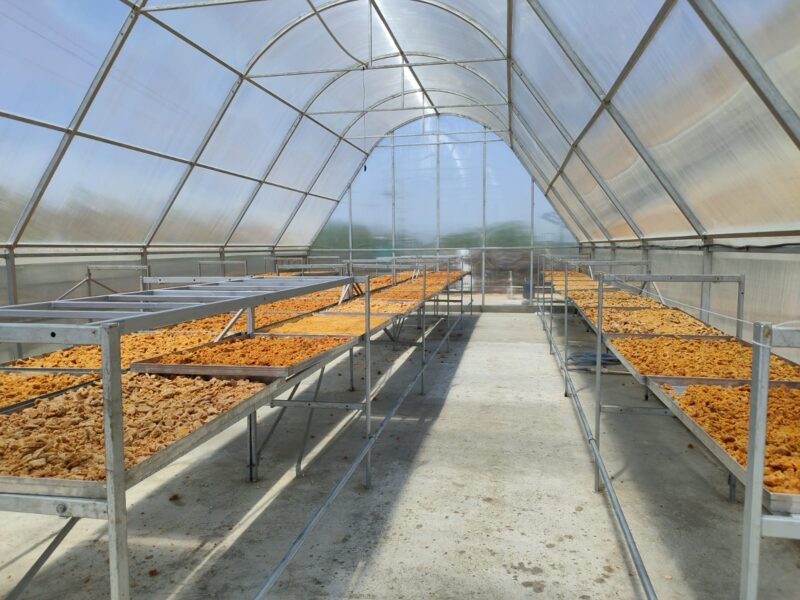
Inside climate-controlled agricultural infrastructure, innovation becomes practical: testing, processing, and cultivation systems like these help translate research into usable farm-level solutions; Photo courtesy of Sri Sai Fibres
In Telangana, for example, the government partnered with manufacturers including Sri Sai to deploy subsidized, ICRISAT-designed, naturally ventilated polyhouses to more than 900 farmers growing high-value crops such as bell peppers and tomatoes.
The potential of protected-cultivation systems is significant. ICRISAT has highlighted gains in water-use efficiency, fertilizer efficiency, and yields under such systems relative to conventional cultivation. But the evidence base remains uneven. Some of the strongest performance claims still come from internal polling, small-sample surveys, or institution-led reporting rather than structured, independent long-term measurement.
That does not invalidate the case for this infrastructure. It strengthens the argument that the sector needs better evidence.
This is where the larger argument comes into focus: agricultural research systems and enabling infrastructure remain weakly connected to impact measurement frameworks.
What is missing is not intent, but the systems that make adoption possible at scale.
Once installation is complete, long-term tracking often stops. Researchers may report varietal releases. Governments may track distribution. Farmers may receive infrastructure or inputs. But there is often little systematic evidence on income gains, long-term adoption of climate-smart practices, or improvements in soil and water systems over time.
That gap has consequences. If research infrastructure is foundational to agricultural resilience but its downstream effects remain weakly measured, it risks staying under-valued within the impact economy.
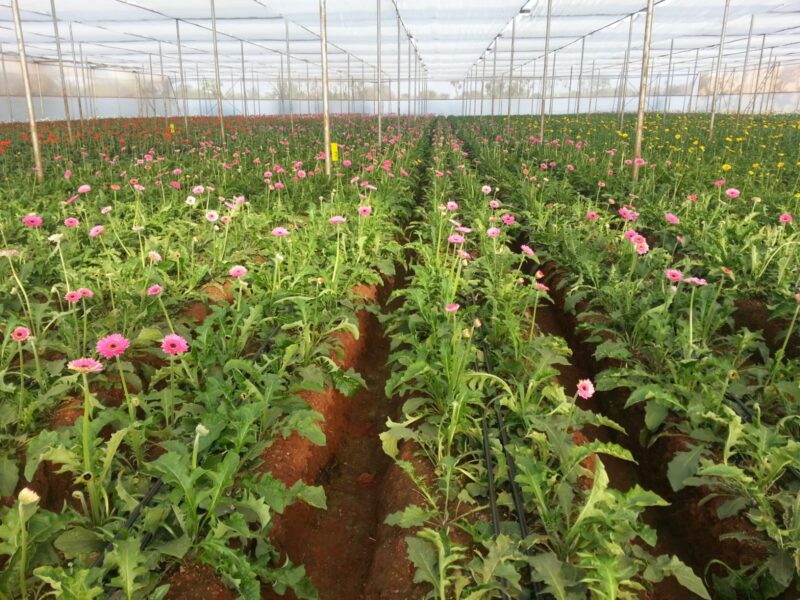
Gerbera flowers with drip irrigation in a large polyhouse, another component of the Telangana Horticulture Department farmer project; Image courtesy of SriSai
Bridging this gap would require integrated measurement frameworks built across research institutions, governments, infrastructure providers, and impact specialists. It would also require impact investors to widen their field of vision. Not every high-impact intervention sits neatly at the farmer-facing end of the chain. Some of the most important leverage points sit earlier, in the enabling systems that make innovation, testing, and adoption possible.
Sri Sai offers one example of this emerging category. When Ananda Vegesina joined the business, she saw that the company occupied a rarely acknowledged position: close both to research environments and to farmer-facing deployment. That creates the possibility — at least in principle — of helping connect infrastructure provision with more deliberate impact tracking across the chain.
Sri Sai’s trajectory points to a broader tension in impact investing.
Entrepreneurial intent matters. But the larger question is whether the impact ecosystem is structured to recognize and support sectors where value is co-created across institutions, governments, markets, and communities — not just within an individual enterprise.
Some of the most important leverage points in agricultural transition sit earlier in the chain, in the enabling systems that make innovation, testing, and adoption possible.
For more than a decade, impact has often leaned on the success of standout ventures. That approach can surface innovation, but it can also mirror the traditional economy more than reimagine it. Agricultural infrastructure complicates that model. Its value lies not only in the performance of one company, but in the conditions it creates for many others to succeed.
If regenerative agriculture is to move beyond scattered pilots and isolated success stories, the focus must shift from backing individual firms alone to building the enabling conditions across the value chain. That means investing not only in end-user solutions, but in the research, infrastructure, and measurement systems that allow transition to happen at scale.
Otherwise, the sector risks settling into an uneasy pattern: compelling examples, ambitious rhetoric, and too few pathways to structural change.


Related Content
 8864
0
8864
0


 9776
0
9776
0

Comments

Deep Dives
RECENT
 7527
0
7527
0
 13415
0
13415
0
 7929
0
7929
0
Editor's Picks
 20353
0
20353
0
 10042
0
10042
0
 12088
0
12088
0
Webinars
News & Events
Subscribe to our newsletter to receive updates about new Magazine content and upcoming webinars, deep dives, and events.
Become a Premium Member to access the full library of webinars and deep dives, exclusive membership portal, member directory, message board, and curated live chats.

Join our global community of systems-minded changemakers.
Subscribe to the Impact Entrepreneur newsletter for the latest insights, magazine features, and invitations to exclusive webinars, Deep Dives, and events.




0 Comments