Forging the Next Economy with Nature as Our Guide




 10756
10756
 0
0

 14560
0
14560
0

 11189
0
11189
0

An interview with SOCAP President Robert Munson
 8290
0
8290
0
Accelerating post-wildfire recovery in ways conventional solutions can’t achieve
 15293
0
15293
0

 9742
0
9742
0

 2290
0
2290
0
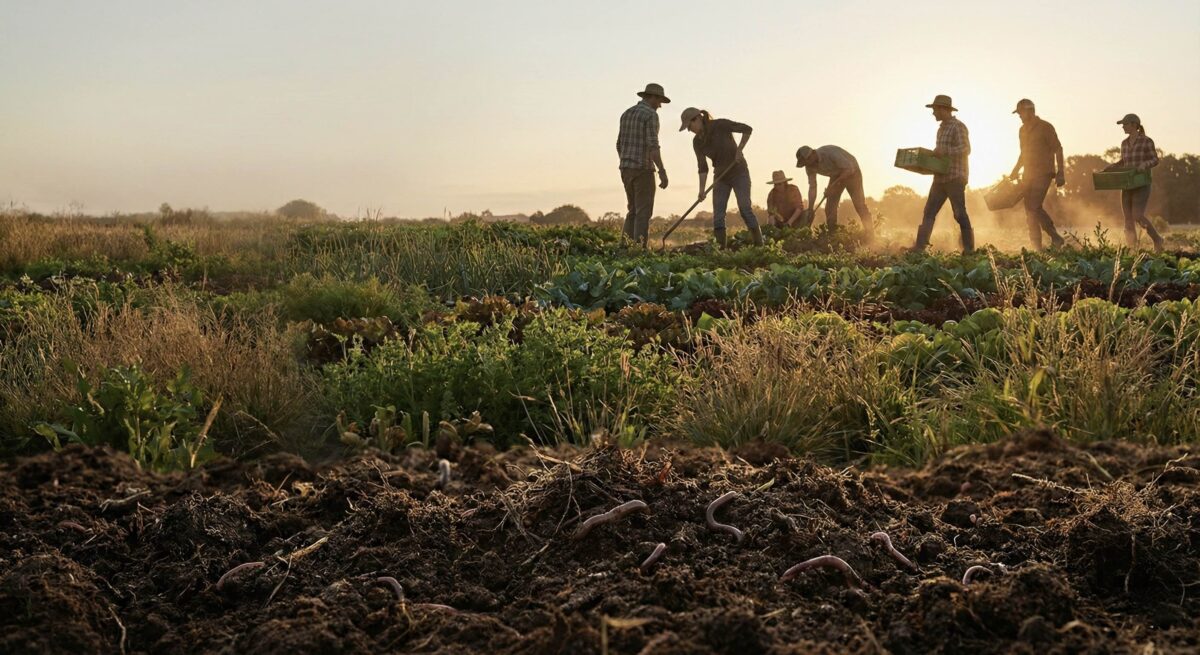
Regenerative organic agriculture is no longer a niche practice — it is a systems-level investment opportunity that aligns soil health, climate resilience, public health, and inclusive economic growth. As capital, policy, and farmers converge, the question is no longer whether regeneration works, but whether we will fund it at the scale the moment demands.
When you view agriculture solely as food production, you miss what it can be: a foundational lever for climate resilience, public health, rural revitalization, and inclusive wealth creation. Across the world, farmers, investors, and communities are rediscovering something ancient yet newly urgent — the power of soil to anchor thriving systems of life and livelihood.
Regenerative Organic Agriculture (ROA), which blends soil health, social fairness, and animal welfare, is no longer a fringe concept. It represents a systems strategy for aligning capital with ecological and human well-being, rather than short-term yield or shareholder value. As Christine Mahoney, Author and Chief Innovation Officer of the Batten School of Leadership & Public Policy at the University of Virginia puts it, “Regeneration isn’t a niche — it’s infrastructure for life.”
The momentum is visible. Investment tracking firm RFSI recorded 37 regenerative food-system deals totaling $1.17 billion globally in the first quarter of 2025. The regenerative agriculture market stood at $12.66 billion in 2024 and is projected to reach $57.16 billion by 2033 with an extraordinary 18.7% compound annual growth rate. Once scaled, regenerative practices have delivered 15–25% higher returns relative to conventional agriculture, according to BCG and OP2B.
Yet the capital flowing into regeneration remains far below what’s needed for a full-scale transition. Much of today’s “climate-smart” public funding still directs more than half of its dollars to practices that do little to reduce emissions or rebuild soils. As Jeff Tkach, CEO of the Rodale Institute notes, “Healthy soil equals healthy people. Fix the way we farm, and we can heal every other system downstream.”
The promise is clear, but the pathway is uneven especially for farmers carrying the risks of change.
Transition Risk & The J-Curve.
Regenerative systems often take three to five years to stabilize, leaving farmers with early yield dips that traditional debt instruments are ill-suited to support.
Technical Assistance Gaps.
Pilot grants abound, but long-term technical assistance the “boring backbone” of soil testing, field coaching, and peer mentorship remains woefully underfunded.
The Missing Middle.
The infrastructure that connects farms to markets, aggregation hubs, cold storage, regional processing is too small for venture capital and too large for philanthropy.
Demand Uncertainty.
Farmers want advance market commitments from buyers before risking production changes. Without demand certainty, supply-side transformation stalls.
Fair Pay vs. Affordability.
Paying farmers fairly can raise prices for low-wealth consumers, a tension only blended capital and health partnerships can resolve.
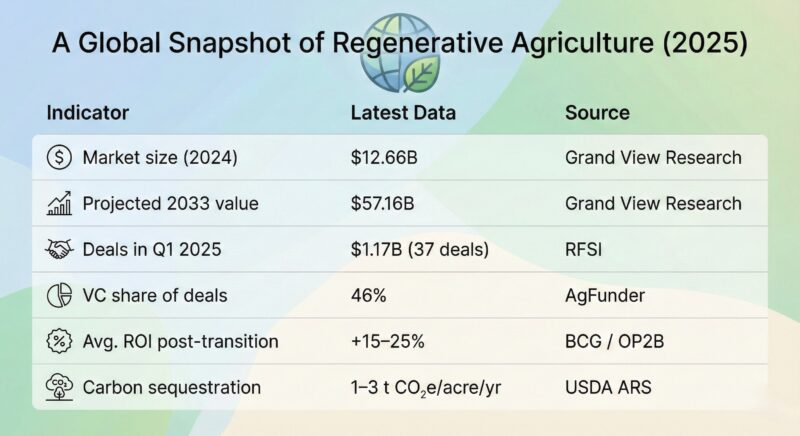 This graphic provides a concise summary of the key market data for regenerative organic agriculture, including its market size, projected growth, and investment trends.
Soil as Climate Infrastructure — Healthy soils store carbon, hold water, buffer droughts, reduce floods, and restore biodiversity. They are nature’s adaptation system scalable, affordable, and self-reinforcing.
Economic Multipliers — Local processing and transparent pricing can keep up to four times more of each food dollar circulating in rural communities, strengthening local economies.
Human Health — Nutrient-dense, chemical-free foods reduce chronic disease burdens and deepen the connection between agriculture and public health outcomes.
Workforce & Dignity — Regeneration has quietly become a workforce strategy, empowering immigrant, first-generation, and women farmers with better jobs, leadership pathways, and intergenerational wealth-building.
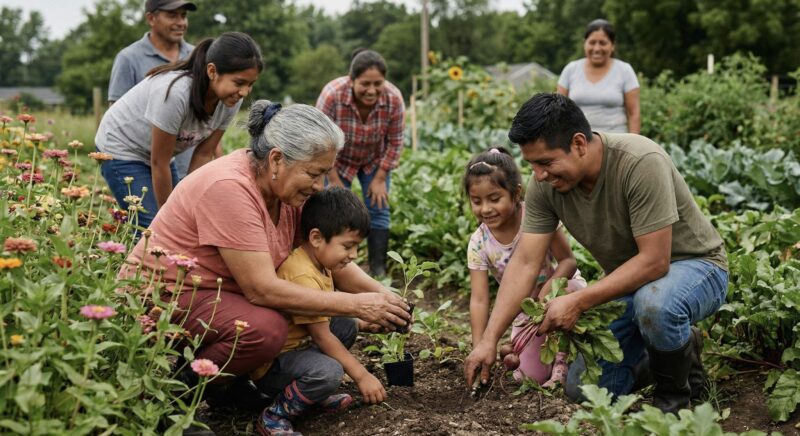
Two of the most compelling examples of this “human multiplier” is unfolding at Wayflowering and Thistlerock Farm. Founders Christine Mahoney and John Kluge are deeply respected for their practice in making regenerative agriculture double as social regeneration. Immigrant families who once labored in anonymity now lead pollinator gardens, manage logistics, and teach soil stewardship. Children see their parents not only tending land but building enterprises, knowledge, and community standing. Regeneration, in this context, is not simply ecological repair it is belonging made tangible.
Tom McDougall, Founder and CEO of 4P Foods captures this shift succinctly: “Money is made up. Soil is real.”
Philanthropy, private investors, and public agencies each hold a piece of the puzzle. Real transformation occurs only when those pieces interlock.
Together, these mechanisms de-risk the farmer, strengthen local markets, and ensure that regenerative food is accessible to all communities, not just affluent ones.
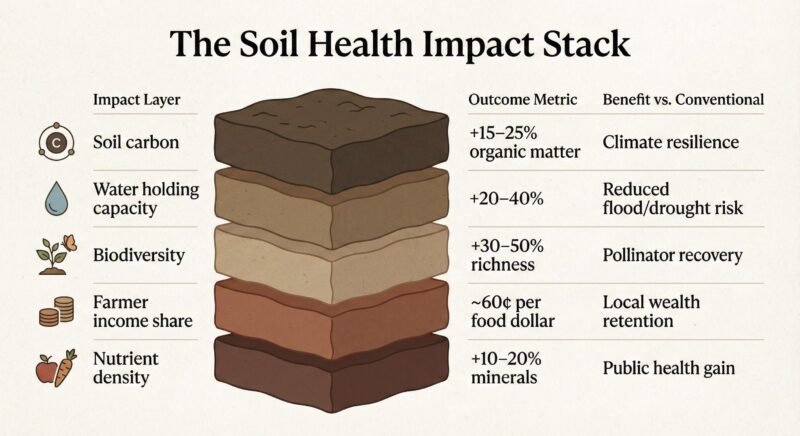 This graphic illustrates the multi-faceted benefits of regenerative agriculture, showing how improvements in soil health lead to positive outcomes for climate resilience, biodiversity, farmer livelihoods, and public health.
If regenerative organic agriculture is to move from inspiring exception to everyday reality, policy must evolve alongside capital.
Without such shifts, regenerative practices remain courageous outliers. With them, they become the backbone of resilient regional food systems.
At its core, this movement is not just about transforming agriculture; it is about rethinking how we value life itself. Soil becomes both mirror and map reflecting the extractive mindset that brought us here, and pointing toward a regenerative future rooted in reciprocity.
If policymakers can set the table, and investors bring capital that is as patient and alive as the ecosystems it seeks to restore, regeneration can move from buzzword to baseline. The tools are already in our hands. The question is whether we will use them to sustain speculation or seed renewal.
The good news? The ground beneath us has already begun to shift.


Related Content

Re-imagining our economy in service of ecological harmony and equitable well-being
 11904
0
11904
0
Innovative Solar Solutions for Energy Resilience in Underserved Communities
7915
0

Revitalizing a family business and becoming leaders in food banking
 14247
0
14247
0

Start early!
7685
0
Comments

Deep Dives
RECENT
 8290
0
8290
0
 15293
0
15293
0
 9742
0
9742
0
Editor's Picks
 10756
0
10756
0
 14560
0
14560
0
 11189
0
11189
0
Webinars
News & Events
Subscribe to our newsletter to receive updates about new Magazine content and upcoming webinars, deep dives, and events.
Become a Premium Member to access the full library of webinars and deep dives, exclusive membership portal, member directory, message board, and curated live chats.

Join our global community of systems-minded changemakers.
Subscribe to the Impact Entrepreneur newsletter for the latest insights, magazine features, and invitations to exclusive webinars, Deep Dives, and events.


0 Comments