Building an Alabama Entrepreneurial Ecosystem
Focused on black business owners.




Focused on black business owners.

 10024
10024
 0
0

Impact investors and the community as a whole has missed a leadership opportunity.
 12053
0
12053
0

 9853
0
9853
0

A new marketplace called OutcomesX
 7506
0
7506
0

 13340
0
13340
0

Innovating and supporting women
 7895
0
7895
0

 3636
0
3636
0

Playing and watching sports is a favorite pastime for billions of people around the world. But as global temperatures climb and heat waves blanket major cities, the games we love may never look the same.
The signs are everywhere. Professional athletes, conditioned to the very limits of human capacity, are finding themselves undone by conditions that their training cannot overcome. Whether it’s kicking a ball on a sun-scorched pitch or sprinting after a serve in suffocating humidity, biology has its thresholds — and climate change is pushing them past the breaking point.
Few sports illustrate this more starkly than football (or “soccer” as it’s called in some countries). Tournaments such as the World Cup and the European Championships are now increasingly hostage to extreme weather. This past summer offered a preview. In Switzerland, during the UEFA Women’s Euro 2025, and across the United States during the Club World Cup and Gold Cup, daytime temperatures routinely climbed into the 90s (or about 35 degrees Celsius). Governing bodies loosened restrictions to allow fans to carry water into stadiums, handed out sunscreen, and advised people to seek shade. Coaches and medical staff resorted to cold vests, ice baths, and cooling towels just to keep players upright.

Even with these measures, conditions were punishing. Sarina Wiegman, coach of the English women’s team, spoke of elaborate “protocols” to keep her team from overheating, while Atletico Madrid’s Marcos Llorente admitted his toes were so sore from the heat that “even my toenails were hurting.” Chelsea’s Enzo Fernández described one match as “very dangerous,” recalling dizziness that forced him to lie down on the field, and his coach, Enzo Maresca, confessed that training sessions had become “impossible.” Former Arsenal manager Arsène Wenger conceded that cooling breaks and watering pitches were the only way to make play bearable. PSG manager Luis Enrique observed that entire matches were “clearly influenced” by the temperature, while Borussia Dortmund’s Niko Kovac resorted to cooling sticks and air-conditioned waiting rooms to keep his squad from wilting. The players survived. Spectators, however, were left to fend for themselves.
Climate change is forcing sports to confront an uncomfortable reality: resilience strategies can delay but not prevent disruption.
FIFA guidelines now mandate water breaks when the Wet Bulb Globe Temperature — a measure that factors in heat and humidity — reaches 89.6°F. The rule was introduced during Brazil’s 2014 World Cup, but it already feels outdated as climate change accelerates. The 2026 World Cup in North America will be the ultimate stress test: 104 matches spread across 16 cities, each vulnerable not only to heat but also to wildfire smoke, drought, or flooding. A recent study by Football for Future and Common Goal warned of “potentially dangerous levels of heat” for afternoon matches, and FIFPRO, the global players’ union, has pressed FIFA to avoid midday kickoffs in high-risk cities such as Kansas City, Miami, and Monterrey.
But no matter how detailed FIFA’s contingency plans — air-conditioned stadiums, covered venues, scheduled cooling breaks — weather does not obey regulations. Storms can flood pitches, droughts can crack them, smoke can make them unbreathable. Athletes may refuse to play in unsafe conditions. Medical emergencies will alter games and possibly careers. Younger players might gain an edge in adaptability while veterans struggle to cope. What once seemed like improbable disruptions now appear inevitable.

The precedent was set in 2015 when FIFA moved the 2022 World Cup in Qatar to November and December to avoid lethal summer heat. Future hosts — from Morocco, Portugal, and Spain in 2030 to Saudi Arabia in 2034 — will likely have to make similar concessions. The “beautiful game,” in other words, is already being reshaped by climate change.
Tennis, too, has become a frontline sport in the climate crisis. Matches demand explosive speed, endurance, and concentration over hours of play — almost always outdoors, often under punishing sun. Players have begun to speak openly about the dangers. During the 2018 Australian Open, Gaël Monfils admitted it was “tough to breathe,” describing dizziness and what he called a “small heatstroke” that lasted nearly an hour. That same year at the US Open, multiple players forfeited matches due to heat exhaustion. Richard Berankis said bluntly that the World Tennis Association “should have canceled the matches,” warning that change would only come “when someone dies.”
Governing bodies have responded, albeit haltingly.
Five years later, at the 2023 US Open, Daniil Medvedev echoed that grim forecast: “One day, a player is going to die,” he said, asking aloud how far the sport could push its athletes. The tournament was also marked by a dramatic climate protest, when an activist glued his feet to the stands, delaying play for nearly an hour. Even Wimbledon — known for its temperate English setting — saw a match delayed in 2025 when a spectator collapsed from heat.
Governing bodies have responded, albeit haltingly. The US Open introduced a heat policy in 2018, requiring partial closure of the Arthur Ashe Stadium roof when temperatures topped 90°F with 50 percent humidity. The Australian Open has refined its Extreme Heat Policy multiple times, most recently in 2019, with a five-point scale that allows for suspension of play in severe conditions. The International Tennis Federation even adopted an Extreme Weather Policy for the 2024 Paris Olympics, mandating monitoring of the Wet Bulb Globe Temperature. Yet across these reforms runs a common thread: change tends to follow only after high-profile crises or outcry from star athletes.
It doesn’t take a meteorologist to predict that, sooner rather than later, players’ bodies will be pushed past the point of endurance.
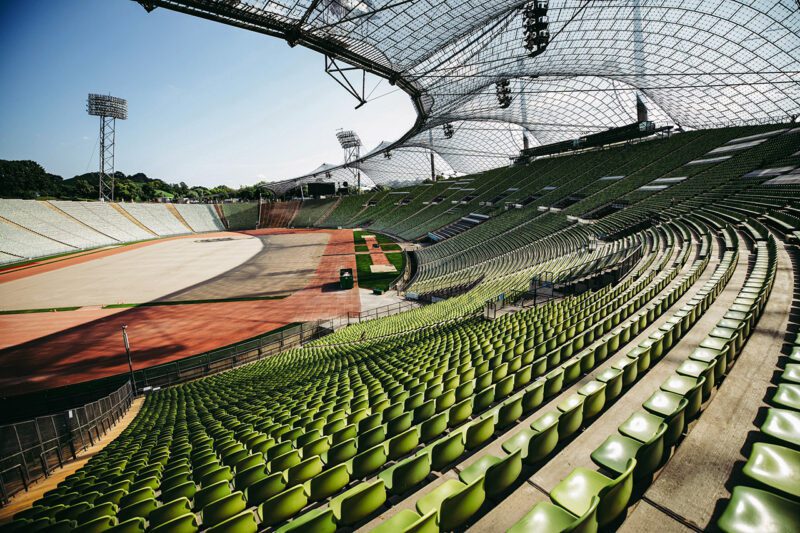
This pattern will soon collide with the world’s biggest sporting stage. The 2028 Summer Olympics in Los Angeles will unfold in a region prone to heat waves, wildfires, droughts, and flash floods. Organizers are working on climate resilience measures — more shaded areas, for example — but history suggests these preparations may not be enough. The 2020 Tokyo Games were the hottest Olympics ever, with more than 100 athletes reporting heat-related illnesses. The 2024 Paris Games were marred by complaints of dehydration, fogginess, and insomnia during a heat wave. At some point, the International Olympic Committee will face a stark choice: change the timing of the Games, or rule out certain cities altogether.
Climate change is forcing sports to confront an uncomfortable reality: resilience strategies can delay but not prevent disruption. Football and tennis offer vivid case studies, but no sport — however global, historic, or lucrative — is immune. Sponsors may grow hesitant to invest in competitions where conditions compromise play, and poorer nations without resources to adapt may be excluded from hosting altogether, reinforcing global inequalities. Some athletes may be forced to shorten their careers or choose less dangerous sports, forever changing the economics of some competitions and potentially even rewriting the record books.
The games will go on, but they will not be the same.


Related Content


 9742
0
9742
0


Comments

Deep Dives
RECENT
 7506
0
7506
0
 13340
0
13340
0
 7895
0
7895
0
Editor's Picks
 10024
0
10024
0
 12053
0
12053
0
 9853
0
9853
0
Webinars
News & Events
Subscribe to our newsletter to receive updates about new Magazine content and upcoming webinars, deep dives, and events.
Become a Premium Member to access the full library of webinars and deep dives, exclusive membership portal, member directory, message board, and curated live chats.

Join our global community of systems-minded changemakers.
Subscribe to the Impact Entrepreneur newsletter for the latest insights, magazine features, and invitations to exclusive webinars, Deep Dives, and events.





0 Comments