Business Across the Green Line
What Cyprus’s bicommunal enterprises reveal about trust, trade, and divided economies



What Cyprus’s bicommunal enterprises reveal about trust, trade, and divided economies

 151
151
 0
0

How impact entrepreneurs can build a more flexible capital stack
 154
0
154
0

Beth Gardiner on Big Oil’s plastic bet and recycling’s limits
 198
0
198
0

What a Barbados summit revealed about the region's climate economy
 378
0
378
0

How legal design reshapes voice, risk, capital, and value
 424
0
424
0

A Calabar case for climate resilience
 330
0
330
0

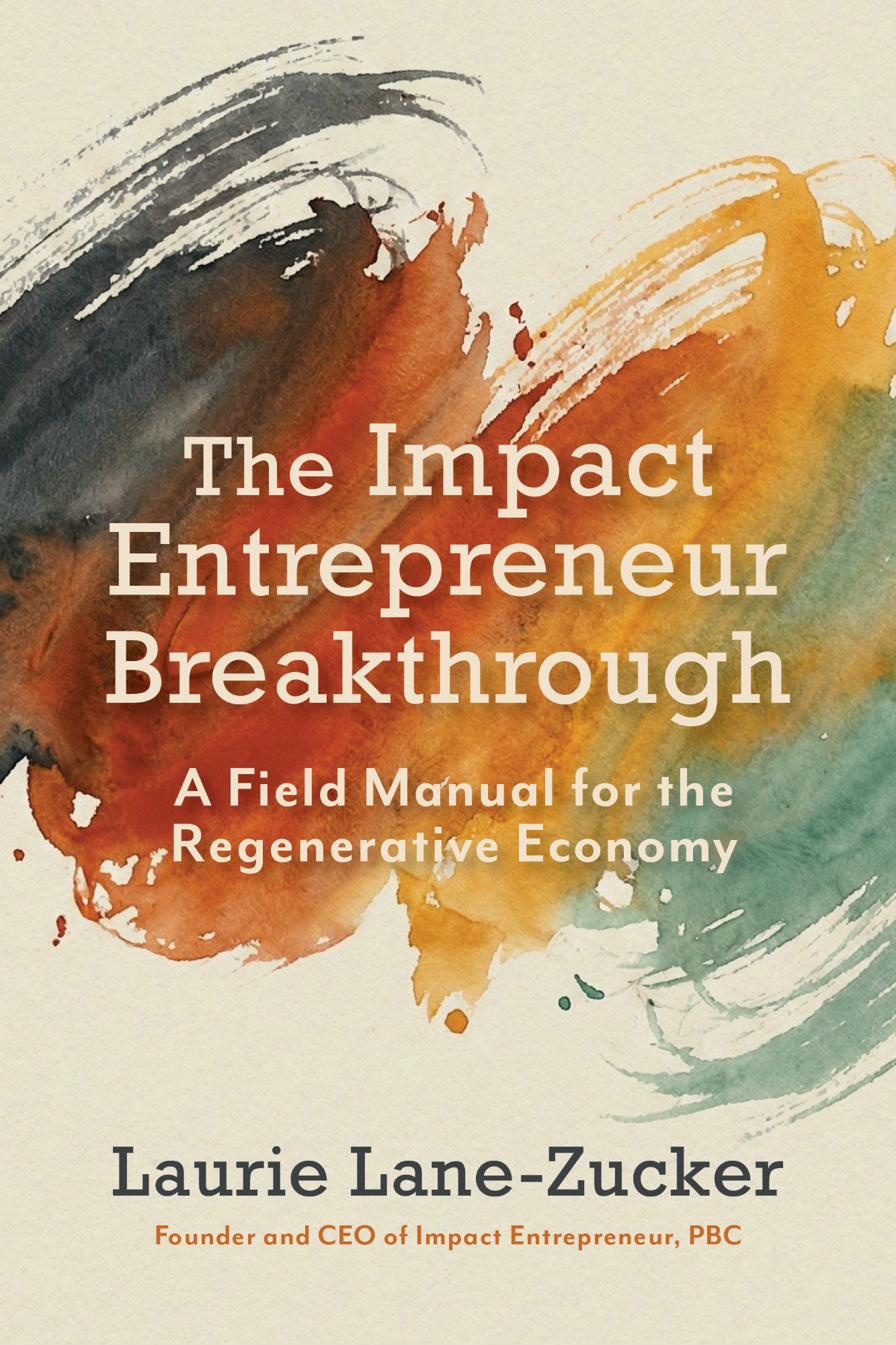
Everything journalists, podcast hosts, reviewers, and event organizers need to cover The Impact Entrepreneur Breakthrough: A Field Manual for the Regenerative Economy — publishing September 1, 2026 from Berrett-Koehler, distributed globally by Penguin Random House. Bios, descriptions, cover art, endorsements, and interview questions below are cleared for editorial use.
Verified publication details for fact-checking and listings.
Three lengths, each cleared for use as written. Each version stands alone.
Fifteen years after coining the term “impact entrepreneur,” Laurie Lane-Zucker delivers the field manual for the regenerative economy — a practical map for building an economy where business, capital, and culture create lasting value for people, communities, and the living world.
The old economy rewards extraction, short-term thinking, and growth at any cost. The Impact Entrepreneur Breakthrough is the field manual for building the alternative: a regenerative economy where business, capital, and culture create lasting value for people, communities, and the living world. Drawing on thirty-five years of leadership in impact entrepreneurship and systems change, Laurie Lane-Zucker maps the full architecture of transformation — enterprises designed for healing, ownership rooted in justice, capital as custodian, markets that reflect true costs, and culture as infrastructure — and introduces Defense as a Service™, the Prevention Dividend™, and the Prevention Ratio™.
Build the Economy That Heals.
The old economy rewards extraction, short-term thinking, and growth at any cost. The Impact Entrepreneur Breakthrough is the field manual for building the alternative — a regenerative economy where business, capital, and culture create lasting value for people, communities, and the living world.
Drawing on thirty-five years of leadership in impact entrepreneurship, regenerative enterprise, and systems change, Laurie Lane-Zucker maps the full architecture of transformation, including enterprises designed for healing, ownership structures rooted in justice, capital as custodian, markets that reflect true costs, and culture as infrastructure. He introduces Defense as a Service™, a groundbreaking framework that redefines security through prevention rather than reaction, along with the Prevention Dividend™ and Prevention Ratio™, practical tools for measuring what prevention is actually worth.
This is more than a book about better business. It’s a field manual for anyone — entrepreneur, investor, educator, community leader, or policymaker — ready to build what comes next.
Three bio lengths, cleared for editorial use. Headshot available in print resolution below.

Laurie Lane-Zucker is the founder and CEO of Impact Entrepreneur PBC. He coined the term “impact entrepreneur” in 2011, cofounded the concept of “place-based education,” and led The Orion Society for twelve years, collaborating with Wendell Berry, Barry Lopez, and Terry Tempest Williams. He founded one of the earliest Certified B Corps and publishes Impact Entrepreneur Magazine. He lives in Sheffield, Massachusetts.
Laurie Lane-Zucker is the founder and CEO of Impact Entrepreneur, PBC, a global media and community platform reaching more than 70,000 systems-minded changemakers across 200+ countries. He coined the term “impact entrepreneur” in 2011 and co-created the concept of “place-based education” with John Elder in the 1990s.
As Founding Executive Director of The Orion Society (1992–2004) — which the Boston Globe called “the philosophical voice of the environmental movement” — he edited and published Wendell Berry, Barry Lopez, Terry Tempest Williams, and David James Duncan, and organized more than 100 conferences and summits worldwide, including the landmark 1996 Watershed Conference at the Library of Congress. He went on to found Triad Institute and Hotfrog, a Founding B Corporation among the first twenty-five Certified B Corps, which completed the first equity transaction on an impact investment exchange.
The Impact Entrepreneur Breakthrough: A Field Manual for the Regenerative Economy (Berrett-Koehler, September 2026) distills thirty-five years of field leadership and introduces Defense as a Service™, the Prevention Dividend™, and the Prevention Ratio™. He lives in Sheffield, Massachusetts.
Laurie Lane-Zucker is the founder and CEO of Impact Entrepreneur, PBC, a global media and community platform serving the regenerative economy — one of the world’s largest networks of systems-minded changemakers, reaching more than 70,000 practitioners across 200+ countries. The platform publishes Impact Entrepreneur Magazine, produces live webinar series including “Luminarias,” and convenes field-building conferences across the impact economy.
Lane-Zucker coined the term “impact entrepreneur” in 2011, giving a name — and, over the following fifteen years, a language, a community, and a home — to a global movement of founders, investors, and institution-builders who make regeneration, equity, and ecological restoration the foundational logic of how value gets created. In the 1990s, he co-created the concept of “place-based education” with John Elder, helping shape a generation of environmental learning.
As Founding Executive Director of The Orion Society (1992–2004) — called “the philosophical voice of the environmental movement” by the Boston Globe — he edited and published acclaimed authors including Wendell Berry, Barry Lopez, Terry Tempest Williams, and David James Duncan, created The Forgotten Language Tour, and organized more than 100 conferences and summits worldwide, from the landmark 1996 Watershed Conference at the Library of Congress to programs with the Rockefeller Brothers Fund and the Aga Khan Trust for Culture.
An early architect of the impact economy’s institutions, Lane-Zucker founded Triad Institute and Hotfrog, a Founding B Corporation and among the first twenty-five Certified B Corps, which completed the first equity transaction on an impact investment exchange. He also served as Executive Director of Seven Pillars House of Wisdom.
His new book, The Impact Entrepreneur Breakthrough: A Field Manual for the Regenerative Economy (Berrett-Koehler Publishers, September 1, 2026), distills thirty-five years of field leadership into a practical map of the regenerative economy’s full architecture — business, capital, and culture. It introduces Defense as a Service™, a framework that redefines security through prevention rather than reaction, alongside the Prevention Dividend™ and Prevention Ratio™, tools for measuring what prevention is actually worth. The book features 36 original watercolor illustrations and is accompanied by a suite of practitioner resources on the Impact Entrepreneur platform.
Lane-Zucker lives in Sheffield, Massachusetts, in the Berkshires.
The book’s core vocabulary, in brief — for segment framing, show notes, and reviews.
Not a job title but an identity — claimed by founders, investors, educators, and institution-builders who reject the margins of change (incremental adjustments, add-on fixes, making extraction slightly less harmful) and instead make regeneration, equity, and ecological restoration the foundational logic of how value gets created. Impact entrepreneurs build enterprises that cannot succeed unless the systems they are embedded in become healthier.
Not a sector but a civilizational alternative to extraction — operational and scaling, not aspirational. The book maps it across three interdependent dimensions: business (enterprises designed for healing, with ownership structures that protect mission), capital (investment as custodianship rather than extraction), and culture (the narrative, attention, and identity infrastructure that determines whether structural change endures). The book distinguishes regeneration — actively restoring and enhancing — from sustainability, which merely maintains.
A redefinition of security through five interdependent pillars: Ecological Stability, Public Health Capacity, Economic Equity, Democratic Infrastructure, and Community Cohesion. The argument: a society’s genuine safety is produced by the health of these systems, not by the scale of its arsenal.
The book’s most provocative framework: a regenerative alternative to militarized security that treats genuine defense as something prevention delivers — investing upstream in the Five Pillars rather than reacting downstream with force. Introduced for the first time in this book.
Practical, quantitative tools for measuring what prevention is actually worth. The Prevention Dividend names the returns societies earn when they invest ahead of crises — in hazard mitigation, ecosystem restoration, pandemic preparedness, early childhood, and conflict prevention — and the Prevention Ratio gives policymakers, foundations, and investors a common yardstick for comparing upstream investment against the cost of reaction.
All quotes cleared for editorial use with attribution as shown.
The most comprehensive and compelling vision I’ve ever seen for how business can regenerate — not just repair. I thought I understood the landscape, but Lane-Zucker reveals possibilities I hadn’t even imagined.
A groundbreaking and motivational manual — it opens new horizons for the vision of the entrepreneur. A brave vision for creating value and justice for all relations: the co-owners, the community, the customer, the environment, society, and the generations to follow.
This dire moment calls for deep commitment, and this book illuminates not just the best practices of impact entrepreneurship but a wider notion of how we can rebuild culture, markets, and ourselves to enable the future we want.
The problem isn’t a lack of good intentions — it’s the systems themselves. This book names what I’ve seen after decades in the field: we’ve been trying to solve systemic problems one venture at a time. A field manual for building movements, not exceptions.
Lane-Zucker’s book makes a compelling case that our current economic system is driving both social and ecological collapse — and offers a clear path forward. A vital guide to moving from extraction to regeneration.
This important work cuts through the rhetoric of ‘doing good’ to show where justice in entrepreneurship actually lives: in ownership, governance, and capital. A clear, rigorous field manual for building enterprises designed for equity and regeneration.
Extraordinary. A rallying cry for system-shapers, charting a clear, compelling path for anyone ready to help build the regenerative economy this moment demands. Laurie Lane-Zucker guides readers seamlessly from diagnosis to design to implementation, equipping them with incisive tools, visionary frameworks, and the stories of innovators already forging the next economy where justice, mutualism, and planetary healing drive how we live and work.
Few people have done more to give the impact economy a language, a community, and a home than Laurie Lane-Zucker. This book is the culmination of that work. It is visionary in its ambition, generous in its practical tools, and grounded in a genuine belief that we can build something better.
Twelve questions in four themes, for interviews, podcasts, and moderated conversations.
Signature keynotes available for conferences, institutions, and media programs.
The signature keynote. Traces the arc of the book: from the emergence of impact entrepreneurship as a civilizational response, through the structural innovations that make regeneration possible, to the cultural transformation required for those innovations to endure.
Audience: conferences, foundations, corporate leadership, civic gatherings.
A paradigm-shifting presentation on why record global military spending is failing to make us safer, and what genuine security infrastructure looks like. Introduces the Five Pillars of Real Security, the Prevention Dividend, and the DaaS operating model.
Audience: policy conferences, security and defense forums, municipal leadership, foundations.
Focused on the economic architecture of regeneration: enterprise design, ownership structures that protect mission, custodial capital, and markets that reflect true costs — including both negative externalities and positive cascading benefits.
Audience: business conferences, B Corp summits, social enterprise networks, MBA programs.
Draws on Part IV of the book: the role of narrative, attention, and identity in enabling or undermining structural change — and why the best-designed policies and enterprises fail when the cultural operating system is still running extraction.
Audience: media, arts, education, and social change conferences.
High-resolution art and press materials. Press releases available for immediate download.
Print-quality JPG of the front cover, suitable for reviews, listings, and article art.
Dimensional cover render (PNG, transparent background) for feature layouts and social graphics.
Formal print-resolution portrait of Laurie Lane-Zucker, cleared for editorial use with credit.
Alternate environmental portrait for feature layouts, cleared for editorial use with credit.
The general announcement release: fifteen years after coining “impact entrepreneur,” the definitive map of the regenerative economy.
The security-focused release introducing Defense as a Service and the case for security through prevention.
Berrett-Koehler’s press one-sheet and fact sheet: book details, author bio, interview topics, and sample questions for producers and interviewers.
Interior illustration samples, additional formats, or custom art for a feature — write us and we’ll turn it around quickly.
Review copies (print and digital) are available for journalists, podcast hosts, reviewers, and educators. Interview and appearance requests are welcome.
Media inquiries & review copies: Impact Entrepreneur, PBC · info@impactalchemist.com
Publisher publicity: Berrett-Koehler Publishers · publicity@bkpub.com
The Impact Entrepreneur Breakthrough: A Field Manual for the Regenerative Economy · Berrett-Koehler Publishers, September 1, 2026 · Distributed globally by Penguin Random House. Defense as a Service™, Prevention Dividend™, and Prevention Ratio™ are trademarks. Bios, descriptions, cover art, and endorsement quotes on this page are cleared for editorial use with attribution as shown.
Join our global community of systems-minded changemakers.
Subscribe to the Impact Entrepreneur newsletter for the latest insights, magazine features, and invitations to exclusive webinars, Deep Dives, and events.