The Fortress Is Burning
What Iran and Ukraine reveal about the failure of militarized security


What Iran and Ukraine reveal about the failure of militarized security

 2643
2643
 0
0

How AI could expand access to capital without replacing human judgment
 2238
0
2238
0

 894786
0
894786
0
How an export-first model is pricing citizens out of a national staple
 2275
0
2275
0

How demand verification can cut overproduction emissions
 2084
0
2084
0

Why private equity keeps mispricing labor in healthcare
 2218
0
2218
0
Upcoming Events

 1156
0
1156
0
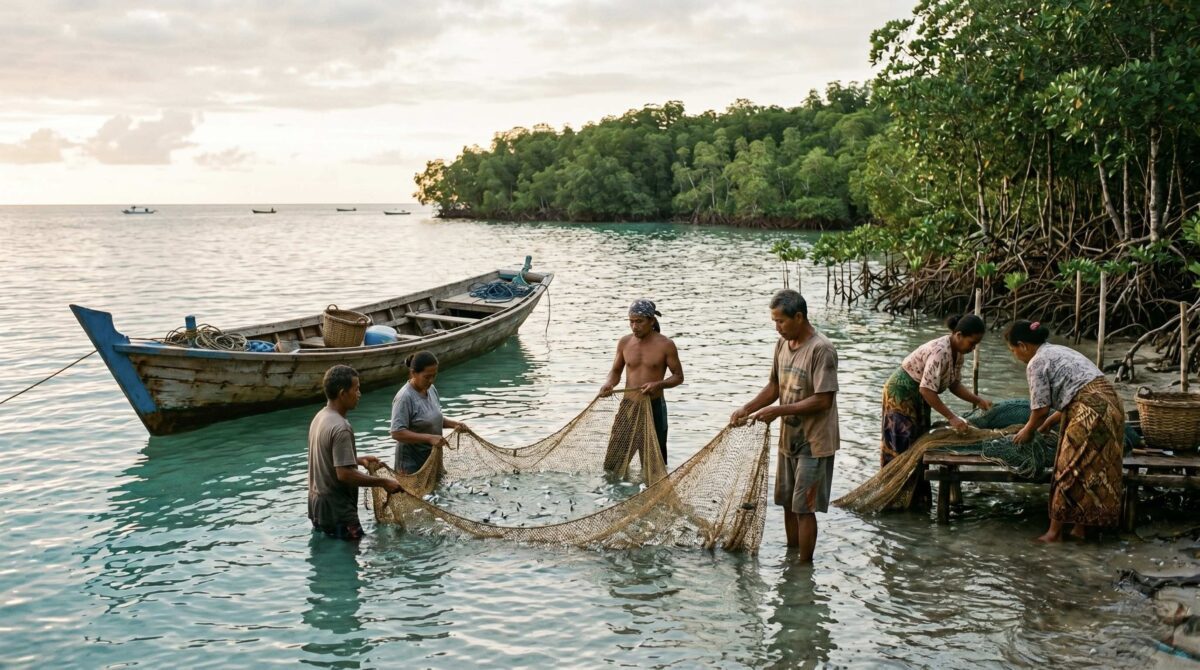
The UK’s planned cuts to climate aid are not simply a budgetary adjustment. They threaten to unravel years of community-led adaptation in vulnerable coastal regions, undermining food security, marine ecosystems, and the local institutions that help communities withstand climate shocks.
As recently reported, the UK is planning to slash climate aid to the Global South by 14%, reducing funding to just £2 billion a year. According to the investigation, schemes worth millions of pounds intended to protect the marine environment will be significantly scaled back.
These cuts are not simply a retreat from the UK’s global climate commitments. They risk dismantling some of the most effective and cost-efficient defenses we have against climate-driven poverty, food insecurity, and instability. By undermining community-led adaptation, they leave local NGOs, community-based organizations, cooperatives, and local governments facing difficult decisions about how — or whether — they can continue supporting the communities they work alongside.
As the impacts of climate change intensify, the consequences of these cuts will be felt most acutely by those on the frontlines of the climate crisis, including coastal communities in regions where histories of extraction and colonial exploitation have shaped present-day vulnerability. These communities have often contributed least to the causes of climate change, yet they face its most immediate and severe consequences — a pattern increasingly described as a climate-colonial nexus.
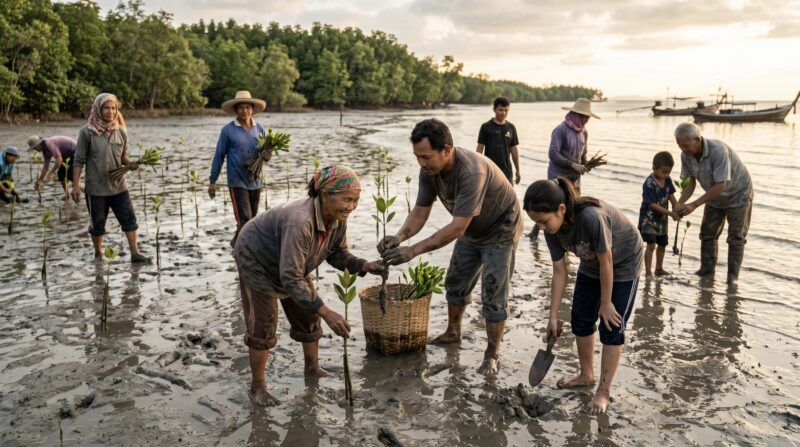
Nature-based adaptation depends on patient, locally led investment — not abrupt funding cycles shaped by distant political decisions.
The role of public climate finance in supporting these communities is becoming more critical as climate impacts intensify and the allocation of resources to respond remains profoundly unequal. By stepping back from these commitments, the UK risks undermining international climate action at precisely the moment it needs to scale.
Coastal communities are among those most severely affected by climate change, facing rising sea levels, stronger and more frequent storms, coastal erosion, and warming seas. These pressures directly endanger homes, livelihoods, and food security, leaving communities that depend on healthy marine ecosystems increasingly exposed.
Cuts to climate aid do more than slow progress — they undermine the very foundations of community-led adaptation.
The impact of climate aid cuts on coastal communities around the world will therefore be profound. In Madagascar alone, around 1.5 million people depend directly on artisanal fishing for their livelihoods, with many more relying on it for daily nutrition and income. Investments in restoring mangroves and coral reefs — often led by coastal communities themselves — are critical to rebuilding fisheries and strengthening resilience. If support is withdrawn, years of progress risk being undone, with devastating consequences for both biodiversity and the communities that depend on it. And the ripple effects will not stop at national borders. As pressure on food systems and natural resources grows, so too does the risk of displacement, instability, and conflict.
Cuts to climate aid do more than slow progress — they undermine the very foundations of community-led adaptation, which depends on long-term trust, local leadership, and effective stewardship. Valuing Indigenous and local knowledge is central to this work. Combining scientific data with traditional, generational, and place-based knowledge is essential to building a robust understanding of climate risk and shaping responses that are grounded in lived reality.
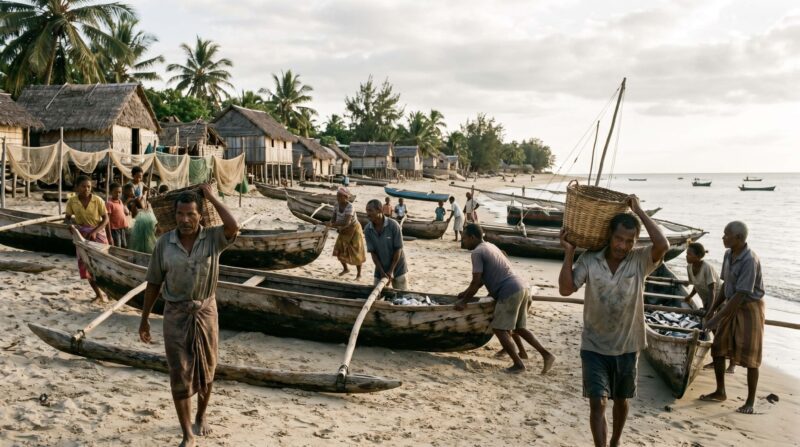
Small-scale fishers help sustain food systems for hundreds of millions of people, yet the public financing that supports their resilience remains precarious.
Adaptation finance is not a one-off intervention but an incremental, cumulative process, with each step reinforcing the next. When funding is withdrawn abruptly, it destabilizes systems that communities have spent years restoring. Governance structures are disrupted, local capacity is weakened, and hard-won resilience can begin to unravel at the very moment it is most needed.
When climate finance is treated as discretionary rather than structural, frontline communities bear the cost of policy instability far beyond their control.
Over the past two decades, Blue Ventures has worked in long-term partnership with small-scale fishers and coastal communities whose livelihoods depend on healthy marine ecosystems. Support from UK Aid programmes that are now subject to cuts has enabled communities in Madagascar, as well as in countries across Asia and West and East Africa, to restore mangroves, protect seagrass beds and coral reefs, and rebuild fisheries that underpin food security and economic resilience. These outcomes are the result of locally led action sustained by flexible, long-term investment. Without continued support, years — and in some places decades — of progress could be rapidly undone, leaving communities more exposed to climate shocks and further entrenching vulnerability.
What these cuts reveal is not only the precariousness of individual programmes, but the fragility of adaptation systems that remain dependent on donor commitments vulnerable to political reversal. When climate finance is treated as discretionary rather than structural, frontline communities bear the cost of policy instability far beyond their control.
Public climate finance plays a critical role in building resilience for vulnerable coastal communities, supporting investments in nature-based solutions, resilient infrastructure, and early warning systems for extreme weather events. These investments, in turn, enable locally led adaptation by strengthening livelihoods, supporting community governance, and protecting the ecosystems that buffer communities from climate shocks.
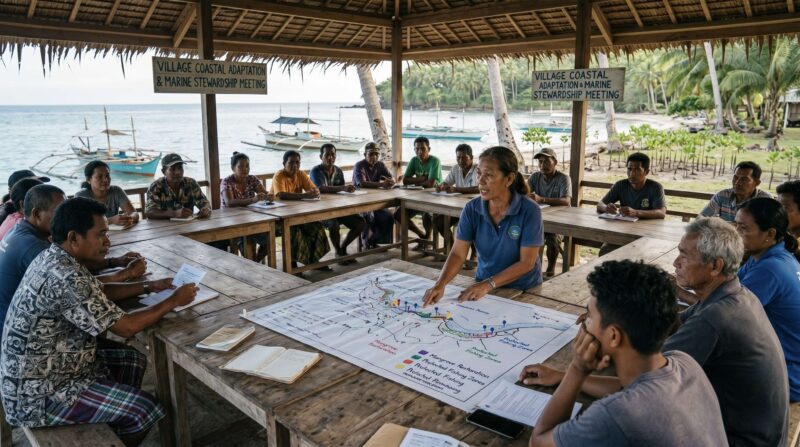
Community-led adaptation is built through trust, local leadership, and governance systems that can take years to strengthen and only moments to destabilize.
This is why public climate finance matters. It remains one of the most transparent and accountable ways for governments to support those most affected by a crisis they did least to cause. More than three billion people already live in places highly vulnerable to climate change, according to the IPCC. This is not the moment to pull back support for climate resilience.
UK climate aid is not charity. It is a strategic investment in the resilience of coastal communities, the food systems they sustain, and the ocean ecosystems that regulate climate, store carbon, and support life on a planetary scale. When coastal food systems fail, the consequences extend far beyond national borders, fueling displacement, economic disruption, and insecurity.
The short-term financial savings from these cuts may appear politically expedient, but the long-term humanitarian, environmental, and geopolitical costs will be far greater.
Community-led adaptation is widely recognized as an effective and cost-efficient approach to building climate resilience because it draws on local knowledge, fosters leadership, and delivers solutions rooted in lived experience and local context. Abrupt reductions in funding not only slow that progress but risk undoing years of community-led work.
The short-term financial savings from these cuts may appear politically expedient, but the long-term humanitarian, environmental, and geopolitical costs will be far greater. Delayed action and underinvestment today simply shift much higher costs into the future — economically, socially, and politically. As climate impacts intensify, governments in the Global North must recognize that supporting frontline communities is not optional charity, but a necessary investment in a more stable, equitable, and climate-resilient world.


Related Content

Why militarized security keeps making us less safe
1869
0

Risk-sharing, resilience, and post-genocide Rwanda
 1861
0
1861
0
Why investing with impact is no longer enough
2710
0

What Ramadan reveals about solidarity as economic infrastructure
1433
0
Comments

Deep Dives

Featuring
Laurie Lane-Zucker
Founder & CEO, Impact Entrepreneur
July 30 - 12:00 PM EST
RECENT
 2275
0
2275
0
 2084
0
2084
0
 2218
0
2218
0
Editor's Picks
 10641
0
10641
0
 9938
0
9938
0
 16587
0
16587
0
 2643
0
2643
0
 2238
0
2238
0
 894786
0
894786
0
Webinars
News & Events
Subscribe to our newsletter to receive updates about new Magazine content and upcoming webinars, deep dives, and events.
Become a Premium Member to access the full library of webinars and deep dives, exclusive membership portal, member directory, message board, and curated live chats.

Join our global community of systems-minded changemakers.
Subscribe to the Impact Entrepreneur newsletter for the latest insights, magazine features, and invitations to exclusive webinars, Deep Dives, and events.





0 Comments