Building an Impact Economy in Georgia
Connecting Georgia’s social enterprises to markets and capital




Connecting Georgia’s social enterprises to markets and capital

 64
64
 0
0

Gabriel Grant on giving shareholders a way to express what matters to them
 88
0
88
0

For mission-led organizations, a change of manager tests whether workplace inclusion is built to last.
 73
0
73
0

Why free education tools need reliable access, credible evidence, and lasting support
 348
0
348
0

What Islamic finance and impact investing can learn from each other
 419
0
419
0

After the flood, recovery capital must do more than replace what was lost
 397
0
397
0

 15467
0
15467
0

Ratings are a ubiquitous part of the Information Age. Need to figure out where to go to dinner? You can use Google Reviews. Need to buy a car? You can check Consumer Reports. Need to find a doctor? You can use HealthGrades.
Ratings are designed to distill large amounts of information into a simple, accessible data point used to inform decisions. But not all ratings are created equal. Some ratings pull from single sources of data, such as public reports, whereas others combine multiple sources of data to provide more robust insight, such as third-party datasets, IOT device data, and survey data. The value of a rating lies in the quality of the underlying data sources and methodology, which ultimately determines its reliability and validity.
In the past year, one rating that’s become more widely scrutinized is environmental, social, and governance (ESG) ratings. Beyond the traditional factors included in investment analysis, ESG ratings were designed to incorporate a new set of factors to better predict financial performance. Despite their growth in popularity, there are a number of structural limitations with ESG ratings.
The value of a rating lies in the quality of the underlying data sources and methodology, which ultimately determines its reliability and validity.
The scope of ESG rating approaches is limited, and for investors interested in directing their money towards impactful companies, the methodology is fundamentally flawed. The list below outlines a few of these challenges and concerns:
Instead of relying on ESG ratings that oversimplify measurement methodologies and are limited to short-term financial materiality, investors should demand a new paradigm of benchmarking — one that prioritizes both financial and stakeholder materiality (i.e., double materiality) and that creates a more comprehensive and accurate representation of companies’ past and predicted performance to drive investment decisions.
The scope of ESG rating approaches is limited, and for investors interested in directing their money towards impactful companies, the methodology is fundamentally flawed.
Double materiality benchmarking is grounded in the principle that the next generation of investors will increasingly need their investments to achieve both a financial return and optimize for positive impact. This cohort acutely understands that the current state of affairs is unsustainable in part because they will be the ones to live through its direct ramifications.
Double materiality benchmarking also rests on the belief that investing with this dual focus is not concessionary. As outlined in my prior article, ESG & Impact: Why We Need Both for Meaningful Change, companies that meaningfully integrate the voices of their stakeholders into ongoing business strategy — and adapt business practices to improve social and environmental outcomes — will ultimately increase customer retention, reduce hidden operational risks, and create long-term sustainable value with stakeholders and shareholders alike.
Prevailing ESG ratings overlook an entire segment of investors who want to incorporate the total societal impact of a company into investment decisions.
The first — and perhaps most critical — of any rating process is defining the scope of data and metrics used in the rating. Unlike ESG ratings that typically use a standard metric set for all companies in a given industry, double materiality benchmarking recognizes that even within sectors or industries, different companies have different stakeholders, products, and operational processes. This means that even within a single industry, what’s financially or impactfully material to one company may not be to another. The scope of double materiality benchmarking should have the flexibility for objective, stakeholder-driven determination on key performance indicators (KPIs) — both qualitative practice indicators and quantitative performance indicators — to be included in the rating. This means conducting an independent, objective double materiality assessment (with the dual focus on financial and impact materiality) by surveying stakeholders directly, and weighting issue areas and individual KPIs based on their perceived importance.

The second step in the double materiality rating process is determining where to source the data. Many ESG raters source data from public reports or low-fidelity self-reported data, but this has a number of challenges as described above. In addition, in many cases this method relies on the same data being publicly available, limiting the approach to only those companies that voluntarily disclose their information. This effectively creates a patchwork of disparate companies and metrics with varying data collection methods, levels of validation, and assurance quality. For investors in private markets, this approach is even further limited due to the lack of any disclosure requirements for private companies. Another option is to source benchmark data from public datasets, such as the World Bank, OECD, or a number of other open-source providers, but many of these sources only have data at a country level, not an individual company level. Finally, these public datasets are also limited to specific KPIs and do not offer the ability for customized insight.
Investors should demand a new paradigm of benchmarking — one that prioritizes both financial and stakeholder materiality
As reliance on business software has become a universal standard of any IT pipeline in both the public and private sectors, a new option for data sourcing has recently emerged – privately-shared, anonymized, raw datasets sourced directly from companies’ existing systems. Through direct data system integrations (a common, secure data transfer approach), companies and their investors can create an ecosystem of real-time aggregate performance at an individual data point- and metric-level. By sharing their data, companies can in turn unlock the unattributed benchmark data from similar peers across the same metrics. This is the ideal data sourcing approach to create meaningful and reliable ESG and impact benchmarks and indices, as it ensures companies’ disclosed results are customizable, auditable, and ultimately investment grade.
Indexing is the process of measuring performance of a group of similar organizations to develop a commonly accepted standard of comparison. Major regulations including the SEC’s proposed rule on ESG investment practices and the EU’s SFDR regulation, have included indexing as a mandatory part of disclosure.
ESG indices to date have been far too shallow in their methodology, and do not reflect the level of metric-level specificity and evaluation design needed for meaningful insights. Dynamic indexing is a core component of the double materiality benchmarking methodology, and requires two key characteristics that set it apart from its predecessor:
 Increased Precision via Multifactor Filtering: Indices need to resemble the companies in question enough to serve as a valid point of comparison and contrast. For example, comparing a small consumer finance lending company in Colombia to a multinational bank index in the United States likely doesn’t have enough normalization for meaningful assessment. But comparing a small consumer finance lending company in Colombia to a South American consumer finance index likely does. At an individual KPI- or metric-level, indices should implement filtering and adjusted benchmark values based on company size, geographic location, industry, and — most importantly — product or service type. This level of precision in normative benchmarking will ensure that companies get true comparison points that are similar enough to serve as a standard. In scientific terms, this effectively creates a control group for means of comparison.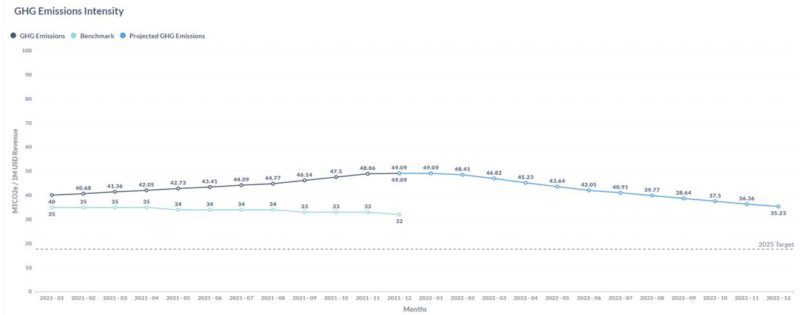
Exhibit A: Longitudinal Comparison to Benchmark Performance. This graphic illustrates how dynamic benchmarking, with longitudinal trend lines, can show whether a portfolio company is outperforming relative to the broader industry.
The principles of dynamic indexing – rooted in validated metric-level results, precise benchmark values, and longitudinal comparisons – sets the stage for a more reliable, valid, and effective method of predicting financial and impact performance.
A new ESG+I (ESG + Impact) rating system could serve as the data intelligence engine that investors need.
As a growing number of investors increasingly seek ways to invest more responsibly and effectively, they require a solution with more depth and reliability than the current ESG ratings. This demanded solution – while necessarily robust – must also be simple to incorporate into existing processes and easy to understand. Using the principles from the double materiality benchmarking methodology, a new ESG+I (ESG + Impact) rating system could serve as the data intelligence engine that investors need. ESG+I ratings would include ratings on three different levels:
Together, these three rating levels comprise the ESG+I rating. As illustrated in Exhibit B below, ESG+I ratings assign “grades” on a curve, based on the company’s year-over-year performance on metrics that are material to the company, relative to the company’s index performance. Results for each metric are rolled up to a company rating, and company ratings are rolled up to fund ratings.
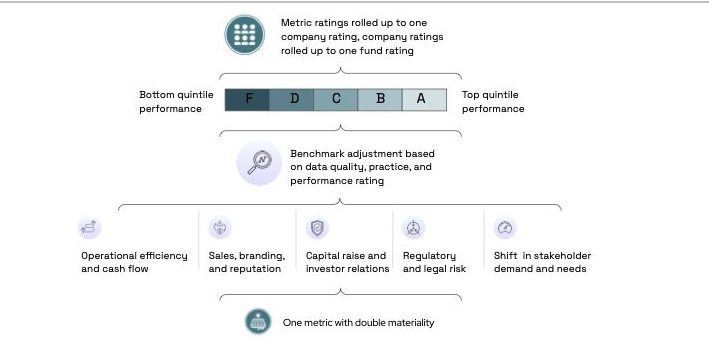
By leveraging the principles of double materiality benchmarking to create ESG+I ratings, investors can be more confident in their ability to assemble a portfolio of assets that will be more likely to achieve high financial and impact performance. In addition, companies will be better equipped to use concrete data to ‘move the needle’ on specific, material issue areas that matter to their stakeholders. This will create a positive feedback loop and lay the groundwork for systems change efforts, including performance-based investing. The opportunity to bridge the gap between data-driven evaluation and meaningful business action is possible — now it’s up to our generation to build and use the technology needed to make it a reality.



Related Content
Connecting Georgia’s social enterprises to markets and capital
64
0
Gabriel Grant on giving shareholders a way to express what matters to them
88
0
For mission-led organizations, a change of manager tests whether workplace inclusion is built to last.
73
0

Artist Rob Strati on inherited objects, the limits of market price, and the creative possibilities…
112
0
Comments

Deep Dives
RECENT
 348
0
348
0
 419
0
419
0
 397
0
397
0
Editor's Picks
 64
0
64
0
 88
0
88
0
 73
0
64
0
88
0
64
0
88
0
73
0
73
0
64
0
88
0
64
0
88
0
73
0
Webinars

Signed and personally inscribed — you'll write the inscription as you order. Limited · 50…
News & Events

The board can add 2% for each 50% rise in the company’s value

Applications close December 2, or sooner once 250 arrive

Repeat borrowers in Colombia and Indonesia took it over the line
Subscribe to our newsletter to receive updates about new Magazine content and upcoming webinars, deep dives, and events.
Become a Premium Member to access the full library of webinars and deep dives, exclusive membership portal, member directory, message board, and curated live chats.


0 Comments