The Global EV Transition
How electrification, policy, and overproduction are reshaping mobility



How electrification, policy, and overproduction are reshaping mobility

 2594
2594
 0
0

How Islamic Philanthropy is redefining impact capital in Indonesia
 3024
0
3024
0

Reimagining philanthropy in India’s Impact Economy
 2549
0
2549
0

Disability access, institutional design, and Thailand’s 2026 election
 2275
0
2275
0

What it will take to electrify Africa at scale
 1794
0
1794
0

 3586
0
3586
0

 1677
0
1677
0
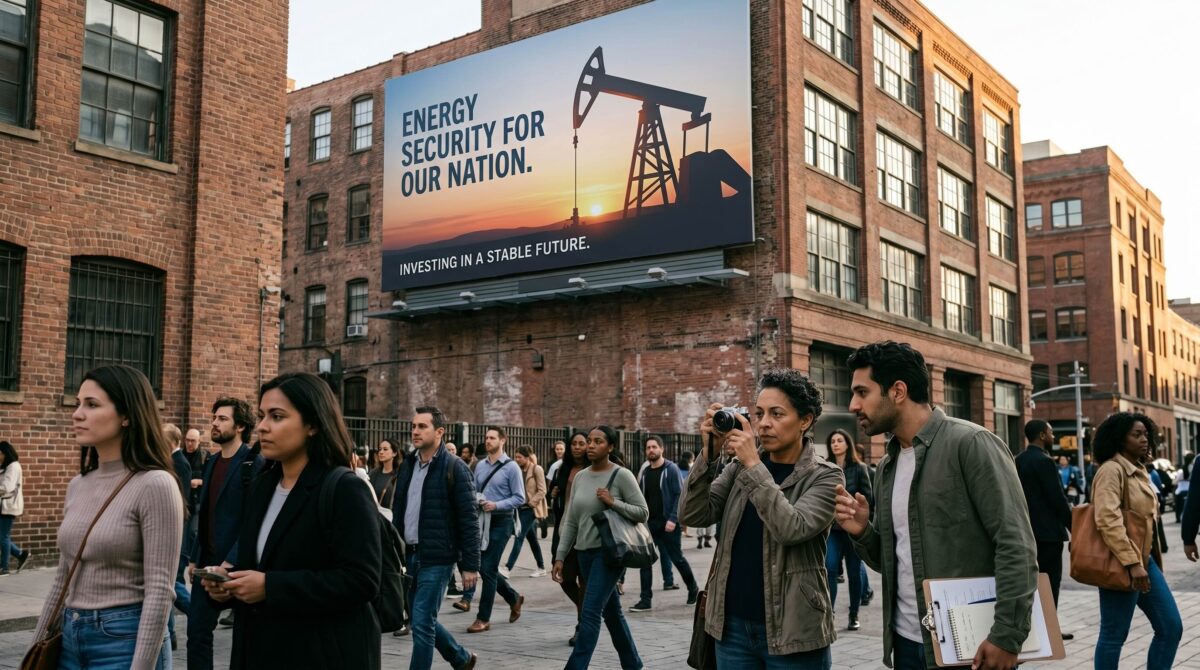
As oil and gas giants move beyond greenwashing toward a more assertive politics of delay, climate communicators face a different challenge: not just exposing disinformation, but filling the narrative vacuum with something stronger. Dmitriy Ioselevich argues that credible, confident “greenshouting” may be one of the climate movement’s most underused tools.
The fossil fuel propaganda machine has entered a new era — one in which fossil fuels are treated as synonymous with economic stability, energy dominance, and national security.
Gone are the old days of fossil fuel companies pretending climate change is not real. But also gone are the relatively recent days of oil and gas firms putting on a smile and positioning themselves as good-faith partners in the clean energy transition.
Remember all those net-zero commitments and clean energy investments? Neither do most fossil fuel executives, who these days seem far more interested in using their marketing budgets to preserve a status quo defined by delay, inaction, and misinformation.
That is the conclusion of a new “Toxic Accounts” research project from Clean Creatives, which analyzed nearly 2,000 ads from BP, Shell, ExxonMobil, and Chevron between 2020 and 2024 to assess the key narrative shifts happening across the fossil fuel industry.
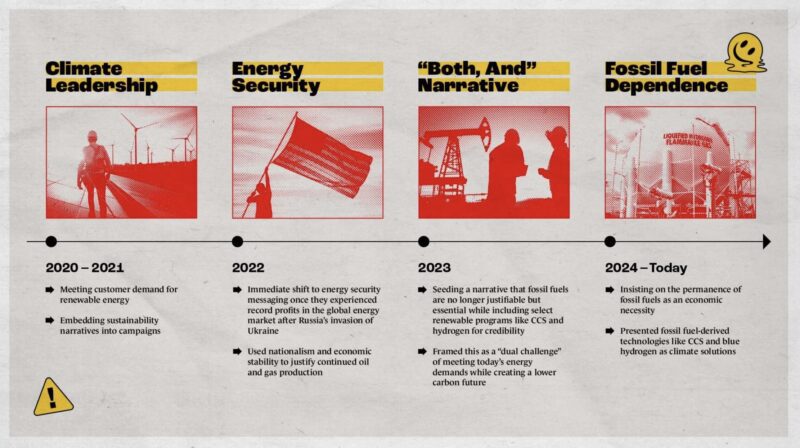
The fossil fuel industry’s messaging has not disappeared; it has evolved — from the language of climate leadership to a harder narrative of energy security, managed dependence, and the supposed permanence of fossil fuels.
“Greenwashing has taken on a new form,” said Nayantara Dutta, Head of Research at Clean Creatives and lead author of the report. “While the world is phasing out fossil fuels, oil companies are crafting a narrative which keeps them profitable and in power.”
“What we’re seeing is climate disinformation evolving in real time,” said Dana Schran, General Coordinator of the Climate Action Against Disinformation coalition. “Instead of denying the crisis, oil majors like BP and Shell are reshaping the story to make fossil fuel expansion seem necessary and responsible. It’s a sophisticated effort to protect political influence and profits, even as climate impacts intensify.”
Or as Emily Atkin put it in her Heated newsletter, the fossil fuel industry is “focused on convincing us that the world is only safe and stable if they are in charge.”
That is quite a claim for an industry whose products and political influence have helped lock the world into repeated cycles of instability, dependency, and conflict. In the eyes of fossil fuel executives, the only thing stable about a fossil fuel world is the demand for ever more fossil fuels.
That helps explain why the biggest fossil fuel companies spend a combined $7 billion a year on media, creative advertising, and PR. These campaigns do not just give oil and gas firms a social license to operate — they help shape public demand, narrow political imagination, and weaken the will to act.
So what can be done about it?
The climate movement has no shortage of ideas for how to jam up the fossil fuel propaganda machine.
Some efforts are aimed directly at the flow of money and influence behind these campaigns: banning fossil fuel ads, pressuring media companies and sports organizations to reject fossil fuel ads, pushing PR and ad agencies to cut ties with oil and gas clients, and urging brands to work only with climate-aligned creative and financial partners. Others focus on the demand side — helping the public recognize climate misinformation when they see it, or experimenting with humor and culture as a way to make climate communications more resonant and less exhausting.
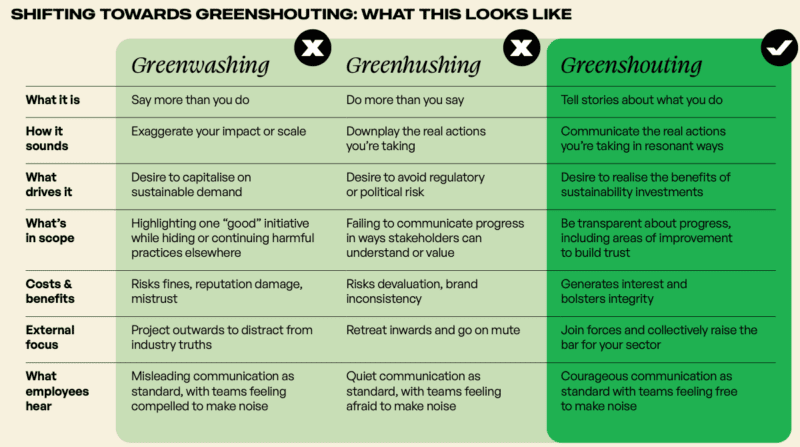
The real communications choice is no longer just between greenwashing and silence, but between retreat and credible public leadership — communicating real sustainability progress clearly enough to strengthen trust and raise the bar.
These efforts are important, and often complementary. But it is not enough to just take the megaphone away from fossil fuel companies. There also needs to be a compelling counternarrative about why climate action matters, what a better future looks like, and who benefits from the transition.
After all, we have decades of research showing that lies spread faster than the truth, especially when confusion and uncertainty fill the space in between.
While the world is phasing out fossil fuels, oil companies are crafting a narrative which keeps them profitable and in power.
“In moments like this, narrative integrity is not a luxury — it is a responsibility,” said Kumi Naidoo, President of the Fossil Fuel Treaty Initiative. “If we leave the story untold, extractive interests will gladly tell it for us.”
A growing group of creative-minded organizations is now stepping in to fill the storytelling void — not just to critique fossil fuel messaging, but also to encourage climate leaders and their advisors to communicate more forcefully, more clearly, and more authentically.
“The challenge of greenhushing isn’t just about one actor going quiet,” said Lucy von Sturmer, founder of Creatives for Climate, in a recent LinkedIn post. “When a whole movement starts to greenhush it transfers power, dismantles accountability and quietly stalls systemic change. To hold the line on climate action we desperately need a stronger, more coordinated, more confident narrative ecosystem.”
To help build that ecosystem, Creatives for Climate — along with B Lab and Ethical Agency Alliance member Nice and Serious — recently unveiled The GreenSHOUTING Guide at ChangeNOW in Paris. The 32-page interactive guide is designed for brands, agencies, and creators who want to communicate “sustainability progress with confidence, credibility and cultural impact.”
The guide is full of research, case studies, toolkits, and practical insights — all aimed at helping communicators move from the harmful habits of greenwashing and greenhushing toward what it defines as greenshouting: “the practice of communicating sustainability efforts openly, accurately and courageously, grounding claims in evidence, acknowledging challenges, and strengthening a transparent information ecosystem.”
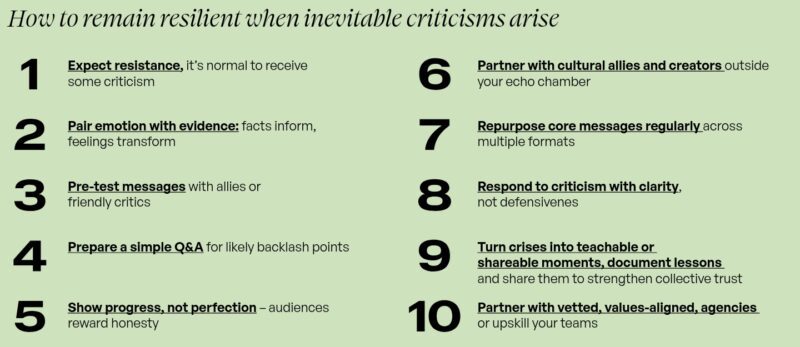
Credible climate communication is not about avoiding criticism; it is about preparing for it — with evidence, emotional intelligence, trusted allies, and the confidence to turn backlash into deeper public understanding.
“I’ve spent a lot of my career thinking not just about what we say, but what happens when we stop saying anything at all,” said Harriet Kingaby, co-founder of the Conscious Advertising Network and a contributor to the GreenSHOUTING guide. “What I witness is that greenhushing rarely starts as a clear decision. It begins with a pause, a website quietly removing sustainability claims, a team tying itself in knots over wording, and then that pause becomes permanent.”
Most of the time, that silence does not begin in bad faith. It begins in confusion — amid regulatory shifts, public scrutiny, politicized attacks, and a growing sense that sustainability language itself has become risky terrain.
Anyone working in the impact economy will recognize this trend toward greenhushing, especially in response to the anti-ESG backlash that has swept across parts of the U.S. and Europe in recent years. The recent string of executive actions targeting climate-related initiatives, combined with the weakening of disclosure regimes and rising reputational anxiety, has only deepened the sense that there is no safe way to speak up.
But silence comes with a cost — not only to a company’s reputation or competitive position, but to the broader project of system change.
According to the 2025 Edelman Trust Barometer, more than half of consumers believe businesses are not doing enough to address climate change. A similarly large share say that if a brand does not communicate what it is doing on societal issues, they assume it is either doing nothing — or hiding something. Another study, from Anthesis Group, found that a significant share of the reputational advantage enjoyed by market leaders can be explained by how they are perceived on environmental issues. And yet, many companies remain inauthentic in how they communicate sustainability performance — either overstating their efforts or saying too little about them.
For brands that want to escape this self-defeating “sustainability doom loop,” the authors of the GreenSHOUTING guide offer examples of seven distinct storytelling dials — tone, simplicity, abundance, disruption, culture, emotion, and humility — that can be tuned up or down depending on which sustainability stories are most authentic for each organization.
This kind of strategic storytelling has often been sidelined within the climate movement, which has long preferred to counter fossil fuel disinformation with scientific facts, reports, and policy analysis. Those tools remain essential. But facts alone rarely win a narrative fight, especially in a fragmented media environment where people are increasingly sorted into separate realities.
But silence comes with a cost — not only to a company’s reputation or competitive position, but to the broader project of system change.
“The more disorganized the media environment is, the more important it is to be disciplined in your messaging and targeting,” said Mike Casey, President of Tigercomm, a cleantech PR, marketing communications, and public affairs firm. “You need to meet people where they are in terms of their existing values, information diet, and belief system.”
That is not a call to dumb anything down. It is a reminder that the battle over climate action is not just a battle over evidence. It is also a battle over meaning, identity, aspiration, and power.
And that matters far beyond brand communications. Narrative failure does not just distort public understanding; it shapes markets, constrains policy, and weakens the operating environment for the very businesses and institutions trying to build a more sustainable economy.
Of course, there will continue to be attacks, bad-faith criticisms, and even lawsuits from the fossil fuel industry and its enablers. But a little collective courage could go a long way in leveling the playing field.
As GoodPower strategist Jennifer González argues, we need to “flood the zone” with compelling pro-climate stories and narratives if we want to shift culture and ultimately influence policy decisions.
And if you are willing to speak, you might as well try shouting.


Related Content

Institutional amnesia and the regenerative correction
 1965
0
1965
0

What happens when adoption outruns safeguards and governance
 1989
0
1989
0

How frugal systems reshape power, capital, and scale
1526
0

How an export-first model is pricing citizens out of a national staple
 2063
0
2063
0
Comments

Deep Dives
RECENT
 2275
0
2275
0
 1794
0
1794
0
 3586
0
3586
0
Editor's Picks
 2594
0
2594
0
 3024
0
3024
0
 2549
0
2549
0
Webinars
News & Events
Subscribe to our newsletter to receive updates about new Magazine content and upcoming webinars, deep dives, and events.
Become a Premium Member to access the full library of webinars and deep dives, exclusive membership portal, member directory, message board, and curated live chats.

Join our global community of systems-minded changemakers.
Subscribe to the Impact Entrepreneur newsletter for the latest insights, magazine features, and invitations to exclusive webinars, Deep Dives, and events.





0 Comments