Building an Impact Economy in Georgia
Connecting Georgia’s social enterprises to markets and capital




Connecting Georgia’s social enterprises to markets and capital

 55
55
 0
0

Gabriel Grant on giving shareholders a way to express what matters to them
 85
0
85
0

For mission-led organizations, a change of manager tests whether workplace inclusion is built to last.
 73
0
73
0

Why free education tools need reliable access, credible evidence, and lasting support
 339
0
339
0

What Islamic finance and impact investing can learn from each other
 414
0
414
0

After the flood, recovery capital must do more than replace what was lost
 396
0
396
0


 5008
0
5008
0

Luceildes Fernandes Maciel is a beneficiary of Bolsa Família and Bolsa Verde
Across the Global South, most people now rely on data-driven systems for welfare, banking, and healthcare. Yet not all data systems are designed with justice in mind. As emerging economies undergo rapid digitization, data justice is becoming a critical lens for evaluating how data directly affects people’s lives. Beyond privacy and accuracy, the central question is whether data systems actively promote equity, inclusion, and dignity.
Where complex social hierarchies intersect with accelerating technological adoption, data justice becomes not only desirable — but urgent.
From privacy to data justice
Data justice highlights the use of data to promote equity, dignity, and inclusion. It extends beyond debates about privacy and algorithmic accuracy. While privacy frameworks focus on protecting individuals, data justice emphasizes protecting communities, ensuring they are neither excluded nor misrepresented in datafied systems.
Data justice is emerging as a crucial framework for the Global South.
As Dencik, Hintz, and Cable (2016) note, data justice brings together diverse approaches and concerns in response to a dominant discourse that centers either efficiency and security or privacy and data protection. By contrast, data justice looks holistically at whose needs are reflected, whose rights are upheld, and whose harms are addressed.
Why the Global South?
Data justice is particularly urgent for marginalized groups across gender, disability, and socio-economic lines. While countries such as India, Nepal, and Bhutan have made substantial legislative progress, effective implementation remains uneven.

Photo Courtesy of Ghana Social Opportunities Project
South Asia is actively shaping its own approaches to data governance, influenced by shared colonial histories, cultural ties, and related policy environments. Europe’s comprehensive frameworks are often treated as reference points, but South Asian models reflect distinct social and economic realities.
Despite promising steps, regional challenges persist: limited digital access, weak infrastructure, and a tendency to prioritize national security over human security. High-profile breaches, such as those associated with India’s Aadhaar biometric system, underscore the need for stronger safeguards.
Data justice highlights the use of data to promote equity, dignity, and inclusion.
While SAARC lacks a cohesive data protection agenda, national laws and constitutional guarantees suggest a slow but deliberate shift toward a rights-based approach.
Core pillars of data justice
Data justice emphasizes:
Its concerns include:
Redress is essential: what happens when harm occurs, and how are remedies offered?
Digitizing social protection: Promise and peril
The rapid digitization of social protection systems offers both opportunity and risk. Governments such as Brazil and Kenya are deploying algorithms and digital IDs to streamline access to welfare benefits. While these systems can improve reach and efficiency, they also risk reinforcing existing inequalities.

Image Courtesy of Agência Senado
Digital platforms often simplify complex social realities into narrow data models. In Brazil, the Cadastro Único enabled more than millions of people to receive COVID-19 emergency support through an AI-enabled platform. Yet automated systems such as Bolsa Família often treat poverty as gender-neutral, overlooking caregiving burdens disproportionately carried by women — and thus potentially obscuring differentiated vulnerability.
Similarly, many social protection systems increasingly rely on data infrastructures developed or maintained by private technology companies, raising concerns about:
Women in Bolsa Família, for example, face a privacy paradox: they must disclose intimate personal data to access benefits, yet that data may later be used to surveil or penalize them.
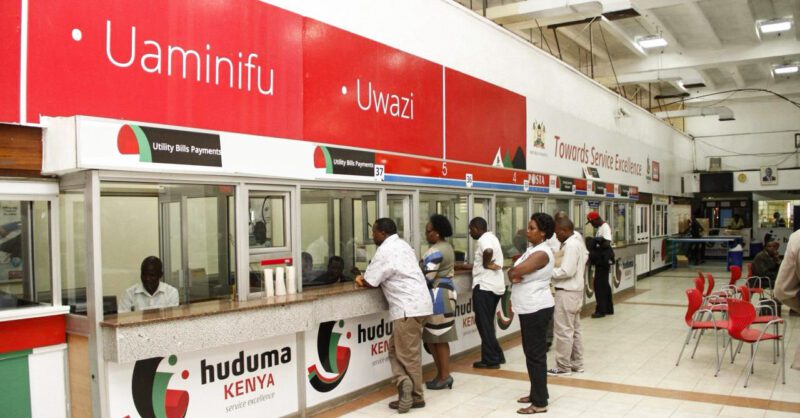
Photo Courtesy of Huduma Kenya
In Ghana, the e-Zwich credit-scoring tool has expanded financial access but has faced criticism for its lack of transparency — particularly affecting women, who comprise much of the unbanked population.

Photo by Maria Schiffer, Courtesy of KfW
In Kenya, the biometric ID system Huduma Namba excluded a huge percentage of rural residents due to structural and logistical barriers. Many digital systems prioritize administrative efficiency over equity, centralizing control in opaque algorithmic architectures.
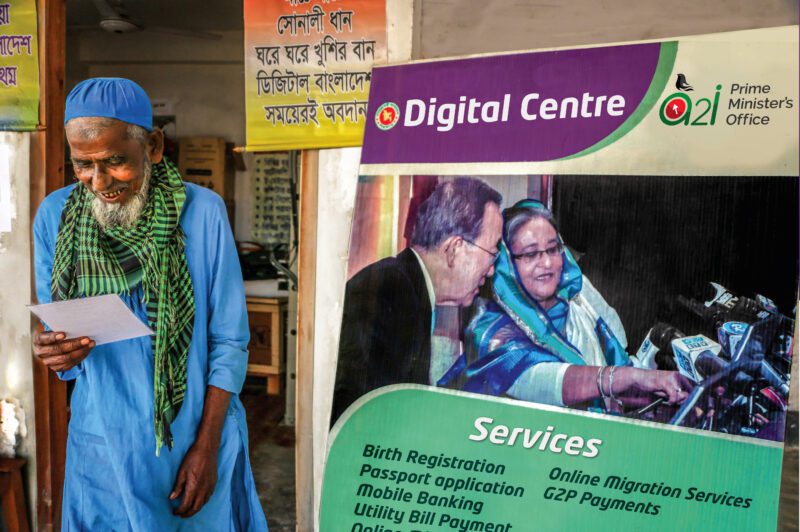
Bangladesh a2i; Photo Courtesy of UNDP
Toward responsible governance
Robust governance is needed to ensure transparency, equity, participation, and redress. Some promising South–South developments include:
The Indian government's IDfy platform (Indian Digital Identity Verification and Fraud Prevention) requires users to provide explicit, auditable consent prior to data verification. This ensures that users retain agency over the use of their identity and verification data, which is in line with justice-by-design by emphasizing user control over silent enrolment.
TymeBank in South Africa combines low-cost physical access points with digital banking to reach underserved and rural clients. Its hybrid approach, which combines online onboarding with in-person assistance, encourages involvement and equity among many populations.
These examples highlight why data justice is essential now: successful models can spread, but so can harmful ones.
“Persistent inequalities… still confront us — calling urgently for renewed vision and collective action.”
— Gilbert F. Houngbo, ILO Director-General
A justice-by-design blueprint
A justice-by-design approach encourages continuous improvement, especially when systems affect communities with intersectional identities.
Community Input → Design → Deploy → Audit → Redress → Iterate
A shared blueprint rooted in community experience can accelerate change that is context-responsive and equity-driven — helping individuals evolve from passive recipients of services to co-architects of inclusive growth.
Justice-by-design helps ensure that products and platforms uphold dignity, avoid replicating inequities, and strengthen long-term resilience.
“Social development and social justice are indispensable for the achievement and maintenance of peace and security.”
— Copenhagen Declaration on Social Development, 1995
Justice-by-design checklist
This checklist is particularly relevant to impact entrepreneurs, ESOs, and responsible investors who design, fund, or support data-driven solutions. Justice-by-design helps ensure that products and platforms uphold dignity, avoid replicating inequities, and strengthen long-term resilience.
Toward equitable data futures
Data justice is emerging as a crucial framework for the Global South as governments, social enterprises, and investors increasingly rely on digital systems to deliver services and expand opportunity. But without intentional design, these systems risk deepening the very inequities they aim to address.
Ensuring that data systems are representative, transparent, participatory, and accountable is not just a rights-based imperative — it is necessary for building resilient societies and inclusive economies.
--
Sources



Related Content
Connecting Georgia’s social enterprises to markets and capital
55
0
Gabriel Grant on giving shareholders a way to express what matters to them
85
0
For mission-led organizations, a change of manager tests whether workplace inclusion is built to last.
73
0

Artist Rob Strati on inherited objects, the limits of market price, and the creative possibilities…
111
0
Comments

Deep Dives
RECENT
 339
0
339
0
 414
0
414
0
 396
0
396
0
Editor's Picks
 55
0
55
0
 85
0
85
0
 73
0
55
0
85
0
55
0
85
0
73
0
73
0
55
0
85
0
55
0
85
0
73
0
Webinars

Signed and personally inscribed — you'll write the inscription as you order. Limited · 50…
News & Events

The board can add 2% for each 50% rise in the company’s value

Applications close December 2, or sooner once 250 arrive

Repeat borrowers in Colombia and Indonesia took it over the line
Subscribe to our newsletter to receive updates about new Magazine content and upcoming webinars, deep dives, and events.
Become a Premium Member to access the full library of webinars and deep dives, exclusive membership portal, member directory, message board, and curated live chats.


0 Comments