Building an Impact Economy in Georgia
Connecting Georgia’s social enterprises to markets and capital



Connecting Georgia’s social enterprises to markets and capital

 66
66
 0
0
Gabriel Grant on giving shareholders a way to express what matters to them
 88
0
88
0

For mission-led organizations, a change of manager tests whether workplace inclusion is built to last.
 73
0
73
0

Why free education tools need reliable access, credible evidence, and lasting support
 362
0
362
0

What Islamic finance and impact investing can learn from each other
 422
0
422
0
After the flood, recovery capital must do more than replace what was lost
 399
0
399
0
 488
0
488
0

Changing public narratives requires more than a compelling message — it requires sustained investment in the people, organizations, and creative infrastructure that produce culture; Image by Andrej Lisakov
A $10 million family endowment is testing whether flexible grants can help climate movements compete not only in policy and technology, but in the cultural terrain where public permission for change is built.
Clean Creatives estimates that 29 major fossil fuel companies spend roughly $7 billion a year combined on advertising, media, and public relations. Their goal is not merely to sell polluting products. It is to manufacture and maintain a cultural story in which fossil fuels remain synonymous with prosperity, freedom, and modern life.
Policy advocacy, grassroots organizing, and technological innovation can struggle to advance while that story remains intact. Yet the narrative infrastructure needed to contest fossil-fuel power remains chronically underfunded.
The Carmack Collective is testing what a relatively small, flexible pool of philanthropic capital can do to change the story about fossil fuels. Launched in 2023 with a $10 million family endowment and a singular focus on “confronting and dismantling” the fossil fuel industry, The Carmack Collective distributed $1.5 million in grants in 2025 and plans to increase its 2026 grantmaking budget to $1.75 million. The Carmack Collective is housed as a donor-advised fund at the Tides Foundation. Its distinctive wager is that cultural interventions — including comedy, journalism, film, public art, and live experiences — should be funded as movement infrastructure rather than treated as promotional support after the “real” work is done.
“The Carmack Collective was born out of my work as an individual funder and donor organizer,” said founder and executive director Jessie Bluedorn. “I wanted to create a project that scaled up my wealth redistribution, more deeply involved my family, had a high level of transparency, and was deeply informed by movement leaders.”
Bluedorn is also executive producer at Carmack Productions, a separate multimedia production company focused on climate storytelling, with a particular interest in comedy. The two entities use different financial tools, but share a belief that culture helps determine when political and economic change becomes possible — and what that change could look like.
“There are very few large institutional funders working on climate narrative infrastructure,” said Ricky Benavidez, managing director of The Carmack Collective. “There are so many great organizations out there but not a consistent source of funding. Narrative is chronically underfunded, so we wanted to fill that gap by joining those funders who get it.”
The Carmack Collective organizes its grantmaking around two complementary areas: Movement Building and Culture Change. Movement Building supports organizing, direct action, litigation, research, and policy campaigns. Culture Change supports groups using creative work to reshape public understanding of the fossil fuel industry and expand the audiences willing to engage with climate action.
Movement Building creates political and community power, while Culture Change shifts the terrain that the movement operates on.
“Movement Building creates political and community power, while Culture Change shifts the terrain that the movement operates on,” Benavidez said. “They reinforce each other as two complementary sides of the same coin.”
The portfolio reflects that ecosystem logic. Movement Building grantees include organizations such as Sunrise Movement, Fossil Free London, and Climate Defiance. Culture Change grantees range from industry-facing networks such as Clean Creatives and Creatives for Climate to entertainment and media organizations including Yellow Dot Studios, Climate Town, Drilled Media, and DeSmog. Other grantees work through film festivals (Climate Film Festival), industry events (Hollywood Climate Summit), public programming (Entertainment + Culture Pavilion), and physical gathering spaces (Climate Imaginarium).
The point is not that any single film, campaign, podcast, or protest will dislodge the cultural power of the fossil fuel industry. The Carmack Collective is funding multiple points of intervention in the belief that movements become stronger when organizing, research, storytelling, humor, and community experiences reinforce one another.
The Carmack Collective’s grantmaking structure is designed to match different stages of organizational development across different kinds of opportunities. Multi-Year Grants generally provide $20,000 to $50,000 per year for three years. The Catalytic Fund offers discretionary support for time-sensitive opportunities, proven solutions ready to scale, or emerging ideas with the potential to drive meaningful change. The Flow Fund provides variable-sized one-year grants decided on by an advisory board of movement and culture leaders that operates autonomously from The Carmack Collective.
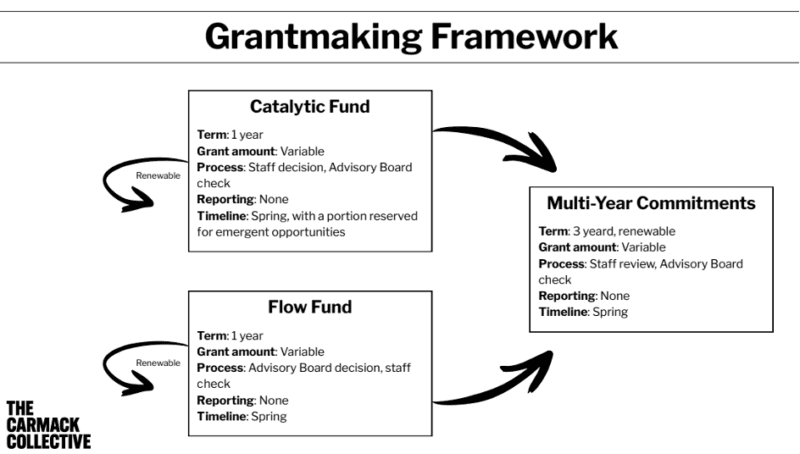
The Carmack Collective’s grantmaking framework combines responsive, participatory, and multi-year funding. Courtesy of The Carmack Collective.
Organizations that first receive a Catalytic or Flow Fund grant may later qualify for a multi-year commitment as their work develops. This structure allows The Carmack Collective to seed experiments, respond quickly, and then provide longer-term stability when an approach shows promise.
“We’re very nimble in getting seed funding to organizations as a proof of concept for larger funders, which want to see success metrics before they come in,” Benavidez said.
The fund also leans heavily into trust-based philanthropy. It prioritizes unrestricted and multi-year support, keeps application requirements light, and does not require formal written reports. Instead, staff use verbal check-ins to evaluate progress, identify needs, and co-define what success should mean for a particular grant.
As Benavidez puts it: “They’re the experts, we’re the fan base.”
Reducing paperwork does not have to mean abandoning accountability. Trust-based approaches attempt to replace a compliance-heavy relationship with mutual accountability, candid dialogue, and learning. Some grantees share comparative audience metrics showing whether a project reached people through a new message or medium. Others use conversations to surface what worked, what failed, and what both parties can do differently.
That still leaves a difficult question: How should funders evaluate cultural influence without recreating the short-term metrics and reporting burdens they are trying to escape? The Trust-Based Philanthropy Project argues that evaluation can retain rigor while shifting from a “proving” stance to a learning stance. For narrative work, that means tracking contribution, reach, experimentation, relationships, and strategic coherence without pretending that a single grant can be cleanly credited for a change in public opinion or policy.
“We look for whether a project reached new audiences, amplified an existing campaign, or offered an innovative way of presenting an idea,” Benavidez said. “But it’s important to remember that cultural impact is cumulative, not linear. Culture predates policy by five to ten years. We know this kind of cross-pollination takes time, which is why we take an ecosystem approach.”
What Even Is Climate Town? A video by Climate Town
The value of flexible funding becomes clearest in the details of what grantees do with it. At Yellow Dot Studios, founded by filmmaker Adam McKay, grant support helps finance experiments in entertainment, short-form media, and comedy designed to make climate information more engaging. Research commissioned by Rare found that McKay’s hit Netflix comedy, Don’t Look Up, produced measurable shifts in several climate-action attitudes, although effects varied across audiences and measures.
Yellow Dot has continued to test formats that conventional climate communications might avoid, including comedy series, creator partnerships, documentaries, and live shows. More recently, it launched a public preparedness campaign signed by celebrities including Mark Ruffalo, Joaquin Phoenix, and Hannah Einbinder to raise awareness and call for action ahead of a potentially historic El Niño warming event. The World Meteorological Organization says a strong El Niño is intensifying and is expected to dominate global climate patterns through August–October 2026, increasing the likelihood of above-normal temperatures and significant shifts in rainfall patterns.
“What’s fun about The Carmack Collective is they can be as hands-off as needed, but when we do need them they’re right there,” said Staci Roberts-Steele, executive director and producer at Yellow Dot Studios. “It’s a perfect balance, and so they’ve really become one of our easiest funders to work with.”
The climate movement doesn’t lack solutions; it lacks the cultural and political power to see these solutions through.
For Climate Town, an independent media company that uses humor to explain climate systems and corporate behavior, flexible money purchased something prosaic but consequential: research capacity.
“We’re very scrappy, so any extra money lets us add an extra step to the process that makes the final product look a lot better,” said Climate Town founder and comedian Rollie Williams.
One of those steps was hiring a researcher to develop the evidence behind popular YouTube videos such as “Your Single Use iPhone” and “Exxon’s $600 Million Dollar Green Goo”. The grant did not produce a single easily isolated outcome; it strengthened the organization’s ability to make humorous work that remained factually grounded and credible.
At Drilled Media, multi-year support has provided time to expand investigative reporting beyond a project-by-project cycle and experiment with work connecting climate deception to democracy, human rights, technology, and online subcultures.
“The fossil fuel industry spends so many resources on narrative change, so it’s obviously not enough to have facts on our side — if being on the right side of history was enough, then we’d be living in a very different world,” said Drilled founder and investigative journalist Amy Westervelt. “They have always been very supportive of trying new approaches, so now that we have this multi-year grant we have time to actually build things.”
Those experiments include the Carbon Bros podcast collaboration, which examined links between fossil-fuel misinformation and the manosphere, as well as reporting that feeds podcasts, books, and scripted projects. The common thread is not a particular medium. It is the ability to follow a line of inquiry long enough to build an audience and connect climate accountability to the wider systems shaping public life.
The Biggest Killer You Don't Know About, Featuring Poppy Liu; Video by Do You Even Care and Yellow Dont Studios
The Carmack Collective’s impact is best understood as part of a broader ecosystem rather than attributed to any single grant. One salient proof point is its structure: it gives under-resourced organizations room to experiment, build capacity, and develop work that larger funders — or commercial investors — may later be willing to support.
That signaling function is central to the grantmaking strategy. Bluedorn and Benavidez do not see the fund’s $10 million starting endowment as sufficient to build the cultural and political power the climate movement needs. Nor was the fund created to operate in perpetuity. Its broader ambition is to influence other donors while its capital is being deployed.
“We see 50% of our work as grantmaking, and the other 50% is getting other people to shift what they fund and how they fund it,” Benavidez said, describing a strategy he calls “philanthropic agitation.” “The climate movement doesn’t lack solutions; it lacks the cultural and political power to see these solutions through.”
That may be The Carmack Collective’s most consequential proposition: Culture change is not adjacent to systems change. It is part of the infrastructure through which societies decide which systems are legitimate, which futures feel imaginable, and which ideas can gather enough power to move from the margins into the mainstream.
--
Disclosure: The author is a member of the Clean Creatives and Creatives for Climate communities through his consultancy, 17 Communications. He also volunteers with the Climate Film Festival and serves as a contributing editor to Cinecology, the Festival’s digital magazine. These affiliations are unpaid.


Related Content
Connecting Georgia’s social enterprises to markets and capital
66
0
Gabriel Grant on giving shareholders a way to express what matters to them
88
0
For mission-led organizations, a change of manager tests whether workplace inclusion is built to last.
73
0

Artist Rob Strati on inherited objects, the limits of market price, and the creative possibilities…
112
0
Comments
Deep Dives
RECENT
 362
0
362
0
 422
0
422
0
 399
0
399
0
Editor's Picks
 66
0
66
0
 88
0
88
0
 73
0
66
0
88
0
66
0
88
0
73
0
73
0
66
0
88
0
66
0
88
0
73
0
Webinars
Signed and personally inscribed — you'll write the inscription as you order. Limited · 50…
News & Events

The board can add 2% for each 50% rise in the company’s value
Applications close December 2, or sooner once 250 arrive
Repeat borrowers in Colombia and Indonesia took it over the line
Subscribe to our newsletter to receive updates about new Magazine content and upcoming webinars, deep dives, and events.
Become a Premium Member to access the full library of webinars and deep dives, exclusive membership portal, member directory, message board, and curated live chats.


0 Comments