Building an Impact Economy in Georgia
Connecting Georgia’s social enterprises to markets and capital



Connecting Georgia’s social enterprises to markets and capital

 56
56
 0
0
Gabriel Grant on giving shareholders a way to express what matters to them
 85
0
85
0

For mission-led organizations, a change of manager tests whether workplace inclusion is built to last.
 73
0
73
0

Why free education tools need reliable access, credible evidence, and lasting support
 341
0
341
0

What Islamic finance and impact investing can learn from each other
 415
0
415
0
After the flood, recovery capital must do more than replace what was lost
 396
0
396
0
 719
0
719
0
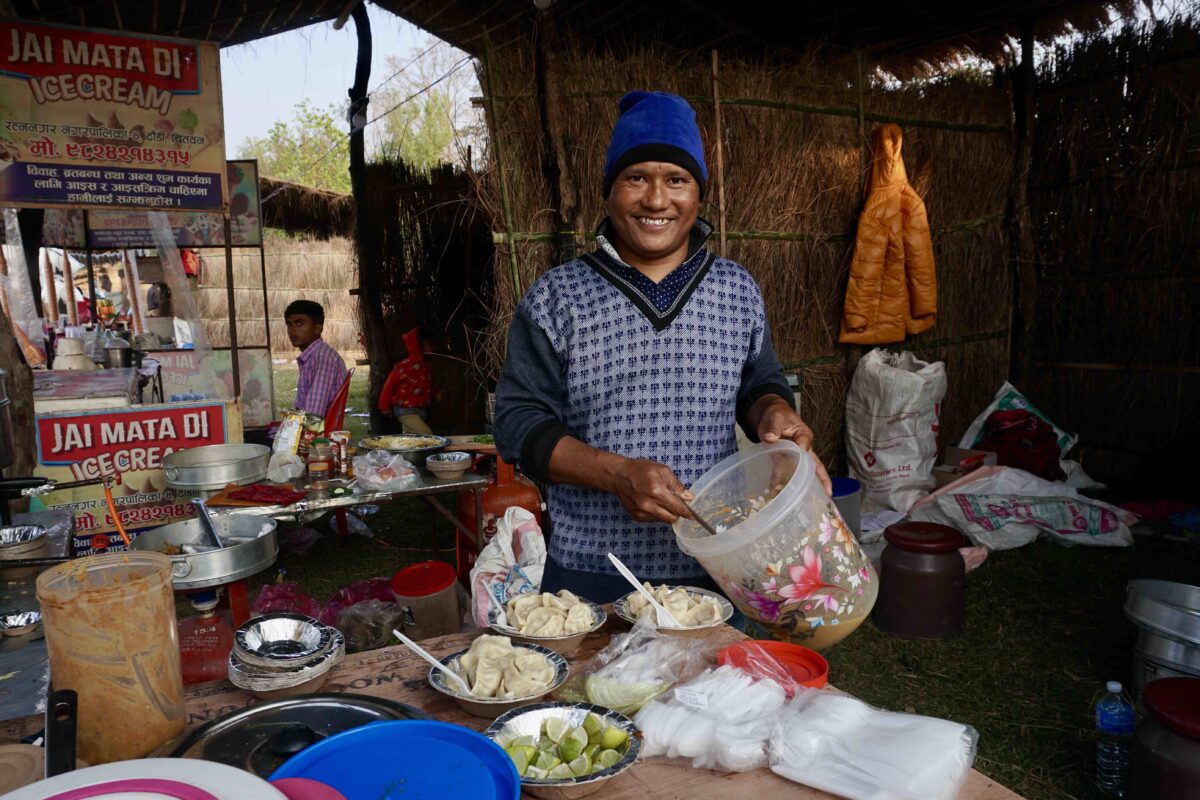
Local vendors sell traditional foods at the Elephant Festival in Sauraha, Chitwan district, Nepal, from December 26 to 28, 2025.
Each year, Nepal’s Elephant Festival delivers a vital income surge for local vendors, women entrepreneurs, and tourism workers — while raising deeper questions about seasonality, value capture, and ethical sustainability.
Each December, the Elephant Festival in Nepal’s Chitwan district transforms a quiet stretch of southern Nepal into a dense marketplace of visitors, vendors, and performances. For tourists, it is a spectacle — elephant parades, games, and cultural shows. For many local households, it is something else entirely: one of the few concentrated income opportunities of the year.
At the Baghmara playground in Sauraha, crowds gather to watch elephants kick footballs and take part in beauty contests. Nearby, food stalls do brisk business. One of the busiest belongs to 42-year-old Hari Narayan Chaudhary, who sells traditional Tharu cuisine. For his family, December is not just another month — it is the most important time of the year.
“We do business throughout the year, but no other time brings this kind of excitement or income,” Chaudhary says.
In a region where livelihoods are shaped by seasonality, tourism cycles, and limited access to formal employment, the festival functions as a temporary economic engine. Food sellers, artisans, hotel workers, elephant handlers, and transport providers rely on the influx of visitors to supplement incomes that are otherwise uncertain. For some families, earnings from a few weeks can help cover school fees, debt payments, or basic household needs for months to come.
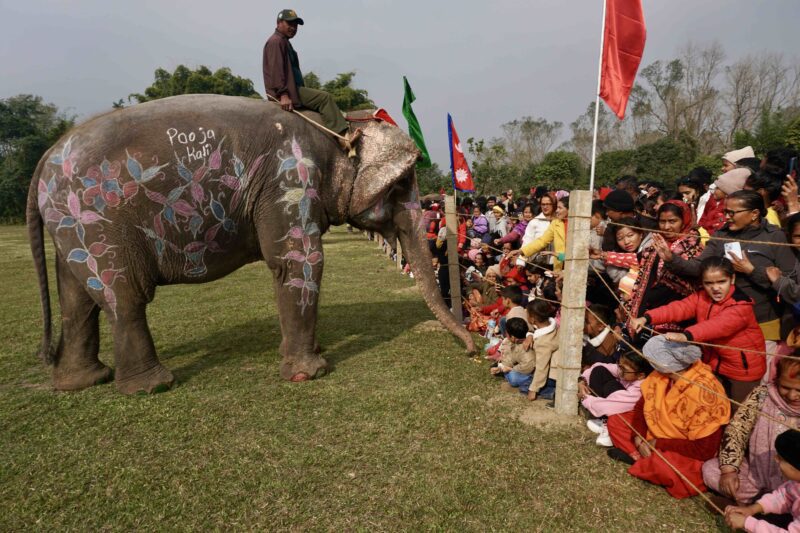
Tourists offer money and fruit to an elephant during the Elephant Festival in Sauraha on December 27. In Hinduism, elephants are considered a symbol of Lord Ganesh.
The Elephant Festival thus sits at the intersection of opportunity and vulnerability — a vivid example of how tourism-linked microenterprise can both support livelihoods and expose households to concentrated risk.
For vendors like Chaudhary, the festival period represents a critical economic window. During the event, his family earns around 50,000 rupees a day selling Tharu dishes such as snails, rice, fish, and momos — far more than at other times of the year. His wife and daughter help run the stall, working long hours as crowds ebb and flow.
In a region where livelihoods are shaped by seasonality, tourism cycles, and limited access to formal employment, the festival functions as a temporary economic engine.
“There is no other exciting time other than the elephant festival,” Chaudhary says.
But this concentration also reveals a structural weakness. Income tied to a short annual event is, by definition, fragile. Once the festival ends, many vendors return to months of low or unpredictable earnings, with few alternatives to smooth income across seasons.
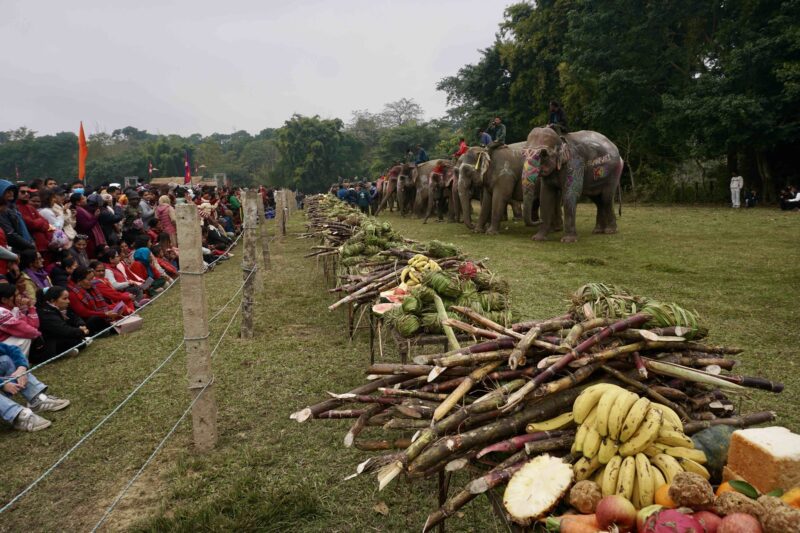
Elephants are brought together for a feeding event in Sauraha, Chitwan district, Nepal, on December 28, organized by the Regional Hotel Association of Nepal.
While the festival generates activity across the local economy, the distribution of benefits is uneven. Small vendors and informal workers shoulder much of the labor and volatility, while larger hotels, tour operators, and associations are better positioned to capture steadier returns.
The festival does not eliminate economic precarity — it temporarily alleviates it.
Some local entrepreneurs report increased sales during the festival but limited control over pricing, stall placement, or crowd flow — factors that can determine whether a day is profitable or not. Women, in particular, often operate at the narrowest margins, relying on unpaid family labor and absorbing losses when conditions shift.
This imbalance raises a familiar question in tourism-dependent economies: who bears the risk, and who captures the upside?
Concerns about elephant welfare are not peripheral to this question — they are central to it. Animal rights activists argue that elephants are subjected to stressful training to perform in competitions and that chemicals used in beauty contests can harm their health.
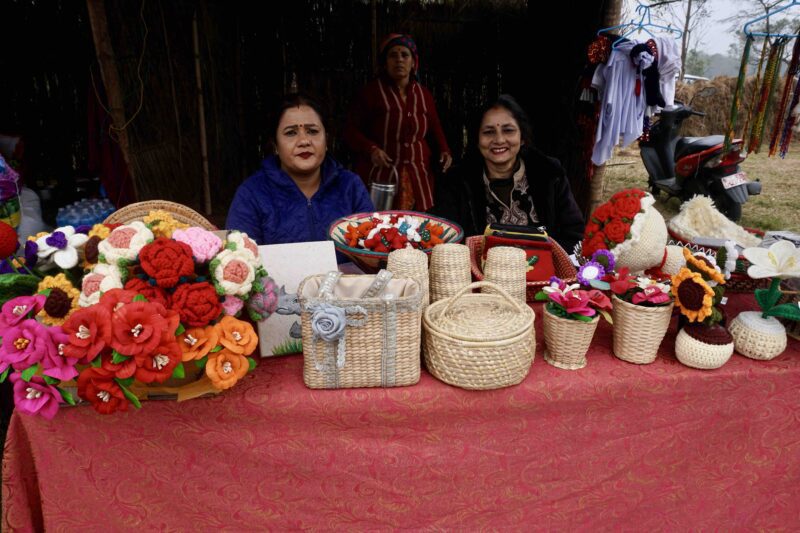
At the Elephant Festival in Sauraha on December 28, local women sell handicrafts — a key source of household income.
Chitwan’s Elephant Festival illustrates a broader challenge facing tourism-led development strategies. Events can generate short-term income and visibility, but without diversification, local capacity-building, or alternative employment pathways, they can also lock communities into cycles of dependency.
For women vendors and informal workers, the festival offers agency and income — but not necessarily stability. For elephant handlers, it provides work — but under conditions that may become harder to sustain. For the local economy as a whole, it delivers seasonal vitality without guaranteeing year-round resilience.
The future of Chitwan’s Elephant Festival raises a larger question that extends beyond Nepal: can tourism models built around spectacle evolve into systems that distribute value more equitably and withstand ethical, economic, and environmental pressure?
If the festival were to change — or disappear — what would replace the income it provides? And who would bear the cost of that transition?
For families like Chaudhary’s, whose livelihoods depend on a few weeks each year, the answers will shape not only next season’s earnings, but their long-term economic security.


Related Content
Connecting Georgia’s social enterprises to markets and capital
56
0
Gabriel Grant on giving shareholders a way to express what matters to them
85
0
For mission-led organizations, a change of manager tests whether workplace inclusion is built to last.
73
0

Artist Rob Strati on inherited objects, the limits of market price, and the creative possibilities…
111
0
Comments
Deep Dives
RECENT
 341
0
341
0
 415
0
415
0
 396
0
396
0
Editor's Picks
 56
0
56
0
 85
0
85
0
 73
0
56
0
85
0
56
0
85
0
73
0
73
0
56
0
85
0
56
0
85
0
73
0
Webinars
Signed and personally inscribed — you'll write the inscription as you order. Limited · 50…
News & Events

The board can add 2% for each 50% rise in the company’s value

Applications close December 2, or sooner once 250 arrive

Repeat borrowers in Colombia and Indonesia took it over the line
Subscribe to our newsletter to receive updates about new Magazine content and upcoming webinars, deep dives, and events.
Become a Premium Member to access the full library of webinars and deep dives, exclusive membership portal, member directory, message board, and curated live chats.


0 Comments