Beyond Investment Readiness
How collateral rules and payment terms keep impact capital out of reach



How collateral rules and payment terms keep impact capital out of reach

 121
121
 0
0

Why free education tools need reliable access, credible evidence, and lasting support
 163
0
163
0

What Islamic finance and impact investing can learn from each other
235
0

How states can crowd in local early-stage capital
328
0

Why last-mile healthcare needs an operating model, not just more mobile clinics
 297
0
297
0

How Australia’s succession wave could turn ownership into a funding model
 413
0
413
0

 523
0
523
0
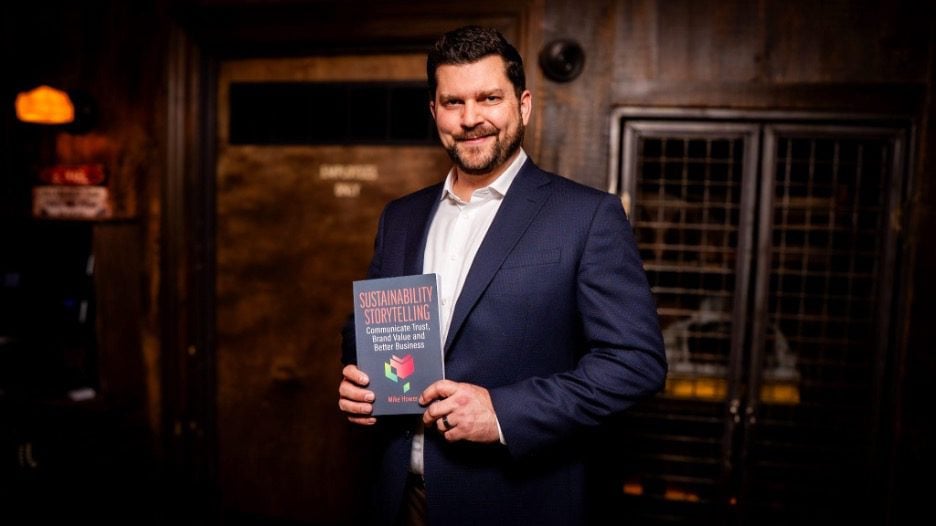
Mike Hower, founder of Hower Impact and author of Sustainability Storytelling, argues that credible communication is essential to building stakeholder trust. Credit: Hower Impact.
As sustainability backlash, greenhushing, and AI-generated “slop” reshape the communications landscape, Mike Hower argues that better storytelling is no longer a branding exercise — it is a strategic tool for trust, accountability, and systems change.
Impact entrepreneurs are already familiar with calls to reclaim the narrative around sustainability and to shift from “greenhushing” to greenshouting.
Easier said than done. Anyone who has ever worked on a sustainability marketing campaign — whether a major launch announcement or a small sound bite — knows the challenge of aligning on a message and securing approvals. Even the slightest change in tone can set off a cascade of internal debate about whether, when, and how to publicize a point of view.
The narrative shift will not happen through good intentions alone. It will require the skills and judgment of a growing field of sustainability storytellers: communications professionals who are as comfortable discussing climate reporting, greenwashing risk, and stakeholder trust as they are shaping a campaign for a new sustainability initiative.
“I’ve witnessed the power of a well-told sustainability story to inspire action, build trust, and create value,” said Mike Hower, founder of Hower Impact and author of the new book Sustainability Storytelling. “And I’ve seen the consequences when those stories are absent, muddled, or downright misleading.”
Hower has been plying his trade as a sustainability storyteller for nearly two decades, including more than 10 years as a writer for GreenBiz, now Trellis, and more recently as host of The Sustainability Communicator podcast. Along the way, he saw firsthand why companies need to tell stories that are compelling, credible, compliant, and grounded in context — what Hower calls the Four C’s of Effective Sustainability Storytelling — if they hope to accelerate environmental and social progress.
“The companies with the best sustainability reputations don’t just do the work; they talk about it consistently and credibly through a steady stream of communication,” said Hower. “Effective sustainability storytelling requires consistency, authenticity, and continuous learning. It’s an ongoing effort as well as a two-way street — you’re not talking to your audiences, but engaging with them.”
Impact Entrepreneur spoke with Hower about his new book, the complicated history of sustainability communications, the power of stories, the effects of AI, and the skills a new generation of sustainability storytellers will need to motivate stakeholders into action.
Hower: I wrote Sustainability Storytelling to address a serious gap in corporate sustainability: the willingness and ability of corporations to communicate sustainability effectively. Over the past decade or so, we’ve seen companies jumping from one extreme to the other — either overcommunicating when they had little substance to speak of, or staying silent out of fear of backlash. With the earliest waves of corporate social responsibility and then corporate sustainability focused too much on fluffy PR claims, many companies assumed the problem could be solved by collecting and reporting more data. While substance is critical for effective storytelling, more data alone isn’t enough. What we’re seeing is that the problem with sustainability progress isn’t so much informational as it is motivational.
More data doesn’t always equal more action on sustainability. The challenge isn’t educational — it’s motivational.
That’s where storytelling comes in. Stories are how humans make sense of information overload — they always have been. Stories help make topics like climate change, resource depletion, gender inequality, racial inequality, and other sustainability issues salient for stakeholders, from investors to customers and employees.
A challenge I encountered was that sustainability communication is often treated as an afterthought rather than a strategic imperative. Companies often rely on communications generalists to communicate complex sustainability topics, or they ask technical sustainability experts with limited storytelling experience to do the work. This book seeks to help both groups translate sustainability strategy into stories that motivate stakeholders into action.
Hower: The Four C’s of Effective Sustainability Storytelling are a constant tension. For the longest time, companies were overly focused on Compelling — making stories interesting for audiences. Many have since moved to prioritize Credible by ensuring their sustainability claims have substance. And with the emerging regulatory environment and mounting legal risks, companies are now more fixated on Compliant.
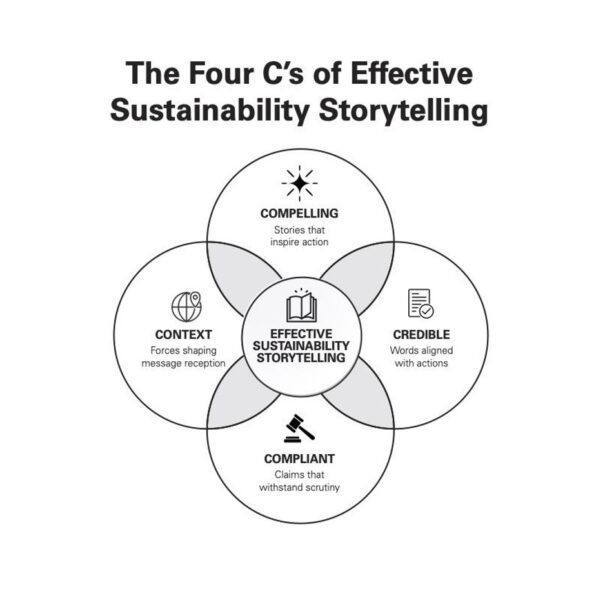
Hower’s Four C’s framework calls for sustainability communication that is compelling, credible, compliant, and grounded in context. Credit: Hower Impact.
The problems come when a company focuses on one pillar at the expense of one or more of the others. Every company is in a different stage of its sustainability storytelling journey. Before you communicate anything, you have to make sure that you actually have a sustainability story to tell.
Hower: This is always a hard one for a former journalist to answer because I might be a little too critical and set a high bar. One of the best campaigns I worked on in recent years was the Mars Net Zero Roadmap. I partnered with Mars as a fractional sustainability communication executive to help translate its net zero strategy into a roadmap that clearly communicated its approach to achieving net zero by 2050.
As a consumer-facing brand, Mars had to balance Credible with Compelling. We couldn’t make the story overly technical if we wanted consumers to care, but we also needed substance. The solution was to create layers of communication: a higher-level consumer-facing website with videos, supported by a roadmap PDF and technical papers for those who wanted to dig deeper. That layered approach matters because different audiences need different levels of proof. Just as important, the campaign had strong C-suite buy-in, which helped fuel its success.
Hower: The tension between purpose and profit is as old as business itself. While many communicators focus on present challenges, it’s impossible to understand the modern context without knowing how we got here. In my research for the book, I found that business has long needed a social purpose to maintain its license to operate — quite literally going back to Ancient Rome and then during the centuries leading up to the Industrial Revolution. It wasn’t socially acceptable for companies to pursue profit for profit’s sake. There needed to be a demonstrable public benefit.

Sustainability storytelling depends on alignment across strategy, evidence, risk, and stakeholder trust; Photo credit: Getty Images
Of course, the reality was less idealistic — greed often won out — but the fact that social norms expected businesses to do more than just make money was critical. During the Gilded Age in the United States, we lost those norms as unprecedented levels of wealth were concentrated in a few hands, coinciding with deep social and economic pain and environmental destruction.
As I discuss in the book, the first professional communicators emerged during this time to repair the public images of these billionaires. Political reforms in the early 20th century pushed back and placed new guardrails on business. By 1970, this culminated in the first Earth Day, the creation of the U.S. Environmental Protection Agency, and landmark environmental laws such as the Clean Air Act and Clean Water Act.
Environmentalism was a unifying issue at the time, and many business interests were terrified. Reactionary forces fought back with the narrative that we must choose between environmental protection and economic prosperity. That untruth filtered through business school curricula and popular media for decades. Today, many business and political leaders continue to perpetuate it.
Reclaiming the story that business has a social responsibility is beyond the remit of any single organization. In many ways, this enters the realm of culture, ethics, and the norms we have around business. But I think a good place to start is politics and policy. The unchecked rise of AI companies is showing us what happens when shareholder supremacy drives society to extremes. I actually think AI can become a unifying issue for people across the political spectrum in recognizing that businesses must earn their licenses to operate by benefiting society — not just enriching shareholders.
Hower: The social and environmental impacts of AI aside, this will certainly affect sustainability communication — but I’d be wary of making broad generalizations about its overall impact. From the perspective of communicators, AI offers real opportunities for amplifying our efforts. When I was writing my book, for example, I leveraged AI to help me research much faster than traditional Googling would have allowed. The caveat is that I always instructed the AI tool to provide links, which I could follow to read the primary source myself. That allowed me to conduct research much more efficiently. The risk is when people rely only on the AI’s responses without checking primary sources, which can lead to mistakes.
Doom paralyzes. Blind optimism invites inaction. Effective communication lives between the two, anchored in realism but oriented toward agency.
An AI tool in the hands of a seasoned writer can be very effective if it is used as a thought partner or editorial assistant. You might draft content yourself, then ask for feedback to sharpen it. As someone who has written thousands of articles the old-fashioned way, I know when to accept AI’s feedback and when to reject it. What worries me is earlier-career professionals or less skilled writers who haven’t done the reps of learning how to write effectively without AI support. That is why we’re seeing so much “AI slop” creep into content across the board: content that might be technically accurate but lacks a human spark and original thinking.
That’s the double-edged sword of AI. In the hands of an experienced, driven professional, it can be a force multiplier. In the hands of an inexperienced or lazy person, it can create temptations — or a false sense of efficacy — that ultimately make sustainability communication worse. But this also creates a real opportunity for genuinely good communication that is human-driven, even if AI-assisted. That’s why I am adamant about continuing to teach my Writing for Impact masterclass, where I teach sustainability and communications professionals the fundamentals of effective sustainability writing through hands-on workshopping where AI isn’t allowed.
The final thing I’ll add is how AI will shape the way messages are disseminated and received. I recently saw a journalist on LinkedIn say they were going to use an AI agent to sift through PR pitches automatically. What worries me is that this might become part of a PR arms race, where organizations use AI to spin out overwhelming volumes of content, hoping a few pieces make it through journalists’ AI filters. And then there is the impact of AI-driven algorithms on shaping what information we receive and how it’s framed. That might be a topic for my next book.
Doom paralyzes. Blind optimism invites inaction. Effective communication lives between the two, anchored in realism but oriented toward agency.
Hower: I love this question because I often talk about how modern sustainability communications is still influenced by “Mad Men era” thinking of swindle and spin. Yes, any communicator’s job is to protect the brand. But trying to downplay or hide failure and overplay successes just doesn’t work in today’s era of free information flow and widespread skepticism. Companies used to have control over “the truth” because communications was a one-way street. In today’s information environment, where anyone with a smartphone can break a story about a company’s sustainability failures, radical transparency is key. Companies must be willing and able to demonstrate sustainability performance for stakeholders who demand it.
I think the Mad Men of sustainability communications would be a lot less dramatic. It would involve sustainability communicators respecting the Four C’s: Context, Compelling, Credible, and Compliant. The drama would come from building the cross-functional relationships between sustainability, communications, and legal teams to ensure that the organization’s sustainability messages are actually moving the needle. This is less about flashy “impact campaigns” and more about the smaller, everyday communications that add up.
Hower: I would ban cliché phrases like “we’re building a better future” and “going green.” I would also make it illegal for people to keep creating buzzwords playing off “greenwashing” that some groups have been trying to make happen.
Hower: If readers take away anything from the book, it’s this: storytelling matters in sustainability. This isn’t about spin or creative campaigns. It is about using strategic communication to advance sustainability and business goals. It’s not optional, and silence isn’t a strategy.
Storytelling alone won’t fix broken systems. It can’t rewrite incentives that reward short-term extraction, replace weak regulation, or substitute for real sustainability performance. No amount of clever messaging can make up for inaction. But storytelling can make meaningful action possible. It builds the public will that makes ambitious climate policy politically viable. It creates market demand that turns sustainable business models into profitable ones. And it shapes cultural expectations — what customers expect, what employees demand, and what investors reward.


Related Content
How collateral rules and payment terms keep impact capital out of reach
121
0
Why free education tools need reliable access, credible evidence, and lasting support
163
0
What Islamic finance and impact investing can learn from each other
235
0

After the flood, recovery capital must do more than replace what was lost
 323
0
323
0
Comments
Deep Dives
RECENT
 328
0
328
0
 297
0
297
0
 413
0
413
0
Editor's Picks
 121
0
121
0
 163
0
163
0
 235
0
121
0
121
0
163
0
235
0
235
0
121
0
121
0
163
0
235
0
Webinars
Signed by the author. Collected at the door at Lipton Hall, NYU School of Law,…
Signed and personally inscribed — you'll write the inscription as you order. Limited · 50…
News & Events

The foundation begins putting the larger pool to work in 2027

Federal policy uncertainty and limited grants top 2026 risks

An introductory program for foundations and family offices
Subscribe to our newsletter to receive updates about new Magazine content and upcoming webinars, deep dives, and events.
Become a Premium Member to access the full library of webinars and deep dives, exclusive membership portal, member directory, message board, and curated live chats.

0 Comments