How Cutting-Edge Science Can Solve the Looming Protein Crisis





 14616
14616
 0
0

 11231
0
11231
0

 9203
0
9203
0
Bridging the Gap
 8233
0
8233
0

 11149
0
11149
0

 1095
0
1095
0

In the aftermath of cartel violence in western Mexico, the most important resilience did not come only from the state. It came from the local economic and civic actors whose work sustains livelihoods, trust, and continuity — offering a powerful lens on what the impact economy looks like under real pressure.
On the morning of February 22, I did not yet know that one of the most powerful cartel leaders in the world had just been killed.
What I saw instead was smoke.
My husband, my son, and I were driving toward the local tianguis — a Sunday ritual — when I noticed a plume rising from the mountains outside Puerto Vallarta. At first, it barely registered. A controlled burn, I thought. Something routine.
Then traffic slowed.
Then stopped.
A burned-out car appeared on the roadside, still smoldering, heat radiating through our windows. At the next intersection, military vehicles — not one or two, but many — stood in formation. Soldiers watched the road, alert, unsmiling. The air had shifted. Something was wrong.
The first real signal came not from the authorities, but from our phones. Local Facebook groups lit up with fragmented updates: roadblocks, gunfire, vehicles set ablaze. By the time we reached the market, vendors were already talking. Armed men had passed through minutes earlier. Gunfire could still be heard in the distance.
We turned around and went home.
By midday, the broader picture began to emerge. In the early hours of that morning, Mexican security forces had carried out a major operation in Jalisco, killing Nemesio Oseguera Cervantes — known as “El Mencho” — the leader of one of the most powerful and heavily armed criminal organizations in the world. The response was immediate and coordinated. Across multiple states, highways were blocked, vehicles torched, and cities partially paralyzed in a show of force.
What we had driven into was not an isolated incident. It was a system under stress.
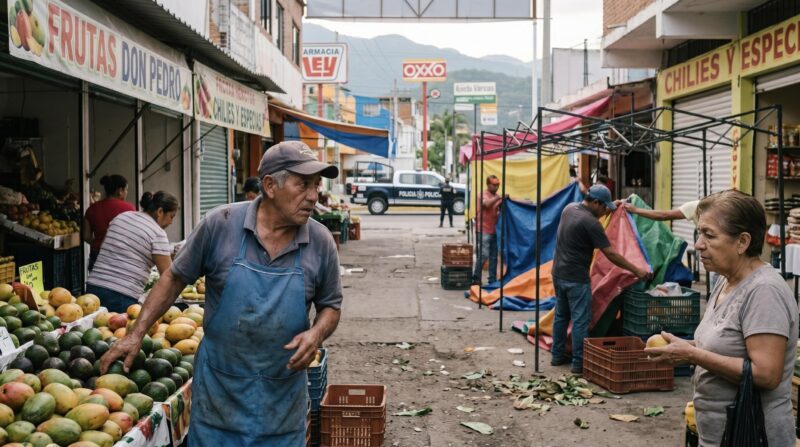
Resilience is not abstract — it is built through everyday economic activity that quietly restores continuity.
And then, just as quickly, something else happened.
By Tuesday morning, traffic had returned. Businesses reopened. Schools adjusted schedules and resumed. Municipal updates continued at a steady cadence. The visible signs of disruption receded.
The system did not collapse. It recalibrated.
From the United States, moments like this are often interpreted as instability — another confirmation of a familiar narrative about dysfunction south of the border. From here, the picture looks different.
What becomes visible is not only risk, but response — and, more importantly, what — and who — makes that response possible.
It is tempting to treat cartel violence as a contained national problem. It is not.
The systems that shape life in western Mexico are deeply integrated with those of the United States. Supply chains cross the border multiple times before a product is complete. Tourism economies depend heavily on U.S. demand. Agricultural goods move north daily. Labor, capital, and information flow continuously between the two countries.
The system did not collapse. It recalibrated
So do less visible forces.
The United States remains the largest consumer market for illegal drugs. It is also a primary source of the firearms that fuel cartel violence. These dynamics are not incidental — they are structural.
What happened in Mexico on February 22 is not disconnected from U.S. economic and social systems. It is entangled with them.
Violence, in this context, is not simply a breakdown. It is an emergent property of shared systems — systems that generate value and extraction at the same time.
That is the harder truth.
But it is only part of the story.
In the days that followed, what mattered most was not only the scale of the disruption. It was what allowed daily life to resume.
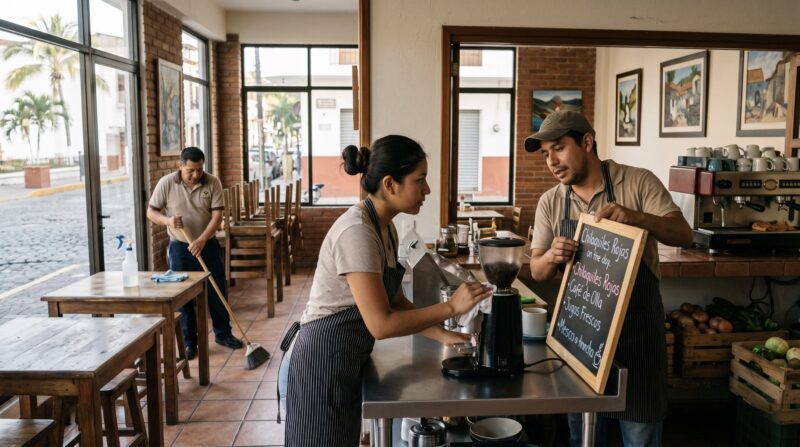
Local enterprises absorb shock through decisions made in real time — balancing risk, continuity, and responsibility to workers.
Some of that resilience came from the state.
Local authorities issued frequent, centralized updates. Messaging was consistent and actionable. Federal, state, and municipal actors aligned quickly, both in deployment and communication. This reduced panic and created a baseline of predictability.
But state response alone does not explain what I witnessed.
The deeper resilience came from the dense web of local economic and civic actors who sustained continuity in real time.
Vendors returned to the tianguis the following Sunday. Small businesses reopened, even amid uncertainty. Employers made decisions about whether to maintain payroll or close temporarily. Community networks shared information faster than official channels could catch up.
Resilience is not abstract. It is built — and rebuilt — through everyday economic activity.
These actions were not coordinated from a single command center. They emerged from relationships — trust, familiarity, and shared dependence.
They are easy to overlook. But they are foundational.
In environments shaped by both organized violence and cross-border extraction, resilience is not abstract. It is built — and rebuilt — through everyday economic activity.
What becomes visible in these moments is something we rarely name directly: the presence of local impact economies.
These are not formal categories. They are lived systems.
They include enterprises that prioritize continuity for workers even when revenue is uncertain; business networks that share verified information to prevent panic-driven shutdowns; local supply chains that adapt quickly when larger systems are disrupted; and civic and community organizations that connect employers, workers, and institutions in real time.
They operate in close proximity to risk. And they absorb it.
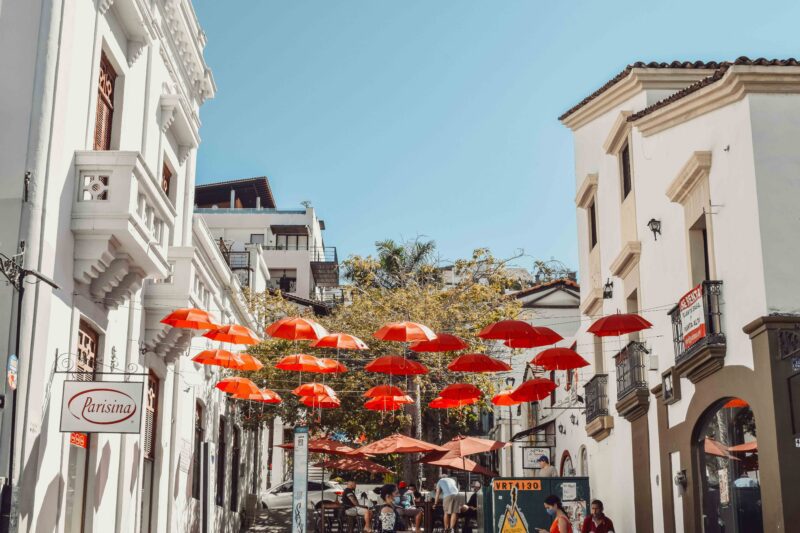
When locally rooted economies hold, they do more than recover — they stabilize the systems that connect far beyond the border; Image by Nicole Herrero
Boutique hotel operators and short-term rental hosts fielded cancellations while deciding how to support current guests and when to accept new arrivals. Restaurant owners tracked municipal updates before resuming service. By Tuesday, day cruises had resumed from the region’s main marinas. Within days, activity returned along the Malecón Puerto Vallarta — a central artery of the local economy where restaurants, vendors, and small businesses depend on steady foot traffic, much of it tied to U.S. tourism demand and the broader cross-border systems that sustain it.
For many, these were not abstract decisions. They were immediate trade-offs: revenue versus risk, continuity versus caution, payroll versus closure.
These actors do not eliminate instability. But they change its trajectory. They reduce the likelihood that disruption becomes deeper economic and social breakdown.
They sustain livelihoods when systems falter. They maintain trust where uncertainty could otherwise spread.
In this sense, they function as a form of preventive infrastructure — not by stopping shocks from occurring, but by limiting how far those shocks travel.
It is important not to overstate this resilience.
Not all businesses reopened immediately. Not all workers were protected. In sectors like tourism and transportation, revenue losses were real and, in some cases, lasting. For hourly workers, missed shifts meant missed income.
And even as visible disruption receded, underlying uncertainty remained — in operations, in income, in planning.
Resilience is not the absence of harm. It is the capacity to continue despite it — and that capacity is unevenly distributed.
For those working in and around the impact economy — investors, entrepreneurs, ecosystem builders — moments like this offer a different kind of signal.
They reveal not only where systems are vulnerable, but what allows them to hold.
They do not eliminate instability. But they change its trajectory.
First, resilience is local before it is institutional. National narratives about fragility or stability often obscure the reality on the ground. In moments of disruption, municipal capacity, community networks, and locally rooted enterprises are often the first and most important line of response.
Second, not all economic activity contributes equally to stability. Extractive systems — whether driven by illicit markets or legal demand — generate value while externalizing risk. Community-embedded economic actors, by contrast, help absorb that risk by maintaining continuity, preserving trust, and supporting livelihoods when broader systems are under strain.
Third, capital allocation shapes which of those systems grows stronger.
That dynamic is visible in the role played by local business networks and institutions that help communities maintain economic continuity under pressure. Groups like CANACO SERVYTUR Puerto Vallarta, which connect and support small and mid-sized businesses across the region, contribute to the trust, coordination, and information flow that sustain local economies.
If capital continues to reinforce extractive dynamics, instability will remain a structural feature. If it strengthens locally rooted networks of trust, coordination, and economic participation, resilience can deepen.
It is easier to treat violence as foreign dysfunction.
It is harder — and more honest — to see it as a shared outcome.
The systems that connect the United States and Mexico generate extraordinary economic value. They also generate pressure — pressure that is unevenly distributed, but collectively produced.
What I witnessed on February 22 was not only the shock of that pressure being released.
It was the response.
The bakery that opened the next morning.
The vendors who returned to their stalls.
The employers who chose to keep paying their workers.
The networks that carried information faster than uncertainty could spread.
These are not peripheral details.
They are the foundations of continuity.
Two months on, life here looks, on the surface, as it did before. The rhythms have returned. The systems are moving again.
But what remains visible — if you know where to look — is something deeper.
In places repeatedly shaped by forces beyond their control, resilience is not accidental.
It is built.
And sustained.
Together.

Related Content

Revitalizing a family business and becoming leaders in food banking
14301
0

Start early!
7732
0

Rethinking the reporting of waste
 12181
0
12181
0

Leveraging research-backed insights in the due diligence room
 12302
0
12302
0
Comments

Deep Dives
RECENT
 9203
0
9203
0
 8233
0
8233
0
 11149
0
11149
0
Editor's Picks
 14616
0
14616
0
 11231
0
11231
0
Webinars
News & Events
Subscribe to our newsletter to receive updates about new Magazine content and upcoming webinars, deep dives, and events.
Become a Premium Member to access the full library of webinars and deep dives, exclusive membership portal, member directory, message board, and curated live chats.

Join our global community of systems-minded changemakers.
Subscribe to the Impact Entrepreneur newsletter for the latest insights, magazine features, and invitations to exclusive webinars, Deep Dives, and events.


0 Comments