Love and Care in the Future of Public Markets
Gabriel Grant on giving shareholders a way to express what matters to them


Gabriel Grant on giving shareholders a way to express what matters to them

 71
71
 0
0

For mission-led organizations, a change of manager tests whether workplace inclusion is built to last.
 71
0
71
0

Artist Rob Strati on inherited objects, the limits of market price, and the creative possibilities…
109
0

Why free education tools need reliable access, credible evidence, and lasting support
 329
0
329
0

What Islamic finance and impact investing can learn from each other
 409
0
409
0

After the flood, recovery capital must do more than replace what was lost
 388
0
388
0

 6425
0
6425
0
Institutional investors are circling the world’s forests, fields, and oceans with new intent. The language of “natural capital” — once relegated to the lexicon of conservationists — is now popping up in pension fund reports and sovereign wealth fund strategies. Climate urgency is one reason. So is the math: natural capital, which includes the planet’s stock of forests, soils, water, and biodiversity, underpins an estimated 4.5% of global GDP.
Yet despite the growing attention, the actual money on the table remains small — and what’s there is being funneled into familiar territory.
A recent review of the annual and sustainability reports of 12 major pension and sovereign wealth funds, representing $6.1 trillion in assets under management (AUM), found just $11.5 billion clearly allocated to nature-based solutions in 2023–2024. That’s a 0.2% of their collective AUM. Broader surveys by JPMorgan and Schroders paint a similar picture. For all the talk of biodiversity credits and carbon markets, institutional portfolios are still overwhelmingly anchored in the old stalwarts of timberland and farmland — sectors European and Canadian pensions, in particular, have held for decades.

European fund managers note that, while institutions want to signal commitment to natural capital, most remain reluctant to venture into untested markets or novel financial structures. For now, they are largely seeking exposure through established assets — particularly timberland and farmland — rather than experimenting with emerging instruments like biodiversity credits or complex blended vehicles.
Search online for “how to invest in natural capital” and you’ll find a buffet of reports on carbon and biodiversity credits, marine conservation, and regenerative agriculture. But the reality inside pension portfolios looks very different. Nearly 97% of reported allocations are tied up in two categories: timberland/sustainable forestry, and agricultural land (see Figure 1). These are tangible, cash-flow-generating assets with established track records and risk-return profiles that match institutional mandates.
For all the talk of biodiversity credits and carbon markets, institutional portfolios are still overwhelmingly anchored in the old stalwarts of timberland and farmland.
For now, when carbon and biodiversity credits are in the mix, it’s as an option value attached to working lands, not the core investment. And the idea isn’t necessarily to earn cashflows from credit sales, but rather to secure credits for investors’ own use (such as through an offtake agreement). A recent survey by Gresham House of institutional investors in the UK found “overwhelmingly that investors prefer to generate their own credits from their investments, rather than buying them.”
This conservative approach reflects both fiduciary caution and the lack of a mature market infrastructure. Canadian pension funds, like many of their global peers, have emphasized that they cannot responsibly allocate beneficiaries’ capital into assets lacking reliable data, transparent pricing, and trusted intermediaries. Until carbon and biodiversity markets mature, these institutions continue to channel most of their natural capital investments into more established areas like timberland and agriculture.
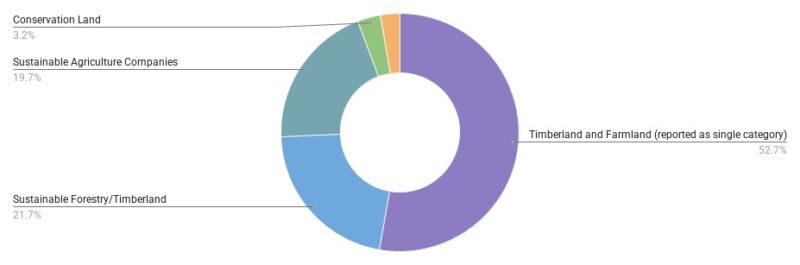
Share of reported allocations for a sample of pension and sovereign wealth funds with natural capital strategies. Institutions reviewed: ABP, AP1, AP2, AP3, AP4, AP7, Australian Super, CDPQ, CalSTRS, GBIF, NBIM, and UniSuper.
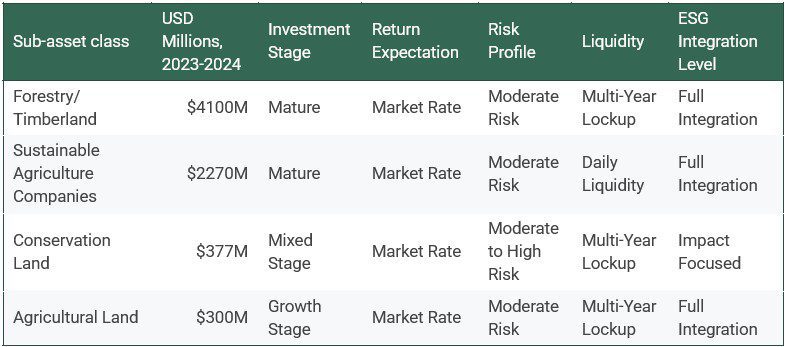
Data from a sample of 12 pension and sovereign wealth funds with natural capital strategies. Institutions reviewed: ABP, AP1, AP2, AP3, AP4, AP7, Australian Super, CDPQ, CalSTRS, GBIF, NBIM, and UniSuper.
Familiarity, however, is not without its perils. The surge of capital into forestry and farmland brings the risk of repeating past mistakes — including land grabs and community displacement — especially as demand for high-quality projects outstrips supply.
A notorious example still looms large: the TIAA-CREF farmland fund scandal, in which a consortium of global investors — including Sweden’s AP2, Québec’s CDPQ, the British Columbia Investment Management Corporation, and Germany’s ÄVWL — was implicated in illegal land acquisition and community displacement in Brazil. Though the controversy erupted a decade ago, it remains a cautionary tale of what can happen when transparency and accountability fail.

Many funds have since bolstered their ESG frameworks, requiring Free, Prior, and Informed Consent (FPIC), third-party certification, and stricter governance in their mandates. But if allocations rise faster than the supply of attractive investments, so too will the risk of pressure to dilute these safeguards to secure scarce projects. The experience of the voluntary carbon market — which saw trading volumes collapse amid accusations of greenwashing and unethical practices — offers a warning that investor enthusiasm can evaporate overnight if integrity falters.
Even for those steering clear of controversy, another hurdle looms: the pipeline. Nearly every institution surveyed cites a shortage of investable opportunities as the single greatest barrier to scaling allocations. Deal flow is thin, data on nature-related outcomes remains patchy, and measurement standards are still evolving despite the momentum of the Taskforce on Nature-related Financial Disclosures (TNFD), whose signatories now represent $17.7 trillion in AUM.
While many pensions now cite the TNFD framework in their reports, it remains unclear whether this disclosure has spurred meaningful increases in capital deployment toward nature-related investments.

That gap presents both a challenge and an opportunity. Investors hungry for exposure are likely to reward natural capital managers who can originate credible, scalable projects — whether through blended finance vehicles, funds dedicated to natural climate solutions, or creative partnerships with conservation organizations and local communities. Those who can solve for pipeline stand to set the standard as the sector matures. There’s likely a role here for concessional and philanthropic capital in supporting high-quality nature ventures in becoming more “investor-legible” and scaffolding their journey from early-stage to commercial scale.
Despite the bottlenecks, the trajectory is clear. The majority of the institutions surveyed plan to increase their natural capital allocations over the next one to three years, with most projecting 10–50% growth. Market maturation — including more standardized contracts, better risk data, and a broader set of investable vehicles — is seen as the primary catalyst for expansion.
In the meantime, the sector is likely to remain a hybrid of the old and the new. Timberland and agriculture will continue to anchor portfolios, while a trickle of capital experiments with biodiversity credits, marine assets, and regenerative projects. As more success stories emerge — and as integrity frameworks gain teeth — natural capital may yet evolve from a niche theme to a bona fide asset class.


Related Content
Gabriel Grant on giving shareholders a way to express what matters to them
71
0
For mission-led organizations, a change of manager tests whether workplace inclusion is built to last.
71
0
Artist Rob Strati on inherited objects, the limits of market price, and the creative possibilities…
109
0
Counting what we fail to prevent, sixty seconds at a time
102
0
Comments
Deep Dives
RECENT
 329
0
329
0
 409
0
409
0
 388
0
388
0
Editor's Picks
 71
0
71
0
 71
0
71
0
 109
0
71
0
71
0
71
0
109
0
109
0
71
0
71
0
71
0
109
0
Webinars
Signed by the author. Collected at the door at Lipton Hall, NYU School of Law,…
News & Events

The 2025–2026 edition also tries to count benefit corporations

The only craft-focused project in Catalytic Capital Consortium’s new cohort.

The September 14 program and a live IFI Tool demo are online
Subscribe to our newsletter to receive updates about new Magazine content and upcoming webinars, deep dives, and events.
Become a Premium Member to access the full library of webinars and deep dives, exclusive membership portal, member directory, message board, and curated live chats.


0 Comments