Building an Impact Economy in Georgia
Connecting Georgia’s social enterprises to markets and capital


Connecting Georgia’s social enterprises to markets and capital

 49
 0
Gabriel Grant on giving shareholders a way to express what matters to them
 84
0

For mission-led organizations, a change of manager tests whether workplace inclusion is built to last.
 72
0

Why free education tools need reliable access, credible evidence, and lasting support
 339
0

What Islamic finance and impact investing can learn from each other
 413
0
After the flood, recovery capital must do more than replace what was lost
 395
0
 49
0
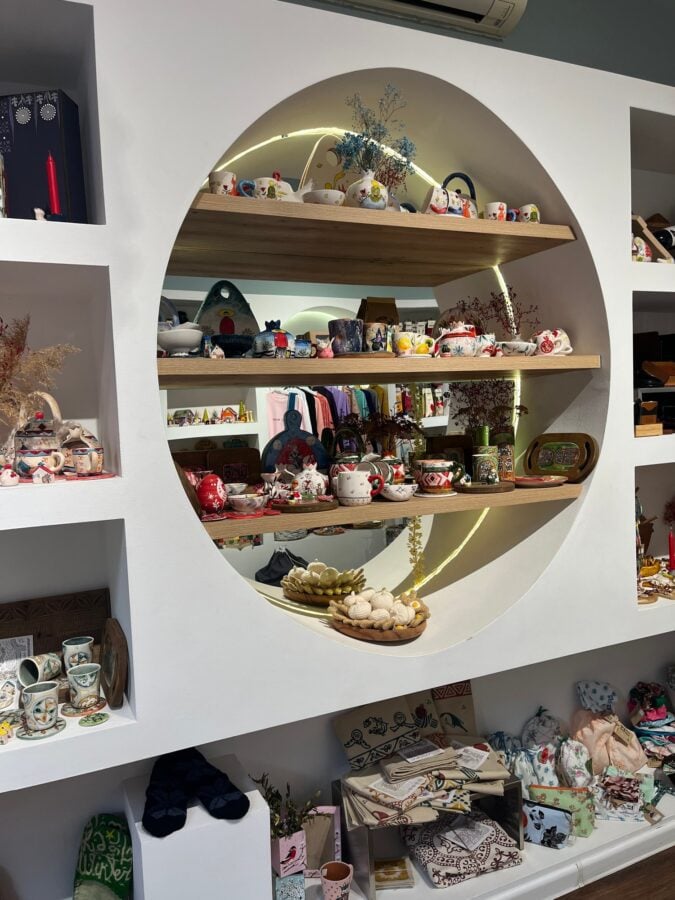
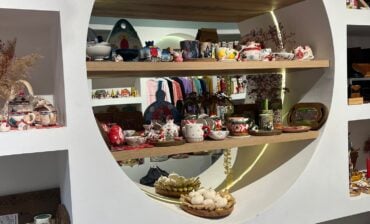
Products from Georgian social enterprises on display at Social Concept Store ESKI in Tbilisi; Photo by Selen Ucak
A Tbilisi shop leads Selen Ucak to a jewelry workshop in Tserovani — and a wider question about Georgia’s impact economy. Enterprises need customers, production capacity, and suitable capital to grow while keeping livelihoods and social purpose central.
On a recent trip to Georgia, my search for locally made design objects led me to Social Concept Store ESKI in Tbilisi. Its colorful shelves revealed a story about what it takes to build an impact ecosystem.
ESKI says it brings together more than 650 products from over 30 Georgian social enterprises, from toys, clothing, and jewelry that support disadvantaged women and children to decorative objects that preserve cultural heritage. Since its launch in 2022, the store says it has reached more than 7,000 customers. From July 2022 to July 2026, it reports transferring $155,000 to social enterprises for products sold through the store.
Salome Kusiani, co-founder of ESKI and executive director of Social Enterprise Alliance Georgia, described the work of changing how consumers perceive social enterprise: better branding and design, and new routes to customers, including tourists, international buyers, and corporate clients. Her point reaches beyond the shop. Compelling ideas, business models, and capital all matter, but enterprises also need sustainable demand for their products.
At ESKI, I encountered the work of Ikorta, a social enterprise producing traditional Georgian jewelry and providing economic opportunity to internally displaced people. That led me to Tserovani, a settlement about 25 kilometers outside Tbilisi, built following the 2008 Russia-Georgia war to house people displaced by the conflict.
Ikorta sits on a residential street, surrounded by trees and mountain views. Alongside its enamel jewelry workshop and gallery wall are classrooms and a library for the community. Ikorta employs nine people, including five directly involved in production; all nine are internally displaced. The enterprise’s work includes professional retraining and income generation for displaced women and youth, as well as reinvesting profits in community programs, preserving traditional techniques, and sharing knowledge about the history of conflict in Georgia.
Ikorta’s business model also illustrates the market challenge facing social enterprises. Although it sells through ESKI, its primary revenue stream comes from tourists who visit the workshop, make their own jewelry, and purchase products on-site. Production work provides regular income, although compensation fluctuates seasonally. According to director Nana Chkareuli, who was displaced from Akhalgori in 2008 and now lives in Tserovani, the enterprise is working to reach international customers, including through a planned Etsy shop.
For Chkareuli, the goal is to move “from small business to scalable business,” with Ikorta growing “from the local market to exports.” Getting there, she says, requires refining production processes and upgrading equipment.
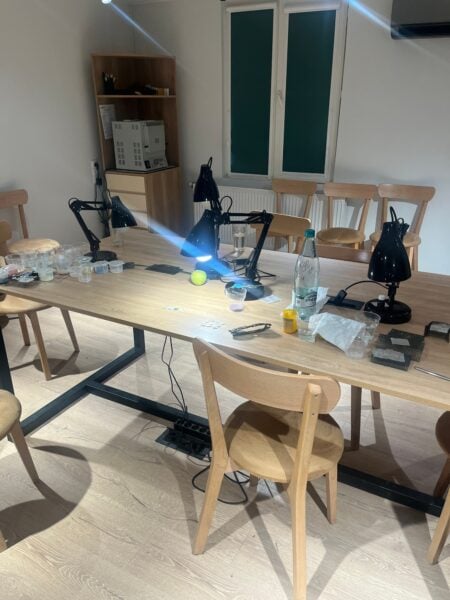
The jewelry-making workshop at Ikorta in Tserovani, Georgia; Photo by Selen Ucak
Ikorta’s ambitions reveal a broader challenge: sustainable economic participation depends on connections among producers, markets, and capital.
Those connections have been more than a decade in the making. The Center for Strategic Research and Development of Georgia (CSRDG) began working on social entrepreneurship in 2009, providing financial and technical support while raising awareness of the model. Networks, training, forums, and fairs helped develop the ecosystem. International and European support also contributed, including through Collaborate for Impact, an initiative that supported social entrepreneurship and impact investing in Eastern Partnership countries.
In 2022, CSRDG established Actio, which describes itself as Georgia’s first impact fund, with support from the EU and Impact Europe, formerly EVPA. Its model sits between conventional grantmaking and commercial investment. Actio offers milestone-based grants and zero-interest loans, with financing of up to €50,000, alongside technical assistance and impact measurement and management support.
Its selection criteria also connect growth to social purpose. At least 70% of profits must be reinvested in the enterprise or spent on social activities. Commercial entities must establish the primacy of their social mission in their statutes.
Compelling ideas, business models, and capital all matter, but enterprises also need sustainable demand for their products.
One portfolio enterprise is Champy, an apple-chip producer in the conflict-affected village of Ditsi. According to an EU-published summary of Actio’s impact report, equipment purchased with Actio’s support helped increase Champy’s annual production 2.5-fold during the reporting period, January 2023 through June 2024.
Champy has also received EU and UNDP support for its development. In June 2026, UNDP reported that it employed 13 people, including 12 women, exported to the United States and Canada, and was preparing to enter Germany. The example shows how production finance and market-access support can complement each other.
What happens as enterprises grow and their financing needs move beyond the type and scale of capital Actio provides?
That question connects social enterprises to Georgia’s broader economy. Small and medium-sized enterprises (SMEs) accounted for 60.6% of business-sector employment in 2024, according to the OECD’s 2026 country note. Citing the 2023 World Bank Enterprise Survey, the OECD reports that small and medium-sized firms were roughly twice as likely as large firms to identify access to finance as their primary obstacle.
Stronger connections with financial institutions, corporations, investors, and international markets could help social enterprises pursue their next stage of growth. But building an impact economy also requires conditions in which the organizations supporting them can operate. In its 2025 Georgia report, the European Commission described restrictions on civil society and international funding that undermine that environment.
The pieces are visible in Georgia: enterprises creating opportunities, intermediaries connecting them to customers, and finance tied to social purpose. Their wider promise depends on how reliably those pieces work together. For a necklace made in Tserovani, reaching international markets means connecting production capacity with customers and suitable capital — while keeping the livelihoods of its makers central to growth.


Related Content
Gabriel Grant on giving shareholders a way to express what matters to them
84
0
For mission-led organizations, a change of manager tests whether workplace inclusion is built to last.
72
0

Artist Rob Strati on inherited objects, the limits of market price, and the creative possibilities…
110
0

Counting what we fail to prevent, sixty seconds at a time
103
0
Comments
Deep Dives
RECENT
 339
0
 413
0
 395
0
Editor's Picks
 49
0
 84
0
 72
0
49
0
84
0
49
0
84
0
72
0
Webinars
Signed and personally inscribed — you'll write the inscription as you order. Limited · 50…
News & Events

The board can add 2% for each 50% rise in the company’s value
Applications close December 2, or sooner once 250 arrive
Repeat borrowers in Colombia and Indonesia took it over the line
Subscribe to our newsletter to receive updates about new Magazine content and upcoming webinars, deep dives, and events.
Become a Premium Member to access the full library of webinars and deep dives, exclusive membership portal, member directory, message board, and curated live chats.


0 Comments