When Impact Stops at the Office Door
For mission-led organizations, a change of manager tests whether workplace inclusion is built to last.




For mission-led organizations, a change of manager tests whether workplace inclusion is built to last.

 63
63
 0
0

Artist Rob Strati on inherited objects, the limits of market price, and the creative possibilities…
 101
0
101
0

Counting what we fail to prevent, sixty seconds at a time
95
0

How states can crowd in local early-stage capital
 387
0
387
0

Why last-mile healthcare needs an operating model, not just more mobile clinics
 372
0
372
0
How Australia’s succession wave could turn ownership into a funding model
 490
0
490
0

 582
0
582
0
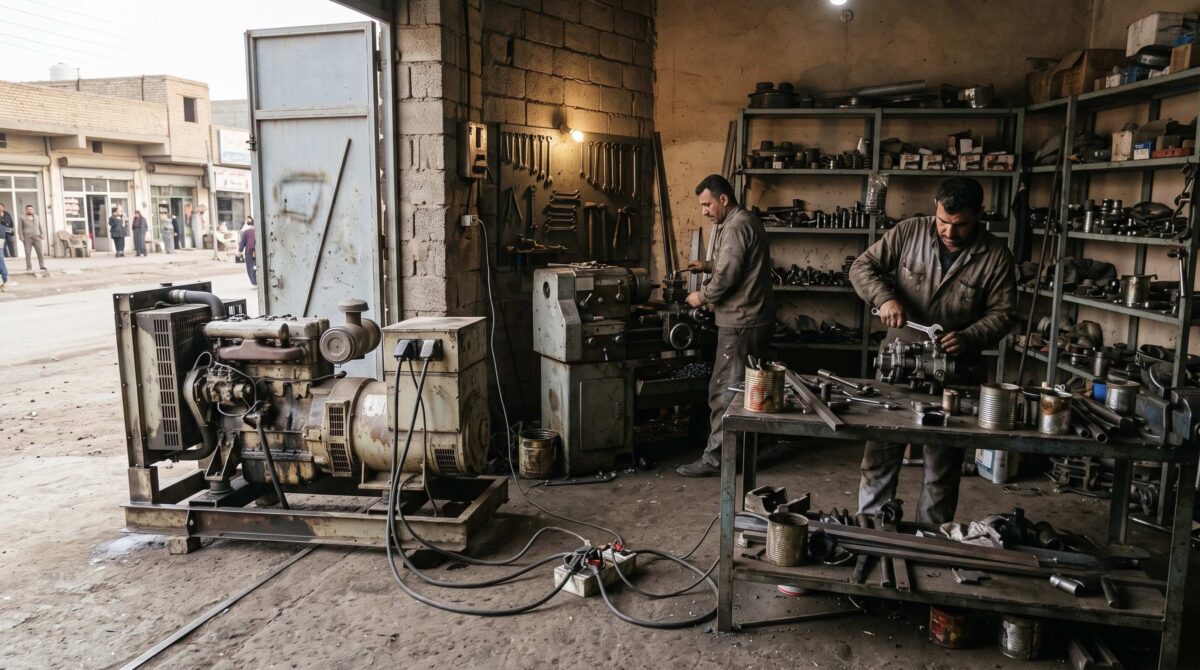
Mosul’s recovery depends not only on rebuilt streets and reopened shops, but on whether power, capital, goods, and contracts can move reliably through the local economy.
Mosul has been visibly rebuilt in important ways, but its economy still struggles to circulate. Capital, electricity, goods, and contracts fail to reach the firms that need them, leaving informal networks and small business owners to carry risks that institutions should absorb.
Eight years after the liberation of Mosul, the reconstruction story has a familiar shape. UNESCO is nearing the end of its work on the Al-Nuri Mosque. Churches have reopened. Government ministries announce milestones. Physical reconstruction has advanced in important ways, although the city’s recovery remains uneven across neighborhoods and communities.
But beneath that visible progress, a different problem persists. Mosul’s economy has not been restored at the level that matters most for durable enterprise: the systems that move capital, electricity, goods, and contracts around still do not function reliably. For impact investors and policymakers working on post-conflict recovery, this distinction — between building things and making them circulate — determines whether recovery becomes durable.
Two numbers tell the story.
Iraq has roughly 32 gigawatts of installed electricity capacity, but can generate only about 16 GW for consumers, with around 40% lost in distribution. At the same time, Iraq burns off billions of cubic meters of its own natural gas every year while continuing to rely on imported gas and electricity to run its power system. The country is not short of energy in the abstract. It is short of the infrastructure and governance needed to move energy from where it is produced to where it is used. Baker Institute research makes the same paradox clear: Iraq’s power shortages persist alongside substantial gas flaring and import dependence.
The financial sector has the same problem. Fewer than 20% of adults in Iraq hold a bank account, and fewer than 5% of micro, small, and medium-sized enterprises use bank lending, according to GIZ’s financial inclusion work in Iraq. This is not because there is no money in the system. Iraq runs oil surpluses in good years, and the $400 million World Bank reconstruction package for Mosul and newly liberated areas shows that capital can be mobilized at scale. The problem is that capital often does not reach the businesses that would use it.
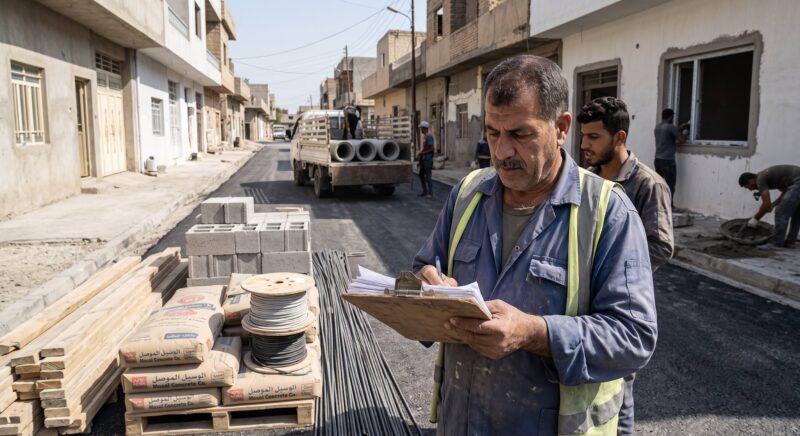
Reconstruction can create demand for local firms, but delayed payments, weak credit systems, and procurement bottlenecks often leave small contractors carrying risks the system should absorb.
In Mosul, these two failures stack on top of each other. A bakery that cannot get a loan ends up running on a neighborhood diesel generator that costs several times the grid tariff. A workshop that cannot access working capital cannot buy the equipment that would reduce its generator bill. The firm carries both risks itself. That is the real story of Iraq’s post-ISIS economy.
It is tempting to say Mosul’s economy is “weak” or “recovering.” Both descriptions are too loose to be useful. What broke, specifically, are three distribution systems.
Banking. The World Bank’s Damage and Needs Assessment recorded that one central bank branch in Mosul and 121 commercial bank branches were directly affected by the conflict, with physical damage of $52 million. Losses to financial assets were far larger: $10 billion in total, including $833 million in deposits seized by ISIS, $8.3 billion in credit impairment to the state-owned Rafidain and Rasheed banks, and $1 billion in additional non-performing loan provisioning at private banks. Four of Iraq’s twelve microfinance institutions went out of business. The machinery for lending at the SME scale was hollowed out, and it has not been rebuilt at the speed returning enterprise requires.
The distinction between building things and making them circulate determines whether recovery becomes durable.
One signal of how differently the market now treats Mosul is the lending geography of the Nomou Iraq Fund. Nomou operates in seventeen governorates, but it does not lend in Nineveh; businesses in Mosul are referred to a separate vehicle, Northern Iraq Investments, because the risk profile is treated as distinct.
Power. The UN’s Funding Facility for Stabilization has implemented more than 3,600 projects across liberated Iraqi cities, including hundreds of power and water plants. But transmission and distribution have not caught up. What fills the gap is a parallel private power market. Iraqis spent nearly $4 billion on private diesel generators in 2018, according to the AGSIW analysis, and reporting on electricity privatization describes a politically connected generator market that critics often call a “generator mafia.” The New Region has noted how entrenched private-generator interests complicate grid reform.
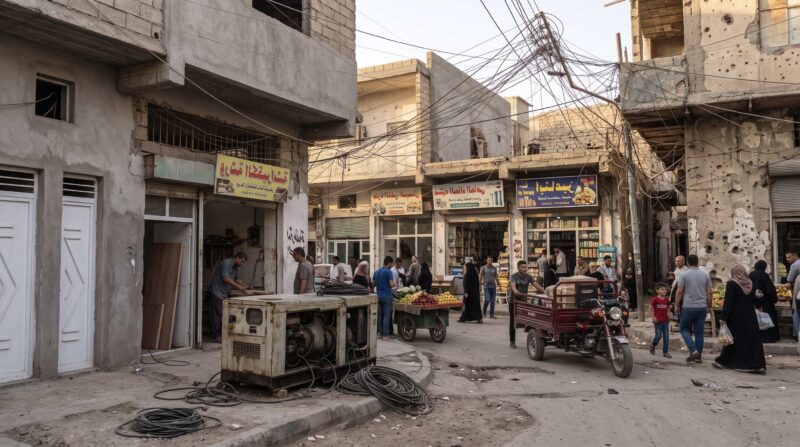
When grid power is unreliable, small firms absorb the cost through private generators, higher operating expenses, and delayed investment.
Property. Around 130,000 homes in Mosul were damaged or destroyed in the 2014–2017 war. Tens of thousands of returnees have incomplete or contested property titles. Without clear title, formal bank lending is effectively impossible, because banks need collateral they can legally recover. This is not a soft constraint. It is a lockout from the formal financial system.
Each of these is a distribution failure, not a capacity failure. That distinction matters for anyone deciding where to put money.
Where formal systems fail, informal ones fill in. The shape of Mosul’s SME economy is not hard to see once you know to look for it.
Most firms transact in cash. It is trusted, immediate, and requires no institutional middleman. The cost is permanent exclusion from credit histories, formal procurement contracts, and receivables-based working capital.
Credit, where it exists, often flows through forms of relationship-based lending, including qard hassan — interest-free lending rooted in Islamic finance — and family, neighborhood, and trade-community funds. Financial inclusion reporting on Iraq describes the broader reliance on informal and alternative channels where formal credit remains difficult to access. These networks price risk through relationships, not paperwork. A butcher can borrow from a cousin or supplier to replace a freezer. The social cost of default can be high, but the ceiling is low. Such networks can finance survival. They cannot finance a warehouse.
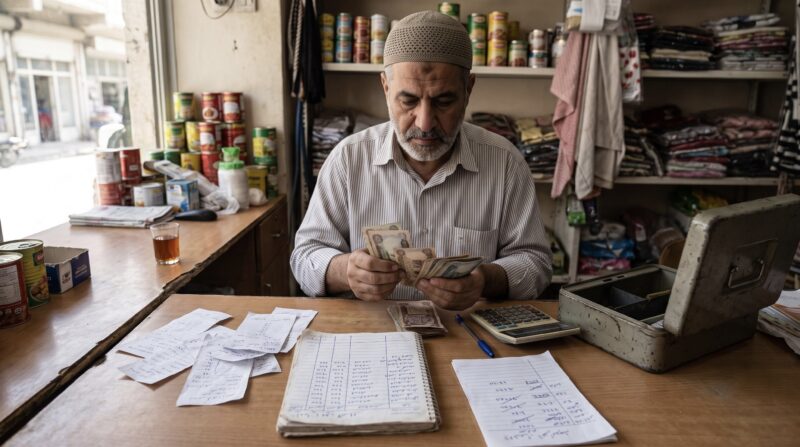
Cash keeps transactions moving, but it also keeps many firms outside the credit histories, procurement contracts, and working-capital systems needed for growth.
For larger sums and cross-border payments, hawala — an informal value-transfer system based on trust networks — handles what banks often cannot. It can be faster and cheaper than bank transfers, with less paperwork. It is also largely unregulated and carries counterparty risk against which users may have little recourse.
The common thread is that risk formal institutions would normally carry — payment risk, power risk, contract risk — is carried by the firm and its owner. A Mosul SME may look less productive than a comparable firm in a stable market, but that is the wrong reading. The firm is running a much larger self-insurance operation alongside its actual business.
Three shifts follow.
First, match the product to the firm. Nomou’s minimum loan is $100,000 over five years, with two to three years of operating history required and turnover of 1.5 times the loan amount. Almost no Mosul firm fits that profile. What Mosul businesses need is smaller, shorter, collateral-light working capital — perhaps $5,000 to $50,000 over six to eighteen months — to cover inventory, cash-flow gaps, and late payments from reconstruction contractors. IOM’s Enterprise Development Fund is closer to the right recovery logic, because it provides financial capital to SMEs in post-conflict and return contexts. But grantmaking alone is not a durable credit market. The missing product is repeatable, appropriately sized working capital at scale.
Informal networks can finance survival. They cannot finance a warehouse.
Second, the plumbing matters more than the capital. Pouring money into Mosul without credit bureaus, title resolution, or movable-collateral registries produces one-off loans that cannot be repeated. Iraq’s Central Bank launched a National Financial Inclusion Strategy 2025–2029 that names these gaps, but implementation will take time. Impact investors with longer time horizons than commercial banks are the right actors to fund the infrastructure — digital ID, alternative credit scoring, cooperative registration, collateral systems, and property documentation — that turns one loan into recurring access.
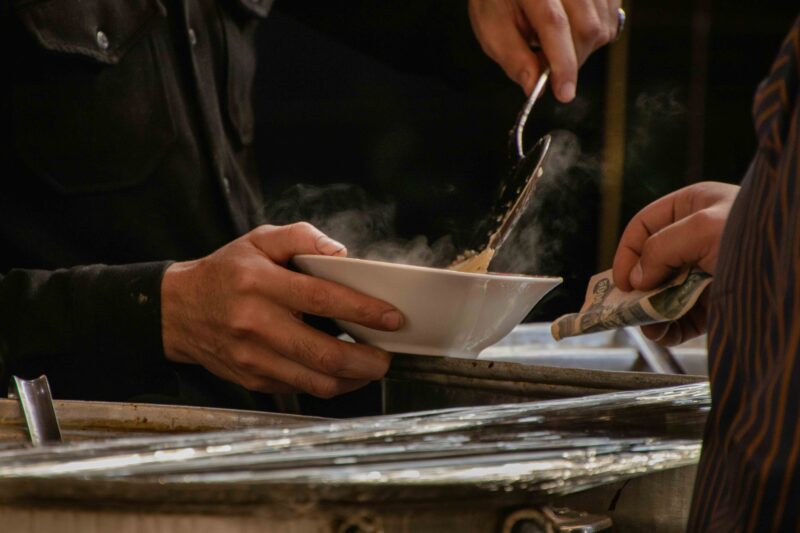
Where formal systems fail, everyday exchange continues through cash, trust, and relationships — systems that sustain survival but rarely finance growth.
Third, procurement is the fastest lever. The most reliable demand source for Mosul SMEs over the last eight years has been reconstruction contracting. But payment cycles are long, and prime contractors can squeeze local subcontractors. Donors and implementing partners have more leverage on procurement terms than they tend to use. Paying Mosul subcontractors on 30-day rather than 90- or 120-day terms would do more for working capital than many new credit facilities. Requiring a defined share of work for Mosul-registered firms would do more for durable enterprise than another accelerator.
Reconstruction in Iraq has often been discussed in the language of rebuilding: mosques, homes, hospitals, roads. That is the language of capacity. Mosul’s economic story is about circulation. The assets are returning. The people are back. Businesses exist. What is missing is the architecture that moves capital, power, goods, and contracts around with enough reliability that firms can stop absorbing every risk themselves.
The test of recovery is not whether Mosul’s economy grows this year. It is whether the next shock — a budget crisis, a militia standoff, another displacement — finds the same firms carrying the same risks, or finds a system that finally distributes them.
--
This article is part of Impact Entrepreneur’s Impact Journalism Institute, in collaboration with Arts4Refugees’ A4R Media Hub, supporting emerging Gen Z journalistic voices covering how the Impact Economy is being built — and tested — in communities affected by conflict, displacement, and economic fragility.


Related Content
For mission-led organizations, a change of manager tests whether workplace inclusion is built to last.
63
0
Artist Rob Strati on inherited objects, the limits of market price, and the creative possibilities…
101
0
Counting what we fail to prevent, sixty seconds at a time
95
0
How collateral rules and payment terms keep impact capital out of reach
224
0
Comments
Deep Dives
RECENT
 387
0
387
0
 372
0
372
0
 490
0
490
0
Editor's Picks
 63
0
63
0
 101
0
101
0
 95
0
63
0
101
0
95
0
95
0
63
0
101
0
95
0
Webinars
Signed by the author. Collected at the door at Lipton Hall, NYU School of Law,…
News & Events
The only craft-focused project in Catalytic Capital Consortium’s new cohort.

The September 14 program and a live IFI Tool demo are online

Pre-seed and seed startups can apply on a rolling basis
Subscribe to our newsletter to receive updates about new Magazine content and upcoming webinars, deep dives, and events.
Become a Premium Member to access the full library of webinars and deep dives, exclusive membership portal, member directory, message board, and curated live chats.


0 Comments