What a Broken Plate Reveals About Value
Artist Rob Strati on inherited objects, the limits of market price, and the creative possibilities…




Artist Rob Strati on inherited objects, the limits of market price, and the creative possibilities…

 77
77
 0
0

Counting what we fail to prevent, sixty seconds at a time
84
0

How collateral rules and payment terms keep impact capital out of reach
 191
0
191
0

How states can crowd in local early-stage capital
362
0

Why last-mile healthcare needs an operating model, not just more mobile clinics
 343
0
343
0
How Australia’s succession wave could turn ownership into a funding model
 461
0
461
0

 814
0
814
0

AI may feel weightless, but its sustainability promise depends on very physical systems: buildings, servers, cooling, electricity, water, and the communities asked to host them.
AI is being sold as a tool to solve sustainability’s hardest data problems, from Scope 3 emissions to climate-risk intelligence. But the infrastructure behind that intelligence — data centers, water use, energy demand, chips, grids, and community consent — is becoming its own sustainability test. Drawing on conversations at Trellis Impact 26, Ming Wong explores what AI’s physical footprint means for impact investors, corporate sustainability leaders, and the communities being asked to host the next generation of digital infrastructure.
Where artificial intelligence stops being abstract and starts getting to work is inside the data center. At Trellis Impact 26, AI was everywhere: in climate-risk dashboards, emissions reporting tools, Scope 3 automation, engineering platforms, and investor conversations. It was being presented not simply as another technology, but as a necessary instrument for making sense of complex sustainability data.
But the promise inside San Francisco’s Moscone Center kept running into the physical world outside it. AI may help companies see hidden emissions in their value chains. It also requires land, water, electricity, minerals, transmission capacity, and public trust. The more powerful the models become, the harder it is to separate AI’s sustainability promise from the infrastructure required to run it.
That tension was reinforced by a recent Gallup poll, which found that seven in ten Americans oppose the construction of AI data centers in their local area, including 48% who are strongly opposed. Gallup also found that local AI data centers are now more unpopular than nearby nuclear power plants, and that half of opponents cite resource concerns, especially water use, energy consumption, and grid constraints.
For sustainability practitioners, this marks a shift. The question is no longer whether AI can help companies manage sustainability data. It can. The harder question is whether the infrastructure behind that intelligence can meet the same standards of accountability, transparency, and community benefit that the impact economy increasingly demands.
To explore that question, I spoke at the conference with three leaders approaching the issue from different points in the system: Dara O’Rourke, Professor at UC Berkeley and Faculty Director of the university’s new Master of Climate Solutions program; Dan Sobrinski, Senior Vice President and Director of Sustainability, Energy, and Climate Change at WSP; and Michelle Moore, CEO of Groundswell. Together, they described an AI supply chain that is moving faster than our tools for governing it.
“The hyperscalers are not in the room,” O’Rourke told me. His point was not that the largest technology companies are absent from sustainability conversations altogether. It was that the companies driving much of AI’s electricity, water, chip, and cloud demand are still too often absent from the rooms where communities, customers, utilities, and sustainability practitioners are trying to define the terms of accountability.
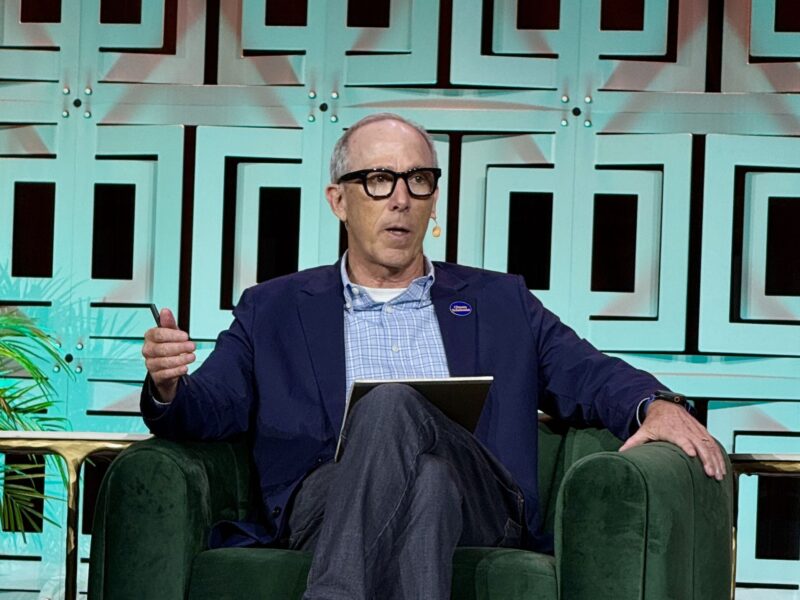
Dara O’Rourke, Professor at UC Berkeley and Faculty Director of the Master of Climate Solutions program, speaks during a Trellis Impact 26 panel on AI, sustainability, and the future of climate action; Photo by Ming Wong
For O’Rourke, incremental software efficiency will not be enough. The real opportunity lies in organizing demand across the full AI stack. He argues for a localized “buyers’ club” model that brings together enterprise customers, model builders, cloud providers, chip manufacturers, and utilities around guaranteed demand for lower-carbon infrastructure.
The logic is market-based but systems-oriented. Rather than waiting for an entire industry to move at once, a coalition can use its purchasing power to secure one anchor cloud provider, one chip partner, and one utility. As O’Rourke put it, the major cloud providers are locked in a “death match against each other,” which creates leverage for customers willing to demand better infrastructure. Advanced purchase commitments can lower supplier risk and make alternatives such as geothermal power, solar-plus-storage, or other low-carbon data-center configurations more financeable.
Data centers have become the place where artificial intelligence stops being abstract.
The cost of failing to build such coalitions is already visible. Anthropic, a company that has positioned itself as a safety- and responsibility-focused AI firm, recently struck a deal to use the full computing power of SpaceX’s Colossus 1 facility in Memphis. At the same time, the broader xAI/SpaceX data-center buildout has drawn environmental scrutiny, including a Clean Air Act lawsuit by the NAACP and environmental groups over gas turbines at xAI’s Colossus 2 project in Southaven, Mississippi.
For O’Rourke, this is the credibility problem. If an “ethical AI” company claims there is no choice but to use controversial infrastructure because compute is scarce, then its ethics are constrained by the weakest part of its supply chain. In sustainability terms, the model is only as responsible as the stack that powers it.
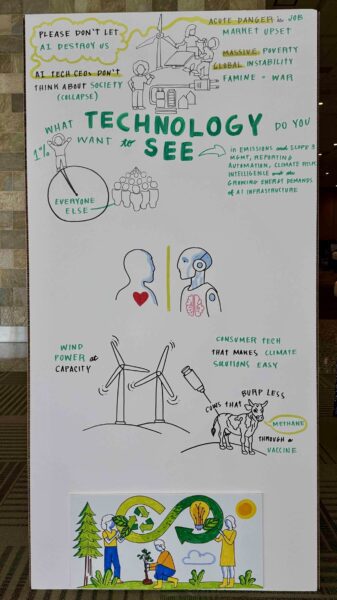
A visual brainstorming wall at Trellis Impact 26 captures one of the article’s central questions: what kind of technology should the sustainability field demand — and at what human and ecological cost? Photo by Ming Wong
The water-energy trade-off
Sobrinski brought the discussion back to engineering reality. Data-center growth is not a new issue, he noted; WSP was working with Microsoft on cloud-computing resource questions more than a decade ago. What has changed is the speed and concentration of demand.
From an engineering perspective, data centers force a difficult balance between water and electricity. Evaporative cooling can reduce server energy loads but consumes significant water. Dry cooling can protect local water supplies but may increase electricity demand, shifting some impacts upstream into the regional power system.
“Evaporative cooling is a very efficient way to run your cooling,” Sobrinski said. “The trade-off is it relies on a lot of water. So you have this balancing act. We can reduce one thing with this cooling technology, but we increase the other.”
The right answer depends on place. A cooling strategy that makes sense in a water-rich region with a clean grid may be irresponsible in a stressed watershed served by fossil-heavy electricity. A data center that looks efficient on one metric can externalize costs on another. There is no universal table that can tell a community, investor, or operator what “sustainable” means without local context.
Sobrinski also emphasized that AI is not only a source of infrastructure pressure; it can be a tool for solving infrastructure problems. WSP and Microsoft have announced a multi-year strategic partnership to accelerate digital and AI transformation in architecture, engineering, and construction. In Sobrinski’s view, embedding AI into the work of planners and engineers can help optimize building systems, strengthen grid planning, and improve the design of resilient infrastructure.
Still, optimization is not the same as governance. Sobrinski cautioned against blanket moratoria that may simply push projects to jurisdictions with weaker standards. Instead, he argued for smart-growth frameworks that let communities and investors evaluate where data centers should be built, under what operating standards, and with what accountability. The GRESB Data Center Assessment, developed with Infrastructure Masons, points in that direction by creating a sustainability benchmark specifically for data-center investments.
Moore approached the issue from the vantage point of the households and communities that live with the consequences of infrastructure decisions. She does not dismiss AI’s potential. In fact, she sees real promise in using AI to organize messy Scope 3 data and make supply-chain transparency more achievable. But she is clear that corporate sustainability goals cannot justify scorched-earth development.
“I understand that there’s a lot at stake,” Moore told me. “National policymakers feel a tremendous sense of urgency to access compute. But you can go fast without breaking things. You can go fast without breaking people. You can’t go fast and break people without dire consequences for everybody down the road.”
For Moore, the data-center debate reveals a missing piece in the AI economy: a trusted way to distinguish responsible infrastructure from harmful infrastructure. Consumers can look for fair-trade certifications in coffee or chocolate. Developers can point to LEED in buildings. But there is still no widely accepted certification that tells enterprise customers, investors, or communities whether the data-center supply chain behind an AI product meets credible social and environmental standards.

AI’s climate promise depends not only on better data, but on the physical infrastructure — servers, energy, cooling, and supply chains — required to produce it; Image by Getty Images
Moore also challenged the standard economic defense of data-center development: job creation. Unlike a manufacturing plant or gigafactory, a highly automated data center can occupy large acreage, strain local utilities, and consume substantial resources while producing relatively few permanent jobs. That imbalance matters, especially as AI raises public anxiety about white-collar, entry-level, and manual labor jobs.
Groundswell has tried to bridge that gap by turning corporate sustainability commitments into localized community benefit. With support from Google, the organization has advanced energy-affordability work in places such as West Memphis, Arkansas, and LaGrange, Georgia, helping fund home repairs, energy-efficiency upgrades, and grid-related resilience. Moore’s argument is that communities should not merely host the infrastructure of the AI economy. They should share in the value it creates.
The paradox of AI and sustainability is not that the technology is either good or bad. It is that both claims are true. AI may help companies understand Scope 3 emissions, identify climate risks, model infrastructure needs, and improve operational efficiency. At the same time, its physical footprint is testing local grids and watersheds, public consent, and the credibility of corporate climate commitments.
AI procurement has become infrastructure due diligence.
For impact investors and practitioners, the implication is straightforward: buying sustainability software while ignoring where that software is hosted is no longer defensible. AI procurement has become infrastructure due diligence. The relevant questions now include: What powers the model? Where is the data center located? How is it cooled? Who bears the local costs? Who receives the local benefits? What standards govern the supply chain?
The AI race will not slow down because sustainability professionals ask politely. But it can be redirected. Buyers’ clubs can create demand for cleaner infrastructure. Engineering firms can design better trade-offs. Benchmarks and certifications can help investors distinguish credible operators from extractive ones. Community partnerships can turn abstract climate pledges into tangible local value.
AI will not become sustainable through software alone. Its ethics, its climate value, and its social license will be built — or broken — in the physical systems underneath it. If we want AI to help build a better future, we have to start by making sure its foundations do not weaken the communities holding up the grid.


Related Content
Artist Rob Strati on inherited objects, the limits of market price, and the creative possibilities…
77
0
Counting what we fail to prevent, sixty seconds at a time
84
0
How collateral rules and payment terms keep impact capital out of reach
191
0

Why free education tools need reliable access, credible evidence, and lasting support
 250
0
250
0
Comments

Deep Dives
RECENT
 362
0
362
0
 343
0
343
0
 461
0
461
0
Editor's Picks
 77
0
77
0
 84
0
84
0
 191
0
77
0
77
0
84
0
191
0
191
0
77
0
77
0
84
0
191
0
Webinars
Signed by the author. Collected at the door at Lipton Hall, NYU School of Law,…
News & Events

The September 14 program and a live IFI Tool demo are online

Pre-seed and seed startups can apply on a rolling basis

Their Built platform helps teams design, launch and run funds
Subscribe to our newsletter to receive updates about new Magazine content and upcoming webinars, deep dives, and events.
Become a Premium Member to access the full library of webinars and deep dives, exclusive membership portal, member directory, message board, and curated live chats.


0 Comments