Beyond Investment Readiness
How collateral rules and payment terms keep impact capital out of reach



How collateral rules and payment terms keep impact capital out of reach

 105
105
 0
0

Why free education tools need reliable access, credible evidence, and lasting support
 117
0
117
0

What Islamic finance and impact investing can learn from each other
206
0

How states can crowd in local early-stage capital
319
0

Why last-mile healthcare needs an operating model, not just more mobile clinics
 285
0
285
0

How Australia’s succession wave could turn ownership into a funding model
 397
0
397
0

 9875
0
9875
0
W e live in an age of innovation so rapid and efficiency so ruthless that as a species, we’re on the cusp of innovating ourselves out of relevance. Whether ChatGPT could have written a better version of this article than I’m about to, I’ll leave up to you. However, the point remains that whole sectors of human professionals will soon be obsolete as a result of technological gains, and we accept that stark eventuality as the necessary byproduct of our push towards ever greater efficiency.
So why in this age of pitiless progress do we tolerate the bureaucratic bloat and budgetary waste that often accompanies humanitarian aid distribution? When it comes to humanitarian aid systems, we accept as normal a certain level of inefficiency. We give grace to aid organizations and allow that their work is good enough, even though a good chunk of the funding available does not wind up as aid in the hands of those who need it. To fix this failure we need more than good intentions. We need good tech.
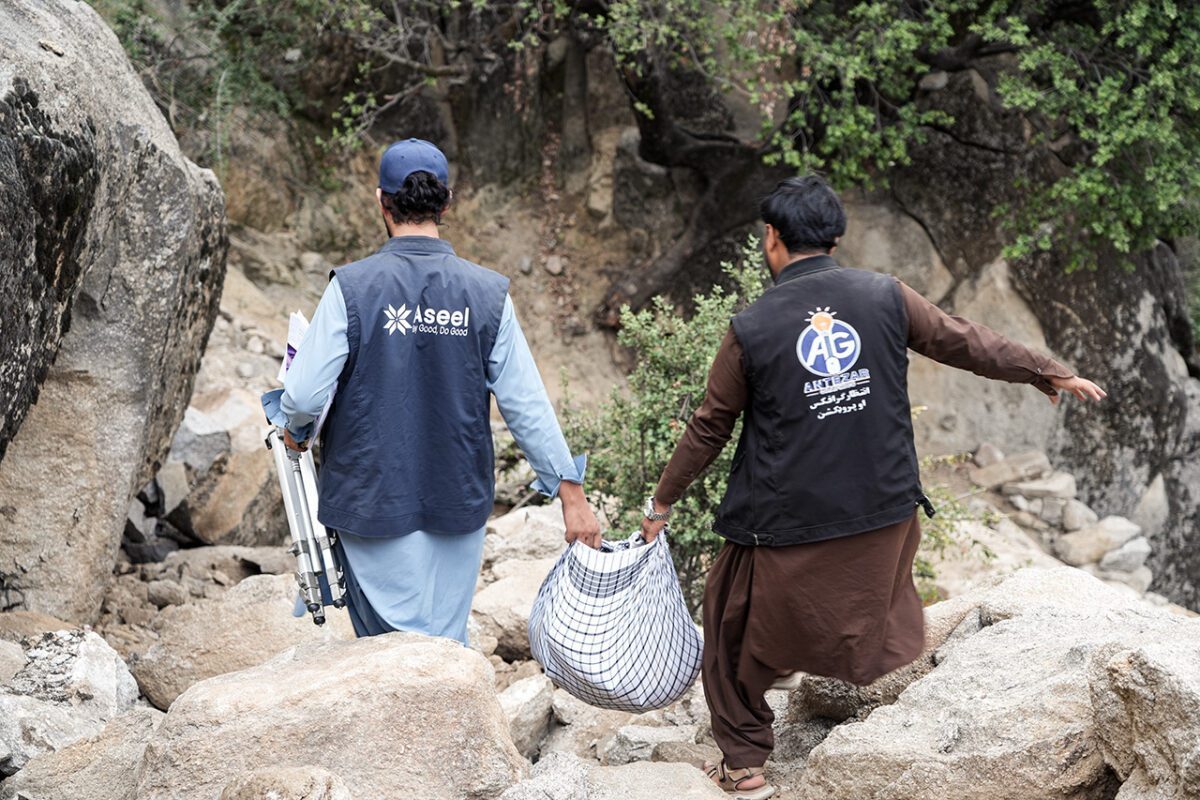
 Photo courtesy of re+connect
Aid is big business and we’ve constructed big organizations to distribute it. The globe spanning NGOs that have become household names or acronyms have massive budgets, huge staffs, external consultants and vast infrastructure to conduct their work in some of the most challenging contexts. But is bigger better? Analyses of the overhead costs, transaction fees, losses and monitoring expenses of international aid organizations by the OECD, World Bank, and academic sources generally place the administrative and operating expenses of such organizations at 10-30% of their budget in developed systems, and up to 50% in higher risk environments. This gap represents a market inefficiency that technology and venture philanthropy could help to address. By leveraging existing IP and applying it in novel humanitarian contexts, tech can drive greater transparency, efficiency, and impact, at a fraction of the operating cost of traditional aid organizations.
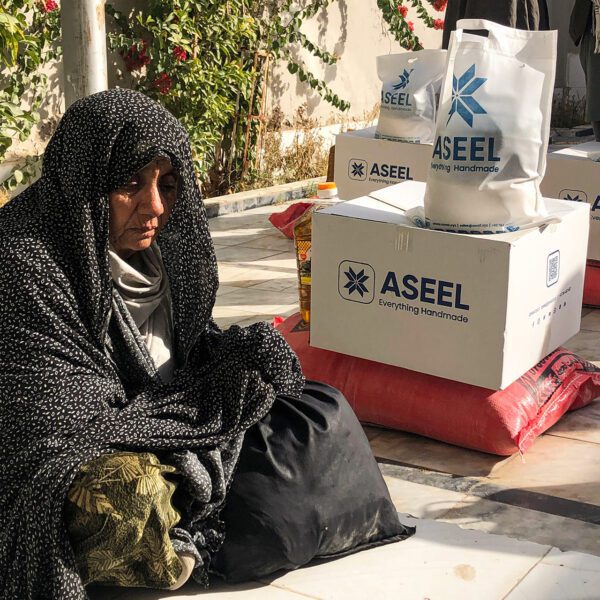 Photo courtesy of Aseel
After the fall of the Afghan government in August of 2021, Nasrat Khalid, a veteran of the World Bank with experience in applying fintech principles to fuel practical economic development, looked around at his native country and saw opportunity in its societal collapse. He had already launched Aseel, an Etsy-like platform that connects local artisans with the global marketplace and his “buy good” ethos easily translated into “do good” humanitarian practicalities.
Aseel’s AidOS platform supports a multiplicity of philanthropic functions including fundraising, direct cash transfers, digital ID cards for beneficiaries and in-kind donation of aid packages delivered by local couriers, who then send video verification of the handoff to donors. Utilizing some of the same technology employed in digital banking and the gig economy, Aseel offers a cost-effective, transparent, and sustainable means for building an aid ecosystem without the physical infrastructure.
Aseel’s decentralized model is an example of disruption in the aid space, but in the best way possible, says Aseel’s VP of Business Development Layma Murtaza. “Two major problems that Aseel is trying to solve for are connecting vulnerable populations with the digital economy, and also countering the inefficiency and lack of transparency in humanitarian aid delivery,” explains Murtaza. She notes that Aseel’s operating margin is only 16% and easily translatable to other countries or contexts, “We have observed the role of disaster, and we just want to expand the scale of humanitarian reach when those situations happen.”
In the aftermath of a wildfire, hurricane or earthquake that hits a community where aid distribution networks are not already established, the response is often a rush of relief efforts and funding that can miss the mark. In such critical contexts, government and non-profit efforts to mobilize aid can be duplicative or fall short of meeting actual needs on the ground. When a humanitarian roadmap has yet to be drawn or when the temporarily displaced don’t know where to turn to for help, in places such as the Pacific Palisades or Puerto Rico, the result is often needless waste and suffering. This is where tech can play a pivotal role.
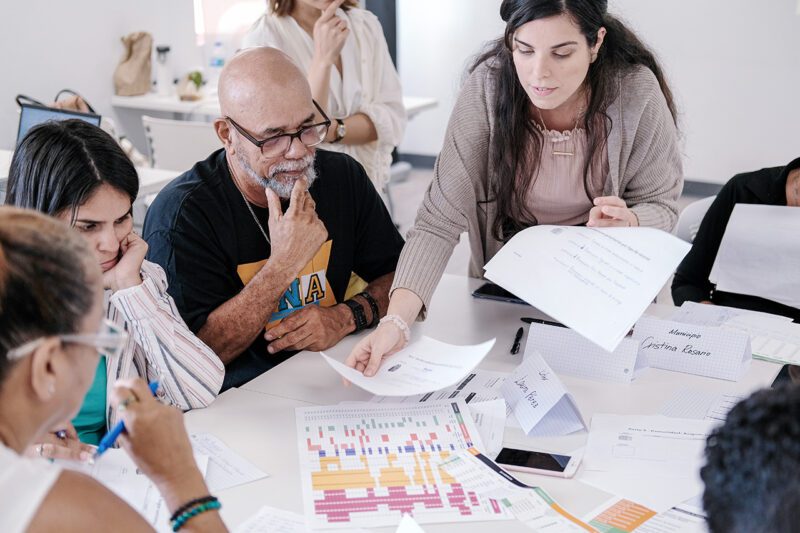 Photo courtesy of re+connect
Inspired by the community-led recovery efforts in Puerto Rico after hurricane Maria, re+connect founders Jasmine Qin and Azury Lin sought to build a tech based civic platform that could help communities around the world prepare for any sort of disruption. Although in practice re+connect serves as a platform that translates human stories into usable, high-quality data for aid NGOs – which households need diapers, which dialysis – in principle its founders believe it is much more than a digital interface powered by AI. Qin and Lin focus a lot less on the tech aspects of re+connect than on the human conversations and community mobilization that make preparedness, responsivity, and resilience possible.
Tech, and likewise the productivity it can power, shouldn’t be viewed as a threat. It should be viewed as a possible pathway for greater scale and reach.
“We're doing the connecting and translating piece. Communicating with each other instead of preparing alone, doing things alone, enduring difficult things alone, back to why don't we do things together? Because there's accountability,” explains Qin of the community engagement that fuels their work. In their view, re+connect provides more than needs mapping technology. It serves as a bridge between spheres that speak different languages, namely communities on the ground and the institutions that support their stability.
New tech centric strategies for aid distribution require new funding approaches. Aseel and re+connect have both been incubated and funded by PollyLabs, a non-profit with an investment arm focused on repurposing existing tech IP for good. PollyLabs first identifies the leverage point in convoluted aid systems and then provides early-stage funding or capacity support for ventures with promising novel applications. “Tech alone isn’t the answer,” explains founder Bar Pereg “it must be coupled with a deep understanding of the problems themselves to develop an economical yet humanistic approach for solutioning.”
 Photo courtesy of PollyLabs
PollyLabs doesn’t just incubate. They innovate too. Their non-profit arm recently launched a pilot program that uses an AI powered chat bot to help families in crisis identify which government benefits and programs they qualify for, and then guides them through a one-time application process. Pereg believes that in the area of rights utilization in particular – working to match individuals and families experiencing a temporary setback with the available support mechanisms – technology can move us closer to total utility of the available aid funding.
Maximizing the effectiveness of every dollar invested in the humanitarian economy should be a primary philanthropic aim. So, if technology can bring us closer to that goal, what’s standing in the way of innovation? Pereg believes that there are many impediments including “a general disconnect between those developing growth technology and those who live and breathe humanitarian solutions.” Other barriers to tech integration within aid systems include structural or social constraints, such as lacking digital infrastructure, differentiated systems, resistance to adoption or regulatory obstruction. However, I would argue that the problem, in fact, goes deeper.
Tech, and likewise the productivity it can power, shouldn’t be viewed as a threat. It should be viewed as a possible pathway for greater scale and reach.
In many contexts humanitarian aid organizations have become job engines that fuel local economies and greater financial inclusion. That presents an inherent conflict of interest wherein it is no longer in the best interest of the NGO to solve the problem but rather to have it persist. While there is usually a need for economic development in the very same areas where the need for humanitarian aid is concentrated, propping up the local economy is not the stated purpose of aid NGOs. Economic development must be differentiated from the distribution of basic, life-sustaining necessities, and the conflict just described disincentivizes the application of technology for greater efficiency. The ecosystem doesn’t want to downsize or decentralize. It wants to protect itself.
Tech, and likewise the productivity it can power, shouldn’t be viewed as a threat. It should be viewed as a possible pathway for greater scale and reach. To accomplish this, we must bridge the divide between the frontline of innovation and the front lines of aid distribution. Entrepreneurs should be bold in their ideas for new humanitarian tech applications and philanthropic funders should be brave in their willingness to back them. Only then can we hope to repurpose a little ruthless efficiency for good.


Related Content
How collateral rules and payment terms keep impact capital out of reach
105
0
Why free education tools need reliable access, credible evidence, and lasting support
117
0
What Islamic finance and impact investing can learn from each other
206
0

After the flood, recovery capital must do more than replace what was lost
 314
0
314
0
Comments
Deep Dives
RECENT
 319
0
319
0
 285
0
285
0
 397
0
397
0
Editor's Picks
 105
0
105
0
 117
0
117
0
 206
0
105
0
105
0
117
0
206
0
206
0
105
0
105
0
117
0
206
0
Webinars
Signed by the author. Collected at the door at Lipton Hall, NYU School of Law,…
Signed and personally inscribed — you'll write the inscription as you order. Limited · 50…
News & Events

The foundation begins putting the larger pool to work in 2027

Federal policy uncertainty and limited grants top 2026 risks

An introductory program for foundations and family offices
Subscribe to our newsletter to receive updates about new Magazine content and upcoming webinars, deep dives, and events.
Become a Premium Member to access the full library of webinars and deep dives, exclusive membership portal, member directory, message board, and curated live chats.

0 Comments